
Discussion
In the following reaction

the major products X and Y, respectively, are:
- A.
- B.

- C.

- D.

Answer: C
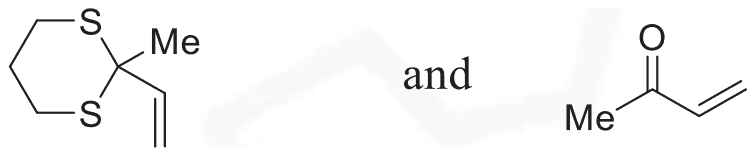
X and Y are 2-methyl-2-(2-phenylsulfinylethyl)-1,3-dithiane and methyl vinyl ketone.
n-BuLi removes the C2 proton of 2-methyl-1,3-dithiane, giving an acyl-anion equivalent. It adds in conjugate fashion to phenyl vinyl sulfoxide, a Michael acceptor, so X carries a CH2CH2S(O)Ph chain on C2.
Refluxing in xylene triggers a syn (Ei) sulfoxide elimination through a five-membered cyclic transition state, losing PhSOH and leaving a vinyl group. HgCl2 with CdCO3 in water then hydrolyses the dithiane to the ketone, giving CH3COCH=CH2, methyl vinyl ketone. The phenyl vinyl sulfoxide has served as a vinyl cation equivalent.
(A) shows the vinyl compound as X, but the elimination needs the heating of the second step. (B) keeps a phenyl in Y, though phenyl leaves with the sulfur. (D) has the anion attacking sulfur rather than the alkene.
Post your comment
Please log in or register to post a comment.
Examination Categories
- SSC Exams
- Banking Exams
- Teaching Exams
- Civil Services Exams
- Railways Exams
- Engineering Recruitment Exams
- Defence Exams
- State Government Exams
- Police Exams
- Insurance Exams
- Nursing Exams
- Other Government Exams
- NRA CET
- PG Entrance Exams
- Campus Placement
- MBA Entrance Exams
- CUET and UG Entrance
- Judiciary Exams
- Regulatory Body Exams
- Software Development