
Discussion
The stress-strain profiles in the figure were obtained following longitudinal tensile loading for a brittle polymer, glass fibre, and a composite lamina consisting of unidirectional continuous glass fibres and the polymer matrix. Assume that the matrix is free of voids, there is perfect bonding between glass fibres and the matrix, and there are no residual stresses in the composite lamina.
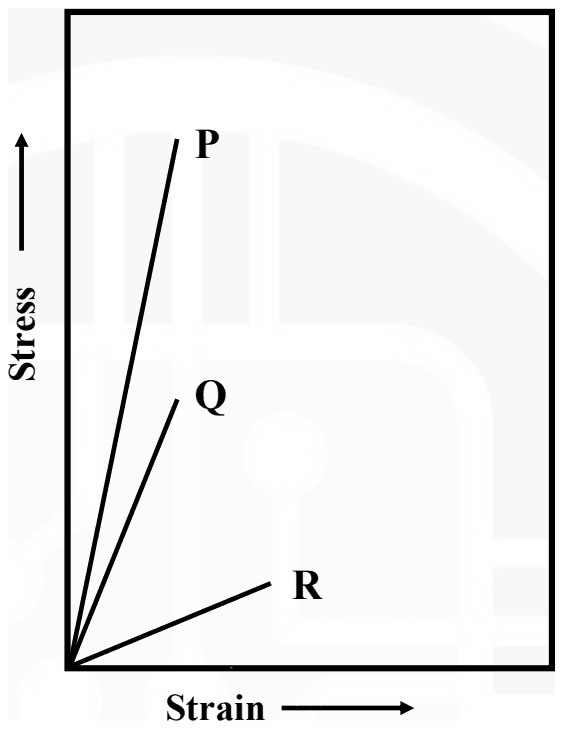
Identify the correct stress-strain profile for the polymer matrix, glass fibre, and their composite lamina from the above figure.
Answer: B
The profiles are P - Glass fibre ; Q - Composite ; R - Matrix.
In longitudinal loading of a unidirectional lamina with perfect bonding, fibre and matrix strain together, so the composite modulus follows the rule of mixtures:
\[ E_{c} = E_{f}V_{f} + E_{m}(1-V_{f}) \]
This lies between the fibre modulus and the matrix modulus. Glass fibre (about 70 GPa) is far stiffer than a brittle polymer matrix (a few GPa), so the steepest line P is the glass fibre, the least steep R is the matrix, and the intermediate Q is the composite.
Any option giving the composite the steepest or the shallowest line contradicts the rule of mixtures, and putting the matrix above the glass fibre reverses their stiffnesses.
Post your comment
Please log in or register to post a comment.
Examination Categories
- SSC Exams
- Banking Exams
- Teaching Exams
- Civil Services Exams
- Railways Exams
- Engineering Recruitment Exams
- Defence Exams
- State Government Exams
- Police Exams
- Insurance Exams
- Nursing Exams
- Other Government Exams
- NRA CET
- PG Entrance Exams
- Campus Placement
- MBA Entrance Exams
- CUET and UG Entrance
- Judiciary Exams
- Regulatory Body Exams
- Software Development