
Discussion
A two-dimensional flow field is described by a combination of a source of strength \(m\) at the origin and a uniform flow, \(U\), in the positive \(x\)-direction such that the velocity potential is given by
\[ \phi = Ux + \frac{m}{2\pi}\ln\sqrt{x^{2} + y^{2}} \]
The stagnation streamline is shown in the figure. Find the distance \(aa'\).
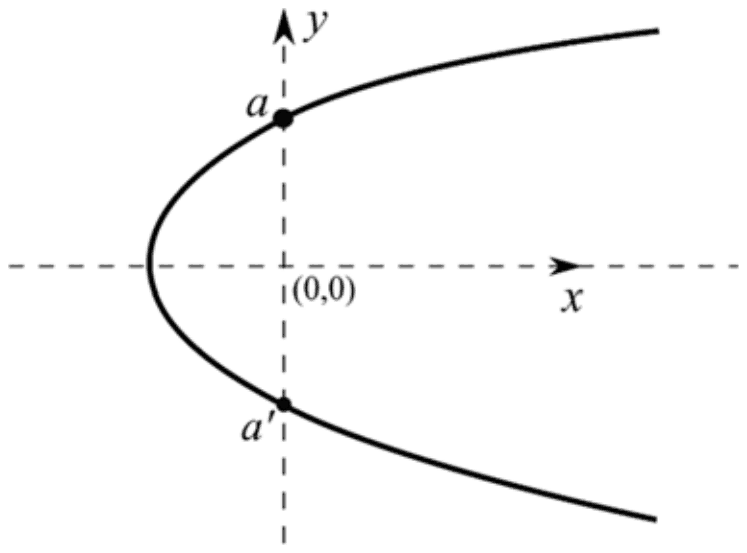
Answer: D
The distance is \(aa' = \frac{m}{2U}\).
The matching stream function is \(\psi = Uy + \frac{m}{2\pi}\theta\). The stagnation point lies on the negative x-axis (\(\theta = \pi\)), so the stagnation streamline is \(\psi = m/2\). Where it crosses the y-axis, \(\theta = \pi/2\):
\[ \begin{aligned} Uy + \frac{m}{2\pi}\cdot\frac{\pi}{2} &= \frac{m}{2} \\ Uy &= \frac{m}{4},\quad y = \frac{m}{4U} \end{aligned} \]
By symmetry \(a'\) is at \(-m/(4U)\), so \(aa' = m/(2U)\). \(m/U\) is the full width of the half-body far downstream, where the streamline becomes parallel to the x-axis, and \(2m/U\) and \(8m/U\) come from mixing up the factors of \(2\pi\).
Post your comment
Please log in or register to post a comment.
Examination Categories
- SSC Exams
- Banking Exams
- Teaching Exams
- Civil Services Exams
- Railways Exams
- Engineering Recruitment Exams
- Defence Exams
- State Government Exams
- Police Exams
- Insurance Exams
- Nursing Exams
- Other Government Exams
- NRA CET
- PG Entrance Exams
- Campus Placement
- MBA Entrance Exams
- CUET and UG Entrance
- Judiciary Exams
- Regulatory Body Exams
- Software Development