
Discussion
In the figure below, \(\angle DEC + \angle BFC\) is equal to ____________ .
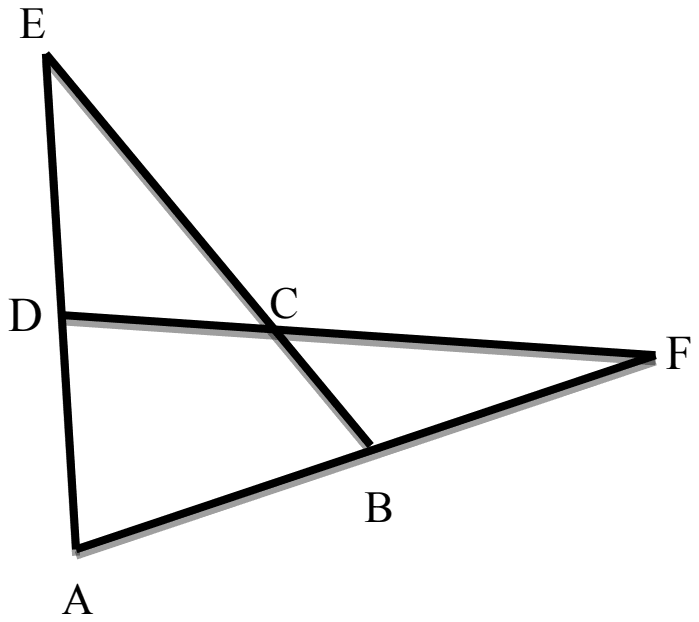
Answer: A
\(\angle DEC + \angle BFC\) equals \(\angle BCD - \angle BAD\).
In the figure A, D, E lie on one line and A, B, F on another, and EB and DF cross at C. Write \(A = \angle BAD\), \(E = \angle DEC\) and \(F = \angle BFC\).
Triangle AEB gives the angle at B, triangle AFD the angle at D, and the angles of quadrilateral ABCD sum to 360°:
\[ \begin{aligned} \angle ABC &= 180^\circ - A - E \\ \angle ADC &= 180^\circ - A - F \\ \angle BCD &= 360^\circ - A - \angle ABC - \angle ADC \\ &= A + E + F \end{aligned} \]
So \(E + F = \angle BCD - \angle BAD\). The options that add \(\angle BAD\) instead of subtracting it overshoot by \(2\angle BAD\), and \(\angle CBA + \angle ADC\) equals \(360^\circ - 2A - E - F\), not \(E + F\).
Post your comment
Please log in or register to post a comment.
Examination Categories
- SSC Exams
- Banking Exams
- Teaching Exams
- Civil Services Exams
- Railways Exams
- Engineering Recruitment Exams
- Defence Exams
- State Government Exams
- Police Exams
- Insurance Exams
- Nursing Exams
- Other Government Exams
- NRA CET
- PG Entrance Exams
- Campus Placement
- MBA Entrance Exams
- CUET and UG Entrance
- Judiciary Exams
- Regulatory Body Exams
- Software Development