
Discussion
A right-angled cone (with base radius 5 cm and height 12 cm), as shown in the figure below, is rolled on the ground keeping the point P fixed until the point Q (at the base of the cone, as shown) touches the ground again.
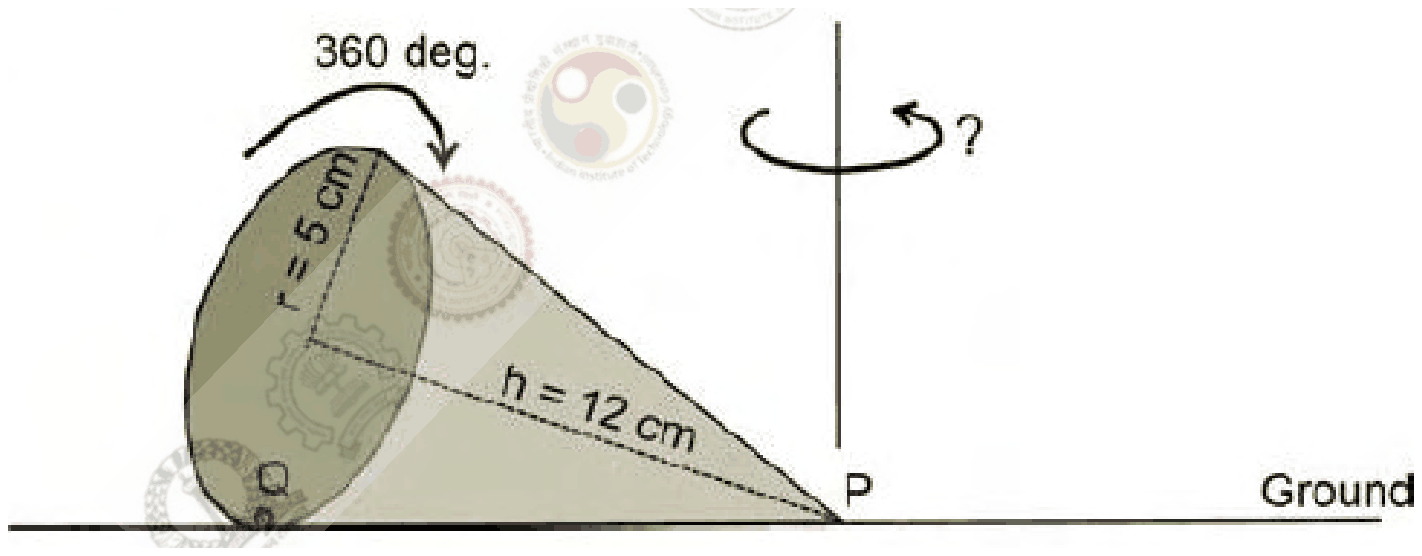
By what angle (in radians) about P does the cone travel?
Answer: D
The cone turns through \(\frac{10\pi}{13}\) radians about P.
The cone rolls on its slant side with the apex P fixed, so each point of the base rim traces a circle on the ground of radius equal to the slant height:
\[ \begin{aligned} l &= \sqrt{5^{2} + 12^{2}} = 13\ \text{cm} \\ \text{arc} &= 2\pi r = 10\pi\ \text{cm} \\ \theta &= \frac{10\pi}{13} \end{aligned} \]
Q touches the ground again after the base has rolled once, laying down a length equal to its circumference along that circle. Using the height 12 in place of the slant height gives \(10\pi/12 = 5\pi/6\), not offered; \(5\pi/12\) and \(5\pi/24\) come from further slips, and \(24\pi/5\) inverts the ratio.
Post your comment
Please log in or register to post a comment.
Examination Categories
- SSC Exams
- Banking Exams
- Teaching Exams
- Civil Services Exams
- Railways Exams
- Engineering Recruitment Exams
- Defence Exams
- State Government Exams
- Police Exams
- Insurance Exams
- Nursing Exams
- Other Government Exams
- NRA CET
- PG Entrance Exams
- Campus Placement
- MBA Entrance Exams
- CUET and UG Entrance
- Judiciary Exams
- Regulatory Body Exams
- Software Development