
Discussion
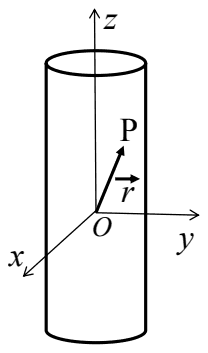
A particle P of mass m is constrained to move on the surface of a cylinder under a force \(-k\vec{r}\) as shown in figure (k is the positive constant). Which of the following statements is correct? (Neglect friction.)
Answer: B
The answer is the motion along the z direction is simple harmonic.
Write \(\vec{r} = x\hat{\imath} + y\hat{\jmath} + z\hat{k}\). The constraint (the cylinder's surface, without friction) can only push perpendicular to the surface, that is horizontally, so it has no \(z\) component. Along \(z\) the only force is \(-kz\):
\[ m\ddot{z} = -kz \]
which is simple harmonic motion with \(\omega = \sqrt{k/m}\).
The force \(-k\vec{r}\) is conservative and the frictionless constraint does no work, so total energy is conserved. Linear momentum is not conserved, since a net force acts. The force \(-k\vec{r}\) exerts no torque about O, and the constraint force, which points towards the axis, has no torque about the axis, so the axial component of angular momentum is conserved; the other components only oscillate with \(z\). Nothing makes the angular momentum grow with time.
Post your comment
Please log in or register to post a comment.
Examination Categories
- SSC Exams
- Banking Exams
- Teaching Exams
- Civil Services Exams
- Railways Exams
- Engineering Recruitment Exams
- Defence Exams
- State Government Exams
- Police Exams
- Insurance Exams
- Nursing Exams
- Other Government Exams
- NRA CET
- PG Entrance Exams
- Campus Placement
- MBA Entrance Exams
- CUET and UG Entrance
- Judiciary Exams
- Regulatory Body Exams
- Software Development