
Discussion
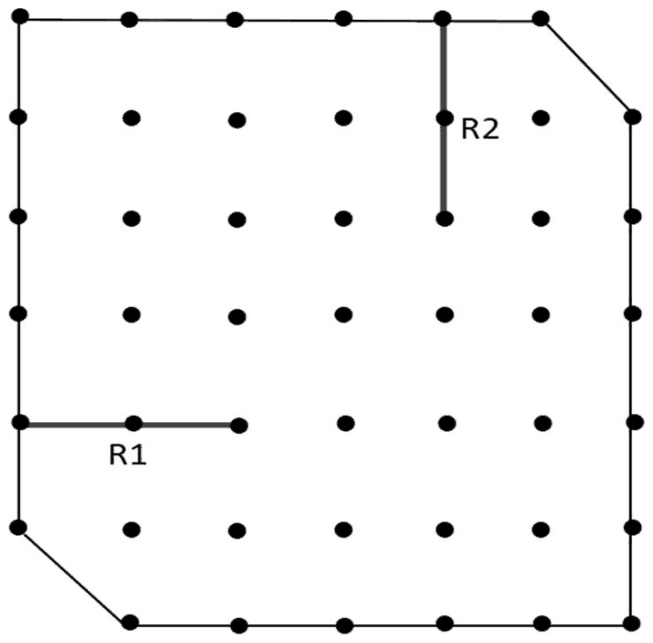
A plot of land must be divided between four families. They want their individual plots to be similar in shape, not necessarily equal in area. The land has equally spaced poles, marked as dots in the below figure. Two ropes, R1 and R2, are already present and cannot be moved.
What is the least number of additional straight ropes needed to create the desired plots? A single rope can pass through three poles that are aligned in a straight line.
Answer: D
The least number of additional ropes is 3.
Number the poles from (0, 0) at the bottom left to (6, 6) at the top right. The land is a 6 by 6 square with two opposite corners cut off; R1 runs from (0, 2) to (2, 2) and R2 from (4, 6) down to (4, 4). Three ropes complete four similar plots:
- from (2, 2) down to (2, 0), through three poles;
- from (4, 4) right to (6, 4), through three poles;
- the diagonal from (2, 2) to (4, 4), through (3, 3).
Each plot is then a square with one corner cut off along a line joining the mid-points of the two sides at that corner: two small ones of side 2 at the bottom left and top right, and two large ones of side 4 at the top left and bottom right. All four have the same shape at two scales, so they are similar, and the areas add up to the 35 square units of the land. Both fixed ropes end up as sides of plots, so nothing is wasted, and 3 is the official least number; the options 4 and 5 use more ropes than this construction needs.
Post your comment
Please log in or register to post a comment.
Examination Categories
- SSC Exams
- Banking Exams
- Teaching Exams
- Civil Services Exams
- Railways Exams
- Engineering Recruitment Exams
- Defence Exams
- State Government Exams
- Police Exams
- Insurance Exams
- Nursing Exams
- Other Government Exams
- NRA CET
- PG Entrance Exams
- Campus Placement
- MBA Entrance Exams
- CUET and UG Entrance
- Judiciary Exams
- Regulatory Body Exams
- Software Development