
Discussion
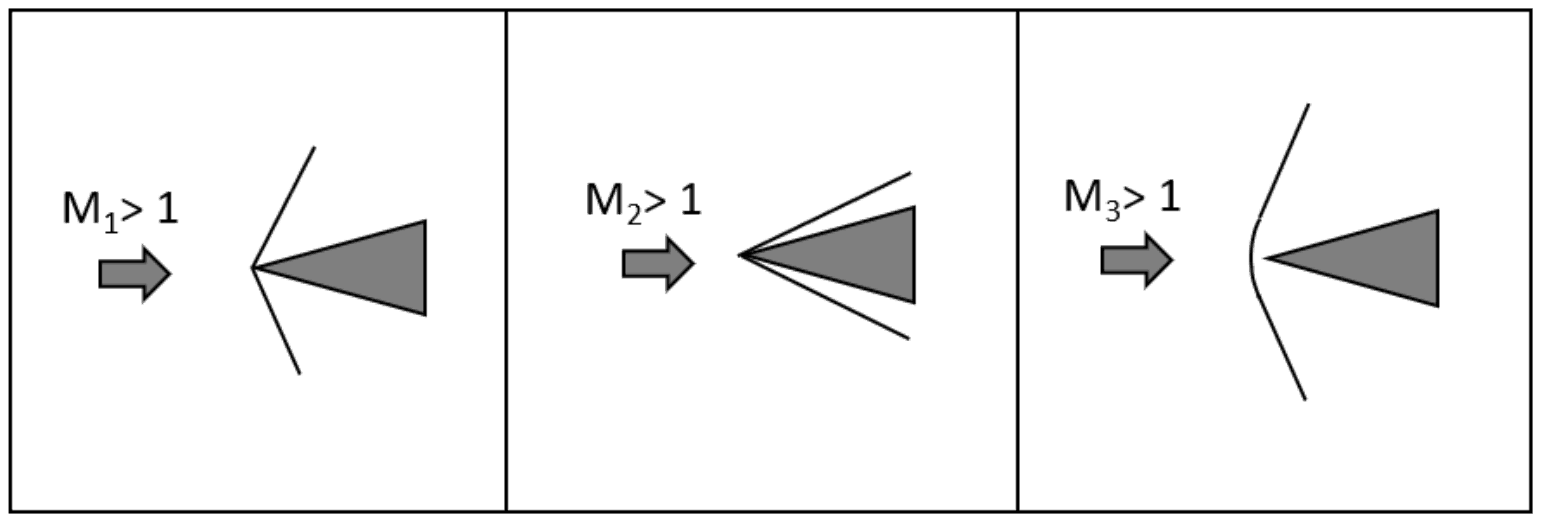
Shock structures for flow at three different Mach numbers over a given wedge are shown in the figure below. Assuming that only the weak shock solutions are possible for the attached oblique shocks, which one of the following options is TRUE?
Answer: D
The correct order is \(M_{3} \lt M_{1} \lt M_{2}\).
For a fixed wedge angle, the weak oblique shock lies closer to the wedge surface (a smaller shock angle) as the Mach number rises, because the shock angle approaches the Mach angle, which shrinks with \(M\). As the Mach number falls, the shock angle grows until, below a certain Mach number, no attached shock can turn the flow through the wedge angle and the shock detaches into a curved bow shock standing ahead of the wedge.
In the figure, the flow at \(M_{3}\) has a detached shock, so \(M_{3}\) is the lowest. The shock at \(M_{2}\) hugs the wedge more closely than the shock at \(M_{1}\), so \(M_{2}\) is the highest. Any order that puts \(M_{3}\) above \(M_{1}\) or \(M_{1}\) above \(M_{2}\) contradicts these shapes.
Post your comment
Please log in or register to post a comment.
Examination Categories
- SSC Exams
- Banking Exams
- Teaching Exams
- Civil Services Exams
- Railways Exams
- Engineering Recruitment Exams
- Defence Exams
- State Government Exams
- Police Exams
- Insurance Exams
- Nursing Exams
- Other Government Exams
- NRA CET
- PG Entrance Exams
- Campus Placement
- MBA Entrance Exams
- CUET and UG Entrance
- Judiciary Exams
- Regulatory Body Exams
- Software Development