
Discussion
Shown below is a Hammett plot obtained for the reaction
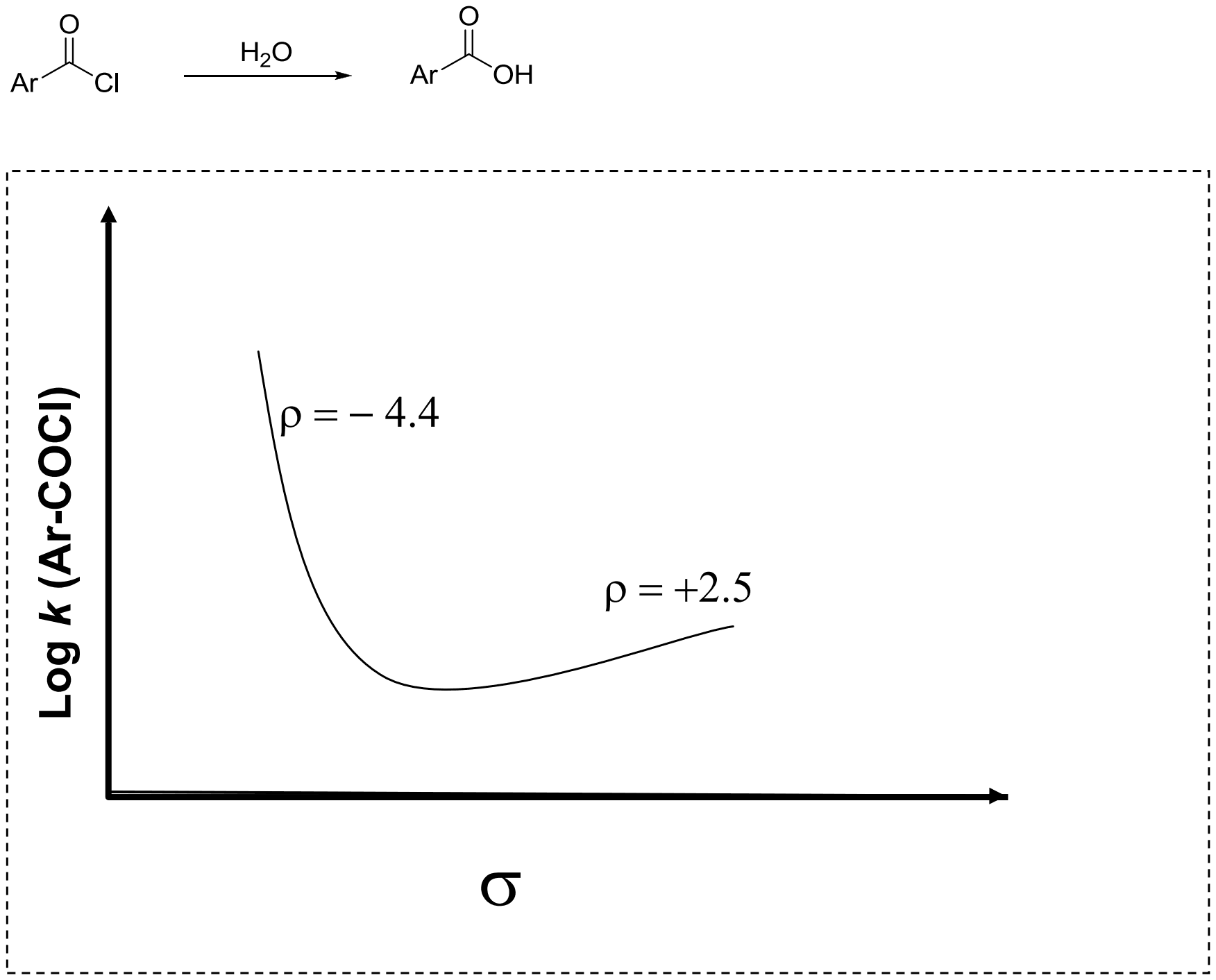
The change in slope of the plot indicates that
Answer: D
The change in slope shows that the mechanism of the reaction is changing.
The Hammett constant ρ measures how charge develops in the rate-determining step. On the left of the plot, for electron-donating substituents, ρ = -4.4: positive charge builds up at the reaction centre, which fits an ionisation (SN1-like) path through an acylium ion. On the right, for electron-withdrawing substituents, ρ = +2.5: negative charge builds up, which fits nucleophilic addition of water to the carbonyl followed by loss of chloride. A plot that changes from a negative to a positive slope is the classic sign that the rate-determining mechanism switches across the substituent series.
Each branch is still a linear free energy relationship, so A is wrong. B and C each describe only one branch: a single sign of ρ would mean one consistent mechanism, not a change.
Post your comment
Please log in or register to post a comment.
Examination Categories
- SSC Exams
- Banking Exams
- Teaching Exams
- Civil Services Exams
- Railways Exams
- Engineering Recruitment Exams
- Defence Exams
- State Government Exams
- Police Exams
- Insurance Exams
- Nursing Exams
- Other Government Exams
- NRA CET
- PG Entrance Exams
- Campus Placement
- MBA Entrance Exams
- CUET and UG Entrance
- Judiciary Exams
- Regulatory Body Exams
- Software Development