
Discussion
A particle is subjected to a potential
\[ V(x) = \begin{cases} \infty, & x \le 0 \\ V_{0}, & a \le x \le b \\ 0, & \text{elsewhere} \end{cases} \]
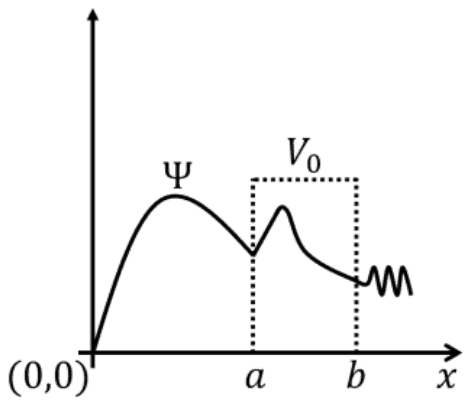
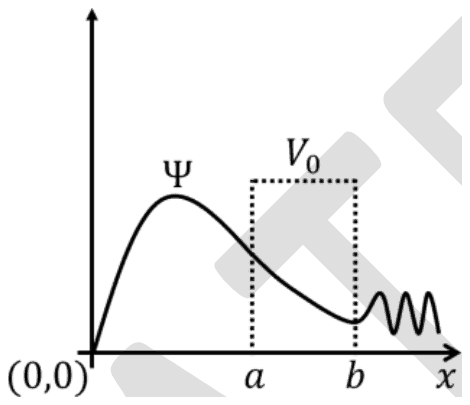
Here, \(a \gt 0\) and \(b \gt a\). If the energy of the particle \(E \lt V_{0}\), which one of the following schematics is a valid quantum mechanical wavefunction \((\Psi)\) for the system?
- A.
- B.
- C.
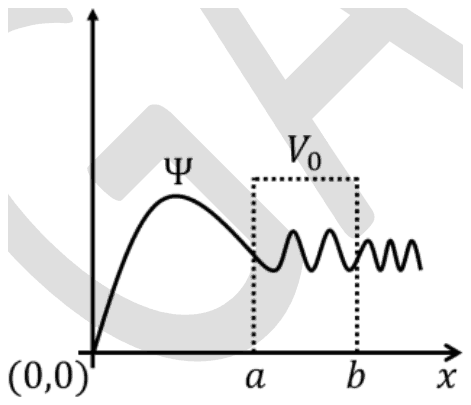
- D.
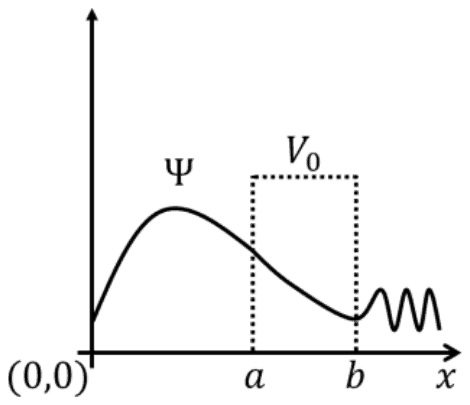
Answer: B
The valid wavefunction is (B).
The requirements are:
- Ψ = 0 at x = 0, because the potential is infinite for x ≤ 0;
- between 0 and a, where E > V = 0, Ψ oscillates (here it rises from zero to a maximum);
- inside the barrier, where E < V0, Ψ is a combination of rising and falling exponentials, so it cannot oscillate or develop a local peak;
- beyond b, Ψ oscillates again; Ψ and its slope are continuous at a and b.
Sketch (B) meets all four. Sketch (A) has a bump inside the barrier, which an exponential cannot produce. Sketch (C) oscillates inside the barrier, as if E were above V0. Sketch (D) looks like (B) but is not zero at x = 0, violating the condition at the infinite wall.
No comment is present. Be the first to comment.
Loading…
Post your comment
Please log in or register to post a comment.
Examination Categories
- SSC Exams
- Banking Exams
- Teaching Exams
- Civil Services Exams
- Railways Exams
- Engineering Recruitment Exams
- Defence Exams
- State Government Exams
- Police Exams
- Insurance Exams
- Nursing Exams
- Other Government Exams
- NRA CET
- PG Entrance Exams
- Campus Placement
- MBA Entrance Exams
- CUET and UG Entrance
- Judiciary Exams
- Regulatory Body Exams
- Software Development