
Instruction
- Total number of questions : 20
- Time allotted : 30:00 Minutes:Seconds.
- Each question carry 1 mark, no negative marks.
- DO NOT refresh the page.
- All the best
Aircraft Propulsion [ Question No: 1 To 20 ] :
Which one of the following is the correct sequence of the position of the given components in a turbo -prop?
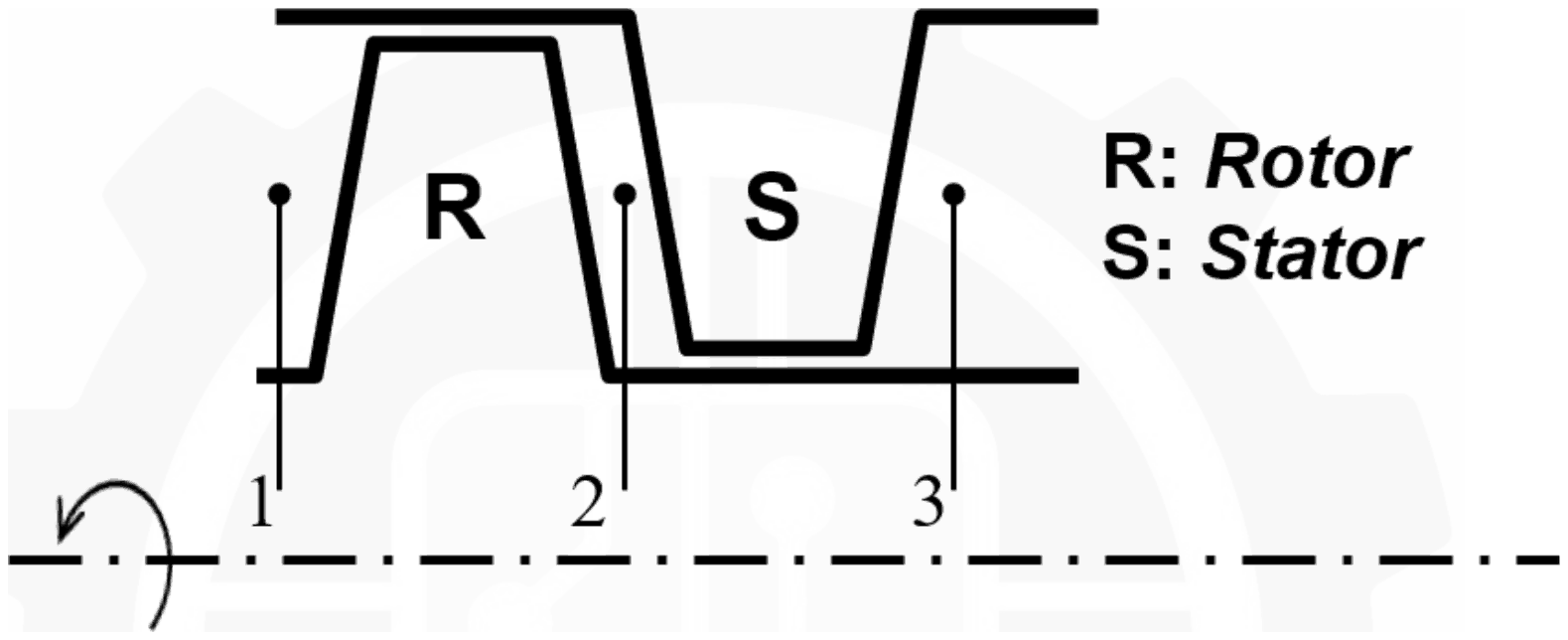
The figure below shows a compressor stage with station numbers 1, 2, and 3 as indicated. If \(p_{0i}\), \(T_{0i}\), and \(C_i\) refer to the average values of total pressure, total temperature, and absolute flow speed, respectively, at the \(i^{th}\) station, select the CORRECT option considering losses.
A scramjet engine features an intake, isolator, combustor, and a nozzle, as shown in the schematic. Station 3 indicates the combustor entry point. Assume stagnation enthalpy to be constant between Stations 1 and 3, and air to be a calorically perfect gas with specific heat ratio \(\gamma\). Select the correct expression for Mach number \(M_{3}\) at the inlet to the combustor from the options given.
(Figure: schematic of the engine with Station 1 at the intake entry, where the Free stream \(M_{\infty}, T_{\infty}, P_{\infty}\) arrives, Station 2 at the isolator entry, Station 3 at the combustor entry, Station 4 at the combustor exit and Station 5 at the nozzle exit.)
Consider the following statements about matching:
1. Continuity of mass flow must be satisfied between components.
2. Turbine work must balance compressor demand.
3. The operating point is where each component is most efficient.
Which of the statements given above is or are correct?
Assertion (A): The operating point of an engine is where its most efficient component prefers to run.
Reason (R): Continuity, work balance and speed compatibility must all be satisfied at once.
Select the correct answer from the options below.
Assertion (A): Gas path analysis can distinguish a compressor fault from a turbine fault.
Reason (R): Each produces a different pattern across exhaust temperature, fuel flow and shaft speed.
Select the correct answer from the options below.
An operator notices that one engine's exhaust gas temperature at take-off has risen by 30 kelvin over two years while its thrust and fuel flow are unchanged.
What does this indicate?
Arrange these steps of a gas path analysis in order:
1. Record the measured parameters at a stable condition
2. Compare them with the expected values for a healthy engine
3. Identify the pattern of deviations across the measurements
4. Infer which component has deteriorated
5. Plan the inspection or repair accordingly
Select the correct sequence.
Corrected speed is physical speed divided by
Assertion (A): A combat aircraft uses a low bypass engine with reheat.
Reason (R): It needs high specific thrust in a slim installation and flies fast.
Select the correct answer from the options below.
The fan of a high bypass turbofan is essentially
Consider the following statements about installed performance:
1. Nacelle drag reduces the thrust the airframe receives.
2. Bleed and power offtakes reduce it further.
3. Installed thrust normally exceeds bare engine test bed thrust.
Which of the statements given above is or are correct?
Consider the following statements about nozzles:
1. A convergent nozzle chokes at the critical pressure ratio.
2. A convergent-divergent nozzle is needed for supersonic exhaust.
3. A choked convergent nozzle is fully expanded.
Which of the statements given above is or are correct?
A turbine extracts \( 175 \ \mathrm{kJ/kg} \) from gas of \( c_p = 1150 \ \mathrm{J/(kg\,K)} \). The total temperature drop is approximately
__________ factor accounts for the exit tangential velocity of a centrifugal impeller falling short of the blade speed.
Air enters a diffuser at \( 200 \ \mathrm{m/s} \) and leaves at \( 80 \ \mathrm{m/s} \). With \( c_p = 1005 \ \mathrm{J/(kg\,K)} \), the ideal static temperature rise is approximately
A subsonic pitot intake is
Consider the following pairs of quantity and definition:
Specific thrust - Thrust per unit air mass flow
Thrust specific fuel consumption - Fuel flow per unit thrust
Bypass ratio - Bypass flow divided by core flow
Overall efficiency - The sum of thermal and propulsive efficiency
How many of the pairs given above are correctly matched?
Statement I: A rocket is the only propulsion type usable outside the atmosphere.
Statement II: It carries its own oxidiser rather than taking it from the surrounding air.
In the light of the above statements, choose the correct answer.
A rocket exhausts \( 200 \ \mathrm{kg/s} \) at \( 3000 \ \mathrm{m/s} \). Ignoring pressure terms, its thrust is
Total number of questions : 20
Number of answered questions : 0
Number of unanswered questions : 20
Aircraft Propulsion [ Question No: 1 To 20 ] :
Which one of the following is the correct sequence of the position of the given components in a turbo -prop?
Your Answer : (Not Answered)
Correct Answer : C
The sequence is Propeller, Compressor, Burner, Turbine.
A turboprop is a gas turbine that drives a propeller. Air passes the propeller at the front, enters the compressor, is heated in the burner (combustion chamber), and then expands through the turbine, which drives both the compressor and, through a reduction gearbox, the propeller.
Any order that puts the turbine before the burner is wrong, because the turbine can only extract work from gas that has already been heated. Orders starting with the compressor are wrong because the propeller sits ahead of the engine core.
The figure below shows a compressor stage with station numbers 1, 2, and 3 as indicated. If \(p_{0i}\), \(T_{0i}\), and \(C_i\) refer to the average values of total pressure, total temperature, and absolute flow speed, respectively, at the \(i^{th}\) station, select the CORRECT option considering losses.
Your Answer : (Not Answered)
Correct Answer : A
The correct option is \(p_{01} \lt p_{02}\), \(p_{02} \gt p_{03}\); \(T_{01} \lt T_{02}\), \(T_{02} \approx T_{03}\); \(C_1 \lt C_2\), \(C_2 \gt C_3\).
Across the rotor (1 to 2) work is done on the air, so total temperature and total pressure both rise, and the rotor turns the flow so that the absolute speed increases: \(C_2 \gt C_1\).
Across the stator (2 to 3) no work is done and the walls are effectively adiabatic, so the total temperature stays the same. The stator is a diffuser: it slows the flow (\(C_3 \lt C_2\)) to raise the static pressure, and because of losses the total pressure falls slightly, \(p_{03} \lt p_{02}\).
The other options fail on the stator: equal total pressure ignores losses, a rise in total temperature or pressure across a stator would need work input, and equal speeds at all stations would mean no diffusion. The option with \(C_1 \gt C_2\) has the rotor slowing the absolute flow, which is backwards.
A scramjet engine features an intake, isolator, combustor, and a nozzle, as shown in the schematic. Station 3 indicates the combustor entry point. Assume stagnation enthalpy to be constant between Stations 1 and 3, and air to be a calorically perfect gas with specific heat ratio \(\gamma\). Select the correct expression for Mach number \(M_{3}\) at the inlet to the combustor from the options given.
(Figure: schematic of the engine with Station 1 at the intake entry, where the Free stream \(M_{\infty}, T_{\infty}, P_{\infty}\) arrives, Station 2 at the isolator entry, Station 3 at the combustor entry, Station 4 at the combustor exit and Station 5 at the nozzle exit.)
Your Answer : (Not Answered)
Correct Answer : B
The correct expression is (B), which follows from conservation of stagnation temperature between the free stream and Station 3.
With constant stagnation enthalpy and a calorically perfect gas, the stagnation temperature is the same at the free stream and at Station 3. Write \(k = (\gamma - 1)/2\):
\[ \begin{aligned} T_{0} &= T_{\infty}(1 + kM_{\infty}^{2}) \\ T_{0} &= T_{3}(1 + kM_{3}^{2}) \end{aligned} \]
Equating the two and solving for \(M_{3}\):
\[ \begin{aligned} kM_{3}^{2} &= \frac{T_{\infty}}{T_{3}}(1 + kM_{\infty}^{2}) - 1 \\ M_{3}^{2} &= \frac{1}{k}\left[\frac{T_{\infty}}{T_{3}}(1 + kM_{\infty}^{2}) - 1\right] \end{aligned} \]
Since \(1/k = 2/(\gamma - 1)\), taking the square root gives exactly expression (B).
Expression (C), \(M_{3} = M_{\infty}\sqrt{T_{\infty}/T_{3}}\), would hold only if the velocity were unchanged through the intake, which ignores the deceleration. Expressions (A) and (D) do not follow from the energy equation; for example, at \(T_{3} = T_{\infty}\) they give \(M_{3} = 0\) or the square root of a negative number, whereas the correct result gives \(M_{3} = M_{\infty}\).
Consider the following statements about matching:
1. Continuity of mass flow must be satisfied between components.
2. Turbine work must balance compressor demand.
3. The operating point is where each component is most efficient.
Which of the statements given above is or are correct?
Your Answer : (Not Answered)
Correct Answer : B
Correct answer: 1 and 2 only
Statements 1 and 2 are the genuine matching conditions, together with speed compatibility on a shaft. Statement 3 is wrong and is the point worth taking away: the operating point is wherever those conditions are simultaneously satisfied, and there is no reason it should coincide with any component’s peak efficiency. Only at the design point is the match arranged to fall near the best points.
Assertion (A): The operating point of an engine is where its most efficient component prefers to run.
Reason (R): Continuity, work balance and speed compatibility must all be satisfied at once.
Select the correct answer from the options below.
Your Answer : (Not Answered)
Correct Answer : D
The reason is true but it refutes the assertion. The engine runs where the three conditions intersect, which is generally not where any individual component would be at its best, and that compromise is what matching means.
Assertion (A): Gas path analysis can distinguish a compressor fault from a turbine fault.
Reason (R): Each produces a different pattern across exhaust temperature, fuel flow and shaft speed.
Select the correct answer from the options below.
Your Answer : (Not Answered)
Correct Answer : C
Correct answer: Both A and R are true, and R is the correct explanation of A
Both are true and the reason is what makes the technique work. A compressor fault and a turbine fault both raise exhaust gas temperature, but they change fuel flow and the two shaft speeds in different combinations. Gas path analysis compares the measured pattern of deviations against those signatures, so the faulty module can often be identified before the engine is opened.
An operator notices that one engine's exhaust gas temperature at take-off has risen by 30 kelvin over two years while its thrust and fuel flow are unchanged.
What does this indicate?
Your Answer : (Not Answered)
Correct Answer : C
Worn seals, eroded blades and growing tip clearances all force the engine to run hotter for the same output. Tracking that trend allows a shop visit to be planned rather than forced by an eventual exceedance in service.
Arrange these steps of a gas path analysis in order:
1. Record the measured parameters at a stable condition
2. Compare them with the expected values for a healthy engine
3. Identify the pattern of deviations across the measurements
4. Infer which component has deteriorated
5. Plan the inspection or repair accordingly
Select the correct sequence.
Your Answer : (Not Answered)
Correct Answer : C
It is the pattern rather than any single reading that identifies the component. A compressor efficiency loss and a turbine flow capacity change both raise the exhaust temperature, but they differ in what else moves alongside it.
Corrected speed is physical speed divided by
Your Answer : (Not Answered)
Correct Answer : C
The relation follows from the way blade Mach numbers depend on temperature. Cold air gives a higher corrected speed for the same physical speed, which is why an engine behaves differently on a cold day at the same shaft rpm.
Assertion (A): A combat aircraft uses a low bypass engine with reheat.
Reason (R): It needs high specific thrust in a slim installation and flies fast.
Select the correct answer from the options below.
Your Answer : (Not Answered)
Correct Answer : C
Correct answer: Both A and R are true, and R is the correct explanation of A
Both are true and directly connected. Supersonic flight demands a slim nacelle, and a fighter needs a great deal of thrust from a small frontal area, which means high specific thrust and therefore a low bypass ratio, typically 0.3 to 1. The same aircraft must accelerate through the transonic drag rise and manoeuvre in combat, and reheat supplies that surge of thrust at a fuel cost it can accept for short periods.
The fan of a high bypass turbofan is essentially
Your Answer : (Not Answered)
Correct Answer : D
It achieves a pressure ratio of about 1.5 in one stage across a very large annulus. The duct around it lets the blade tips run supersonic in relative terms without the losses an open propeller would suffer at the same speed.
Consider the following statements about installed performance:
1. Nacelle drag reduces the thrust the airframe receives.
2. Bleed and power offtakes reduce it further.
3. Installed thrust normally exceeds bare engine test bed thrust.
Which of the statements given above is or are correct?
Your Answer : (Not Answered)
Correct Answer : A
Correct answer: 1 and 2 only
Statements 1 and 2 are correct: nacelle drag and the bleed air and shaft power taken for the aircraft’s systems both reduce what the airframe actually receives. Statement 3 reverses the relationship. Installed thrust is always less than the bare engine test bed figure, and the difference - typically several per cent - must be accounted for in performance calculations rather than discovered in flight test.
Consider the following statements about nozzles:
1. A convergent nozzle chokes at the critical pressure ratio.
2. A convergent-divergent nozzle is needed for supersonic exhaust.
3. A choked convergent nozzle is fully expanded.
Which of the statements given above is or are correct?
Your Answer : (Not Answered)
Correct Answer : C
Correct answer: 1 and 2 only
Statements 1 and 2 are correct: a convergent nozzle chokes when the pressure ratio reaches the critical value, and a supersonic exhaust requires a convergent-divergent passage. Statement 3 is false. A choked convergent nozzle reaches sonic conditions at its exit and leaves the remaining pressure ratio unexpanded, so it discharges above ambient pressure - under-expanded, not fully expanded.
A turbine extracts \( 175 \ \mathrm{kJ/kg} \) from gas of \( c_p = 1150 \ \mathrm{J/(kg\,K)} \). The total temperature drop is approximately
Your Answer : (Not Answered)
Correct Answer : B
Correct answer: 152 K
The work extracted is \( c_p\Delta T_0 \), so
\[ \Delta T_0 = \frac{175\,000}{1150} \approx 152 \ \mathrm{K} \]Note the \( c_p \) of 1150 J/kg K for combustion products, higher than the 1005 used for cold air, because the gas is hot and contains water vapour and carbon dioxide. Using the cold air value would give 174 K, which is one of the distractors.
__________ factor accounts for the exit tangential velocity of a centrifugal impeller falling short of the blade speed.
Your Answer : (Not Answered)
Correct Answer : C
The relative eddy in each passage prevents the air from following the blades exactly. It reduces the work done and the work required in equal measure, so it lowers the pressure ratio without making the machine any less efficient.
Air enters a diffuser at \( 200 \ \mathrm{m/s} \) and leaves at \( 80 \ \mathrm{m/s} \). With \( c_p = 1005 \ \mathrm{J/(kg\,K)} \), the ideal static temperature rise is approximately
Your Answer : (Not Answered)
Correct Answer : C
Correct answer: 16.7 K
The kinetic energy given up appears as static temperature: \[ \Delta T = \frac{V_1^2 - V_2^2}{2c_p} = \frac{200^2 - 80^2}{2 \times 1005} = \frac{33{,}600}{2010} = 16.7\ \mathrm{K}. \] Note it is the difference of the squares, not the square of the difference - the latter would give 7.2 K.
A subsonic pitot intake is
Your Answer : (Not Answered)
Correct Answer : D
Its simplicity and low weight suit subsonic and low supersonic aircraft where shock losses are small or absent. The rounded lip matters because at static conditions the flow must turn sharply into the intake and a sharp lip would separate immediately.
Consider the following pairs of quantity and definition:
Specific thrust - Thrust per unit air mass flow
Thrust specific fuel consumption - Fuel flow per unit thrust
Bypass ratio - Bypass flow divided by core flow
Overall efficiency - The sum of thermal and propulsive efficiency
How many of the pairs given above are correctly matched?
Your Answer : (Not Answered)
Correct Answer : B
Correct answer: Only three
The first three definitions are right. The fourth is wrong and it is the standard error in this subject: overall efficiency is the *product* of thermal and propulsive efficiency, not their sum. A sum would exceed unity for any decent engine, which is the quickest way to see that it cannot be right.
Statement I: A rocket is the only propulsion type usable outside the atmosphere.
Statement II: It carries its own oxidiser rather than taking it from the surrounding air.
In the light of the above statements, choose the correct answer.
Your Answer : (Not Answered)
Correct Answer : C
Both statements are true and the second is the reason for the first. Every air breathing type stops producing thrust where there is no oxygen, and carrying the oxidiser is precisely the mass penalty that limits a rocket's endurance so severely.
A rocket exhausts \( 200 \ \mathrm{kg/s} \) at \( 3000 \ \mathrm{m/s} \). Ignoring pressure terms, its thrust is
Your Answer : (Not Answered)
Correct Answer : D
Thrust is mass flow times exhaust velocity, \( 200 \times 3000 = 600\,000 \) newtons. There is no flight speed term because the rocket takes in nothing, which is precisely why its thrust is independent of speed and altitude alike.
Marks
Total number of questions : 20
Number of answered questions : 0
Number of unanswered questions : 20