
Instruction
- Total number of questions : 20
- Time allotted : 30:00 Minutes:Seconds.
- Each question carry 1 mark, no negative marks.
- DO NOT refresh the page.
- All the best
Botany [ Question No: 1 To 20 ] :
First fossil record of vascular plants appeared in the .................. period.
During photosynthesis, which minerals are required in a splitting reaction ?
Saffron is produced from the flowers of ...................... .
Androgenesis in plants refers to :
Female gametophyte in Gnetum at later stage is :
Chlorophyll-b is distinguished from chlorophyll-a by having a ................. group in place of a ................. group.
Which hormone is involved in counteracting apical dominance induced by auxin ?
The best method for controlling stored grain pests is through :
Photosynthetically Active Radiation (PAR) range is
The following table summarizes the flowering time behavior (days to flower) and the transcript levels in four genotypes of a plant species.
| Genotype | Days to flower | Transcript level of gene A | Transcript level of gene B |
|---|---|---|---|
| Wild type | 30 | Normal | Normal |
| a mutant | 15 | Nil | Increased |
| b mutant | 60 | Normal | Nil |
| ab double mutant | 60 | Nil | Nil |
Which one of the following genetic pathways best explains the observations shown in the table?
Which of the following best represents the flow of energy through an ecosystem?
Which one of the following plant families is characterized by the gynobasic style of female reproductive organ?
With respect to adhesion and cohesion of stamens, identify the INCORRECT statements.
P. Adnation of stamens to petals is described as epiphyllous stamens
Q. In Calotropis, stamens and carpels are united to form gynostegium
R. In syngenesious stamens, filaments are united to form a bundle while the anthers are free
S. Synandrous stamens found in Cucurbita represent the union of filaments as well as anthers
An estimate of phylogenetic relationships among the taxa is commonly represented in the form of a
Central vascular cylinder or stele consists of the primary vascular system (xylem and phloem) and the associate fundamental tissue. Match the schematics of stele in Group I (xylem shown in green, and phloem shown as a square grid) with their respective types in Group II.
Group I:
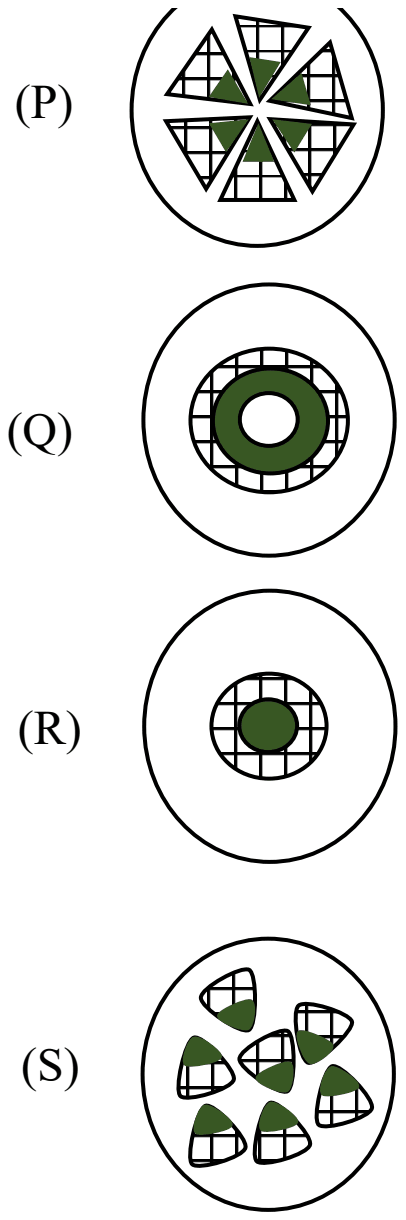
Group II: (1) Protostele; (2) Eustele; (3) Atactostele; (4) Ectophloic siphonostele; (5) Amphiphloic siphonostele
In Angiosperms, normally 'Exarch Xylem' occurs in
The swollen base of a petiole is known as
Which hormone is responsible for cell growth in plant cell ?
The correct path of transfer of electrons in the light harvesting photosystems in vascular plants is _____________.
Which one of the following performs normal C3 photosynthesis when water is available, but switches to crassulacean acid metabolism (CAM) during salt or drought stress?
Total number of questions : 20
Number of answered questions : 0
Number of unanswered questions : 20
Botany [ Question No: 1 To 20 ] :
First fossil record of vascular plants appeared in the .................. period.
Your Answer : (Not Answered)
Correct Answer : A
The first vascular plant fossils appear in the Silurian period.
The earliest known vascular plants, such as Cooksonia, are found in rocks of the middle Silurian, about 430 million years ago. They were small, leafless, branching stems with sporangia at the tips, and vascular plants then diversified rapidly in the Devonian.
The Cambrian is too early, with no land plants yet. The Triassic and Jurassic are Mesozoic periods, by which time ferns, conifers and cycads were long established.
During photosynthesis, which minerals are required in a splitting reaction ?
Your Answer : (Not Answered)
Correct Answer : D
Water splitting needs manganese and chlorine.
Photolysis of water takes place at the oxygen-evolving complex of photosystem II, whose catalytic core is a cluster of four manganese ions and one calcium ion. Chloride ions are an essential cofactor of the same complex. Deficiency of either impairs oxygen evolution.
Magnesium is the central atom of chlorophyll but is not part of the water-splitting reaction. Potassium is important for stomatal movement and enzyme activation, not for photolysis. So every option pairing them with the right element is only half correct.
Saffron is produced from the flowers of ...................... .
Your Answer : (Not Answered)
Correct Answer : B
Saffron comes from Crocus sativus.
Saffron is the dried stigmas of the flowers of Crocus sativus, a cormous plant of the iris family grown in Kashmir, Iran and Spain. Each flower has only three stigmas, picked by hand, which is why it is the most expensive spice; its colour comes from crocin and its aroma from safranal.
Mesua ferrea is the Ceylon ironwood, Nelumbo nucifera is the lotus, and Mammea suriga is the surangi tree, whose flower buds give a dye; none produces saffron.
Androgenesis in plants refers to :
Your Answer : (Not Answered)
Correct Answer : C
Androgenesis is the development of haploid embryo from microspores or pollen in vitro.
In anther or pollen culture, immature pollen grains are switched from their normal path to pollen development and divide to form embryos or callus, giving haploid plants from the male gametophyte. Guha and Maheshwari first produced such plants from Datura anthers in 1964; doubling the chromosomes then gives homozygous lines.
Development or initiation of the androecium and the anthers is ordinary flower development, not androgenesis.
Female gametophyte in Gnetum at later stage is :
Your Answer : (Not Answered)
Correct Answer : D
At a later stage, the female gametophyte of Gnetum is multinucleate.
In Gnetum the functional megaspore undergoes repeated free-nuclear divisions, giving a large female gametophyte with many free nuclei and no archegonia. At the time of fertilisation the micropylar part is still free-nuclear and its nuclei act as eggs; the chalazal part becomes cellular, but the gametophyte as a whole remains a multinucleate structure.
It never stays uninucleate or binucleate. The eight-nucleate gametophyte is the Polygonum-type embryo sac of flowering plants, not that of Gnetum.
Chlorophyll-b is distinguished from chlorophyll-a by having a ................. group in place of a ................. group.
Your Answer : (Not Answered)
Correct Answer : C
Chlorophyll-b has a formyl group in place of a methyl group.
The two chlorophylls share the same porphyrin ring with a central Mg\(^{2+}\) and the same phytol tail. They differ at one position, carbon 7 (C-7) of ring II (ring B): chlorophyll-a carries a methyl group (-CH3), while chlorophyll-b carries a formyl (aldehyde) group (-CHO). This small change shifts chlorophyll-b's absorption peaks, letting it harvest light that chlorophyll-a absorbs poorly.
'Methyl, formyl' reverses the two. Acetyl and acetone groups are not part of this difference.
Which hormone is involved in counteracting apical dominance induced by auxin ?
Your Answer : (Not Answered)
Correct Answer : A
The hormone is Cytokinin.
Auxin from the shoot apex keeps lateral buds dormant (apical dominance). Cytokinins, made largely in the roots, promote cell division in the lateral buds and release them; applying cytokinin to a lateral bud makes it grow even with the apex intact.
Ethylene and ABA tend to inhibit bud growth, and brassinosteroids mainly promote cell elongation; none of them counteracts apical dominance in the way cytokinin does.
The best method for controlling stored grain pests is through :
Your Answer : (Not Answered)
Correct Answer : A
The best method is fumigation.
Stored grain pests such as weevils, beetles and moths live and breed inside the grain mass and even inside individual kernels. A fumigant is a gas, such as phosphine released from aluminium phosphide tablets, that penetrates the whole stack in a sealed store and kills every stage of the insects, including eggs and larvae hidden in the grain, without leaving significant residues once aired.
Systemic insecticides act through a living plant's sap and are useless in harvested grain. Heating enough to kill the insects can damage germination and quality. Biological agents are slow and cannot clear an infestation already inside the grain.
Photosynthetically Active Radiation (PAR) range is
Your Answer : (Not Answered)
Correct Answer : C
The PAR range is 400 nm-700 nm.
Photosynthetically active radiation is the band of wavelengths that plants use for photosynthesis, from about 400 nm (blue-violet) to 700 nm (red), roughly the visible spectrum. Chlorophyll absorbs mostly in the blue and red parts of this band.
The other ranges either extend into the ultraviolet below 400 nm or stop short of the red end at 680 nm, so they do not match the standard definition.
The following table summarizes the flowering time behavior (days to flower) and the transcript levels in four genotypes of a plant species.
| Genotype | Days to flower | Transcript level of gene A | Transcript level of gene B |
|---|---|---|---|
| Wild type | 30 | Normal | Normal |
| a mutant | 15 | Nil | Increased |
| b mutant | 60 | Normal | Nil |
| ab double mutant | 60 | Nil | Nil |
Which one of the following genetic pathways best explains the observations shown in the table?
Your Answer : (Not Answered)
Correct Answer : B
The pathway is A gene suppresses B, which promotes flowering transition.
- The b mutant flowers late (60 days against 30), so B promotes flowering.
- The a mutant flowers early (15 days) and has increased B transcript, so A normally represses B; without A, more B speeds flowering.
- The ab double mutant flowers as late as b alone (60 days), so B is epistatic to A: B acts downstream, and the early flowering of a depends entirely on B.
'A activates B' contradicts the rise in B transcript when A is lost. The options in which B regulates A contradict the b mutant's normal A transcript level and the epistasis of b.
Which of the following best represents the flow of energy through an ecosystem?
Your Answer : (Not Answered)
Correct Answer : C
Energy flows Sun \(\rightarrow\) Producers \(\rightarrow\) Primary consumers \(\rightarrow\) Secondary consumers.
Energy enters an ecosystem as sunlight, is captured by producers (green plants and algae) in photosynthesis, passes to primary consumers (herbivores) that eat the producers, and then to secondary consumers (carnivores) that eat the herbivores. At each step much of it is lost as heat, so the flow is one-way.
The option without the Sun omits the source of the energy. Putting secondary consumers before primary consumers breaks the food chain, and the last option runs the flow backwards.
Which one of the following plant families is characterized by the gynobasic style of female reproductive organ?
Your Answer : (Not Answered)
Correct Answer : A
The family is Lamiaceae.
A gynobasic style arises from the base of the ovary, between its lobes, instead of from the top. In the mint family the bicarpellary ovary is deeply four-lobed (each carpel split by a false septum), and the single style rises from the depression in the middle where the lobes meet. The same feature also marks the related family Boraginaceae.
Euphorbiaceae has a superior, usually tricarpellary ovary with terminal styles. Malvaceae has a terminal style passing up through the staminal tube of its monadelphous stamens. Poaceae has a one-celled ovary topped by two feathery stigmas. None of them has a gynobasic style.
With respect to adhesion and cohesion of stamens, identify the INCORRECT statements.
P. Adnation of stamens to petals is described as epiphyllous stamens
Q. In Calotropis, stamens and carpels are united to form gynostegium
R. In syngenesious stamens, filaments are united to form a bundle while the anthers are free
S. Synandrous stamens found in Cucurbita represent the union of filaments as well as anthers
Your Answer : (Not Answered)
Correct Answer : B
The incorrect statements are P, R.
P is incorrect: stamens attached to petals are epipetalous. 'Epiphyllous' is used for stamens attached to the perianth (tepals), as in lilies, where petals and sepals are not distinct. R is incorrect because it reverses the definition: in syngenesious stamens the anthers are united into a tube while the filaments stay free, as in the sunflower family. Filaments united into a bundle with free anthers is the adelphous condition.
Q is correct: in Calotropis the stamens fuse with the stigma to form a gynostegium. S is correct: in synandrous stamens, as in Cucurbita, both filaments and anthers are fused.
An estimate of phylogenetic relationships among the taxa is commonly represented in the form of a
Your Answer : (Not Answered)
Correct Answer : A
Phylogenetic relationships are commonly shown as a Cladogram.
A cladogram is a branching diagram built from shared derived characters (synapomorphies). Its branch points represent the splitting of lineages from common ancestors, so it is the standard way of presenting an estimate of evolutionary relationships among taxa.
An idiogram is a diagram of a karyotype, showing the chromosomes arranged by size and banding pattern. A phenogram groups taxa by overall similarity, without asking whether the similarity reflects common descent. A dendrogram is any tree diagram from a clustering analysis, so it is a general term rather than the specific phylogenetic estimate.
Central vascular cylinder or stele consists of the primary vascular system (xylem and phloem) and the associate fundamental tissue. Match the schematics of stele in Group I (xylem shown in green, and phloem shown as a square grid) with their respective types in Group II.
Group I:
Group II: (1) Protostele; (2) Eustele; (3) Atactostele; (4) Ectophloic siphonostele; (5) Amphiphloic siphonostele
Your Answer : (Not Answered)
Correct Answer : A
The match is P-2; Q-4; R-1; S-3.
- P, a ring of separate collateral bundles with phloem outside the xylem around a central pith, is a eustele, typical of dicot and gymnosperm stems.
- Q, a continuous cylinder of xylem around a pith with phloem only on the outside, is an ectophloic siphonostele.
- R, a solid central core of xylem surrounded by phloem with no pith, is a protostele, the simplest type.
- S, with many bundles scattered through the ground tissue, is an atactostele, characteristic of monocot stems.
An amphiphloic siphonostele would show phloem on both sides of the xylem ring, which none of the drawings has, so options using item 5 are wrong.
In Angiosperms, normally 'Exarch Xylem' occurs in
Your Answer : (Not Answered)
Correct Answer : C
Exarch xylem normally occurs in the dicot root.
'Exarch' means the protoxylem lies toward the outside, next to the pericycle, and the metaxylem develops toward the centre, so the xylem matures centripetally. This is the arrangement of the radial vascular bundles of roots, in dicots and monocots alike.
Stems, whether dicot or monocot, have endarch xylem: the protoxylem faces the pith and maturation proceeds outward. The veins of a leaf continue the stem's bundles, with the xylem on the upper side and the protoxylem innermost, so a dicot leaf is not exarch either.
The swollen base of a petiole is known as
Your Answer : (Not Answered)
Correct Answer : C
The swollen base of a petiole is the Pulvinus.
A pulvinus is a cushion-like swelling at the base of a petiole (or leaflet stalk), made of thin-walled motor cells. Changes in their turgor move the leaf, as in the sleep movements of legumes and the rapid folding of Mimosa pudica.
A ligule is a thin membranous outgrowth where the leaf sheath meets the blade in grasses. A hastula is a small projection at the junction of the petiole and blade in some palms. Stipules are the paired outgrowths at the base of a leaf, beside the petiole rather than a swelling of it.
Which hormone is responsible for cell growth in plant cell ?
Your Answer : (Not Answered)
Correct Answer : B
The hormone is auxin.
Auxins, chiefly indole-3-acetic acid, promote cell enlargement, especially cell elongation in shoots, by loosening the cell wall so that the cell takes up water and grows. They also control phototropism and apical dominance.
Cytosine is a nitrogen base of DNA, not a hormone (the hormone promoting cell division is cytokinin). Gibberellins mainly cause stem elongation and seed germination, and dormin (abscisic acid) is a growth inhibitor.
The correct path of transfer of electrons in the light harvesting photosystems in vascular plants is _____________.
Your Answer : (Not Answered)
Correct Answer : A
The path is H2O → Photosystem II → Cyt b6f → Photosystem I → NADP+.
In the Z-scheme, the oxygen-evolving complex of photosystem II takes electrons from water, releasing O2. Photosystem II passes them through plastoquinone to the cytochrome b6f complex, which hands them to plastocyanin. Photosystem I re-energises them and sends them via ferredoxin to ferredoxin-NADP+ reductase, which reduces NADP+ to NADPH.
Paths that start at photosystem I have the photosystems in the wrong order. Paths that end at O2 confuse the by-product of water oxidation with the final electron acceptor.
Which one of the following performs normal C3 photosynthesis when water is available, but switches to crassulacean acid metabolism (CAM) during salt or drought stress?
Your Answer : (Not Answered)
Correct Answer : A
The plant is Mesembryanthemum crystallinum, the common ice plant.
The ice plant is the classic facultative CAM species. Well watered, it fixes carbon by the ordinary C3 pathway; under salt or drought stress it induces PEP carboxylase and the other CAM enzymes and switches to opening its stomata at night, which saves a great deal of water.
Cynodon dactylon (Bermuda grass) and Eleusine coracana (finger millet, spelt Eleucine in the paper) are C4 grasses, and Hordeum vulgare (barley) is a C3 plant; none of them switches to CAM.
Marks
Total number of questions : 20
Number of answered questions : 0
Number of unanswered questions : 20