
GATE CH 2025: Chemical Engineering
Text of page 1
Chemical Engineering (CH)


General Aptitude
Q.1 – Q.5 Carry ONE mark Each

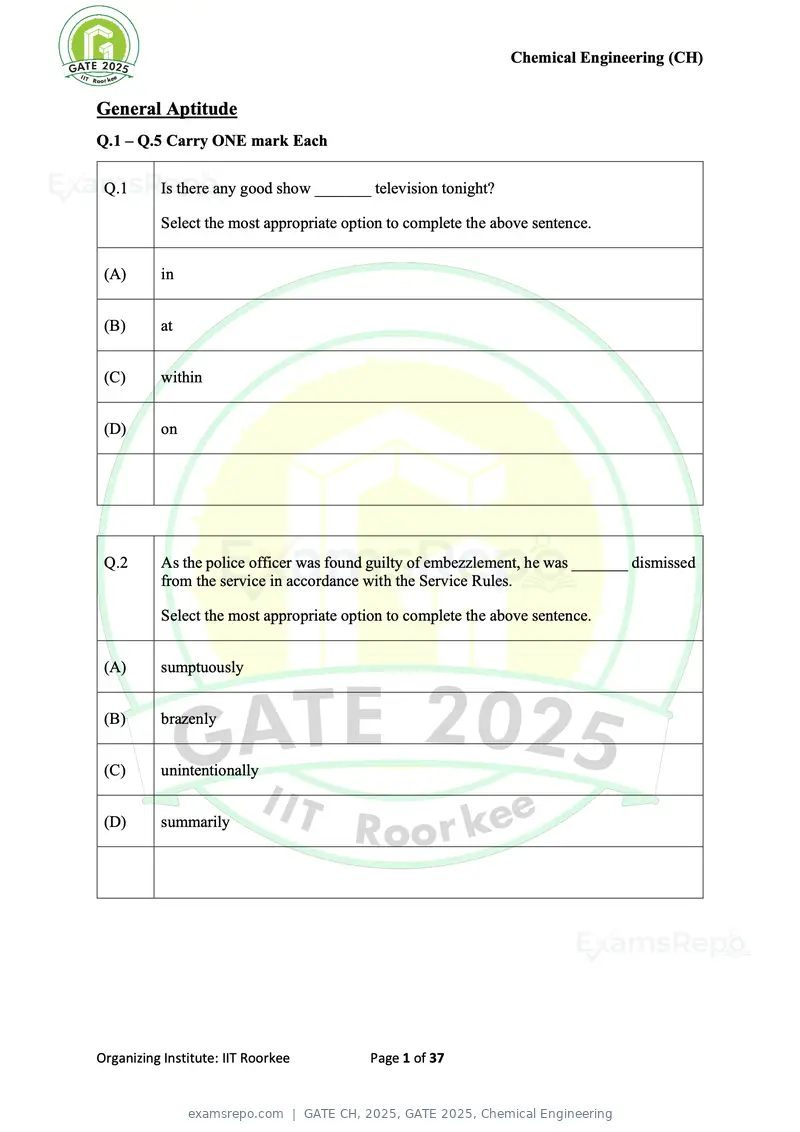
 Q.1      Is there any good show _______ television tonight?

          Select the most appropriate option to complete the above sentence.


 (A)      in


 (B)      at


 (C)      within


 (D)      on


 Q.2      As the police officer was found guilty of embezzlement, he was _______ dismissed
          from the service in accordance with the Service Rules.

          Select the most appropriate option to complete the above sentence.


 (A)      sumptuously


 (B)      brazenly


 (C)      unintentionally


 (D)      summarily


Organizing Institute: IIT Roorkee         Page 1 of 37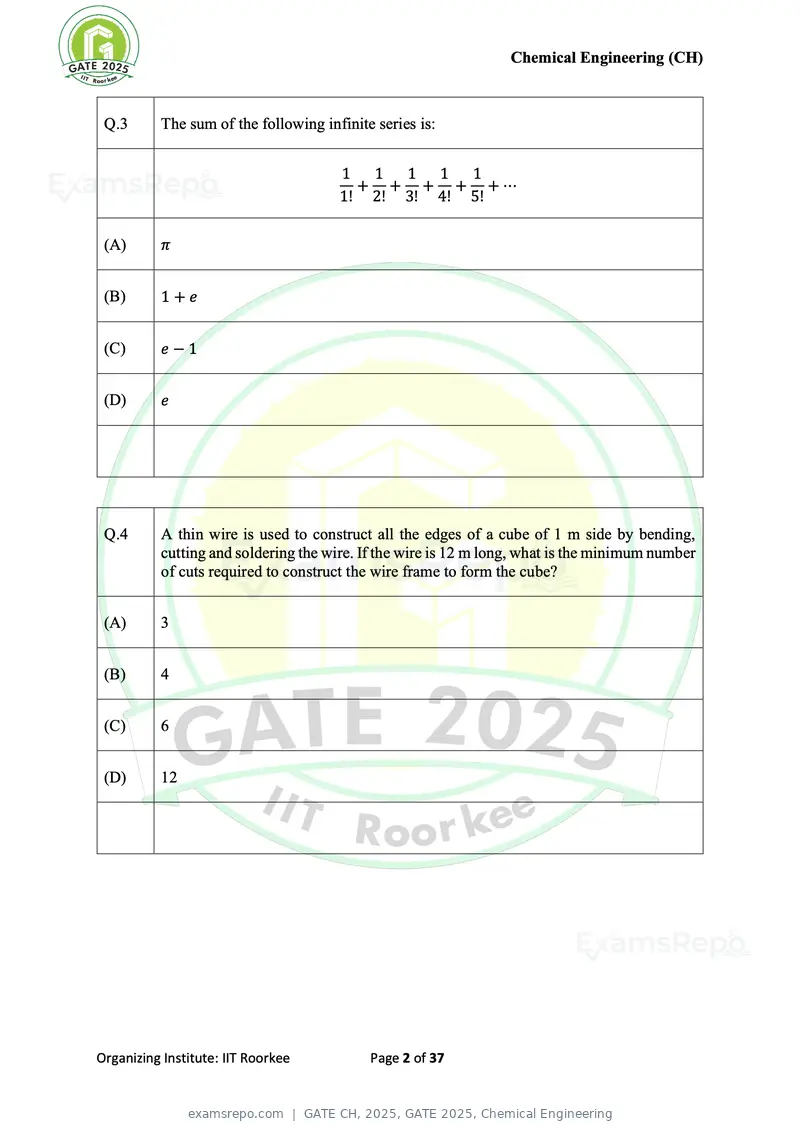
Text of page 2
Chemical Engineering (CH)


 Q.3      The sum of the following infinite series is:


                                      1 1 1 1 1
                                        + + + + +⋯
                                      1! 2! 3! 4! 5!

 (A)      π


 (B)      1+e


 (C)      e−1


 (D)      e


 Q.4      A thin wire is used to construct all the edges of a cube of 1 m side by bending,
          cutting and soldering the wire. If the wire is 12 m long, what is the minimum number
          of cuts required to construct the wire frame to form the cube?


 (A)      3


 (B)      4


 (C)      6


 (D)      12


Organizing Institute: IIT Roorkee          Page 2 of 37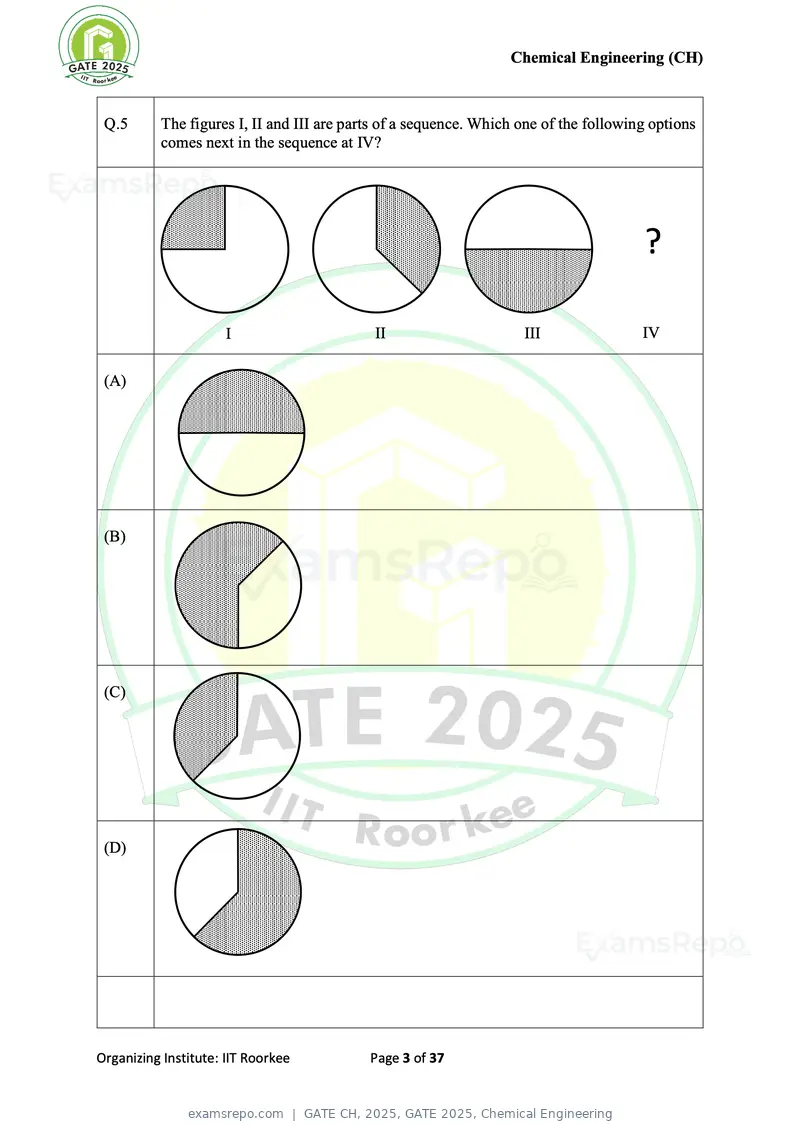
Text of page 3
Chemical Engineering (CH)


 Q.5      The figures I, II and III are parts of a sequence. Which one of the following options
          comes next in the sequence at IV?


                                                                                      ?

                     I                      II                     III                IV

 (A)


 (B)


 (C)


 (D)


Organizing Institute: IIT Roorkee          Page 3 of 37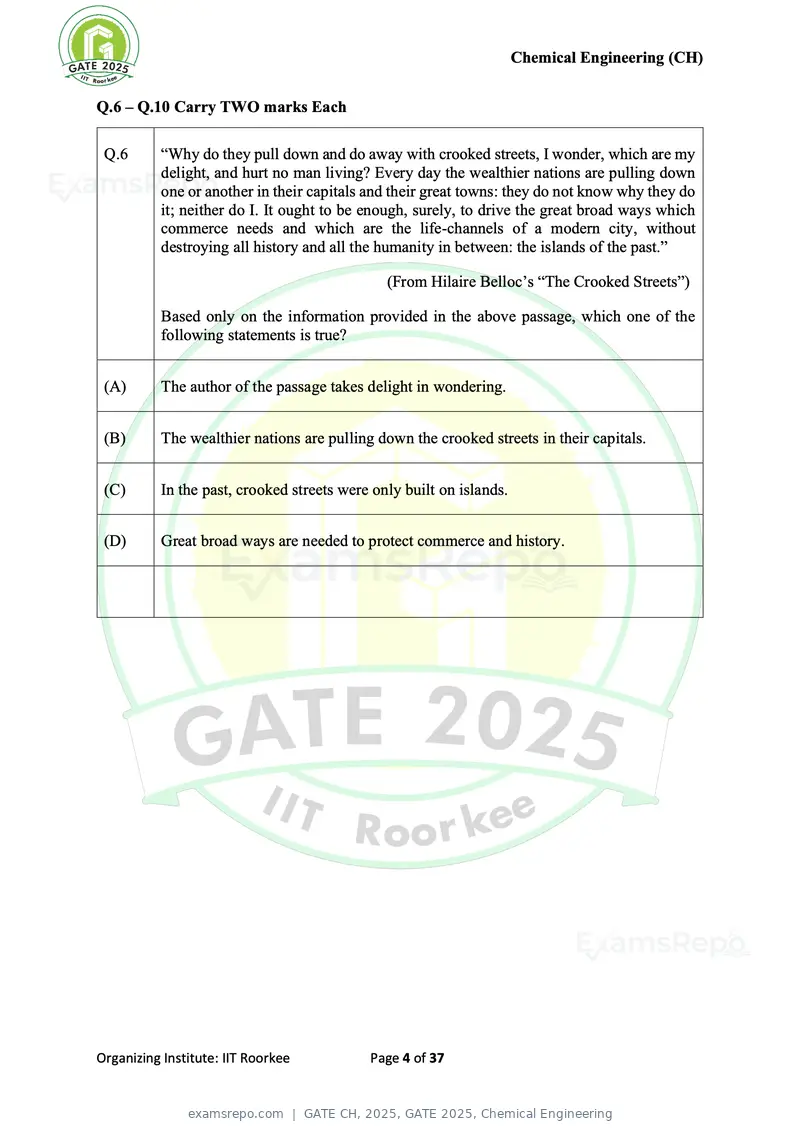
Text of page 4
Chemical Engineering (CH)


Q.6 – Q.10 Carry TWO marks Each

 Q.6      “Why do they pull down and do away with crooked streets, I wonder, which are my
          delight, and hurt no man living? Every day the wealthier nations are pulling down
          one or another in their capitals and their great towns: they do not know why they do
          it; neither do I. It ought to be enough, surely, to drive the great broad ways which
          commerce needs and which are the life-channels of a modern city, without
          destroying all history and all the humanity in between: the islands of the past.”

                                              (From Hilaire Belloc’s “The Crooked Streets”)

          Based only on the information provided in the above passage, which one of the
          following statements is true?


 (A)      The author of the passage takes delight in wondering.


 (B)      The wealthier nations are pulling down the crooked streets in their capitals.


 (C)      In the past, crooked streets were only built on islands.


 (D)      Great broad ways are needed to protect commerce and history.


Organizing Institute: IIT Roorkee          Page 4 of 37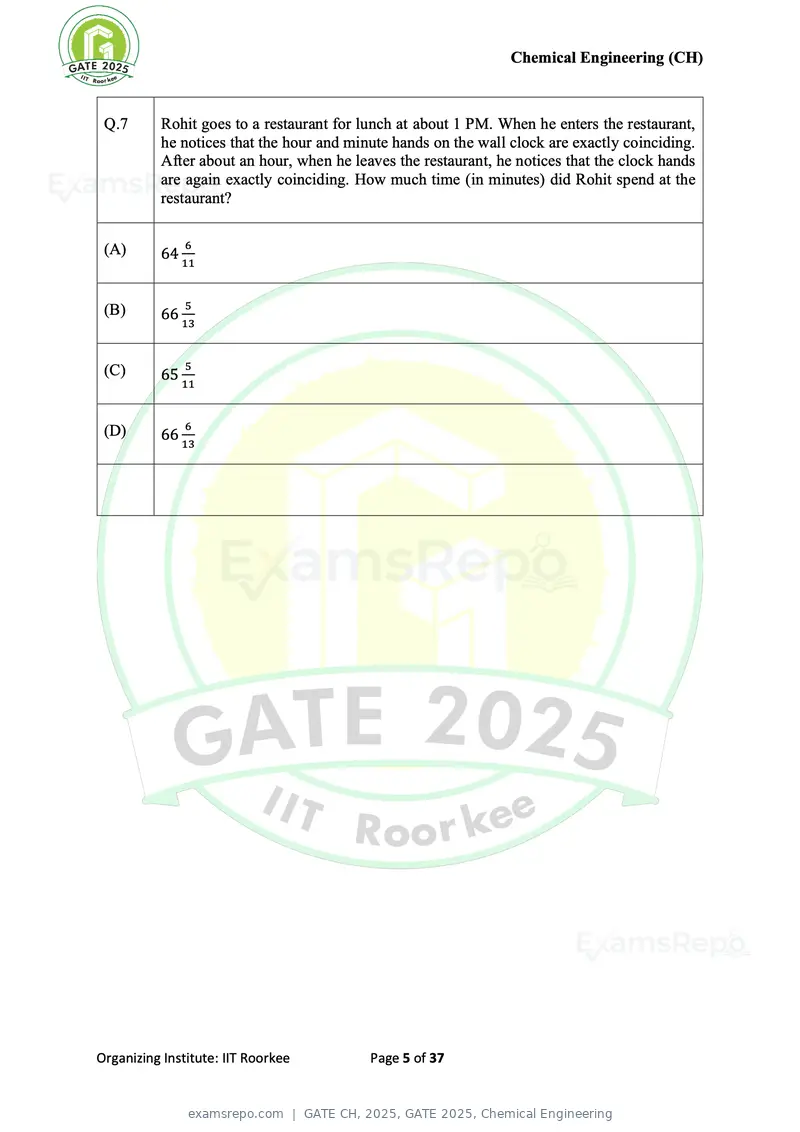
Text of page 5
Chemical Engineering (CH)


 Q.7      Rohit goes to a restaurant for lunch at about 1 PM. When he enters the restaurant,
          he notices that the hour and minute hands on the wall clock are exactly coinciding.
          After about an hour, when he leaves the restaurant, he notices that the clock hands
          are again exactly coinciding. How much time (in minutes) did Rohit spend at the
          restaurant?


 (A)           6
          64 11


 (B)           5
          66 13


 (C)           5
          65 11


 (D)           6
          66 13


Organizing Institute: IIT Roorkee         Page 5 of 37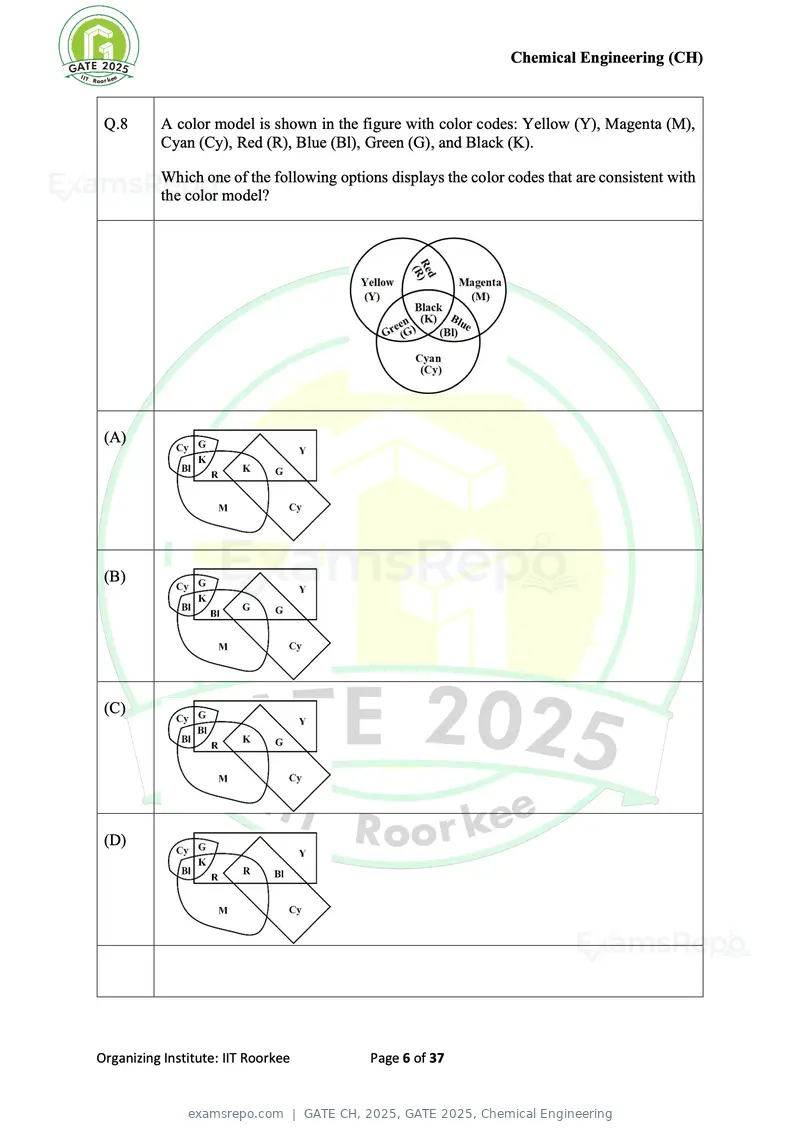
Text of page 6
Chemical Engineering (CH)


 Q.8      A color model is shown in the figure with color codes: Yellow (Y), Magenta (M),
          Cyan (Cy), Red (R), Blue (Bl), Green (G), and Black (K).

          Which one of the following options displays the color codes that are consistent with
          the color model?


 (A)


 (B)


 (C)


 (D)


Organizing Institute: IIT Roorkee         Page 6 of 37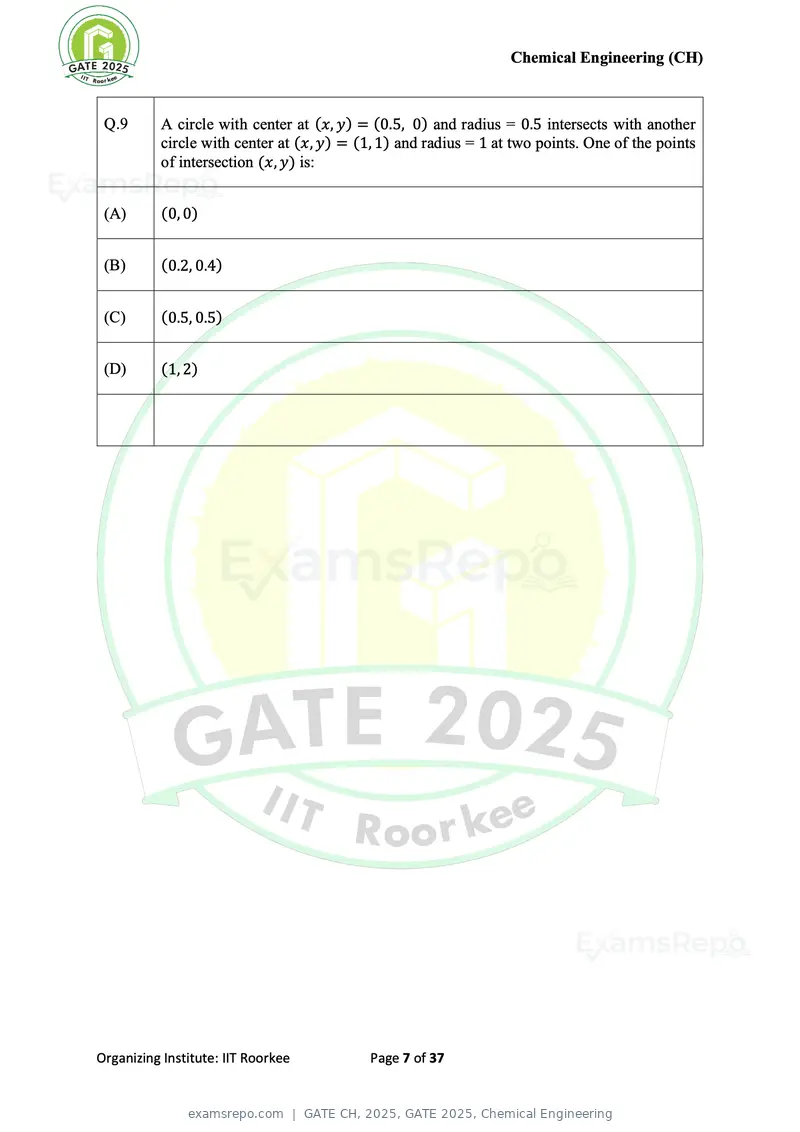
Text of page 7
Chemical Engineering (CH)


 Q.9      A circle with center at (x, y) = (0.5, 0) and radius = 0.5 intersects with another
          circle with center at (x, y) = (1, 1) and radius = 1 at two points. One of the points
          of intersection (x, y) is:


 (A)      (0, 0)


 (B)      (0.2, 0.4)


 (C)      (0.5, 0.5)


 (D)      (1, 2)


Organizing Institute: IIT Roorkee          Page 7 of 37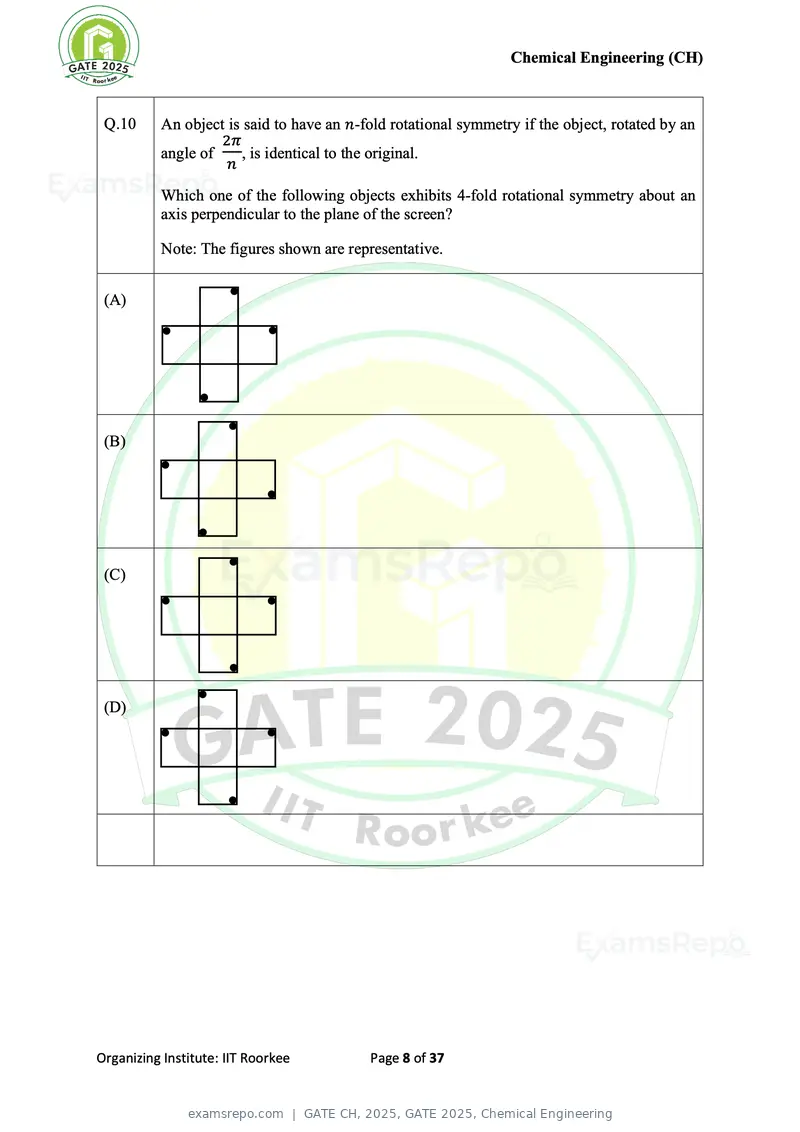
Text of page 8
Chemical Engineering (CH)


 Q.10     An object is said to have an n-fold rotational symmetry if the object, rotated by an
                   2π
          angle of     , is identical to the original.
                    n

          Which one of the following objects exhibits 4-fold rotational symmetry about an
          axis perpendicular to the plane of the screen?

          Note: The figures shown are representative.


 (A)


 (B)


 (C)


 (D)


Organizing Institute: IIT Roorkee         Page 8 of 37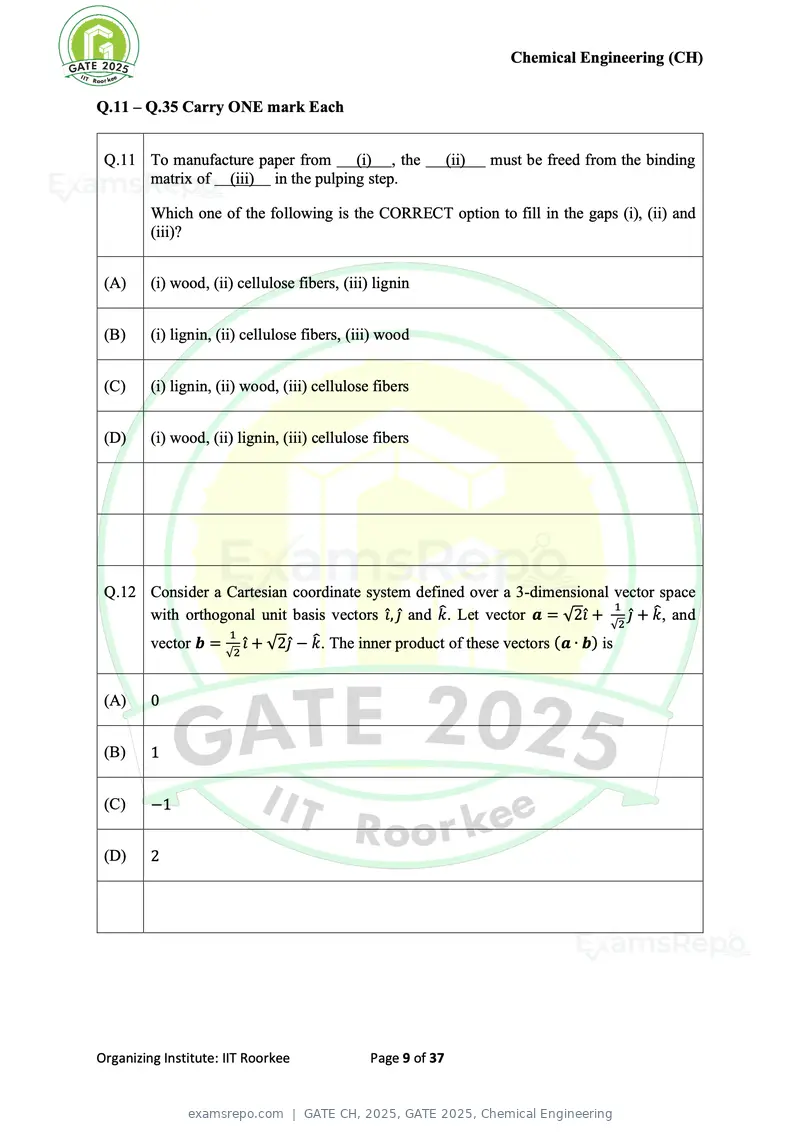
Text of page 9
Chemical Engineering (CH)


Q.11 – Q.35 Carry ONE mark Each


 Q.11 To manufacture paper from    (i) , the                   (ii)   must be freed from the binding
      matrix of (iii) in the pulping step.

         Which one of the following is the CORRECT option to fill in the gaps (i), (ii) and
         (iii)?


 (A)     (i) wood, (ii) cellulose fibers, (iii) lignin


 (B)     (i) lignin, (ii) cellulose fibers, (iii) wood


 (C)     (i) lignin, (ii) wood, (iii) cellulose fibers


 (D)     (i) wood, (ii) lignin, (iii) cellulose fibers


 Q.12 Consider a Cartesian coordinate system defined over a 3-dimensional vector space
                                                                             1
      with orthogonal unit basis vectors î, ĵ and k̂. Let vector a = √2î + ĵ + k̂, and
                                                                                        √2
                      1
         vector b =        î + √2ĵ − k̂ . The inner product of these vectors (a ∙ b) is
                      √2


 (A)     0


 (B)     1


 (C)     −1


 (D)     2


Organizing Institute: IIT Roorkee               Page 9 of 37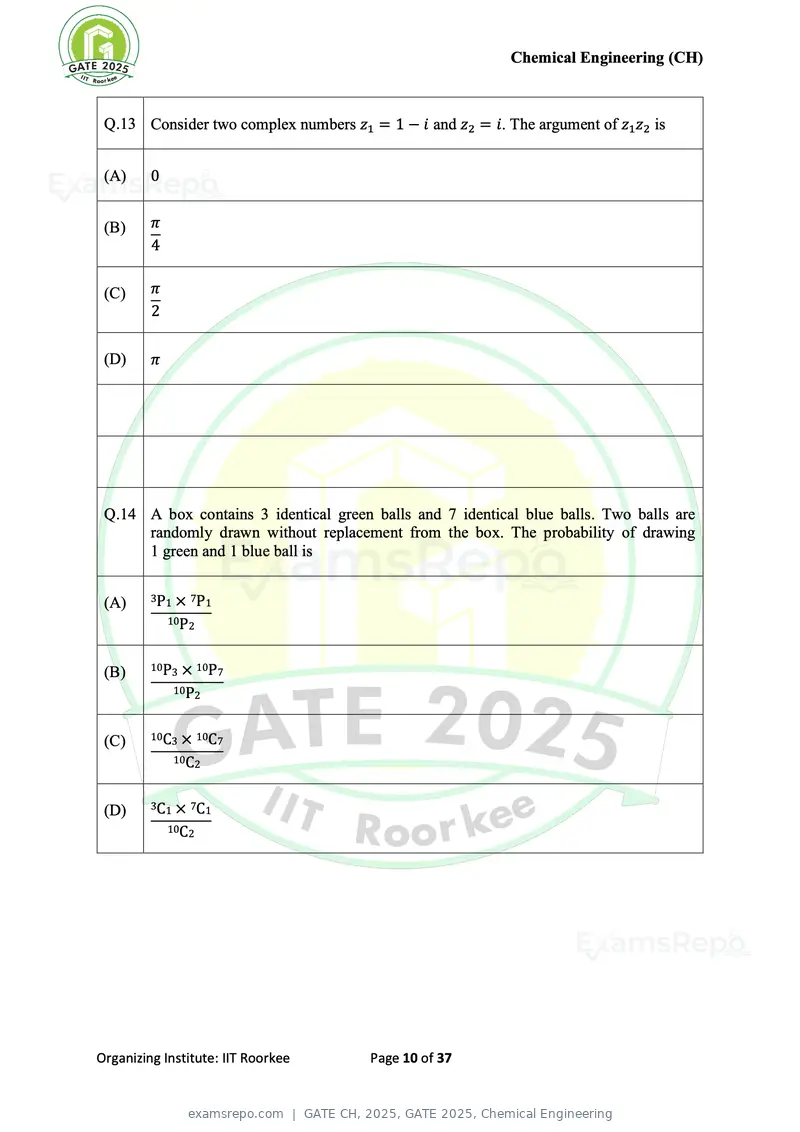
Text of page 10
Chemical Engineering (CH)


 Q.13 Consider two complex numbers z1 = 1 − i and z2 = i. The argument of z1 z2 is


 (A)     0


 (B)     π
         4

 (C)     π
         2

 (D)     π


 Q.14 A box contains 3 identical green balls and 7 identical blue balls. Two balls are
      randomly drawn without replacement from the box. The probability of drawing
      1 green and 1 blue ball is

         3P1 × 7P1
 (A)
             10P2


         10P3 × 10P7
 (B)
             10P2


         10C3 × 10C7
 (C)
             10C2


         3C1 × 7C1
 (D)
             10C2


Organizing Institute: IIT Roorkee      Page 10 of 37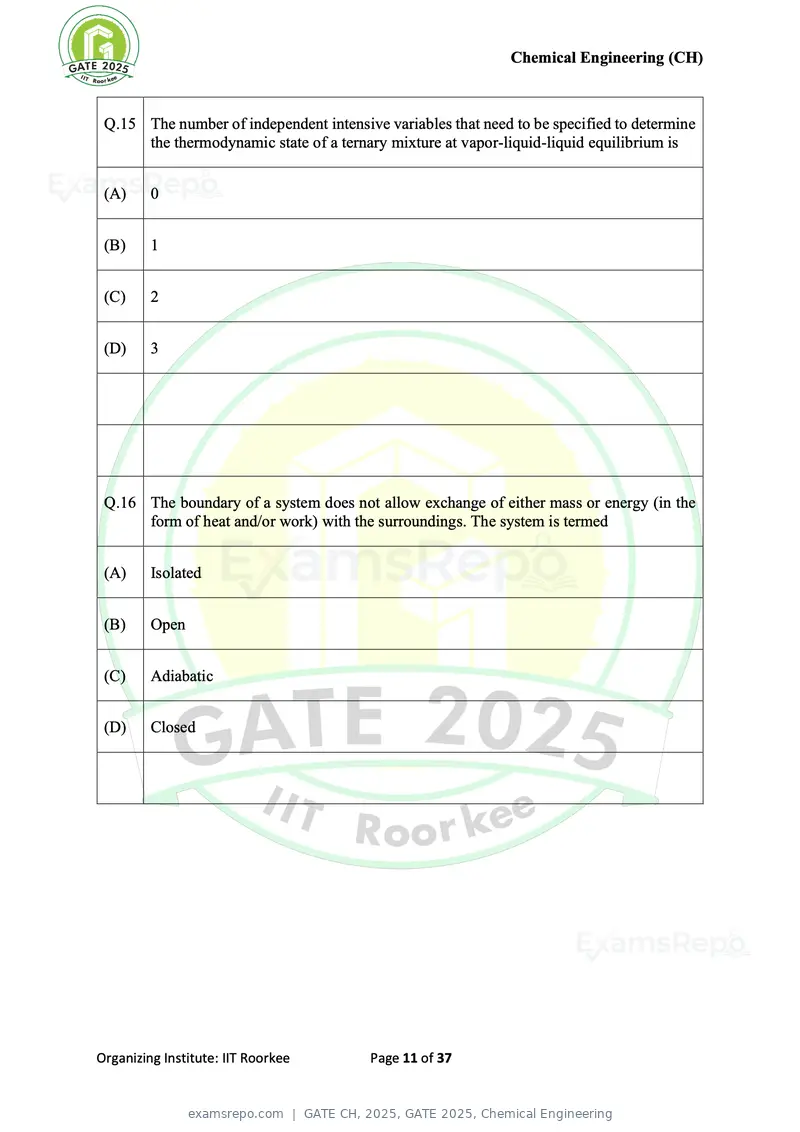
Text of page 11
Chemical Engineering (CH)


 Q.15 The number of independent intensive variables that need to be specified to determine
      the thermodynamic state of a ternary mixture at vapor-liquid-liquid equilibrium is


 (A)     0


 (B)     1


 (C)     2


 (D)     3


 Q.16 The boundary of a system does not allow exchange of either mass or energy (in the
      form of heat and/or work) with the surroundings. The system is termed


 (A)     Isolated


 (B)     Open


 (C)     Adiabatic


 (D)     Closed


Organizing Institute: IIT Roorkee        Page 11 of 37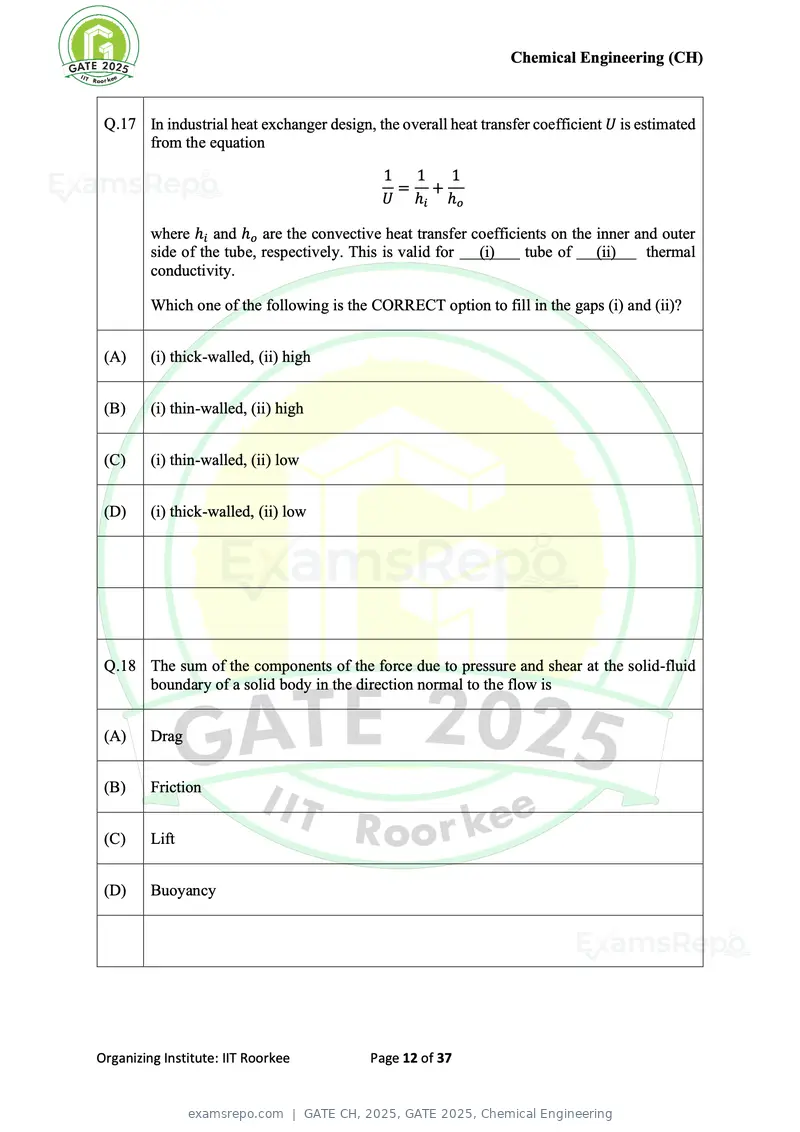
Text of page 12
Chemical Engineering (CH)


 Q.17 In industrial heat exchanger design, the overall heat transfer coefficient U is estimated
      from the equation

                                             1  1  1
                                               = +
                                             U ℎi ℎo

         where ℎi and ℎo are the convective heat transfer coefficients on the inner and outer
         side of the tube, respectively. This is valid for (i)     tube of    (ii)    thermal
         conductivity.

         Which one of the following is the CORRECT option to fill in the gaps (i) and (ii)?


 (A)     (i) thick-walled, (ii) high


 (B)     (i) thin-walled, (ii) high


 (C)     (i) thin-walled, (ii) low


 (D)     (i) thick-walled, (ii) low


 Q.18 The sum of the components of the force due to pressure and shear at the solid-fluid
      boundary of a solid body in the direction normal to the flow is


 (A)     Drag


 (B)     Friction


 (C)     Lift


 (D)     Buoyancy


Organizing Institute: IIT Roorkee          Page 12 of 37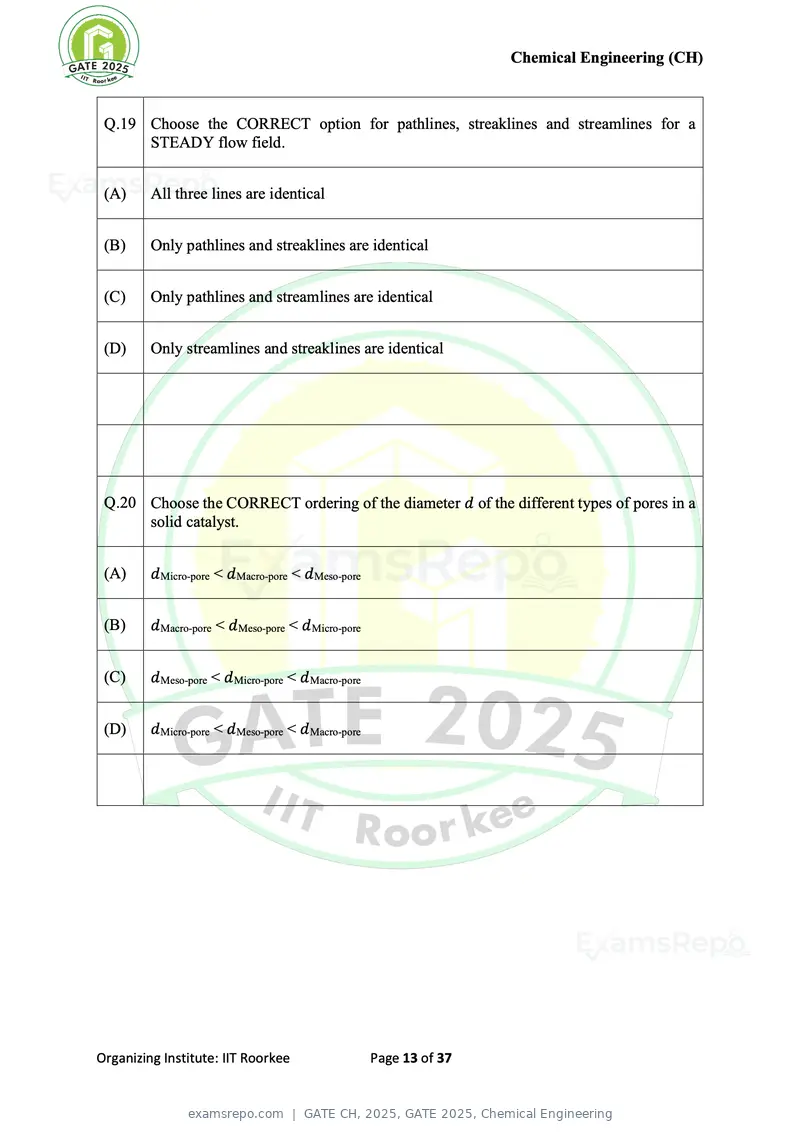
Text of page 13
Chemical Engineering (CH)


 Q.19 Choose the CORRECT option for pathlines, streaklines and streamlines for a
      STEADY flow field.


 (A)     All three lines are identical


 (B)     Only pathlines and streaklines are identical


 (C)     Only pathlines and streamlines are identical


 (D)     Only streamlines and streaklines are identical


 Q.20 Choose the CORRECT ordering of the diameter d of the different types of pores in a
      solid catalyst.


 (A)     d Micro-pore < d Macro-pore < d Meso-pore


 (B)     d Macro-pore < dMeso-pore < dMicro-pore


 (C)     d Meso-pore < dMicro-pore < dMacro-pore


 (D)     d Micro-pore < d Meso-pore < dMacro-pore


Organizing Institute: IIT Roorkee                    Page 13 of 37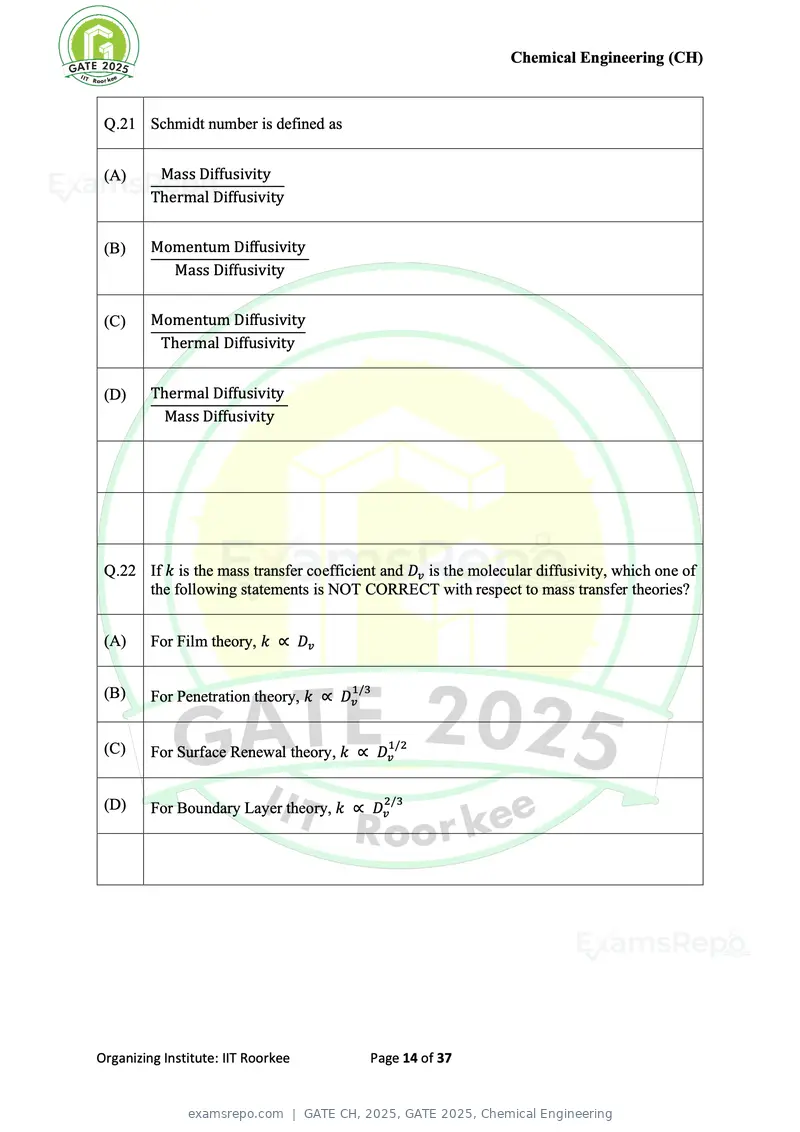
Text of page 14
Chemical Engineering (CH)


 Q.21 Schmidt number is defined as


 (A)      Mass Diffusivity
         Thermal Diffusivity


 (B)     Momentum Diffusivity
           Mass Diffusivity


 (C)     Momentum Diffusivity
          Thermal Diffusivity


 (D)     Thermal Diffusivity
          Mass Diffusivity


 Q.22 If k is the mass transfer coefficient and Dv is the molecular diffusivity, which one of
      the following statements is NOT CORRECT with respect to mass transfer theories?


 (A)     For Film theory, k ∝ Dv


 (B)                                   1/3
         For Penetration theory, k ∝ Dv


 (C)                                         1/2
         For Surface Renewal theory, k ∝ Dv


 (D)                                         2/3
         For Boundary Layer theory, k ∝ Dv


Organizing Institute: IIT Roorkee         Page 14 of 37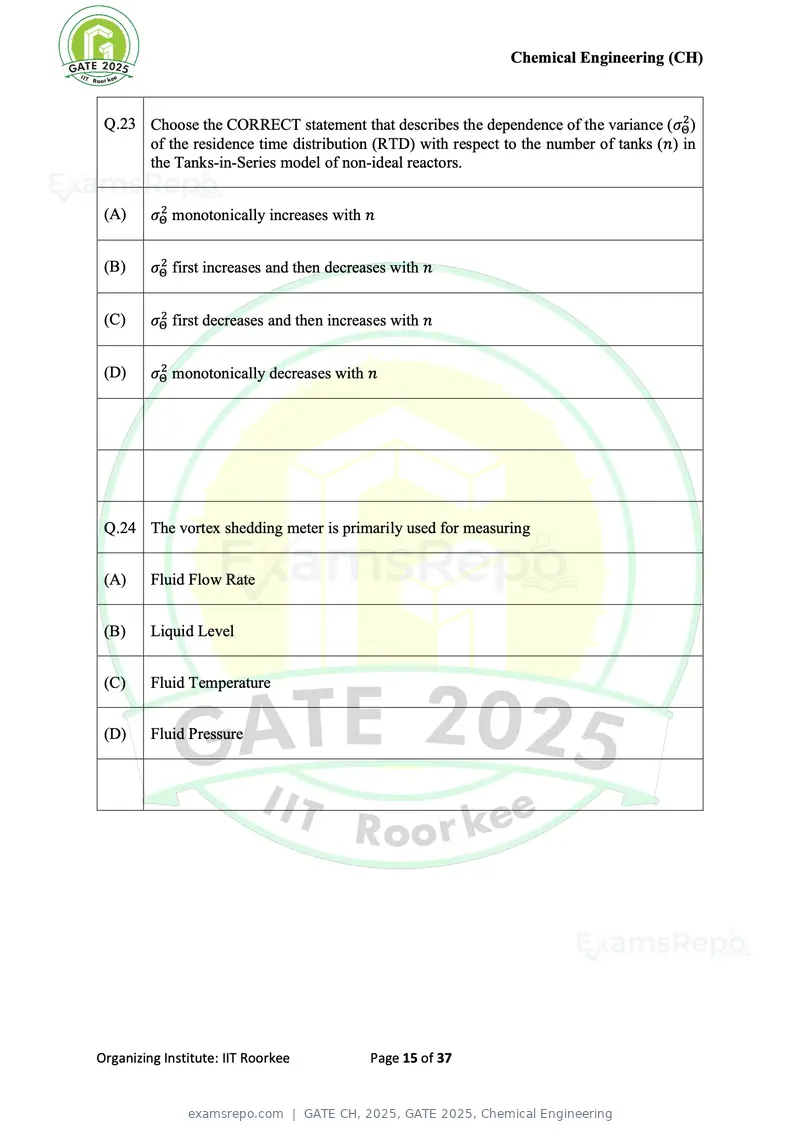
Text of page 15
Chemical Engineering (CH)


 Q.23 Choose the CORRECT statement that describes the dependence of the variance (σΘ2 )
      of the residence time distribution (RTD) with respect to the number of tanks (n) in
      the Tanks-in-Series model of non-ideal reactors.


 (A)     σΘ2 monotonically increases with n


 (B)     σΘ2 first increases and then decreases with n


 (C)     σΘ2 first decreases and then increases with n


 (D)     σΘ2 monotonically decreases with n


 Q.24 The vortex shedding meter is primarily used for measuring


 (A)     Fluid Flow Rate


 (B)     Liquid Level


 (C)     Fluid Temperature


 (D)     Fluid Pressure


Organizing Institute: IIT Roorkee           Page 15 of 37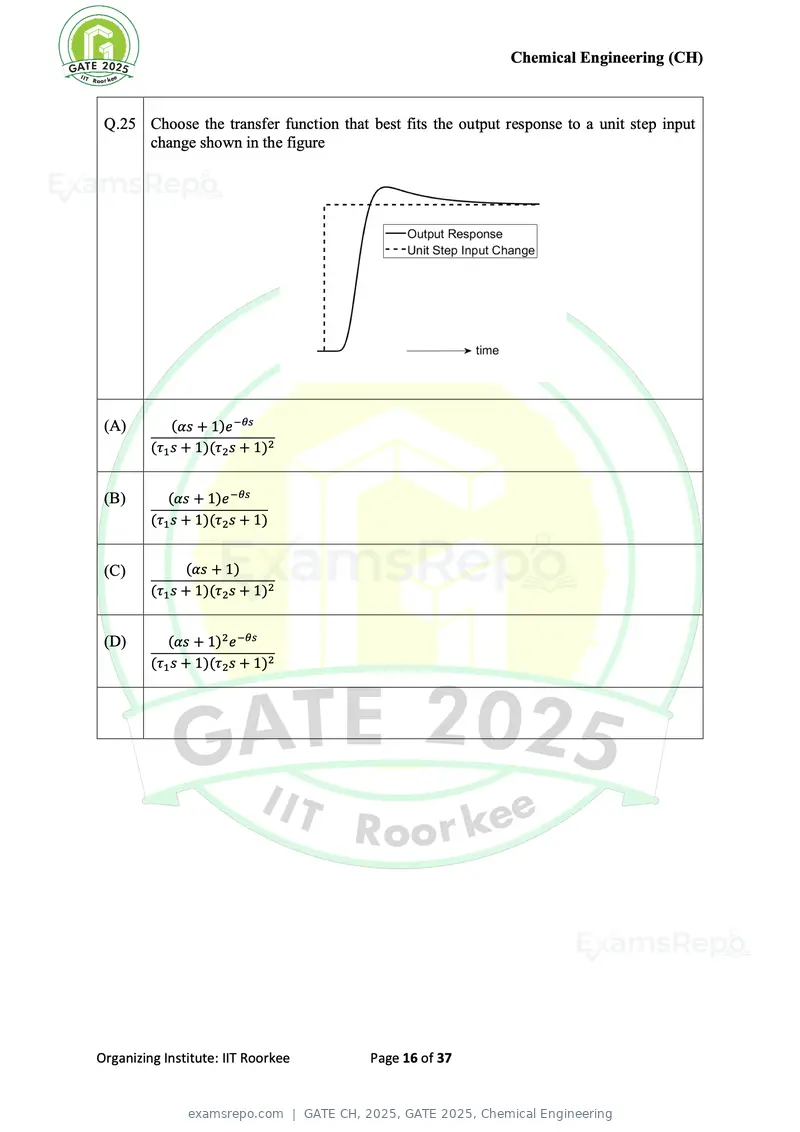
Text of page 16
Chemical Engineering (CH)


 Q.25 Choose the transfer function that best fits the output response to a unit step input
      change shown in the figure


 (A)         (αs + 1)e −θs
         (τ1 s + 1)(τ2 s + 1)2


 (B)        (αs + 1)e −θs
         (τ1 s + 1)(τ2 s + 1)


 (C)           (αs + 1)
         (τ1 s + 1)(τ2 s + 1)2


 (D)        (αs + 1)2 e −θs
         (τ1 s + 1)(τ2 s + 1)2


Organizing Institute: IIT Roorkee        Page 16 of 37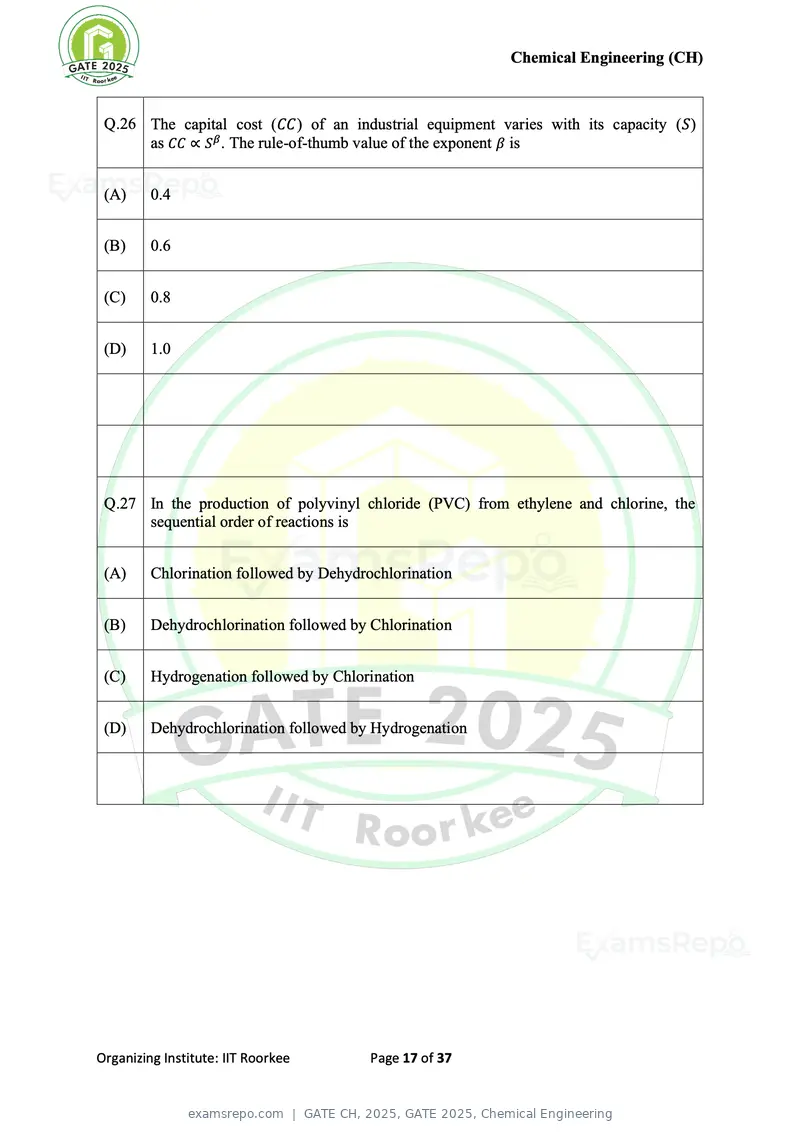
Text of page 17
Chemical Engineering (CH)


 Q.26 The capital cost (CC) of an industrial equipment varies with its capacity (S)
      as CC ∝ Sβ . The rule-of-thumb value of the exponent β is


 (A)     0.4


 (B)     0.6


 (C)     0.8


 (D)     1.0


 Q.27 In the production of polyvinyl chloride (PVC) from ethylene and chlorine, the
      sequential order of reactions is


 (A)     Chlorination followed by Dehydrochlorination


 (B)     Dehydrochlorination followed by Chlorination


 (C)     Hydrogenation followed by Chlorination


 (D)     Dehydrochlorination followed by Hydrogenation


Organizing Institute: IIT Roorkee        Page 17 of 37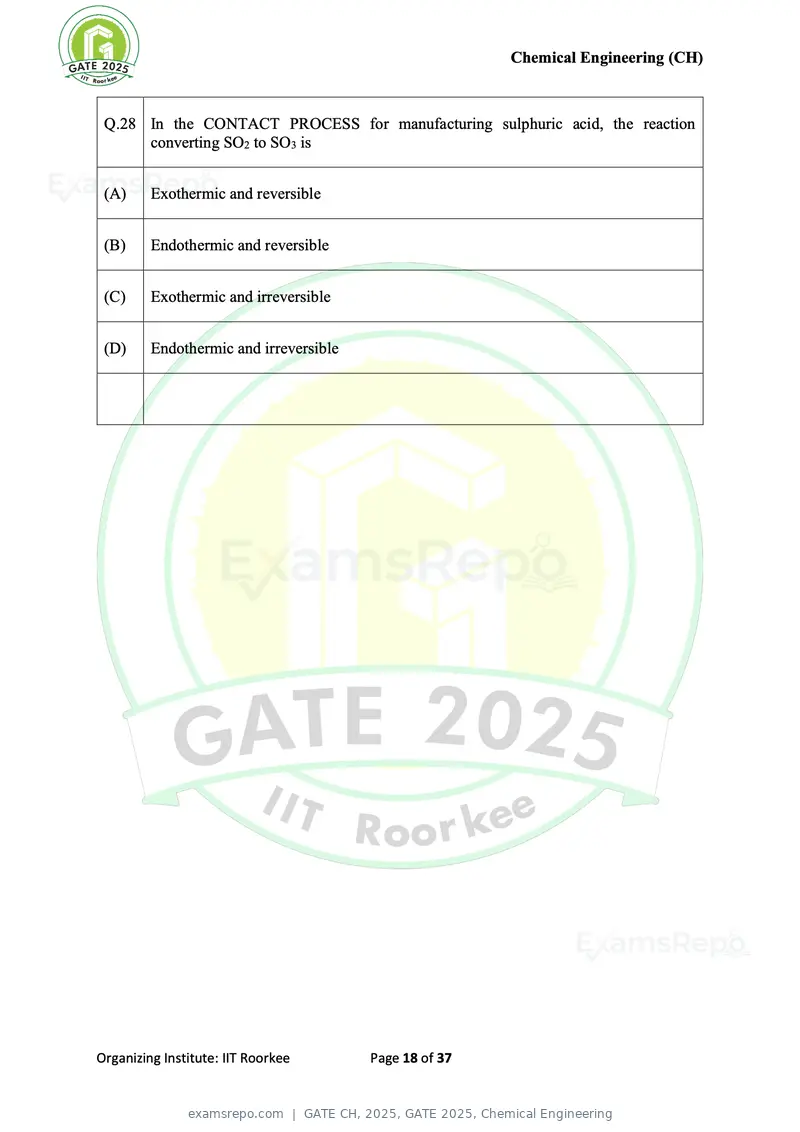
Text of page 18
Chemical Engineering (CH)


 Q.28 In the CONTACT PROCESS for manufacturing sulphuric acid, the reaction
      converting SO2 to SO3 is


 (A)     Exothermic and reversible


 (B)     Endothermic and reversible


 (C)     Exothermic and irreversible


 (D)     Endothermic and irreversible


Organizing Institute: IIT Roorkee       Page 18 of 37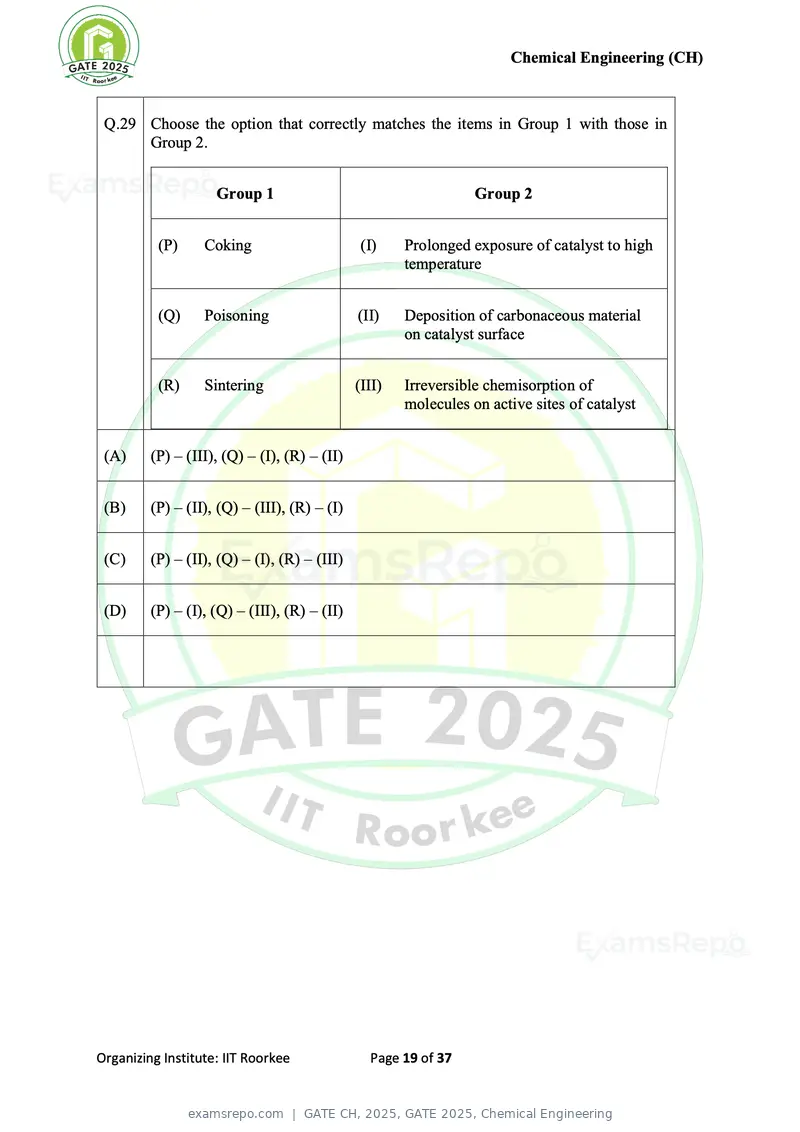
Text of page 19
Chemical Engineering (CH)


 Q.29 Choose the option that correctly matches the items in Group 1 with those in
      Group 2.


                    Group 1                                      Group 2


          (P)     Coking                       (I)    Prolonged exposure of catalyst to high
                                                      temperature


          (Q)     Poisoning                   (II)    Deposition of carbonaceous material
                                                      on catalyst surface


          (R)     Sintering                   (III)   Irreversible chemisorption of
                                                      molecules on active sites of catalyst


 (A)     (P) – (III), (Q) – (I), (R) – (II)


 (B)     (P) – (II), (Q) – (III), (R) – (I)


 (C)     (P) – (II), (Q) – (I), (R) – (III)


 (D)     (P) – (I), (Q) – (III), (R) – (II)


Organizing Institute: IIT Roorkee               Page 19 of 37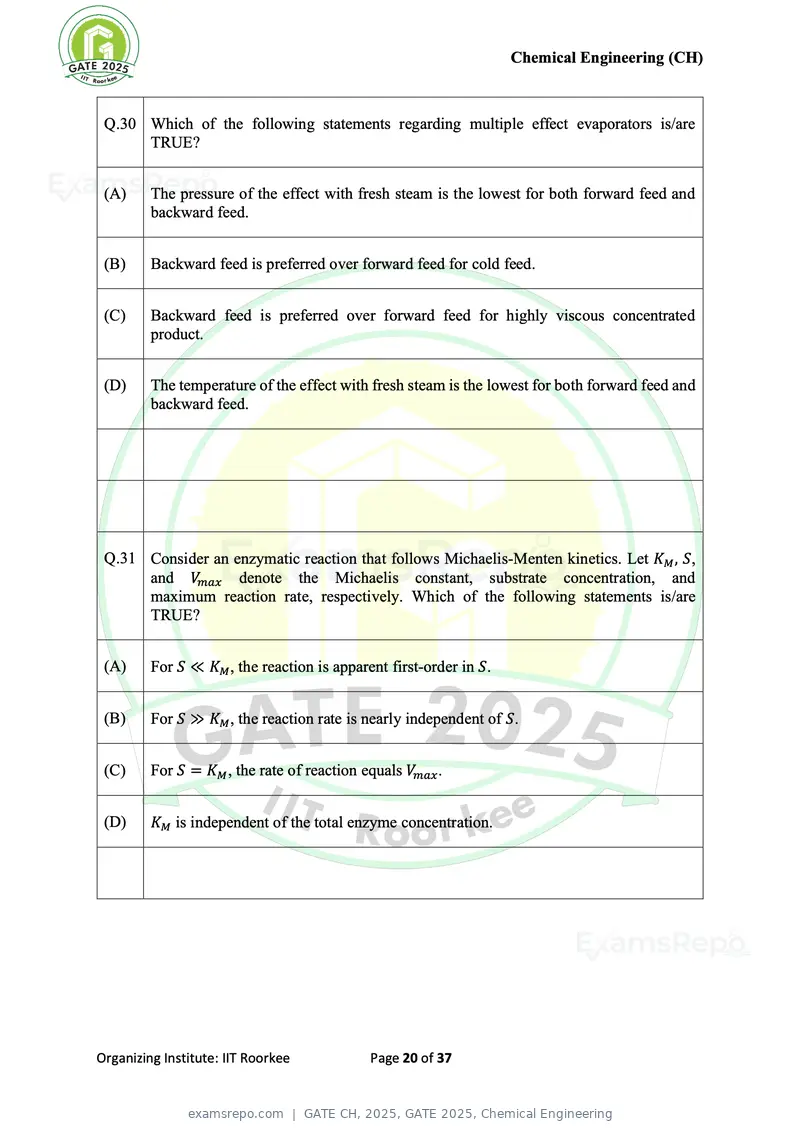
Text of page 20
Chemical Engineering (CH)


 Q.30 Which of the following statements regarding multiple effect evaporators is/are
      TRUE?


 (A)     The pressure of the effect with fresh steam is the lowest for both forward feed and
         backward feed.


 (B)     Backward feed is preferred over forward feed for cold feed.


 (C)     Backward feed is preferred over forward feed for highly viscous concentrated
         product.


 (D)     The temperature of the effect with fresh steam is the lowest for both forward feed and
         backward feed.


 Q.31 Consider an enzymatic reaction that follows Michaelis-Menten kinetics. Let KM , S,
      and Vmax denote the Michaelis constant, substrate concentration, and
      maximum reaction rate, respectively. Which of the following statements is/are
      TRUE?


 (A)     For S ≪ KM , the reaction is apparent first-order in S.


 (B)     For S ≫ KM , the reaction rate is nearly independent of S.


 (C)     For S = KM , the rate of reaction equals Vmax .


 (D)     KM is independent of the total enzyme concentration.


Organizing Institute: IIT Roorkee           Page 20 of 37
Text of page 21
Chemical Engineering (CH)


 Q.32 The following data is given for a ternary ABC gas mixture at 12 MPa and 308 K:


                 Component i →              A                  B                 C


                         yi                0.55               0.20              0.25


                         φ̂i               0.75               0.80              0.95


                 yi : mole fraction of component i in the gas mixture

                 φ̂i : fugacity coefficient of component i in the gas mixture
                       at 12 MPa and 308 K


         The fugacity of the gas mixture is _____ MPa (rounded off to 3 decimal places).


 Q.33 Ideal nonreacting gases A and B are contained inside a perfectly insulated chamber,
      separated by a thin partition, as shown in the figure. The partition is removed, and the
      two gases mix till final equilibrium is reached. The change in total entropy for the
      process is ____ J/K (rounded off to 1 decimal place).


         GIVEN:          Universal gas constant R = 8.314 J/(mol K)


Organizing Institute: IIT Roorkee           Page 21 of 37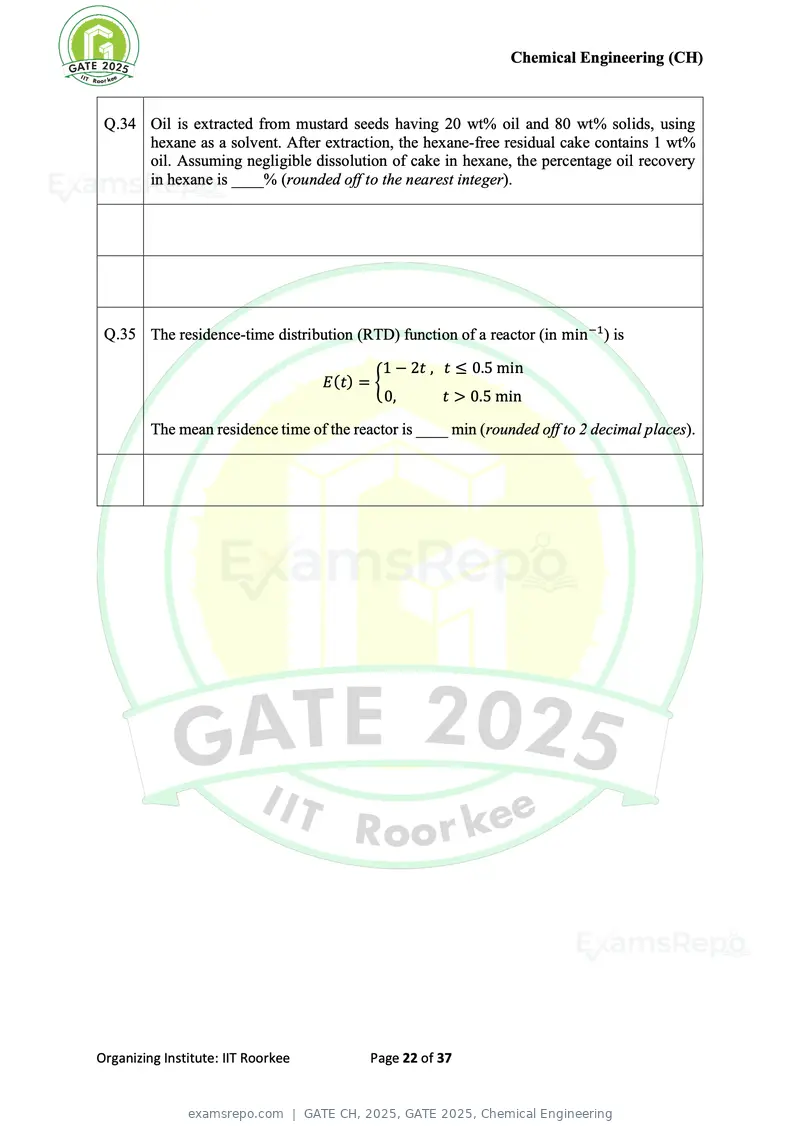
Text of page 22
Chemical Engineering (CH)


 Q.34 Oil is extracted from mustard seeds having 20 wt% oil and 80 wt% solids, using
      hexane as a solvent. After extraction, the hexane-free residual cake contains 1 wt%
      oil. Assuming negligible dissolution of cake in hexane, the percentage oil recovery
      in hexane is ____% (rounded off to the nearest integer).


 Q.35 The residence-time distribution (RTD) function of a reactor (in min−1) is

                                               1 − 2t , t ≤ 0.5 min
                                    E(t) = {
                                               0,      t > 0.5 min

         The mean residence time of the reactor is ____ min (rounded off to 2 decimal places).


Organizing Institute: IIT Roorkee          Page 22 of 37
Text of page 23
Chemical Engineering (CH)


Q.36 – Q.65 Carry TWO marks Each


 Q.36 Consider a Cartesian coordinate system with orthogonal unit basis vectors î, ĵ defined over a
      domain: x, y ∈ [0,1]. Choose the condition for which the divergence of the vector field
      v = axî − byĵ is zero.


 (A)     a−b =0


 (B)     a<b


 (C)     a>b


 (D)     a+b =0


 Q.37 A probability distribution function is given as

                                                    1
                                                      ,     x ∈ (0, a)
                                            p(x) = {a
                                                      0,    otherwise

         where a is a positive constant. For a function f(x) = x 2 , the expectation of f(x) is


 (A)     a2
         3

 (B)     a3
         3

 (C)     2a2
          3

 (D)     2a3
          3


Organizing Institute: IIT Roorkee           Page 23 of 37
Text of page 24
Chemical Engineering (CH)


 Q.38 A hot plate is placed in contact with a cold plate of a different thermal conductivity as shown
      in the figure. The initial temperature (at time t = 0) of the hot plate and cold plate are Tℎ and
      Tc , respectively. Assume perfect contact between the plates.


         Which one of the following is an appropriate boundary condition at the surface S for solving
         the unsteady state, one-dimensional heat conduction equations for the hot plate and cold plate
         for t > 0?


 (A)     Temperature at S is same for both the plates


 (B)     Gradient of temperature at S is same for both the plates


 (C)     Gradient of temperature vanishes at S


 (D)     Temperature at S is the average of Tℎ and Tc


Organizing Institute: IIT Roorkee          Page 24 of 37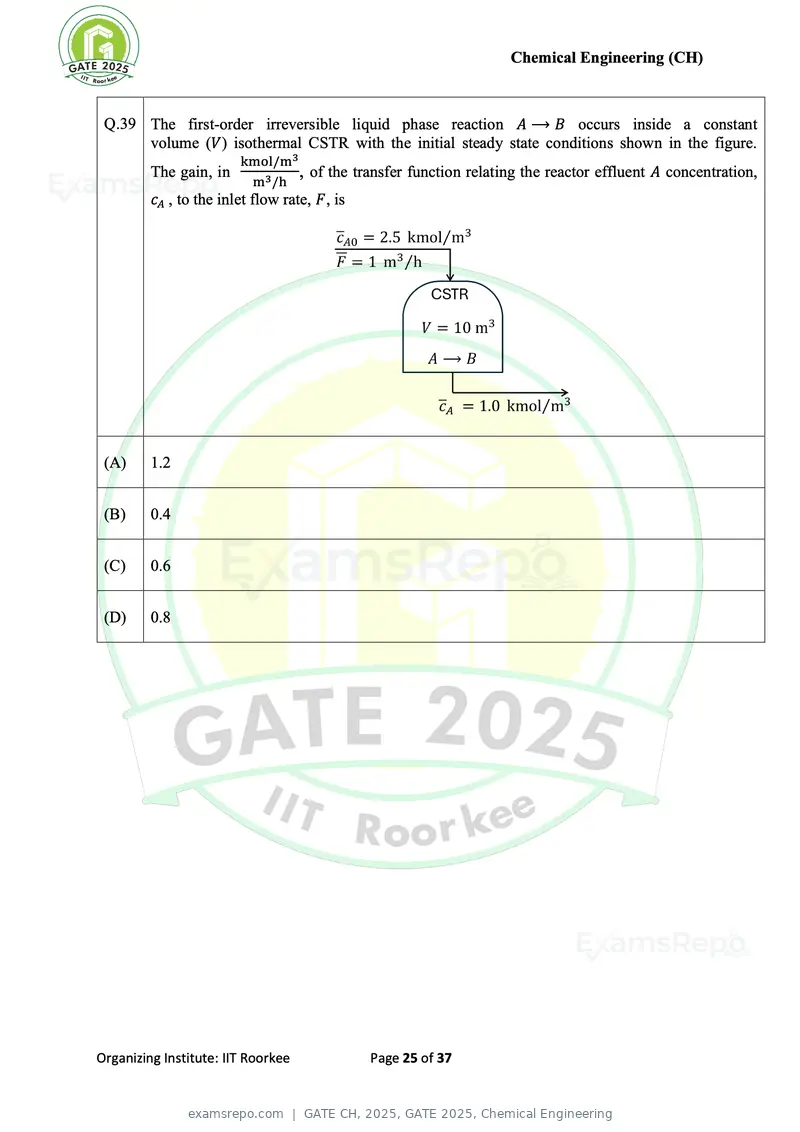
Text of page 25
Chemical Engineering (CH)


 Q.39 The first-order irreversible liquid phase reaction A ⟶ B occurs inside a constant
      volume (V) isothermal CSTR with the initial steady state conditions shown in the figure.
                        kmol/m3
         The gain, in               , of the transfer function relating the reactor effluent A concentration,
                          m3 /h
         cA , to the inlet flow rate, F, is


 (A)     1.2


 (B)     0.4


 (C)     0.6


 (D)     0.8


Organizing Institute: IIT Roorkee              Page 25 of 37
Text of page 26
Chemical Engineering (CH)


 Q.40 500 mg of a dry adsorbent is added to a beaker containing 100 mL solution of concentration
      100 mg phenol/(L solution). The adsorbent is separated out after 5 h of rigorous mixing. If the
      residual concentration in the solution after separating the adsorbent is
      30 mg phenol/(L solution), the amount of phenol adsorbed (in mg per gram of dry adsorbent)
      is


 (A)     7


 (B)     14


 (C)     28


 (D)     18


Organizing Institute: IIT Roorkee        Page 26 of 37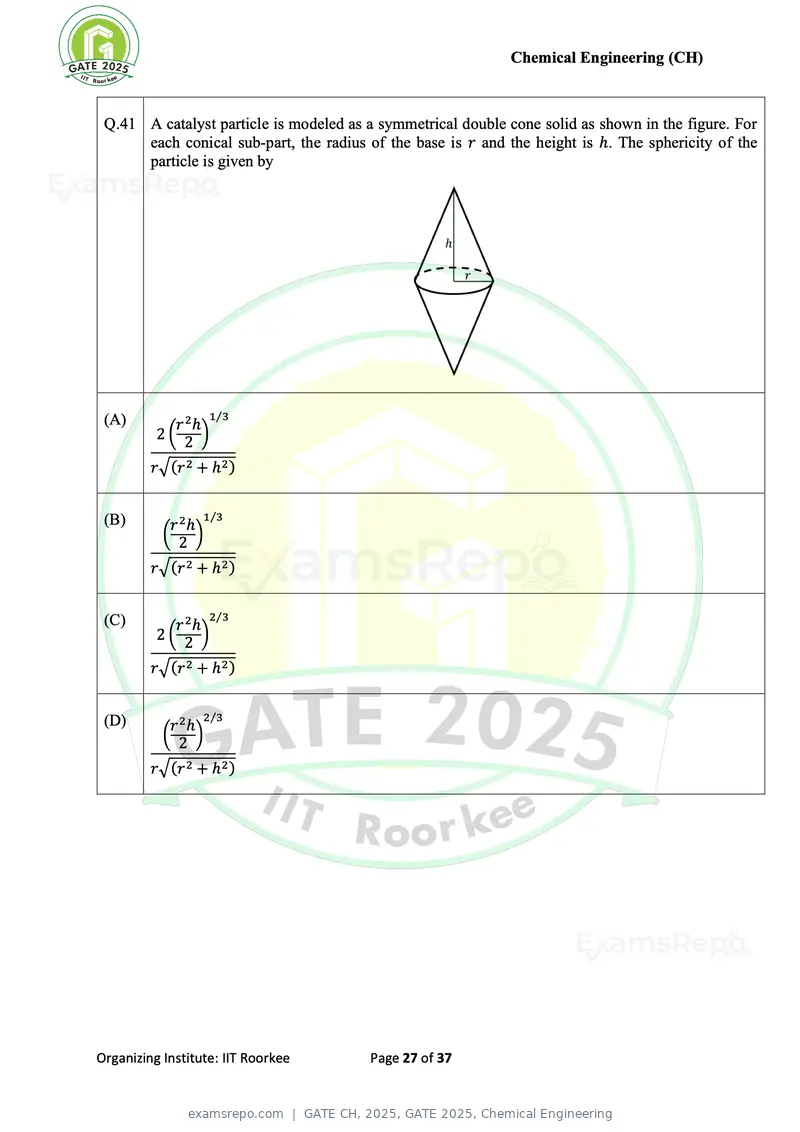
Text of page 27
Chemical Engineering (CH)


 Q.41 A catalyst particle is modeled as a symmetrical double cone solid as shown in the figure. For
      each conical sub-part, the radius of the base is r and the height is ℎ. The sphericity of the
      particle is given by


 (A)                 1⁄3
            r 2ℎ
          2(     )
             2
         r√(r 2 + ℎ2 )


 (B)              1⁄3
            r 2ℎ
           (     )
             2
         r√(r 2 + ℎ2 )


 (C)                 2⁄3
            r 2ℎ
          2( 2 )

         r√(r 2 + ℎ2 )


 (D)              2⁄3
            r 2ℎ
           (     )
             2
         r√(r 2 + ℎ2 )


Organizing Institute: IIT Roorkee       Page 27 of 37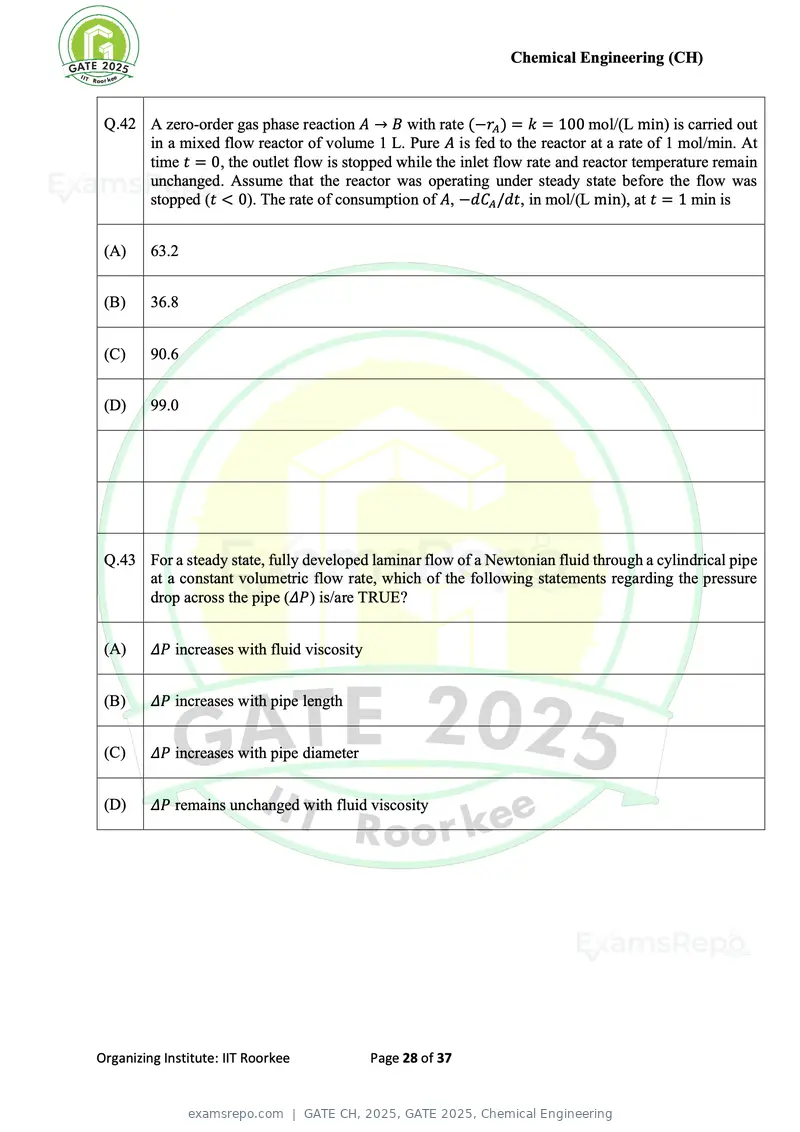
Text of page 28
Chemical Engineering (CH)


 Q.42 A zero-order gas phase reaction A → B with rate (−rA ) = k = 100 mol/(L min) is carried out
      in a mixed flow reactor of volume 1 L. Pure A is fed to the reactor at a rate of 1 mol/min. At
      time t = 0, the outlet flow is stopped while the inlet flow rate and reactor temperature remain
      unchanged. Assume that the reactor was operating under steady state before the flow was
      stopped (t < 0). The rate of consumption of A, −dCA /dt, in mol/(L min), at t = 1 min is


 (A)     63.2


 (B)     36.8


 (C)     90.6


 (D)     99.0


 Q.43 For a steady state, fully developed laminar flow of a Newtonian fluid through a cylindrical pipe
      at a constant volumetric flow rate, which of the following statements regarding the pressure
      drop across the pipe (ΔP) is/are TRUE?


 (A)     ΔP increases with fluid viscosity


 (B)     ΔP increases with pipe length


 (C)     ΔP increases with pipe diameter


 (D)     ΔP remains unchanged with fluid viscosity


Organizing Institute: IIT Roorkee            Page 28 of 37
Text of page 29
Chemical Engineering (CH)


 Q.44 Consider the differential equation

                                                   dy y
                                                     + =0
                                                   dx x
         Choose the CORRECT option(s) for the solution y.


 (A)     y = x + c ; c is a constant

              c
 (B)     y = x ; c is a constant


 (C)     y = −x + c ; c is a constant


 (D)     y=0


 Q.45 Consider the matrix

                                                      2 3
                                                   A=[    ]
                                                      1 2
         The eigenvalues of the matrix are 0.27 and ____ (rounded off to 2 decimal places).


 Q.46 The Newton-Raphson method is used to find the root of

                                             f(x) ≡ x 2 − x − 1 = 0

         Starting with an initial guess x(0) = 1, the second iterate x(2) is ____ (rounded off to 2 decimal
         places).


Organizing Institute: IIT Roorkee           Page 29 of 37
Text of page 30
Chemical Engineering (CH)


 Q.47 Consider moist air with absolute humidity of 0.02 (kg moisture)/(kg dry air) at 1 bar pressure.
      The vapour pressure of water is given by the equation

                                                               4000
                                            ln P sat = 12 −
                                                              T − 40
         where P sat is in bar and T is in K. The molecular weight of water and dry air are 18 kg/kmol
         and 29 kg/kmol, respectively. The dew temperature of the moist air is _____ ℃ (rounded off
         to the nearest integer).


 Q.48 An ideal monoatomic gas is contained inside a cylinder-piston assembly connected to a
      Hookean spring as shown in the figure. The piston is frictionless and massless. The spring
      constant is 10 kN/m. At the initial equilibrium state (shown in the figure), the spring is
      unstretched. The gas is expanded reversibly by adding 362.5 J of heat. At the final equilibrium
      state, the piston presses against the stoppers. Neglecting the heat loss to the surroundings, the
      final equilibrium temperature of the gas is ____ K (rounded off to the nearest integer).


                                                          3
         GIVEN:          For a monoatomic ideal gas, Cv = 2 R, where R = 8.314 J/(mol K)


Organizing Institute: IIT Roorkee         Page 30 of 37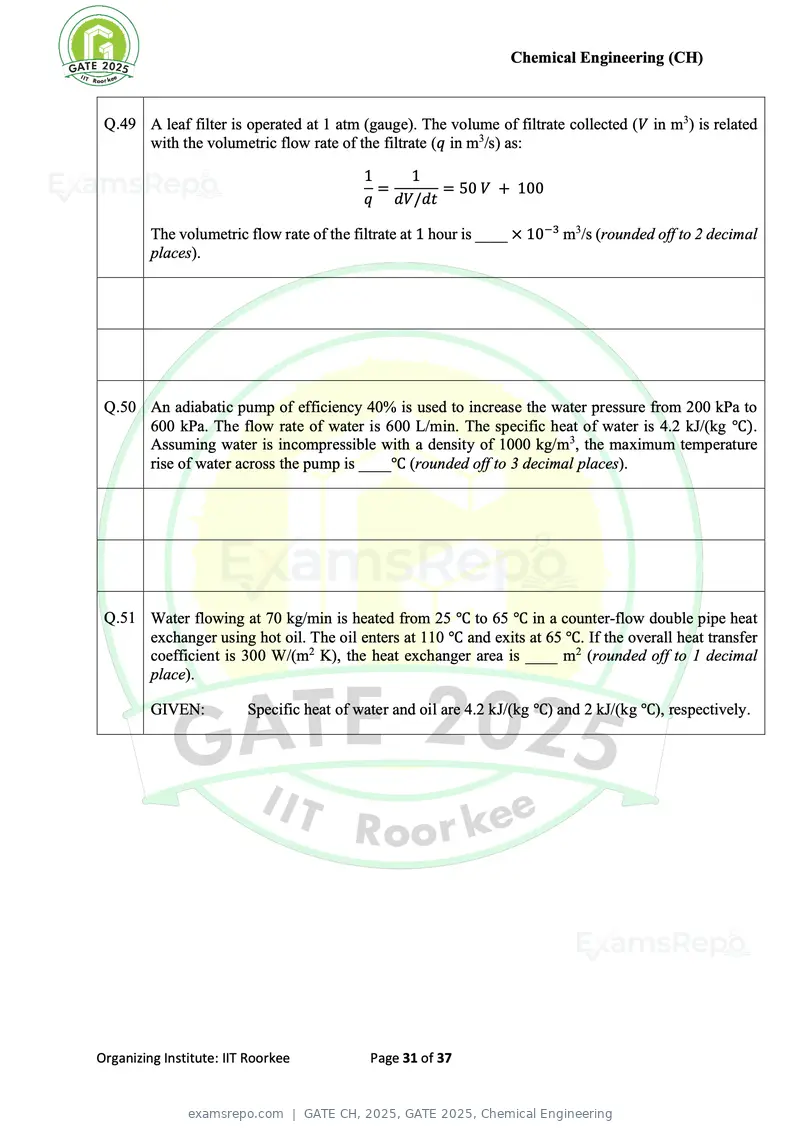
Text of page 31
Chemical Engineering (CH)


 Q.49 A leaf filter is operated at 1 atm (gauge). The volume of filtrate collected (V in m3) is related
      with the volumetric flow rate of the filtrate (q in m3/s) as:

                                           1   1
                                             =     = 50 V + 100
                                           q dV/dt

         The volumetric flow rate of the filtrate at 1 hour is ____ × 10−3 m3/s (rounded off to 2 decimal
         places).


 Q.50 An adiabatic pump of efficiency 40% is used to increase the water pressure from 200 kPa to
      600 kPa. The flow rate of water is 600 L/min. The specific heat of water is 4.2 kJ/(kg ℃).
      Assuming water is incompressible with a density of 1000 kg/m3, the maximum temperature
      rise of water across the pump is ____℃ (rounded off to 3 decimal places).


 Q.51 Water flowing at 70 kg/min is heated from 25 ℃ to 65 ℃ in a counter-flow double pipe heat
      exchanger using hot oil. The oil enters at 110 ℃ and exits at 65 ℃. If the overall heat transfer
      coefficient is 300 W/(m2 K), the heat exchanger area is ____ m2 (rounded off to 1 decimal
      place).

         GIVEN:          Specific heat of water and oil are 4.2 kJ/(kg ℃) and 2 kJ/(kg ℃), respectively.


Organizing Institute: IIT Roorkee           Page 31 of 37
Text of page 32
Chemical Engineering (CH)


 Q.52 Consider laminar flow of water over a wide flat plate maintained at a uniform temperature of
      50 °C as shown in the figure. The freestream velocity and temperature of water are 1.0 m/s
      (parallel to the plate) and 20 ℃, respectively. The distance x from the leading edge, at which
      the thermal boundary layer thickness δT = 0.01 m, is ____ m (rounded off to 1 decimal place).


         GIVEN:          kinematic viscosity: ν = 1.0 × 10⁻⁶ m2/s

                         Prandtl number: Pr = 7.01
                                                                   4.91x
                         velocity boundary layer thickness: δH =       Vx
                                                                   √
                                                                        ν


 Q.53 An electrical wire of 2 mm diameter and 5 m length is insulated with a plastic layer of thickness
      2 mm and thermal conductivity k = 0.1 W/(m K). It is exposed to ambient air at 30 °C. For a
      current of 5 A, the potential drop across the wire is 2 V. The air-side heat transfer coefficient
      is 20 W/(m2 K). Neglecting the thermal resistance of the wire, the steady state temperature at
      the wire-insulation interface is ____°C (rounded off to 1 decimal place).


 Q.54 A binary AB liquid mixture containing 30 mol% A is subjected to differential (Rayleigh)
      distillation at atmospheric pressure in order to recover 60 mol% A in the distillate. Assuming a
      constant relative volatility αAB = 2.2, the average composition of the collected distillate
      is ____ mol% A (rounded off to nearest integer).


Organizing Institute: IIT Roorkee          Page 32 of 37
Text of page 33
Chemical Engineering (CH)


 Q.55 Gas containing 0.8 mol% component A is to be scrubbed with pure water in a packed bed
      column to reduce the concentration of A to 0.1 mol% in the exit gas. The inlet gas and water
      flow rates are 0.1 kmol/s and 3.0 kmol/s, respectively.

         For the dilute system, both the operating and equilibrium curves are considered linear. If the
         slope of the equilibrium line is 24, the number of transfer units, based on the gas side,
         NOG is ____ (rounded off to 1 decimal place).


 Q.56 Solute A is absorbed from a gas into water in a packed bed operating at steady state. The
      absorber operating pressure and temperature are 1 atm and 300 K, respectively. At the
      gas-liquid interface

                                                     yi = 1.5 xi

         where yi and xi are the interfacial gas and liquid mole fractions of A, respectively. At a
         particular location in the absorber, the mole fractions of A in the bulk gas and in the bulk water
         are 0.02 and 0.002, respectively. If the ratio of the local individual mass transfer coefficients
                                                                                                    ky
         for the transport of A on the gas-side (ky ) to that on the water-side (kx ), k = 2,
                                                                                                    x
         then yi equals ____ (rounded off to 3 decimal places).


 Q.57 Components A and B form an azeotrope. The saturation vapour pressures of A and B at the
      boiling temperature of the azeotrope are 87 kPa and 72.7 kPa, respectively. The azeotrope
      composition is ____ mol% A (rounded off to the nearest integer).

         GIVEN:
                                                   γA
                                              ln      = 0.9(xB2 − xA2 )
                                                   γB

         where xi and γi are the liquid phase mole fraction and activity coefficient of component i,
         respectively.


Organizing Institute: IIT Roorkee           Page 33 of 37
Text of page 34
Chemical Engineering (CH)


 Q.58 The reaction A → products with reaction rate, (−rA ) = kCA3 , occurs in an isothermal PFR
      operating at steady state. The conversion (X) at two axial locations (1 and 2) of the PFR is
      shown in the figure.


         The value of l1 /l2 is ____ (rounded off to 2 decimal places).


 Q.59 The catalytic gas phase reaction A → products is carried out in an isothermal batch reactor of
      10 L volume using 0.1 kg of a solid catalyst. The reaction is first-order with

                                               (−rA ) = k ′ a(t)CA

         where

                                                             L
                                            k′ = 1
                                                      (kg catalyst)(h)

         and CA is the concentration of A in mol/L.

         The catalyst activity a(t) undergoes first-order decay with rate constant kd = 0.01 per hour and
         a(0) = 1.

         The reactant conversion after 1 day of operation is ____ (rounded off to 2 decimal places).


Organizing Institute: IIT Roorkee          Page 34 of 37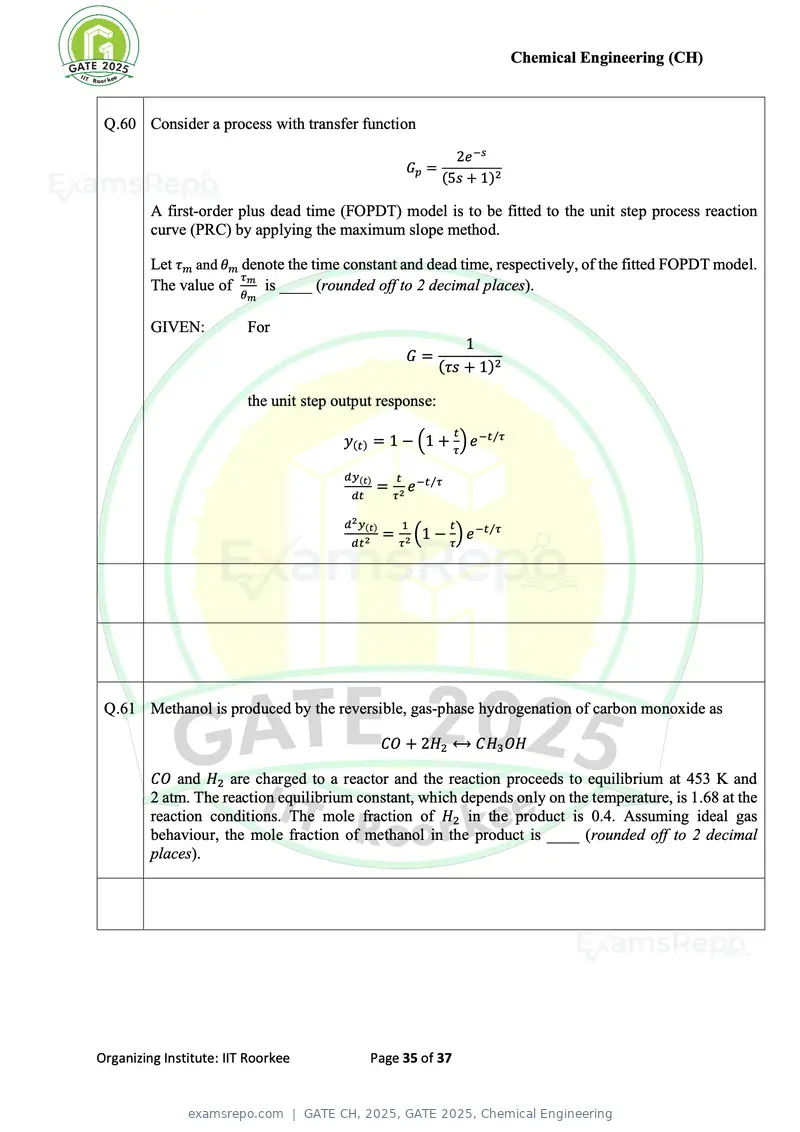
Text of page 35
Chemical Engineering (CH)


 Q.60 Consider a process with transfer function

                                                               2e −s
                                                        Gp =
                                                             (5s + 1)2

         A first-order plus dead time (FOPDT) model is to be fitted to the unit step process reaction
         curve (PRC) by applying the maximum slope method.

         Let τm and θm denote the time constant and dead time, respectively, of the fitted FOPDT model.
                       τ
         The value of θm is ____ (rounded off to 2 decimal places).
                         m


         GIVEN:          For
                                                                 1
                                                        G=
                                                             (τs + 1)2

                         the unit step output response:
                                                                t
                                        y(t) = 1 − (1 + τ) e −t⁄τ

                                        dy(t)       t
                                                = τ2 e −t⁄τ
                                         dt

                                        d2 y(t)         1     t
                                                  = τ2 (1 − τ) e −t⁄τ
                                         dt 2


 Q.61 Methanol is produced by the reversible, gas-phase hydrogenation of carbon monoxide as

                                                  CO + 2H2 ⟷ CH3 OH

         CO and H2 are charged to a reactor and the reaction proceeds to equilibrium at 453 K and
         2 atm. The reaction equilibrium constant, which depends only on the temperature, is 1.68 at the
         reaction conditions. The mole fraction of H2 in the product is 0.4. Assuming ideal gas
         behaviour, the mole fraction of methanol in the product is ____ (rounded off to 2 decimal
         places).


Organizing Institute: IIT Roorkee               Page 35 of 37
Text of page 36
Chemical Engineering (CH)


 Q.62 The block diagram of a series cascade control system (with time in minutes) is shown in the
      figure. For τI = 8 min and Kcs = 1, the maximum value of Kcm , below which the cascade control
      system is stable, is ____ (rounded off to the nearest integer).


 Q.63 It is proposed to install thermal insulation in a residence to save on the summer-monsoon
      season air-conditioning costs. The estimated yearly saving is 20 thousand rupees. The cost of
      installation of the insulation is 150 thousand rupees. The life of the insulation is 12 years. For
      a compound interest rate of 9% per annum, the minimum salvage value of the insulation for
      which the proposal is competitive, is ____ thousand rupees (rounded off to nearest integer).


Organizing Institute: IIT Roorkee         Page 36 of 37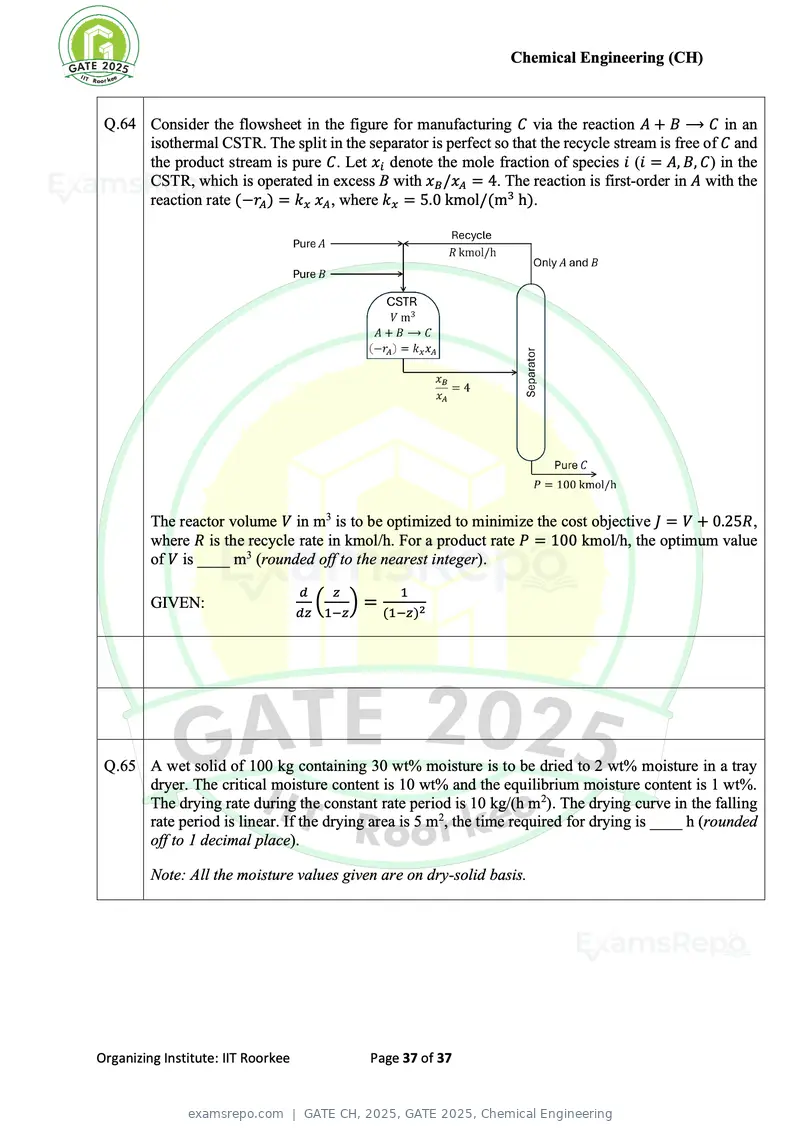
Text of page 37
Chemical Engineering (CH)


 Q.64 Consider the flowsheet in the figure for manufacturing C via the reaction A + B ⟶ C in an
      isothermal CSTR. The split in the separator is perfect so that the recycle stream is free of C and
      the product stream is pure C. Let xi denote the mole fraction of species i (i = A, B, C) in the
      CSTR, which is operated in excess B with xB /xA = 4. The reaction is first-order in A with the
      reaction rate (−rA ) = kx xA , where kx = 5.0 kmol/(m3 h).


         The reactor volume V in m3 is to be optimized to minimize the cost objective J = V + 0.25R,
         where R is the recycle rate in kmol/h. For a product rate P = 100 kmol/h, the optimum value
         of V is ____ m3 (rounded off to the nearest integer).

                                    d   z       1
         GIVEN:                       ( ) = (1−z)2
                                    dz 1−z


 Q.65 A wet solid of 100 kg containing 30 wt% moisture is to be dried to 2 wt% moisture in a tray
      dryer. The critical moisture content is 10 wt% and the equilibrium moisture content is 1 wt%.
      The drying rate during the constant rate period is 10 kg/(h m2). The drying curve in the falling
      rate period is linear. If the drying area is 5 m2, the time required for drying is ____ h (rounded
      off to 1 decimal place).

         Note: All the moisture values given are on dry-solid basis.


Organizing Institute: IIT Roorkee           Page 37 of 37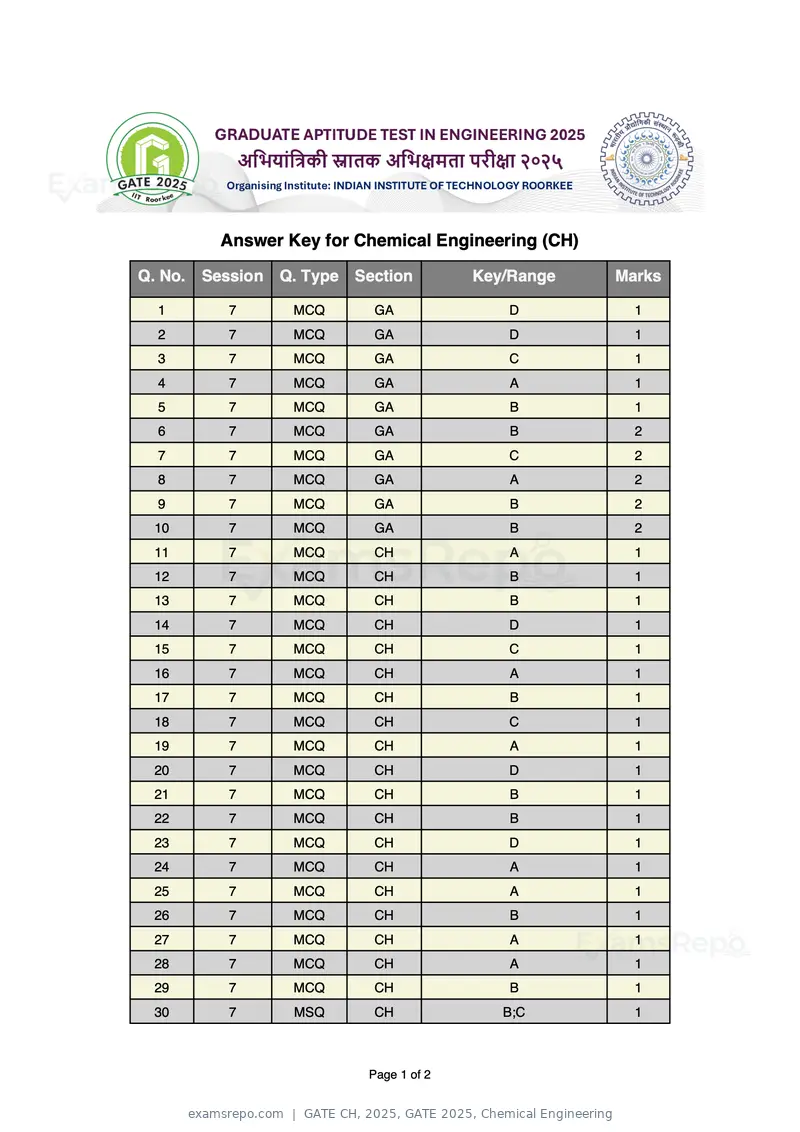
Text of page 1
Answer Key for Chemical Engineering (CH)

Q. No. Session   Q. Type   Section        Key/Range   Marks

  1       7       MCQ        GA              D          1
  2       7       MCQ        GA              D          1
  3       7       MCQ        GA              C          1
  4       7       MCQ        GA               A         1
  5       7       MCQ        GA               B         1
  6       7       MCQ        GA               B         2
  7       7       MCQ        GA              C          2
  8       7       MCQ        GA               A         2
  9       7       MCQ        GA               B         2
 10       7       MCQ        GA               B         2
 11       7       MCQ        CH               A         1
 12       7       MCQ        CH               B         1
 13       7       MCQ        CH               B         1
 14       7       MCQ        CH              D          1
 15       7       MCQ        CH              C          1
 16       7       MCQ        CH               A         1
 17       7       MCQ        CH               B         1
 18       7       MCQ        CH              C          1
 19       7       MCQ        CH               A         1
 20       7       MCQ        CH              D          1
 21       7       MCQ        CH               B         1
 22       7       MCQ        CH               B         1
 23       7       MCQ        CH              D          1
 24       7       MCQ        CH               A         1
 25       7       MCQ        CH               A         1
 26       7       MCQ        CH               B         1
 27       7       MCQ        CH               A         1
 28       7       MCQ        CH               A         1
 29       7       MCQ        CH               B         1
 30       7       MSQ        CH              B;C        1


                            Page 1 of 2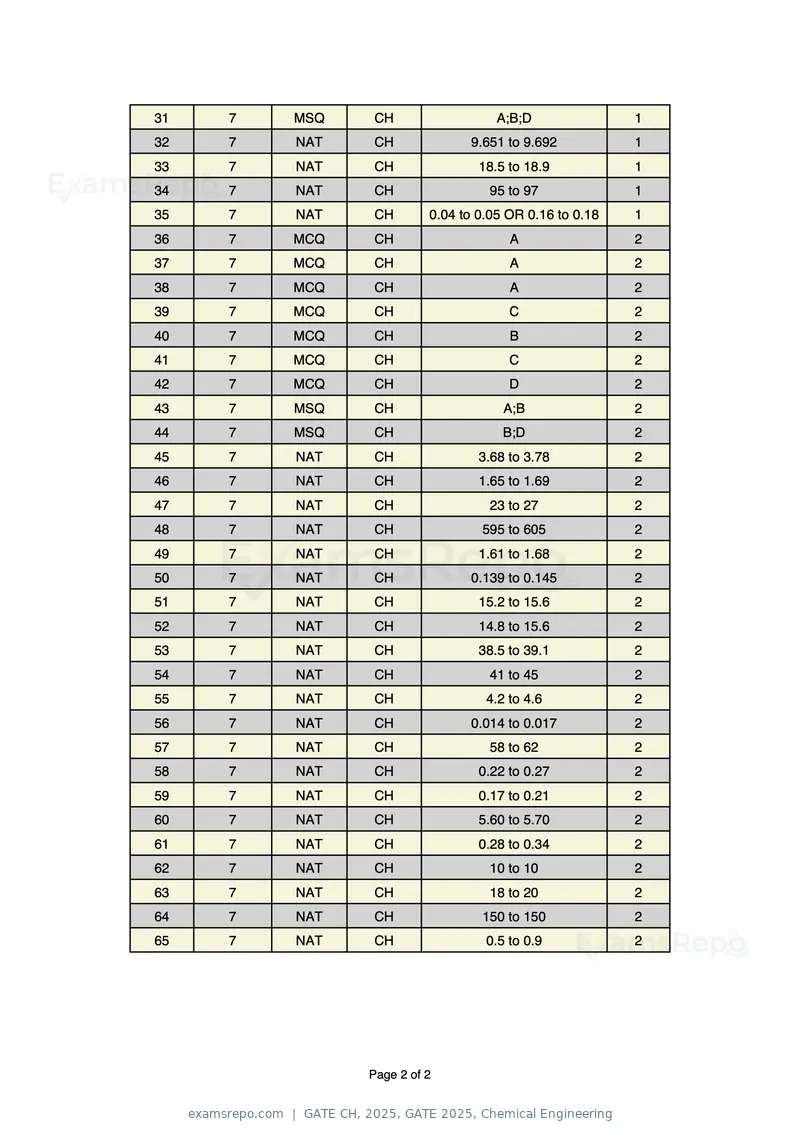
Text of page 2
31   7   MSQ   CH                   A;B;D               1
32   7   NAT   CH              9.651 to 9.692           1
33   7   NAT   CH                18.5 to 18.9           1
34   7   NAT   CH                 95 to 97              1
35   7   NAT   CH        0.04 to 0.05 OR 0.16 to 0.18   1
36   7   MCQ   CH                     A                 2
37   7   MCQ   CH                     A                 2
38   7   MCQ   CH                     A                 2
39   7   MCQ   CH                     C                 2
40   7   MCQ   CH                     B                 2
41   7   MCQ   CH                     C                 2
42   7   MCQ   CH                     D                 2
43   7   MSQ   CH                    A;B                2
44   7   MSQ   CH                    B;D                2
45   7   NAT   CH                3.68 to 3.78           2
46   7   NAT   CH                1.65 to 1.69           2
47   7   NAT   CH                 23 to 27              2
48   7   NAT   CH                595 to 605             2
49   7   NAT   CH                1.61 to 1.68           2
50   7   NAT   CH              0.139 to 0.145           2
51   7   NAT   CH                15.2 to 15.6           2
52   7   NAT   CH                14.8 to 15.6           2
53   7   NAT   CH                38.5 to 39.1           2
54   7   NAT   CH                 41 to 45              2
55   7   NAT   CH                 4.2 to 4.6            2
56   7   NAT   CH              0.014 to 0.017           2
57   7   NAT   CH                 58 to 62              2
58   7   NAT   CH                0.22 to 0.27           2
59   7   NAT   CH                0.17 to 0.21           2
60   7   NAT   CH                5.60 to 5.70           2
61   7   NAT   CH                0.28 to 0.34           2
62   7   NAT   CH                 10 to 10              2
63   7   NAT   CH                 18 to 20              2
64   7   NAT   CH                150 to 150             2
65   7   NAT   CH                 0.5 to 0.9            2


               Page 2 of 2
Page 1 of 37
Source: GATE. Question paper published by GATE.