
WB SET Exam 2017: 20th SET, Paper II, Commerce
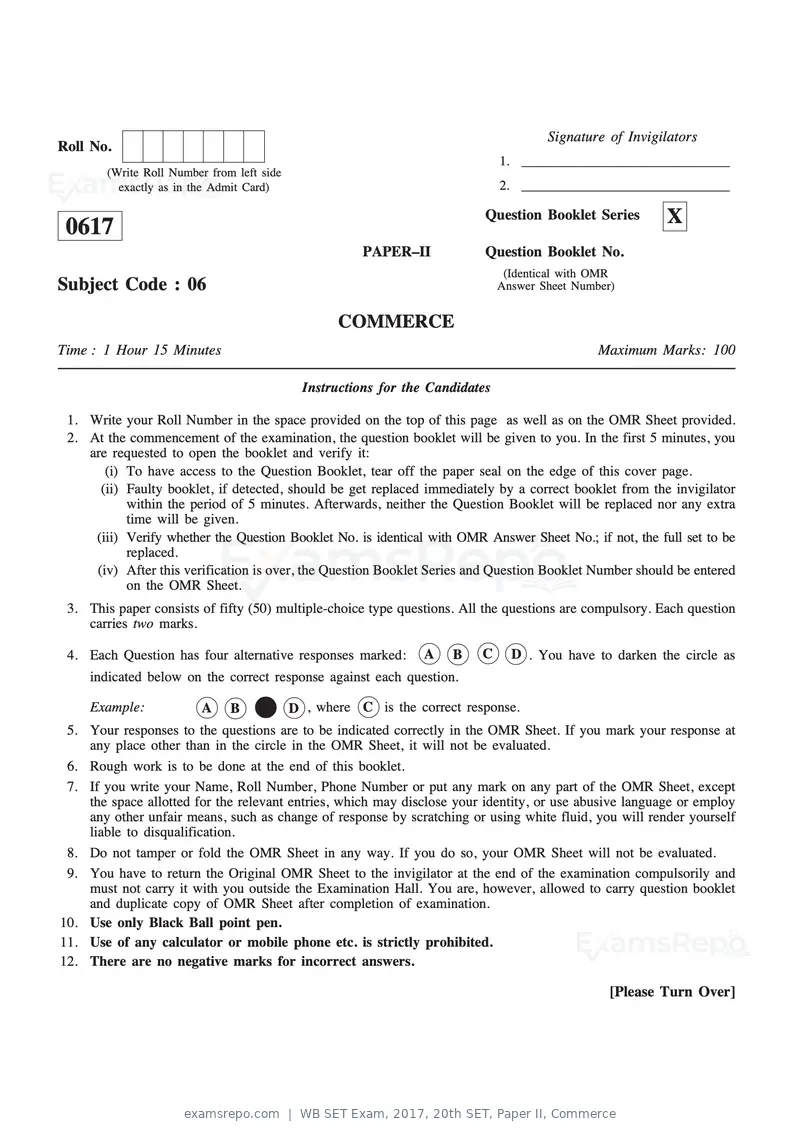
Text of page 1
Signature of Invigilators
Roll No.
                                                                                1. _______________________________
        (Write Roll Number from left side
          exactly as in the Admit Card)                                         2. _______________________________

                                                                            Question Booklet Series        X
 0617
                                                       PAPER–II             Question Booklet No.
                                                                                 (Identical with OMR
Subject Code : 06                                                               Answer Sheet Number)


                                                   COMMERCE
Time : 1 Hour 15 Minutes                                                                         Maximum Marks: 100

                                              Instructions for the Candidates

 1. Write your Roll Number in the space provided on the top of this page as well as on the OMR Sheet provided.
 2. At the commencement of the examination, the question booklet will be given to you. In the first 5 minutes, you
    are requested to open the booklet and verify it:
       (i) To have access to the Question Booklet, tear off the paper seal on the edge of this cover page.
      (ii) Faulty booklet, if detected, should be get replaced immediately by a correct booklet from the invigilator
           within the period of 5 minutes. Afterwards, neither the Question Booklet will be replaced nor any extra
           time will be given.
     (iii) Verify whether the Question Booklet No. is identical with OMR Answer Sheet No.; if not, the full set to be
           replaced.
     (iv) After this verification is over, the Question Booklet Series and Question Booklet Number should be entered
           on the OMR Sheet.
 3. This paper consists of fifty (50) multiple-choice type questions. All the questions are compulsory. Each question
    carries two marks.

 4. Each Question has four alternative responses marked:          A   B    C      D . You have to darken the circle as
     indicated below on the correct response against each question.

     Example:            A     B     C      D , where C is the correct response.
 5. Your responses to the questions are to be indicated correctly in the OMR Sheet. If you mark your response at
    any place other than in the circle in the OMR Sheet, it will not be evaluated.
 6. Rough work is to be done at the end of this booklet.
 7. If you write your Name, Roll Number, Phone Number or put any mark on any part of the OMR Sheet, except
    the space allotted for the relevant entries, which may disclose your identity, or use abusive language or employ
    any other unfair means, such as change of response by scratching or using white fluid, you will render yourself
    liable to disqualification.
 8. Do not tamper or fold the OMR Sheet in any way. If you do so, your OMR Sheet will not be evaluated.
 9. You have to return the Original OMR Sheet to the invigilator at the end of the examination compulsorily and
    must not carry it with you outside the Examination Hall. You are, however, allowed to carry question booklet
    and duplicate copy of OMR Sheet after completion of examination.
10. Use only Black Ball point pen.
11. Use of any calculator or mobile phone etc. is strictly prohibited.
12. There are no negative marks for incorrect answers.

                                                                                                   [Please Turn Over]
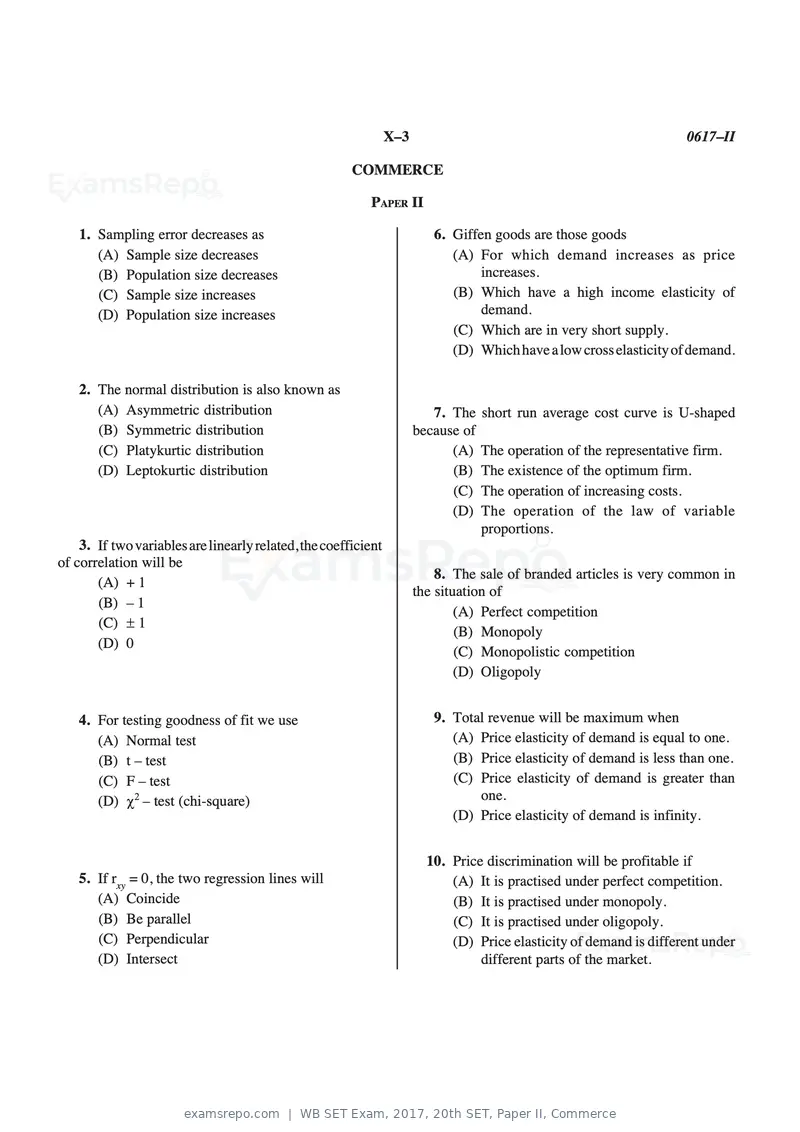
Text of page 3
X–3 0617–II
COMMERCE
PAPER II
1. Sampling error decreases as 6. Giffen goods are those goods
(A) Sample size decreases (A) For which demand increases as price
(B) Population size decreases increases.
(C) Sample size increases (B) Which have a high income elasticity of
(D) Population size increases demand.
(C) Which are in very short supply.
(D) Which have a low cross elasticity of demand.
2. The normal distribution is also known as
(A) Asymmetric distribution 7. The short run average cost curve is U-shaped
(B) Symmetric distribution because of
(C) Platykurtic distribution (A) The operation of the representative firm.
(D) Leptokurtic distribution (B) The existence of the optimum firm.
(C) The operation of increasing costs.
(D) The operation of the law of variable
proportions.
3. If two variables are linearly related, the coefficient
of correlation will be
8. The sale of branded articles is very common in
(A) + 1
the situation of
(B) – 1
(A) Perfect competition
(C) 1
(B) Monopoly
(D) 0
(C) Monopolistic competition
(D) Oligopoly
4. For testing goodness of fit we use 9. Total revenue will be maximum when
(A) Normal test (A) Price elasticity of demand is equal to one.
(B) t – test (B) Price elasticity of demand is less than one.
(C) F – test (C) Price elasticity of demand is greater than
(D) – test (chi-square) one.
(D) Price elasticity of demand is infinity.
10. Price discrimination will be profitable if
5. If rxy = 0, the two regression lines will (A) It is practised under perfect competition.
(A) Coincide (B) It is practised under monopoly.
(B) Be parallel (C) It is practised under oligopoly.
(C) Perpendicular (D) Price elasticity of demand is different under
(D) Intersect different parts of the market.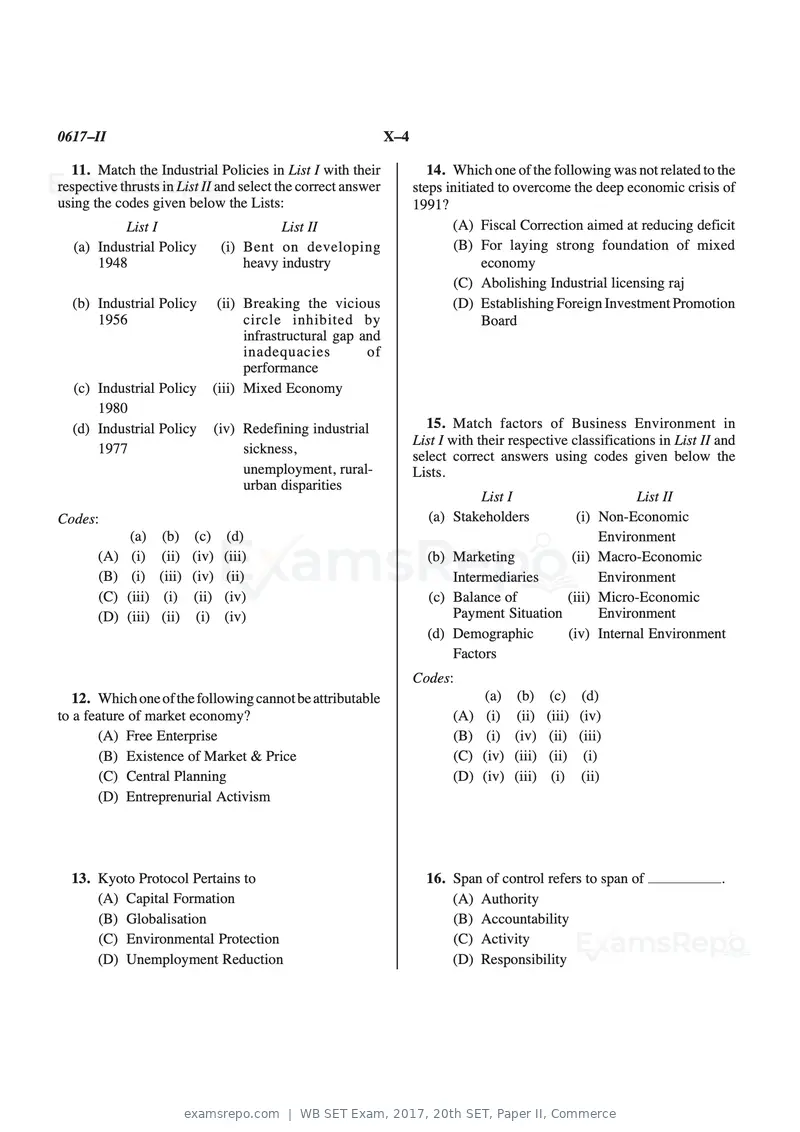
Text of page 4
0617–II                                                       X–4

  11. Match the Industrial Policies in List I with their               14. Which one of the following was not related to the
respective thrusts in List II and select the correct answer         steps initiated to overcome the deep economic crisis of
using the codes given below the Lists:                              1991?
          List I                       List II                             (A) Fiscal Correction aimed at reducing deficit
  (a) Industrial Policy      (i) Bent on developing                        (B) For laying strong foundation of mixed
      1948                       heavy industry                                  economy
                                                                           (C) Abolishing Industrial licensing raj
  (b) Industrial Policy      (ii) Breaking the vicious                     (D) Establishing Foreign Investment Promotion
      1956                        circle inhibited by                            Board
                                  infrastructural gap and
                                  inadequacies         of
                                  performance
  (c) Industrial Policy     (iii) Mixed Economy
      1980
  (d) Industrial Policy     (iv) Redefining industrial                15. Match factors of Business Environment in
                                                                    List I with their respective classifications in List II and
      1977                       sickness,
                                                                    select correct answers using codes given below the
                                 unemployment, rural-               Lists.
                                 urban disparities
                                                                              List I                    List II
Codes:                                                                (a) Stakeholders        (i) Non-Economic
            (a) (b) (c) (d)                                                                       Environment
       (A) (i) (ii) (iv) (iii)                                        (b) Marketing          (ii) Macro-Economic
       (B) (i) (iii) (iv) (ii)                                            Intermediaries          Environment
       (C) (iii) (i) (ii) (iv)                                        (c) Balance of        (iii) Micro-Economic
       (D) (iii) (ii) (i) (iv)                                            Payment Situation       Environment
                                                                      (d) Demographic       (iv) Internal Environment
                                                                          Factors
                                                                    Codes:
   12. Which one of the following cannot be attributable                       (a) (b) (c) (d)
to a feature of market economy?                                            (A) (i) (ii) (iii) (iv)
       (A) Free Enterprise                                                 (B) (i) (iv) (ii) (iii)
        (B) Existence of Market & Price                                    (C) (iv) (iii) (ii) (i)
        (C) Central Planning                                               (D) (iv) (iii) (i) (ii)
       (D) Entreprenurial Activism


  13. Kyoto Protocol Pertains to                                      16. Span of control refers to span of                 .
      (A) Capital Formation                                               (A) Authority
      (B) Globalisation                                                   (B) Accountability
      (C) Environmental Protection                                        (C) Activity
      (D) Unemployment Reduction                                          (D) Responsibility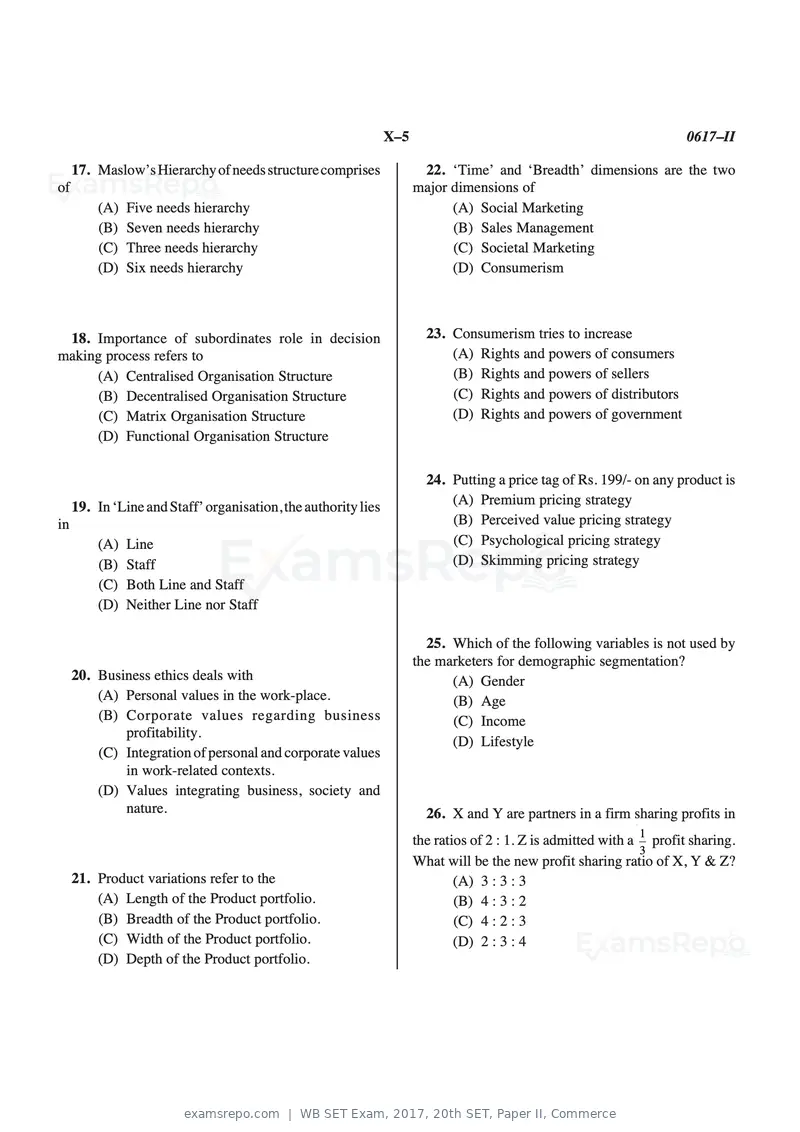
Text of page 5
X–5                                                   0617–II

     17. Maslow’s Hierarchy of needs structure comprises               22. ‘Time’ and ‘Breadth’ dimensions are the two
of                                                                    major dimensions of
         (A) Five needs hierarchy                                           (A) Social Marketing
         (B) Seven needs hierarchy                                          (B) Sales Management
         (C) Three needs hierarchy                                          (C) Societal Marketing
         (D) Six needs hierarchy                                            (D) Consumerism


 18. Importance of subordinates role in decision                        23. Consumerism tries to increase
making process refers to                                                    (A) Rights and powers of consumers
     (A) Centralised Organisation Structure                                 (B) Rights and powers of sellers
     (B) Decentralised Organisation Structure                               (C) Rights and powers of distributors
     (C) Matrix Organisation Structure                                      (D) Rights and powers of government
     (D) Functional Organisation Structure

                                                                        24. Putting a price tag of Rs. 199/- on any product is
     19. In ‘Line and Staff’ organisation, the authority lies               (A) Premium pricing strategy
in                                                                          (B) Perceived value pricing strategy
         (A) Line                                                           (C) Psychological pricing strategy
         (B) Staff                                                          (D) Skimming pricing strategy
         (C) Both Line and Staff
         (D) Neither Line nor Staff

                                                                        25. Which of the following variables is not used by
                                                                      the marketers for demographic segmentation?
     20. Business ethics deals with                                         (A) Gender
         (A) Personal values in the work-place.                             (B) Age
         (B) Corporate values regarding business                            (C) Income
             profitability.
                                                                            (D) Lifestyle
         (C) Integration of personal and corporate values
             in work-related contexts.
         (D) Values integrating business, society and
             nature.                                                    26. X and Y are partners in a firm sharing profits in
                                                                                                              1
                                                                      the ratios of 2 : 1. Z is admitted with a profit sharing.
                                                                                                               3
                                                                      What will be the new profit sharing ratio of X, Y & Z?
     21. Product variations refer to the                                      (A) 3 : 3 : 3
         (A) Length of the Product portfolio.                                 (B) 4 : 3 : 2
         (B) Breadth of the Product portfolio.                                (C) 4 : 2 : 3
         (C) Width of the Product portfolio.                                  (D) 2 : 3 : 4
         (D) Depth of the Product portfolio.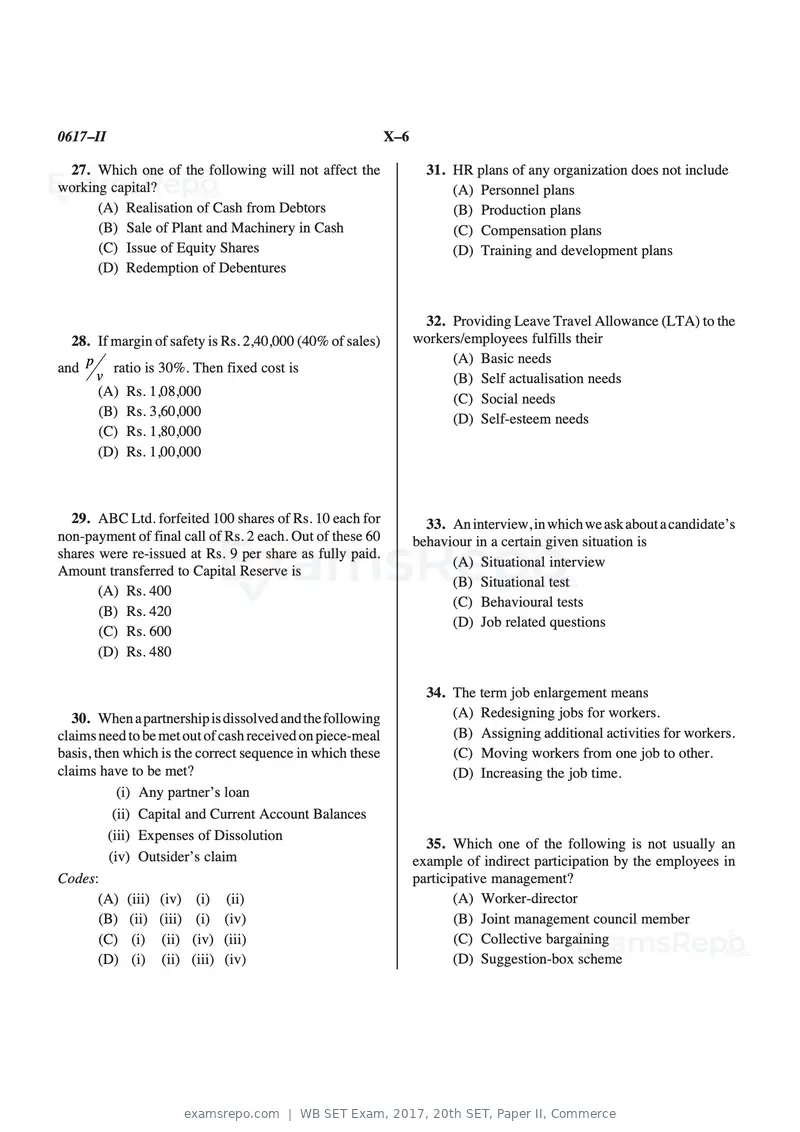
Text of page 6
0617–II                                                    X–6

 27. Which one of the following will not affect the                31. HR plans of any organization does not include
working capital?                                                       (A) Personnel plans
      (A) Realisation of Cash from Debtors                             (B) Production plans
      (B) Sale of Plant and Machinery in Cash                          (C) Compensation plans
      (C) Issue of Equity Shares                                       (D) Training and development plans
      (D) Redemption of Debentures


                                                                  32. Providing Leave Travel Allowance (LTA) to the
  28. If margin of safety is Rs. 2,40,000 (40% of sales)         workers/employees fulfills their
                                                                       (A) Basic needs
and p ratio is 30%. Then fixed cost is
      v                                                                (B) Self actualisation needs
      (A) Rs. 1,08,000
                                                                       (C) Social needs
      (B) Rs. 3,60,000
                                                                       (D) Self-esteem needs
      (C) Rs. 1,80,000
      (D) Rs. 1,00,000


  29. ABC Ltd. forfeited 100 shares of Rs. 10 each for             33. An interview, in which we ask about a candidate’s
non-payment of final call of Rs. 2 each. Out of these 60         behaviour in a certain given situation is
shares were re-issued at Rs. 9 per share as fully paid.
                                                                       (A) Situational interview
Amount transferred to Capital Reserve is
                                                                       (B) Situational test
       (A) Rs. 400
                                                                       (C) Behavioural tests
       (B) Rs. 420
                                                                       (D) Job related questions
       (C) Rs. 600
       (D) Rs. 480

                                                                   34. The term job enlargement means
  30. When a partnership is dissolved and the following                (A) Redesigning jobs for workers.
claims need to be met out of cash received on piece-meal               (B) Assigning additional activities for workers.
basis, then which is the correct sequence in which these               (C) Moving workers from one job to other.
claims have to be met?                                                 (D) Increasing the job time.
            (i) Any partner’s loan
           (ii) Capital and Current Account Balances
         (iii) Expenses of Dissolution
                                                                   35. Which one of the following is not usually an
          (iv) Outsider’s claim                                  example of indirect participation by the employees in
Codes:                                                           participative management?
        (A) (iii) (iv) (i) (ii)                                         (A) Worker-director
        (B) (ii) (iii) (i) (iv)                                         (B) Joint management council member
        (C) (i) (ii) (iv) (iii)                                         (C) Collective bargaining
        (D) (i) (ii) (iii) (iv)                                         (D) Suggestion-box scheme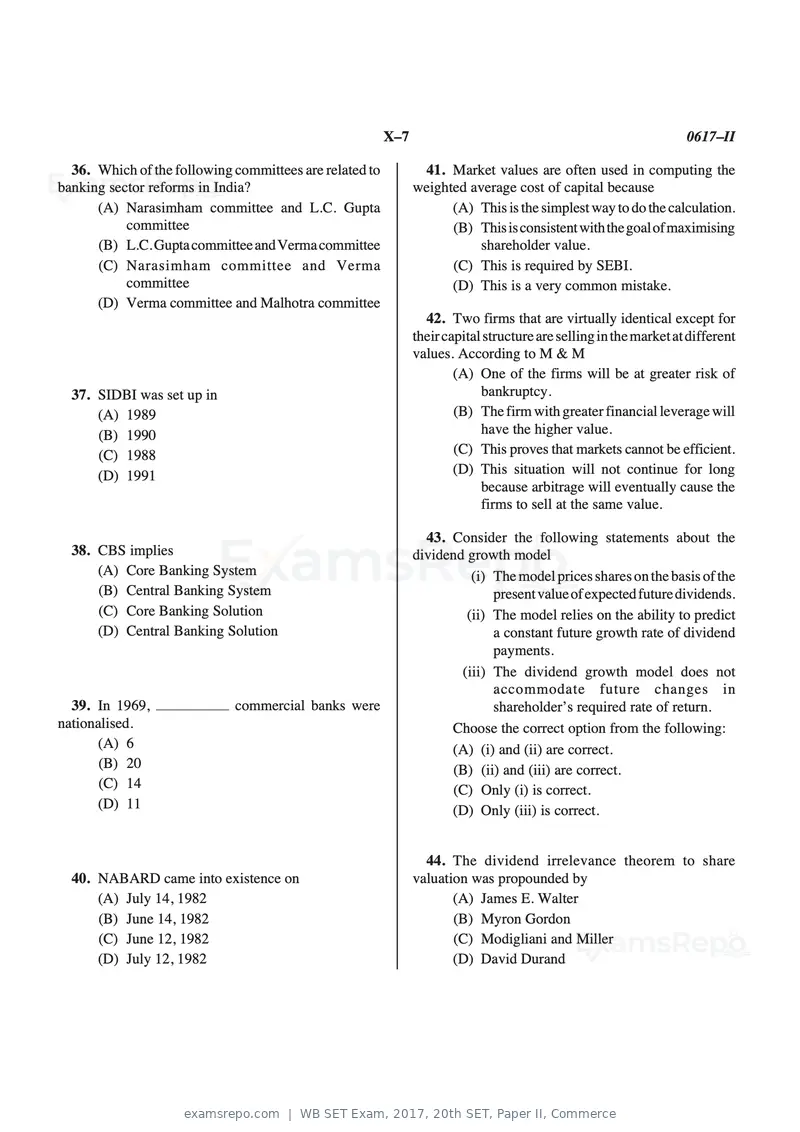
Text of page 7
X–7                                                       0617–II

  36. Which of the following committees are related to          41. Market values are often used in computing the
banking sector reforms in India?                               weighted average cost of capital because
      (A) Narasimham committee and L.C. Gupta                        (A) This is the simplest way to do the calculation.
           committee                                                 (B) This is consistent with the goal of maximising
      (B) L.C. Gupta committee and Verma committee                        shareholder value.
      (C) Narasimham committee and Verma                             (C) This is required by SEBI.
           committee                                                 (D) This is a very common mistake.
      (D) Verma committee and Malhotra committee
                                                                 42. Two firms that are virtually identical except for
                                                               their capital structure are selling in the market at different
                                                               values. According to M & M
                                                                       (A) One of the firms will be at greater risk of
  37. SIDBI was set up in                                                   bankruptcy.
      (A) 1989                                                         (B) The firm with greater financial leverage will
      (B) 1990                                                              have the higher value.
      (C) 1988                                                         (C) This proves that markets cannot be efficient.
      (D) 1991                                                         (D) This situation will not continue for long
                                                                            because arbitrage will eventually cause the
                                                                            firms to sell at the same value.

                                                                 43. Consider the following statements about the
  38. CBS implies                                              dividend growth model
      (A) Core Banking System                                            (i) The model prices shares on the basis of the
      (B) Central Banking System                                             present value of expected future dividends.
      (C) Core Banking Solution                                         (ii) The model relies on the ability to predict
      (D) Central Banking Solution                                           a constant future growth rate of dividend
                                                                             payments.
                                                                       (iii) The dividend growth model does not
                                                                             accommodate future changes in
  39. In 1969,               commercial banks were                           shareholder’s required rate of return.
nationalised.                                                        Choose the correct option from the following:
      (A) 6                                                          (A) (i) and (ii) are correct.
       (B) 20                                                        (B) (ii) and (iii) are correct.
       (C) 14                                                        (C) Only (i) is correct.
      (D) 11                                                         (D) Only (iii) is correct.


                                                                 44. The dividend irrelevance theorem to share
  40. NABARD came into existence on                            valuation was propounded by
      (A) July 14, 1982                                               (A) James E. Walter
      (B) June 14, 1982                                               (B) Myron Gordon
      (C) June 12, 1982                                               (C) Modigliani and Miller
      (D) July 12, 1982                                               (D) David Durand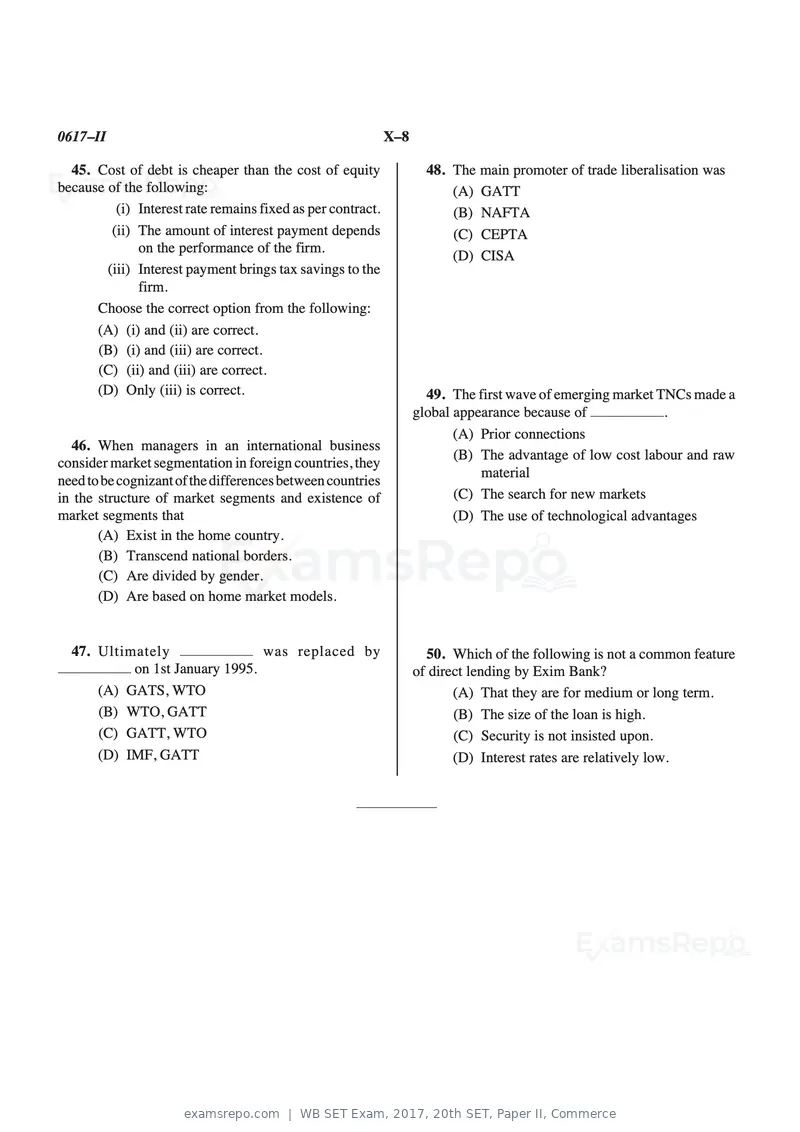
Text of page 8
0617–II                                                      X–8

  45. Cost of debt is cheaper than the cost of equity                48. The main promoter of trade liberalisation was
because of the following:                                                (A) GATT
          (i) Interest rate remains fixed as per contract.               (B) NAFTA
         (ii) The amount of interest payment depends                     (C) CEPTA
              on the performance of the firm.
                                                                         (D) CISA
        (iii) Interest payment brings tax savings to the
              firm.
      Choose the correct option from the following:
      (A) (i) and (ii) are correct.
      (B) (i) and (iii) are correct.
      (C) (ii) and (iii) are correct.
      (D) Only (iii) is correct.                                     49. The first wave of emerging market TNCs made a
                                                                   global appearance because of             .
                                                                          (A) Prior connections
  46. When managers in an international business
                                                                          (B) The advantage of low cost labour and raw
consider market segmentation in foreign countries, they
                                                                              material
need to be cognizant of the differences between countries
in the structure of market segments and existence of                      (C) The search for new markets
market segments that                                                      (D) The use of technological advantages
       (A) Exist in the home country.
       (B) Transcend national borders.
       (C) Are divided by gender.
       (D) Are based on home market models.


  47. Ultimately                was replaced by                      50. Which of the following is not a common feature
           on 1st January 1995.                                    of direct lending by Exim Bank?
      (A) GATS, WTO                                                       (A) That they are for medium or long term.
      (B) WTO, GATT                                                       (B) The size of the loan is high.
      (C) GATT, WTO                                                       (C) Security is not insisted upon.
      (D) IMF, GATT                                                       (D) Interest rates are relatively low.
Text of page 9
X–9       0617–II

ROUGH WORK

Text of page 10
0617–II      X–10

          ROUGH WORK
Text of page 11
X–11      0617–II

ROUGH WORK

Text of page 12
0617–II      X–12

          ROUGH WORK
Official key not published for this paper.
Page 1 of 12
Source: West Bengal College Service Commission. Question paper published by West Bengal College Service Commission.