
TS SET 2013: Paper III, Philosophy
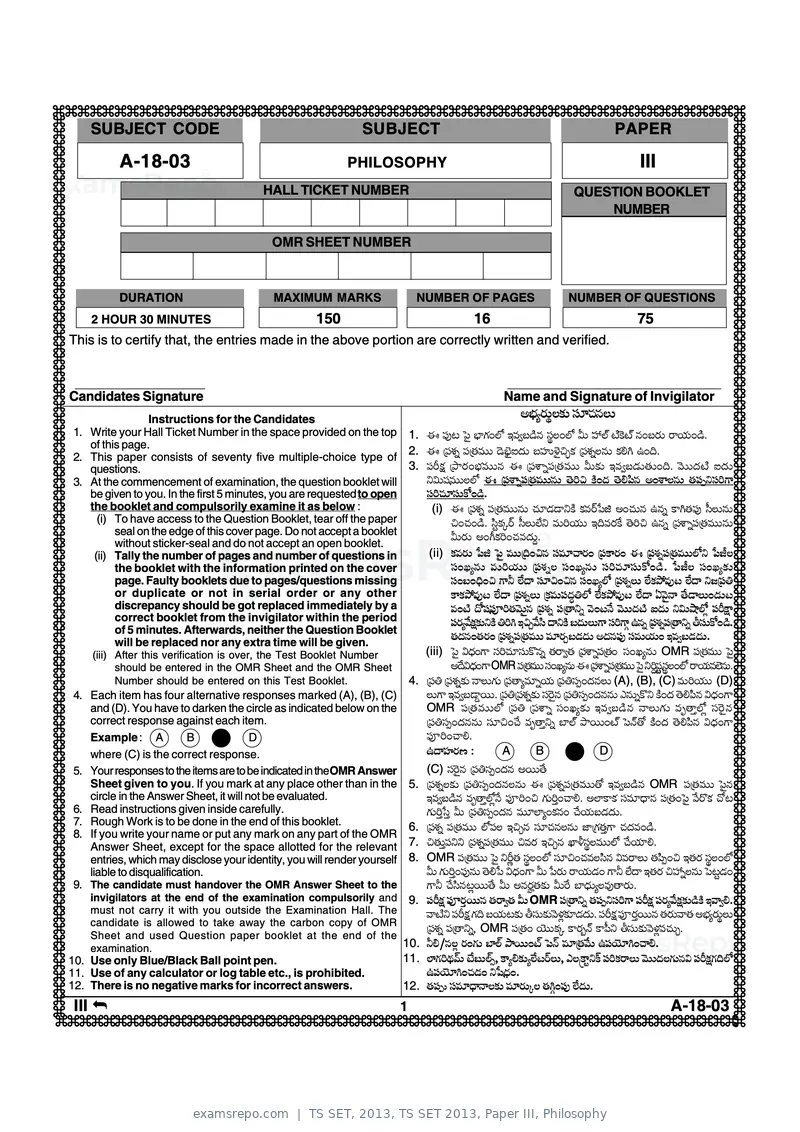
Text of page 1
aaaaaaaaaaaaaaaaaaaaaaaaaaaaaaaaaaaaaaaaaaaaaaaaaaaaaaaa
aaaaaaaaaaaaaaaaaaaaaaaaaaaaaaaaaaaaaaaaaaaaaaaaaaaaaaaaaaaaaaaaaaaaaaaaaaaa
aaaaaaaaaaaaaaaaaaaaaaaaaaaaaaaaaaaaaaaaaaaaaaaaaaaaaaaaaaaaaaaaaaaaaaaaaaaaaaa
SUBJECT CODE SUBJECT PAPER
A-18-03 PHILOSOPHY III
HALL TICKET NUMBER QUESTION BOOKLET
NUMBER
OMR SHEET NUMBER
DURATION MAXIMUM MARKS NUMBER OF PAGES NUMBER OF QUESTIONS
2 HOUR 30 MINUTES 150 16 75
This is to certify that, the entries made in the above portion are correctly written and verified.
Candidates Signature Name and Signature of Invigilator
Instructions for the Candidates A¿æýÅÆæÿ$¦ËMæü$ çÜ*^èþ¯èþË$
1. Write your Hall Ticket Number in the space provided on the top 1. D ç³#r ò³O ¿êVæü ÌZ CÐèþÓºyìþ¯èþ çÜ¦Ë ÌZ Ò$ çàÌý sìýMðüsý ¯èþ ºÆæÿ$ Æ>Äæý$ yìþ.
of this page.
2. D {ç³Ôèý² ç³{èþÐèþ$$ yðþ¿ñýOI§æþ$ ºçßý$âñýO_eMæü {ç³Ôèý²Ë¯èþ$ MæüÍW E ¨.
2. This paper consists of seventy five multiple-choice type of
questions. 3. ç³Èæü {´ëÆæÿ ¿æýÐèþ$$¯èþ D {ç³Ôé²ç³{èþÐèþ$$ Ò$Mæü$ CÐèþÓºyæþ$èþ$ ¨. Ððþ$$§æþsìý I§æþ$
3. At the commencement of examination, the question booklet will °Ñ$çÙÐèþ$$ËÌZ D {ç³Ôé²ç³{èþÐèþ$$¯èþ$ ðþÇ_ Mìü §æþ ðþÍí³¯èþ A Ôé˯èþ$ èþç³µ°çÜÇV>
be given to you. In the first 5 minutes, you are requested to open çÜÇ^èþ*çÜ$Mø yìþ.
the booklet and compulsorily examine it as below : (i) D {ç³Ôèý² ç³{èþÐèþ$$¯èþ$ ^èþ*yæþyé°Mìü MæüÐèþÆÿõ³h A ^èþ$¯èþ E¯èþ² M>Wèþç³# ïÜË$¯èþ$
(i) To have access to the Question Booklet, tear off the paper _ ^èþ yìþ. íÜtMæüPÆÿ ïÜË$Ìôý° Ðèþ$ÇÄæý$$ C¨ÐèþÆæÿMóü ðþÇ_ E¯èþ² {ç³Ôé²ç³{èþÐèþ$$¯èþ$
seal on the edge of this cover page. Do not accept a booklet Ò$Ææÿ$ A XMæüÇ ^èþÐèþ§æþ$ª.
without sticker-seal and do not accept an open booklet.
(ii) Tally the number of pages and number of questions in (ii) MæüÐèþÆæÿ$ õ³h ò³O Ðèþ$${¨ _¯èþ çÜÐèþ*^éÆæÿ {ç³M>Ææÿ D {ç³Ôèý²ç³{èþÐèþ$$ÌZ° õ³iË
the booklet with the information printed on the cover çÜ Qůèþ$ Ðèþ$ÇÄæý$$ {ç³Ôèý²Ë çÜ Qůèþ$ çÜÇ^èþ*çÜ$Mø yìþ. õ³iË çÜ QÅMæü$
page. Faulty booklets due to pages/questions missing çÜ º «¨ _ V>± Ìôý§é çÜ*_ _¯èþ çÜ QÅÌZ {ç³Ôèý²Ë$ ÌôýMæü´ùÐèþ#r Ìôý§é °f{ç³
or duplicate or not in serial order or any other M>Mæü´ùÐèþ#r Ìôý§é {ç³Ôèý²Ë$ {MæüÐèþ$糧æþ®ÌZ ÌôýMæü´ùÐèþ#r Ìôý§é HÐðþO¯é óþyéË$ yæþ$r
discrepancy should be got replaced immediately by a Ðèþ sìý §øçÙç³NÇèþÐðþ$O¯èþ {ç³Ôèý² ç³{é°² Ððþ r¯óþ Ððþ$$§æþsìý I§æþ$ °Ñ$ÚëÌZÏ ç³È>
correct booklet from the invigilator within the period ç³ÆæÿÅÐóþæüMæü$°Mìü ÇW C_aÐóþíÜ §é°Mìü º§æþ$Ë$V> çÜÇV>Y E¯èþ² {ç³Ôèý²ç³{é°² ¡çÜ$Mø yìþ.
of 5 minutes. Afterwards, neither the Question Booklet
will be replaced nor any extra time will be given.
èþ§æþ¯èþ èþÆæÿ {ç³Ôèý²ç³{èþÐèþ$$ Ðèþ*Ææÿaºyæþ§æþ$ A§æþ¯èþç³# çÜÐèþ$Äæý$ CÐèþÓºyæþ§æþ$.
(iii) After this verification is over, the Test Booklet Number (iii) ò³O Ñ«§æþ V> çÜÇ^èþ*çÜ$Mö¯èþ² èþÆ>Óèþ {ç³Ôé²ç³{èþ çÜ Qůèþ$ OMR ç³{èþÐèþ$$ ò³O
should be entered in the OMR Sheet and the OMR Sheet A§óþÑ«§æþ V> OMR ç³{èþÐèþ$$ çÜ Qůèþ$ D {ç³Ôé²ç³{èþÐèþ$$ ò³O °ÇªçÙtt çÜ¦Ë ÌZ Æ>Äæý$ÐèþÌñý¯èþ$.
Number should be entered on this Test Booklet. 4. {ç³ {ç³Ôèý²Mæü$ ¯éË$Væü$ {ç³éÅÐèþ*²Äæý$ {ç³çܵ §æþ¯èþË$ (A), (B), (C) Ðèþ$ÇÄæý$$ (D)
4. Each item has four alternative responses marked (A), (B), (C) Ë$V> CÐèþÓºyézÆÿ$$. {ç³{ç³Ôèý²Mæü$ çÜÆðÿO¯èþ {ç³çܵ §æþ¯èþ¯èþ$ G¯èþ$²Mö° Mìü §æþ ðþÍí³¯èþ Ñ«§æþ V>
and (D). You have to darken the circle as indicated below on the OMR ç³{èþÐèþ$$ÌZ {ç³ {ç³Ôé² çÜ QÅMæü$ CÐèþÓºyìþ¯èþ ¯éË$Væü$ Ðèþé¢ÌZÏ çÜÆðÿO¯èþ
correct response against each item. {ç³çܵ §æþ¯èþ¯èþ$ çÜ*_ ^óþ Ðèþ颰² »êÌý ´ëÆÿ$$ sý ò³¯þø Mìü §æþ ðþÍí³¯èþ Ñ«§æþ V>
Example : A B C D ç³NÇ ^éÍ.
where (C) is the correct response. E§éçßýÆæÿ×ý : A B C D
5. Your responses to the items are to be indicated in theOMR Answer (C) ç
Ü Æð ÿ O ¯ è þ {ç ³ ç Ü µ §æ þ ¯è þ AÆÿ$$ó þ
Sheet given to you. If you mark at any place other than in the 5. {ç³Ôèý²ËMæü$ {ç³çܵ §æþ¯èþ˯èþ$ D {ç³Ôèý²ç³{èþÐèþ$$ø CÐèþÓºyìþ¯èþ OMR ç³{èþÐèþ$$ ò³O¯èþ
circle in the Answer Sheet, it will not be evaluated. CÐèþÓºyìþ¯èþ Ðèþé¢ÌZϯóþ ç³NÇ _ Væü$Ç¢ ^éÍ. AÌêM>Mæü çÜÐèþ*«§é¯èþ ç³{èþ ò³O ÐóþÆöMæü ^ør
6. Read instructions given inside carefully. Væü$Ç¢õÜ¢ Ò$ {ç³çܵ §æþ¯èþ Ðèþ$*ÌêÅ Mæü¯èþ ^óþÄæý$ºyæþ§æþ$.
7. Rough Work is to be done in the end of this booklet. 6. {ç³Ôèý² ç³{èþÐèþ$$ ÌZç³Ë C_a¯èþ çÜ*^èþ¯èþ˯èþ$ gê{Væüèþ¢V> ^èþ§æþÐèþ yìþ.
8. If you write your name or put any mark on any part of the OMR
Answer Sheet, except for the space allotted for the relevant 7. _èþ$¢ç³°° {ç³Ôèý²ç³{èþÐèþ$$ _ÐèþÆæÿ C_a¯èþ RêäçܦËÐèþ$$ÌZ ^óþÄæý*Í.
entries, which may disclose your identity, you will render yourself 8. OMR ç³{èþÐèþ$$ ò³O °È~èþ çÜ¦Ë ÌZ çÜ*_ ^èþÐèþËíܯèþ ÑÐèþÆ>Ë$ èþí³µ _ CèþÆæÿ çÜ¦Ë ÌZ
liable to disqualification. Ò$ Væü$Ç¢ ç³#¯èþ$ ðþÍõ³ Ñ«§æþ V> Ò$ õ³Ææÿ$ Æ>Äæý$yæþ V>± Ìôý§é CèþÆæÿ _à²Ë¯èþ$ ò³rtyæþ
9. The candidate must handover the OMR Answer Sheet to the V>± ^óþíܯèþrÏÆÿ$$óþ Ò$ A¯èþÆæÿáèþMæü$ Ò$Æóÿ »ê«§æþ$ÅËÐèþ#éÆæÿ$.
invigilators at the end of the examination compulsorily and 9. ç³Èæü ç³NÆæÿ¢Æÿ$$¯èþ èþÆ>Óèþ Ò$ OMR ç³{é°² èþç³µ°çÜÇV> ç³Èæü ç³ÆæÿÅÐóþæüMæü$yìþMìü CÐéÓÍ.
must not carry it with you outside the Examination Hall. The Ðésìý° ç³Èæü Væü¨ ºÄæý$rMæü$ ¡çÜ$Mæü$ÐðþâæýÏMæü*yæþ§æþ$. ç³Èæü ç³NÆæÿ¢Æÿ$$¯èþ èþÆæÿ$Ðéèþ A¿æýÅÆæÿ$¦Ë$
candidate is allowed to take away the carbon copy of OMR
{ç³Ôèý² ç³{é°², OMR ç³{èþ Äñý$$MæüP M>Ææÿ¾¯þ M>ï³° ¡çÜ$Mæü$ÐðþâæýÏÐèþ^èþ$a.
Sheet and used Question paper booklet at the end of the
examination. 10. ±Í/¯èþËÏ Ææÿ Væü$ »êÌý ´ëÆÿ$$ sý ò³¯þ Ðèþ*{èþÐóþ$ Eç³Äñý*W ^éÍ.
10. Use only Blue/Black Ball point pen. 11. ÌêVæüÇ£æþÐþ$ sôýº$ÌýÞ, M>ÅÍMæü$ÅÌôýrÆÿË$, GË[M>t°Mü ç³ÇMæüÆ>Ë$ Ððþ$$§æþËVæü$¯èþÑ ç³ÈæüVæü¨ÌZ
11. Use of any calculator or log table etc., is prohibited. Eç³Äñý*W ^èþyæþ °õÙ«§æþ .
12. There is no negative marks for incorrect answers. 12. èþç³ çÜÐèþ*«§é¯éËMæü$ Ðèþ*Ææÿ$PË èþWY ç³# Ìôý§æþ$.
III Ë 1 A-18-03
aaaaaaaaaaaaaaaaaaaaaaaaaaaaaaaaaaaaaaaaaaaaaaaaaaaaaaaaa
Text of page 2
*A1803*


                   HE
                     RE

            WR
              ITE

        NO
          T
       DO


IIIË           2             A-18-03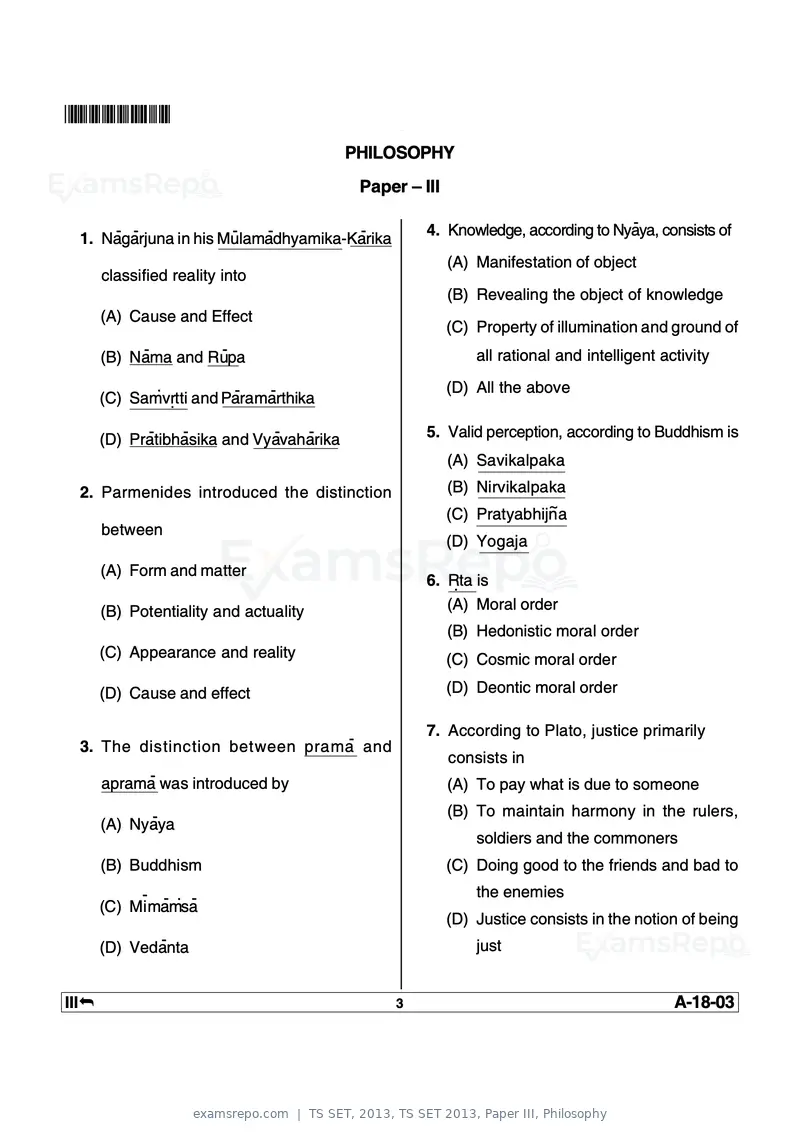
Text of page 3
*A1803*
                                          PHILOSOPHY
                                           Paper – III

                                                       4. Knowledge, according to Nya-ya, consists of
  1. Na-ga-rjuna in his Mu-lama-dhyamika-Ka-rika
                                                          (A) Manifestation of object
       classified reality into
                                                          (B) Revealing the object of knowledge
       (A) Cause and Effect
                                                         (C) Property of illumination and ground of
       (B) Na-ma and Ru-pa                                    all rational and intelligent activity
              .                                          (D) All the above
       (C) Samvr.tti and Pa-rama-rthika

             -    -           -   -                    5. Valid perception, according to Buddhism is
       (D) Pratibhasika and Vyavaharika
                                                          (A) Savikalpaka
  2. Parmenides introduced the distinction               (B) Nirvikalpaka
                                                                       ~a
                                                         (C) Pratyabhijn
       between
                                                         (D) Yogaja
       (A) Form and matter
                                                       6. R.ta is
       (B) Potentiality and actuality                     (A) Moral order
                                                          (B) Hedonistic moral order
       (C) Appearance and reality                        (C) Cosmic moral order

       (D) Cause and effect                              (D) Deontic moral order

                                                       7. According to Plato, justice primarily
  3. The distinction between prama- and
                                                          consists in
       aprama- was introduced by                          (A) To pay what is due to someone
                                                          (B) To maintain harmony in the rulers,
       (A) Nya-ya
                                                              soldiers and the commoners
       (B) Buddhism                                      (C) Doing good to the friends and bad to
            -     .                                           the enemies
       (C) Mi ma-msa-
                                                         (D) Justice consists in the notion of being
       (D) Veda-nta                                           just


IIIË                                               3                                         A-18-03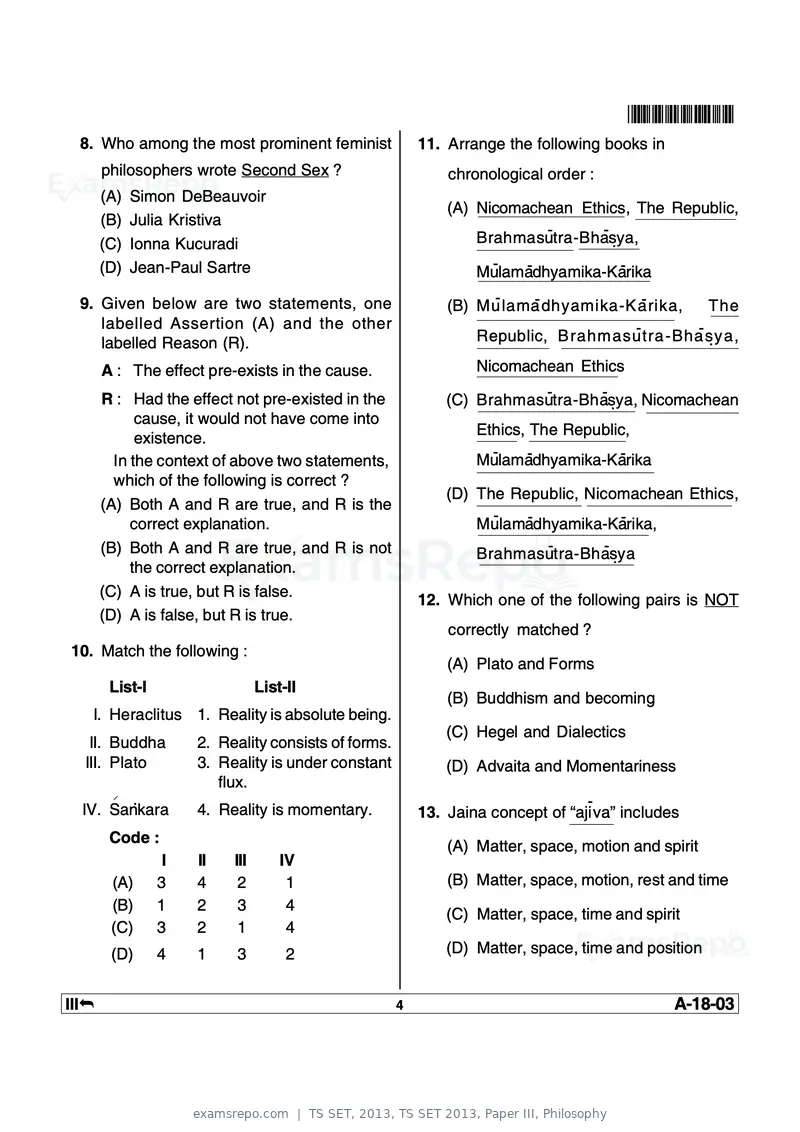
Text of page 4
*A1803*
 8. Who among the most prominent feminist                 11. Arrange the following books in
       philosophers wrote Second Sex ?                        chronological order :
       (A) Simon DeBeauvoir
                                                              (A) Nicomachean Ethics, The Republic,
       (B) Julia Kristiva
       (C) Ionna Kucuradi                                         Brahmasu-tra-Bha-s.ya,
       (D) Jean-Paul Sartre                                       Mu-lama-dhyamika-Ka-rika
 9. Given below are two statements, one                       (B) Mu- lama- dhyamika-Ka- rika,  The
    labelled Assertion (A) and the other
    labelled Reason (R).                                          Republic, Brahmasu- tra-Bha- s. ya,

       A : The effect pre-exists in the cause.                    Nicomachean Ethics

       R : Had the effect not pre-existed in the              (C) Brahmasu-tra-Bha-s.ya, Nicomachean
             cause, it would not have come into
                                                                  Ethics, The Republic,
             existence.
         In the context of above two statements,                  Mu-lama-dhyamika-Ka-rika
         which of the following is correct ?
                                                              (D) The Republic, Nicomachean Ethics,
       (A) Both A and R are true, and R is the
            correct explanation.                                  Mu-lama-dhyamika-Ka-rika,
       (B) Both A and R are true, and R is not                    Brahmasu-tra-Bha-s.ya
            the correct explanation.
       (C) A is true, but R is false.
                                                          12. Which one of the following pairs is NOT
       (D) A is false, but R is true.
                                                              correctly matched ?
10. Match the following :
                                                              (A) Plato and Forms
        List-I                   List-II
                                                              (B) Buddhism and becoming
   I. Heraclitus 1. Reality is absolute being.
                                                              (C) Hegel and Dialectics
   II. Buddha         2. Reality consists of forms.
  III. Plato          3. Reality is under constant            (D) Advaita and Momentariness
                         flux.
        .                                                                         -
  IV. Sankara         4. Reality is momentary.            13. Jaina concept of “aji va” includes
        Code :
                                                              (A) Matter, space, motion and spirit
                  I   II   III       IV
        (A)      3    4     2         1                       (B) Matter, space, motion, rest and time
        (B)      1    2     3         4
                                                              (C) Matter, space, time and spirit
        (C)      3    2     1         4
        (D)      4    1     3         2                       (D) Matter, space, time and position


IIIË                                                  4                                        A-18-03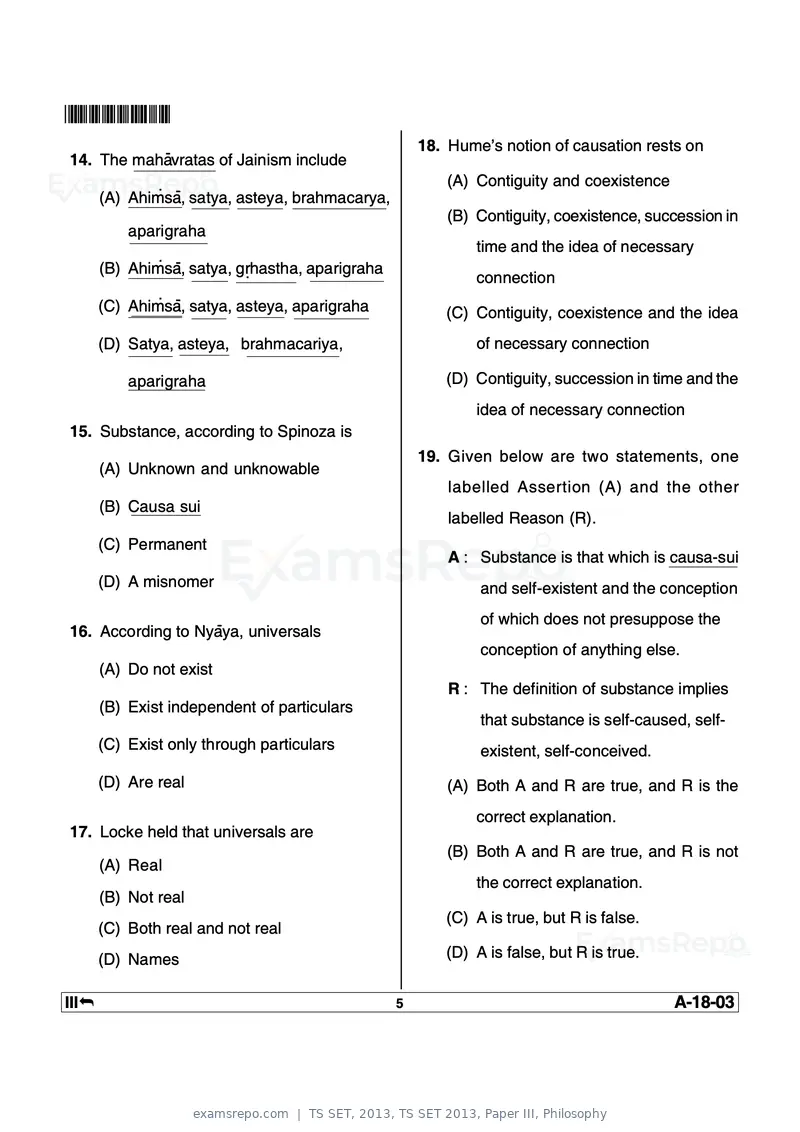
Text of page 5
*A1803*
                                                       18. Hume’s notion of causation rests on
14. The maha-vratas of Jainism include
               .                                           (A) Contiguity and coexistence
       (A) Ahimsa-, satya, asteya, brahmacarya,
                                                           (B) Contiguity, coexistence, succession in
           aparigraha
                                                               time and the idea of necessary
               .
       (B) Ahimsa-, satya, gr.hastha, aparigraha
                                                               connection
               .
       (C) Ahimsa-, satya, asteya, aparigraha             (C) Contiguity, coexistence and the idea
       (D) Satya, asteya, brahmacariya,                        of necessary connection

           aparigraha                                     (D) Contiguity, succession in time and the
                                                               idea of necessary connection
15. Substance, according to Spinoza is
                                                       19. Given below are two statements, one
       (A) Unknown and unknowable
                                                           labelled Assertion (A) and the other
       (B) Causa sui
                                                           labelled Reason (R).
       (C) Permanent
                                                           A : Substance is that which is causa-sui
       (D) A misnomer                                          and self-existent and the conception
                                                               of which does not presuppose the
16. According to Nya-ya, universals
                                                               conception of anything else.
       (A) Do not exist
                                                           R : The definition of substance implies
       (B) Exist independent of particulars
                                                               that substance is self-caused, self-
       (C) Exist only through particulars                      existent, self-conceived.
       (D) Are real                                        (A) Both A and R are true, and R is the
                                                               correct explanation.
17. Locke held that universals are
                                                           (B) Both A and R are true, and R is not
       (A) Real
                                                               the correct explanation.
       (B) Not real
                                                          (C) A is true, but R is false.
       (C) Both real and not real
       (D) Names                                          (D) A is false, but R is true.


IIIË                                               5                                        A-18-03
Text of page 6
*A1803*
20. Match the following                                 22. Locke assigned the following features to
                                                            personal identity
        List-I                       List-II
                                                            (A) Self-reflection
                                      .
   I. Akhya-ti                   1. Sankara                 (B) Memory
                -
   II. Anirvacani ya-khya-ti     2. Goutama                 (C) Space and time

  III. Anyatha-khya-ti           3. Kuma-rila               (D) All the above
           -
  IV. Vipari ta-khya-ti          4. Pra-bha-kara        23. Sabda as a prama-n.a has not been
                                                            accepted by the following school of Indian
        Code :
                                                            philosophy
                 I   II   III   IV                          (A) Veda-nta
        (A)      4   1    2      3                          (B) Nya-ya
        (B)      3   2    1      4                          (C) Buddhism
                                                                   .
        (C)      1   2    3      4                          (D) Sa-nkhya

        (D)      2   4    3      1
                                                        24. Scepticism lies in the denial of

21. Arrange the following philosophers in a                 (A) Possibility of knowledge

       chronological order                                  (B) Non-existence of matter

       (A) Ya-jn
               ~avalkya, Na-ga-rjuna, Gaudapa-da,           (C) Non-existence of God

           Madhva                                           (D) Existence of self

       (B) Na-ga-rjuna, Gaudapa-da, Ya-jn
                                        ~avalkya,
                                                        25. The following forms of vya-pti are accepted
           Madhva                                           by Nya-ya

       (C) Madhva, Na-ga-rjuna, Gaudapa-da,                 (A) Kevala-nvayi

           Ya-jn
               ~avalkya                                     (B) Kevalavyatireki

       (D) Gaudapa-da, Na-ga-rjuna, Ya-jn
                                        ~avalkya,           (C) Anvaya-vyatireki

           Madhva                                           (D) All the above


IIIË                                                6                                          A-18-03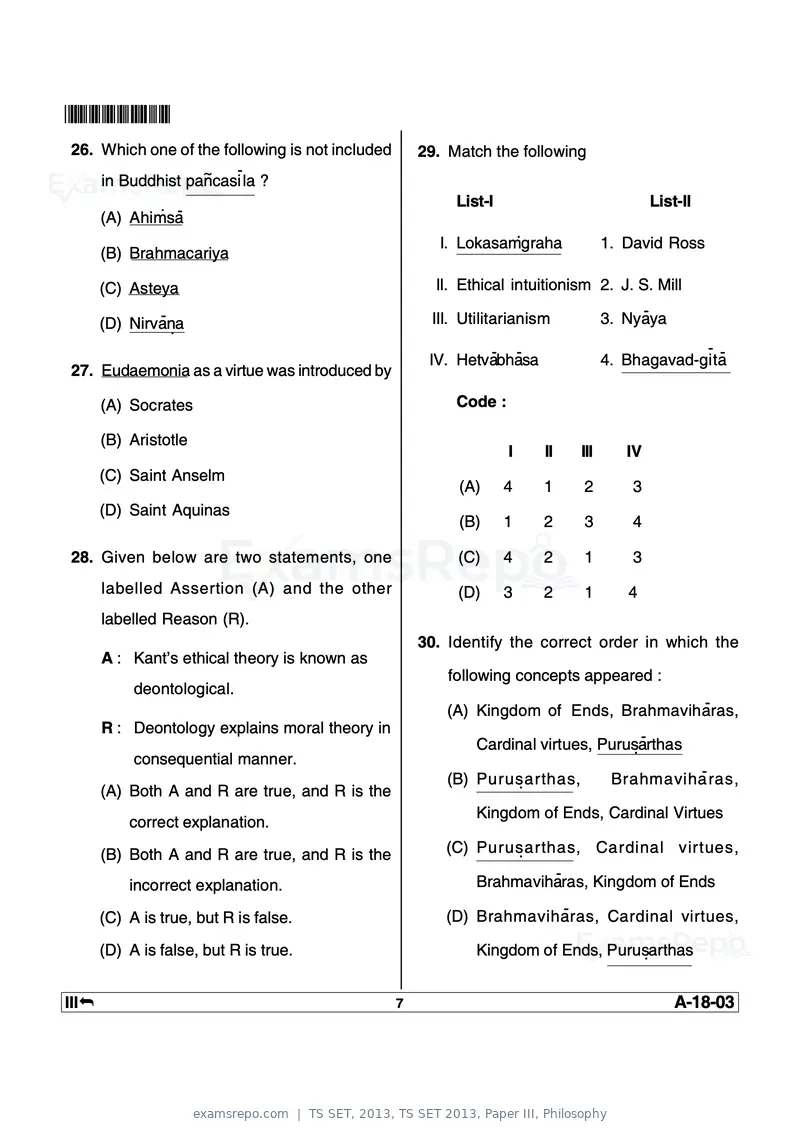
Text of page 7
*A1803*
26. Which one of the following is not included       29. Match the following
                  ~casi-la ?
    in Buddhist pan
               .                                          List-I                            List-II
       (A) Ahimsa-
                                                                  .
                                                        I. Lokasamgraha             1. David Ross
       (B) Brahmacariya

       (C) Asteya                                      II. Ethical intuitionism 2. J. S. Mill

       (D) Nirva-n.a                                  III. Utilitarianism           3. Nya-ya
                                                                                                 -
                                                      IV. Hetva-bha-sa              4. Bhagavad-gi ta-
27. Eudaemonia as a virtue was introduced by

       (A) Socrates                                       Code :

       (B) Aristotle
                                                                   I     II   III      IV
       (C) Saint Anselm
                                                          (A)      4     1    2         3
       (D) Saint Aquinas
                                                          (B)      1     2    3         4

28. Given below are two statements, one                   (C)      4     2    1         3
       labelled Assertion (A) and the other               (D)      3     2    1         4
       labelled Reason (R).
                                                     30. Identify the correct order in which the
       A : Kant’s ethical theory is known as
                                                         following concepts appeared :
            deontological.
                                                         (A) Kingdom of Ends, Brahmaviha-ras,
       R : Deontology explains moral theory in
                                                             Cardinal virtues, Purus.a-rthas
            consequential manner.
                                                         (B) Purus. arthas,          Brahmaviha- ras,
       (A) Both A and R are true, and R is the
                                                             Kingdom of Ends, Cardinal Virtues
           correct explanation.

       (B) Both A and R are true, and R is the          (C) Purus. arthas, Cardinal virtues,

           incorrect explanation.                            Brahmaviha-ras, Kingdom of Ends

       (C) A is true, but R is false.                   (D) Brahmaviha-ras, Cardinal virtues,

       (D) A is false, but R is true.                        Kingdom of Ends, Purus.arthas


IIIË                                             7                                              A-18-03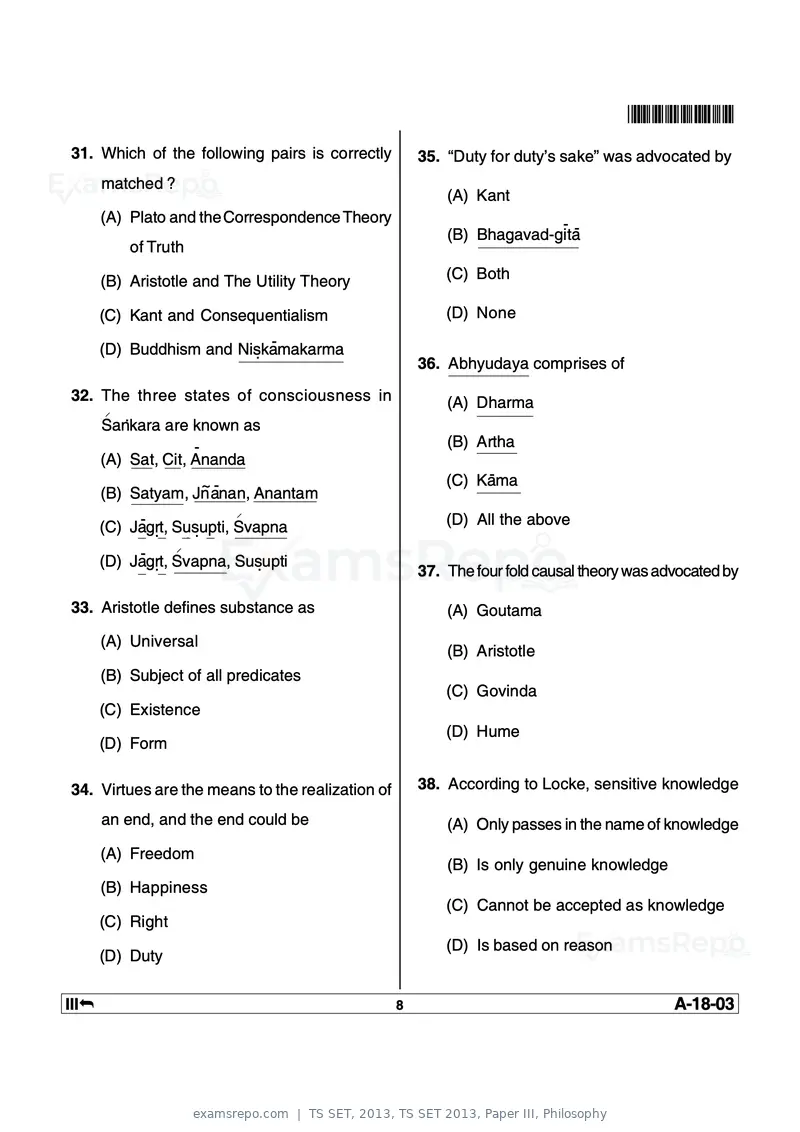
Text of page 8
*A1803*
31. Which of the following pairs is correctly         35. “Duty for duty’s sake” was advocated by
       matched ?
                                                          (A) Kant
       (A) Plato and the Correspondence Theory                          -
                                                          (B) Bhagavad-gita-
           of Truth

       (B) Aristotle and The Utility Theory               (C) Both

       (C) Kant and Consequentialism                      (D) None

       (D) Buddhism and Nis.ka-makarma
                                                      36. Abhyudaya comprises of
32. The three states of consciousness in                  (A) Dharma
       .
    Sankara are known as
                  -                                       (B) Artha
    (A) Sat, Cit, Ananda
                                                          (C) Ka-ma
       (B) Satyam, Jn~a-nan, Anantam

       (C) Ja-gr.t, Sus.upti, Svapna                      (D) All the above

       (D) Ja-gr.t, Svapna, Sus.upti
                                                      37. The four fold causal theory was advocated by

33. Aristotle defines substance as                        (A) Goutama
       (A) Universal
                                                          (B) Aristotle
       (B) Subject of all predicates
                                                          (C) Govinda
       (C) Existence
                                                          (D) Hume
       (D) Form

34. Virtues are the means to the realization of       38. According to Locke, sensitive knowledge

       an end, and the end could be                       (A) Only passes in the name of knowledge
       (A) Freedom
                                                          (B) Is only genuine knowledge
       (B) Happiness
                                                          (C) Cannot be accepted as knowledge
       (C) Right
                                                          (D) Is based on reason
       (D) Duty


IIIË                                              8                                         A-18-03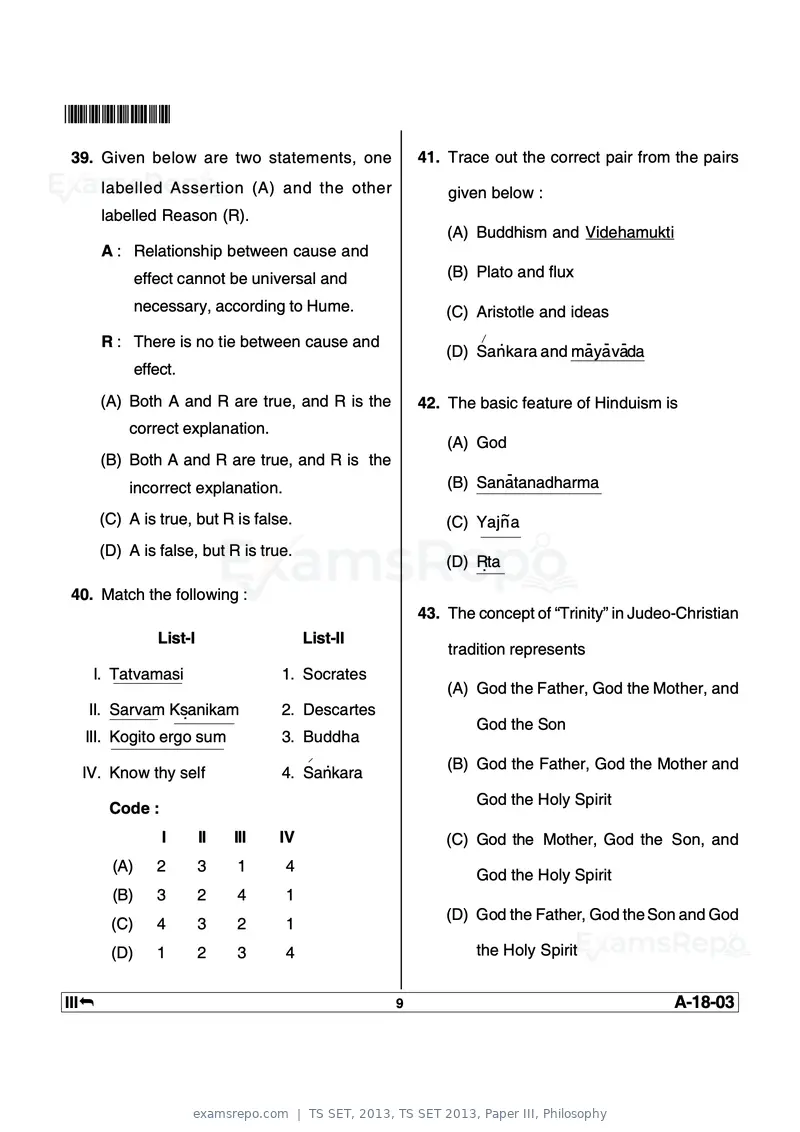
Text of page 9
*A1803*

39. Given below are two statements, one                  41. Trace out the correct pair from the pairs
       labelled Assertion (A) and the other                  given below :
       labelled Reason (R).
                                                             (A) Buddhism and Videhamukti
       A : Relationship between cause and
              effect cannot be universal and                 (B) Plato and flux

              necessary, according to Hume.                  (C) Aristotle and ideas
       R : There is no tie between cause and                       .
                                                             (D) San kara and ma-ya- va-da
              effect.
       (A) Both A and R are true, and R is the           42. The basic feature of Hinduism is
           correct explanation.
                                                             (A) God
       (B) Both A and R are true, and R is the
           incorrect explanation.                            (B) Sana-tanadharma

       (C) A is true, but R is false.                               ~a
                                                             (C) Yajn
       (D) A is false, but R is true.
                                                             (D) R.ta

40. Match the following :
                                                         43. The concept of “Trinity” in Judeo-Christian
                  List-I                   List-II
                                                             tradition represents
   I. Tatvamasi                       1. Socrates
                                                             (A) God the Father, God the Mother, and
   II. Sarvam Ks.anikam               2. Descartes
                                                                 God the Son
  III. Kogito ergo sum                3. Buddha
                                           .                 (B) God the Father, God the Mother and
  IV. Know thy self                   4. Sankara
                                                                 God the Holy Spirit
        Code :
                  I        II   III   IV                     (C) God the Mother, God the Son, and
         (A)     2         3    1     4
                                                                 God the Holy Spirit
         (B)     3         2    4     1
                                                             (D) God the Father, God the Son and God
        (C)      4         3    2     1
        (D)      1         2    3     4                          the Holy Spirit


IIIË                                                 9                                        A-18-03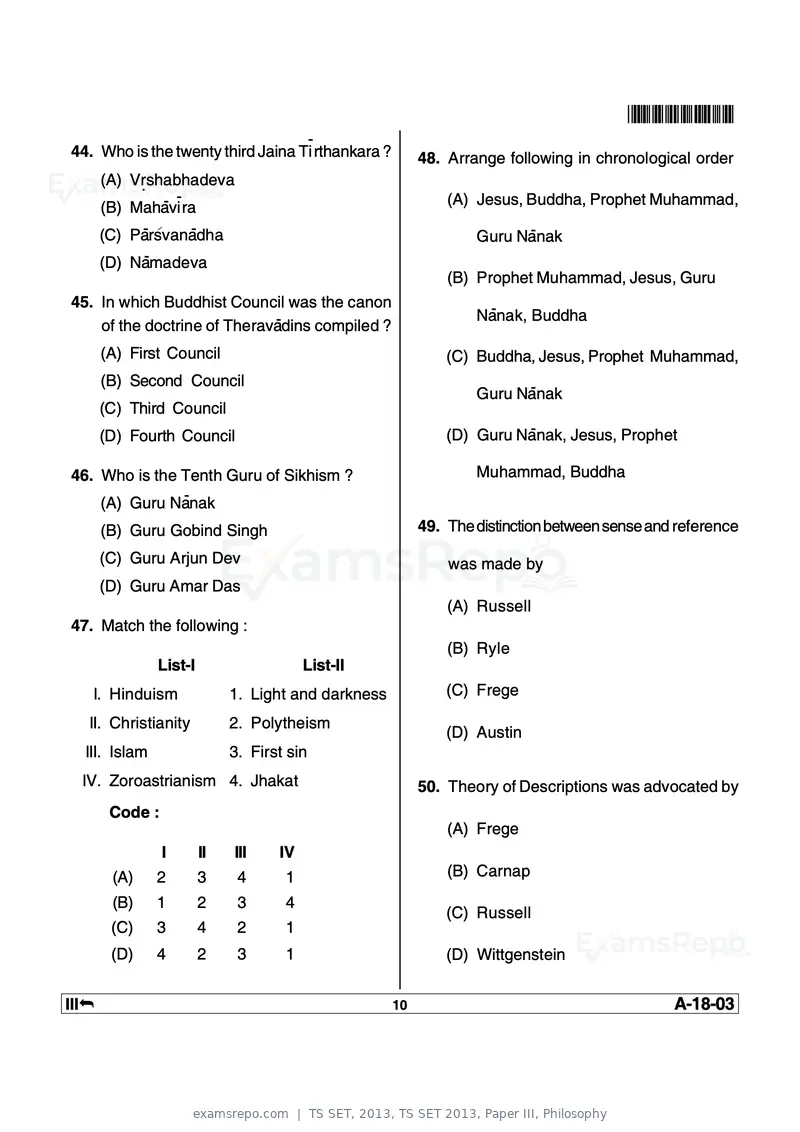
Text of page 10
*A1803*
                                   -
44. Who is the twenty third Jaina Ti rthankara ?          48. Arrange following in chronological order
       (A) Vr.shabhadeva
                 -                                            (A) Jesus, Buddha, Prophet Muhammad,
       (B) Maha-vi ra
       (C) Pa-rsvana-dha                                          Guru Na-nak
       (D) Na-madeva
                                                              (B) Prophet Muhammad, Jesus, Guru
45. In which Buddhist Council was the canon
                                                                  Na-nak, Buddha
    of the doctrine of Therava-dins compiled ?
       (A) First Council                                      (C) Buddha, Jesus, Prophet Muhammad,
       (B) Second Council
                                                                  Guru Na-nak
       (C) Third Council
       (D) Fourth Council                                     (D) Guru Na-nak, Jesus, Prophet

46. Who is the Tenth Guru of Sikhism ?                            Muhammad, Buddha
    (A) Guru Na-nak
       (B) Guru Gobind Singh                              49. The distinction between sense and reference
       (C) Guru Arjun Dev                                     was made by
       (D) Guru Amar Das
                                                              (A) Russell
47. Match the following :
                                                              (B) Ryle
               List-I                    List-II
   I. Hinduism               1. Light and darkness            (C) Frege

   II. Christianity          2. Polytheism
                                                              (D) Austin
  III. Islam                 3. First sin
  IV. Zoroastrianism 4. Jhakat                            50. Theory of Descriptions was advocated by
        Code :
                                                              (A) Frege
                 I      II   III    IV
        (A)    2        3     4      1                        (B) Carnap
        (B)    1        2     3      4
                                                              (C) Russell
        (C)    3        4     2      1
        (D)    4        2     3      1                        (D) Wittgenstein


IIIË                                                 10                                        A-18-03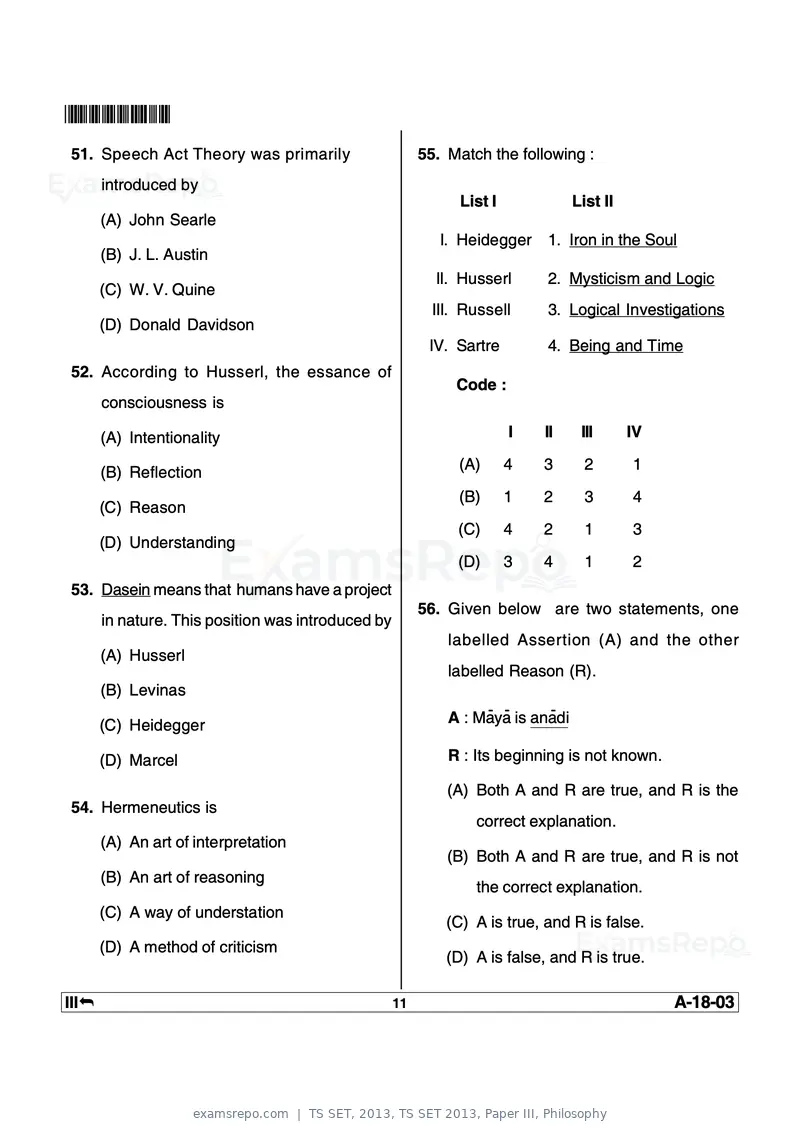
Text of page 11
*A1803*
51. Speech Act Theory was primarily                      55. Match the following :
       introduced by
                                                               List I               List II
       (A) John Searle
                                                            I. Heidegger     1. Iron in the Soul
       (B) J. L. Austin
                                                           II. Husserl       2. Mysticism and Logic
       (C) W. V. Quine
                                                           III. Russell      3. Logical Investigations
       (D) Donald Davidson
                                                          IV. Sartre         4. Being and Time
52. According to Husserl, the essance of
                                                              Code :
       consciousness is

       (A) Intentionality                                               I    II      III      IV

                                                               (A)      4   3         2       1
       (B) Reflection
                                                               (B)      1   2         3       4
       (C) Reason
                                                              (C)       4   2         1       3
       (D) Understanding
                                                              (D)       3   4         1       2
53. Dasein means that humans have a project
                                                         56. Given below are two statements, one
       in nature. This position was introduced by
                                                             labelled Assertion (A) and the other
       (A) Husserl
                                                             labelled Reason (R).
       (B) Levinas

       (C) Heidegger                                         A : Ma-ya- is ana-di

       (D) Marcel                                            R : Its beginning is not known.

                                                             (A) Both A and R are true, and R is the
54. Hermeneutics is
                                                                 correct explanation.
       (A) An art of interpretation
                                                             (B) Both A and R are true, and R is not
       (B) An art of reasoning
                                                                 the correct explanation.
       (C) A way of understation
                                                             (C) A is true, and R is false.
       (D) A method of criticism
                                                             (D) A is false, and R is true.

IIIË                                                11                                             A-18-03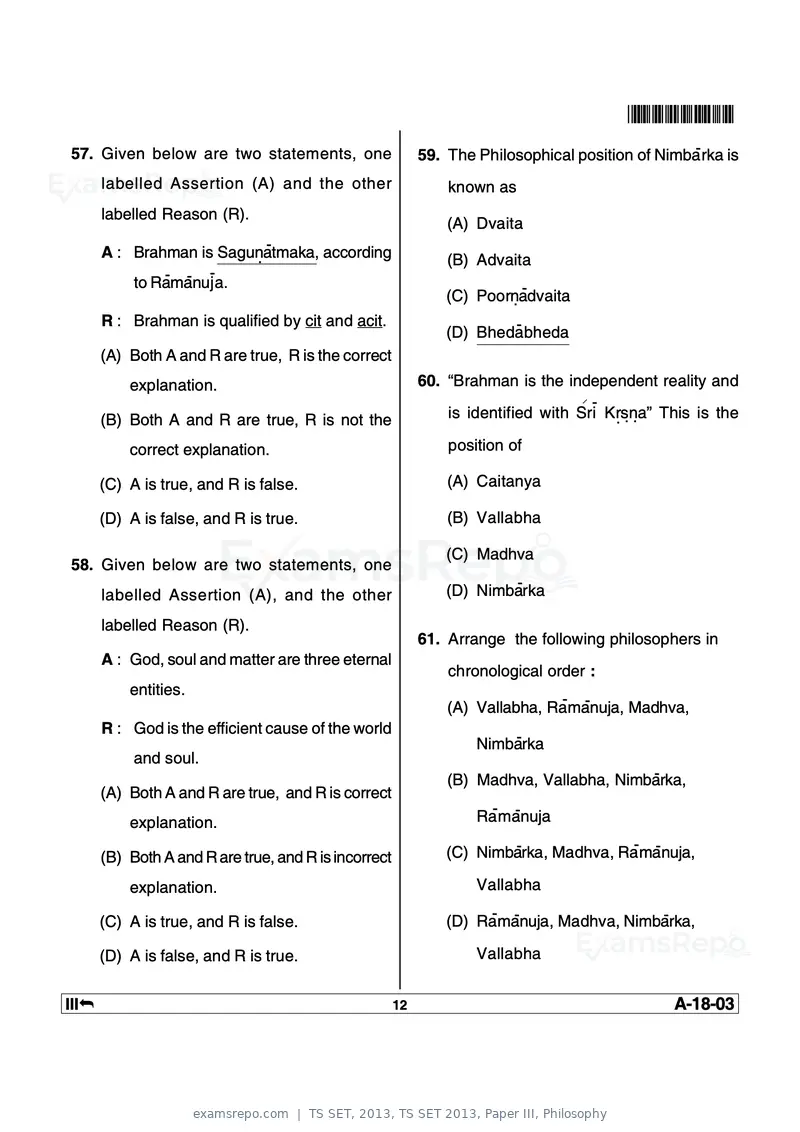
Text of page 12
*A1803*
57. Given below are two statements, one                     59. The Philosophical position of Nimba-rka is
       labelled Assertion (A) and the other                     known as
       labelled Reason (R).
                                                                (A) Dvaita
       A : Brahman is Sagun.a-tmaka, according                  (B) Advaita
                      -
           to Ra-ma-nuj a.
                                                                (C) Poorn.a-dvaita
       R : Brahman is qualified by cit and acit.
                                                                (D) Bheda-bheda
       (A) Both A and R are true, R is the correct
           explanation.                                     60. “Brahman is the independent reality and
                                                                                     -
       (B) Both A and R are true, R is not the                  is identified with Sri Kr.s.n.a” This is the

           correct explanation.                                 position of

       (C) A is true, and R is false.                           (A) Caitanya

       (D) A is false, and R is true.                           (B) Vallabha

                                                                (C) Madhva
58. Given below are two statements, one
       labelled Assertion (A), and the other                    (D) Nimba-rka

       labelled Reason (R).
                                                            61. Arrange the following philosophers in
       A : God, soul and matter are three eternal
                                                                chronological order :
           entities.
                                                                (A) Vallabha, Ra-ma-nuja, Madhva,
       R : God is the efficient cause of the world
                                                                    Nimba-rka
            and soul.
                                                                (B) Madhva, Vallabha, Nimba-rka,
       (A) Both A and R are true, and R is correct
           explanation.                                             Ra-ma-nuja

       (B) Both A and R are true, and R is incorrect            (C) Nimba-rka, Madhva, Ra-ma-nuja,

           explanation.                                             Vallabha

       (C) A is true, and R is false.                           (D) Ra-ma-nuja, Madhva, Nimba-rka,

       (D) A is false, and R is true.                               Vallabha


IIIË                                                   12                                         A-18-03
Text of page 13
*A1803*
62. In Universal Affirmative (A) proposition               65. According to law of excluded middle,

       (A) Subject is distributed and predicate is             (A) A proposition is true when it is true.

           not distributed                                     (B) A proposition cannot be both true and
                                                                    false simultaneously.
       (B) Subject is not distributed and
                                                               (C) A proposition must be either true or
           predicate is distributed
                                                                    false.
       (C) Both subject and predicate are                      (D) A proposition is meaningless.
           distributed
                                                           66. Match the following :
       (D) Both subject and predicate are
                                                                 List-I                     List-II
           undistributed
                                                           I. Transposition 1. {(p & q) ⊃ r} ≡ {(p ⊃ (q ⊃ r )}
63. The relation between I and O propositions
                                                          II. Tautology       2. (p ∨ q) ≡ (q ∨ p)
       in the square of opposition is
                                                          III. Commutation 3. (p / p ≡ p)
       (A) Contradictories                                IV. Exportation     4. (p ⊃ q) ≡ (~ q ⊃~ p)
       (B) Contraries                                            Code :
       (C) Sub-Contraries                                                 I     II    III         IV

       (D) Sub-altern                                            (A)      3    4      2           1
                                                                 (B)      4    3      2           1
64. Determine the fallacy in the categorical                     (C)      1    2      3           4
       syllogism stated below :                                  (D)      4    3      1           2
        All Indians are revolutionaries.
                                                           67. The mood of the Third Figure of the
        All students are revolutionaries.
                                                               categorical syllogism is
        ∴ All students are Indians.
                                                                                            (B)     M−P
       (A) Fallacy of four terms                               (A) M − P
                                                                                                  ∴ M− S
                                                                   S −M                            ∴S −P
       (B) Fallacy of undistributed middle                         ∴S −P
       (C) Fallacy of illicit major                            (C) P −M                     (D) P −M
                                                                   S −M                         M− S
       (D) Fallacy of illicit minor                                ∴S −P                        ∴S −P

IIIË                                                 13                                                A-18-03
Text of page 14
*A1803*
68. The rule of hypothetical syllogism is                  71. “Do not preach religion to a hungry man”
                                                               is the statement of
       (A)    p⊃q             (B) p ⊃ q
              r⊃s                 q⊃r                          (A) Ramakrishna
             ∴p ⊃ s               ∴p ⊃ r                       (B) Tagore
                                                               (C) Vivekananda
       (C) p ∨ q              (D)   p
            q∨p                                                (D) Sri Aurobindo
                                    q
           ∴p ∨ q                 ∴p & q
                                                           72. According to a solipsist
                              .                                (A) There is external world
69. The Gandhian sense of ahimsa- is entirely
                                                               (B) Only I and my consciousness alone
       different from its traditional sense because
                                                                    exist
                         .
       (A) The word ‘ahimsa-’ has a negative                   (C) Everything is an idea
             sense                                             (D) Sense impressions alone exist
                         .
       (B) The word ‘ahimsa-’ has a positive               73. According to W. V. Quine, the distinction
             sense                                             between analytic and synthetic is
                         .
       (C) The word ‘ahimsa-’ has both positive                (A) Logical

             and negative senses                               (B) Logically illfounded

                         .                                     (C) Analytic
       (D) The word ‘ahimsa-’ is neither a positive
                                                               (D) A priori
             nor a negative concept

                                                           74. Artha-patti is reduced to anuma-na by
70. Gandhi describes satya-graha as a
                                                               (A) Nya-ya            (B) Sa-n-khya
       method of
                                                                    -     .
       (A) Conversion of the opponent                          (C) Mi ma-msa-        (D) Advaita

                                                                               -
       (B) Coercion                                        75. The notion of “Ji van-Mukti” was introduced

       (C) Embarrassing the wrong doer                         by
                                                               (A) Buddhism          (B) Nya-ya
       (D) Conversion rather than a method of
                                                               (C) Advaita           (D) Visis.ta-dvaita
             coercion


IIIË                                                  14                                        A-18-03
Text of page 15
*A1803*
          Space for Rough Work


IIIË              15             A-18-03
Text of page 16
*A1803*
       Space for Rough Work


IIIË            16               A-18-03
Official key not published for this paper.
Page 1 of 16
Source: Telangana State Eligibility Test. Question paper published by Telangana State Eligibility Test.