
TS SET 2013: Paper III, Mathematical Sciences
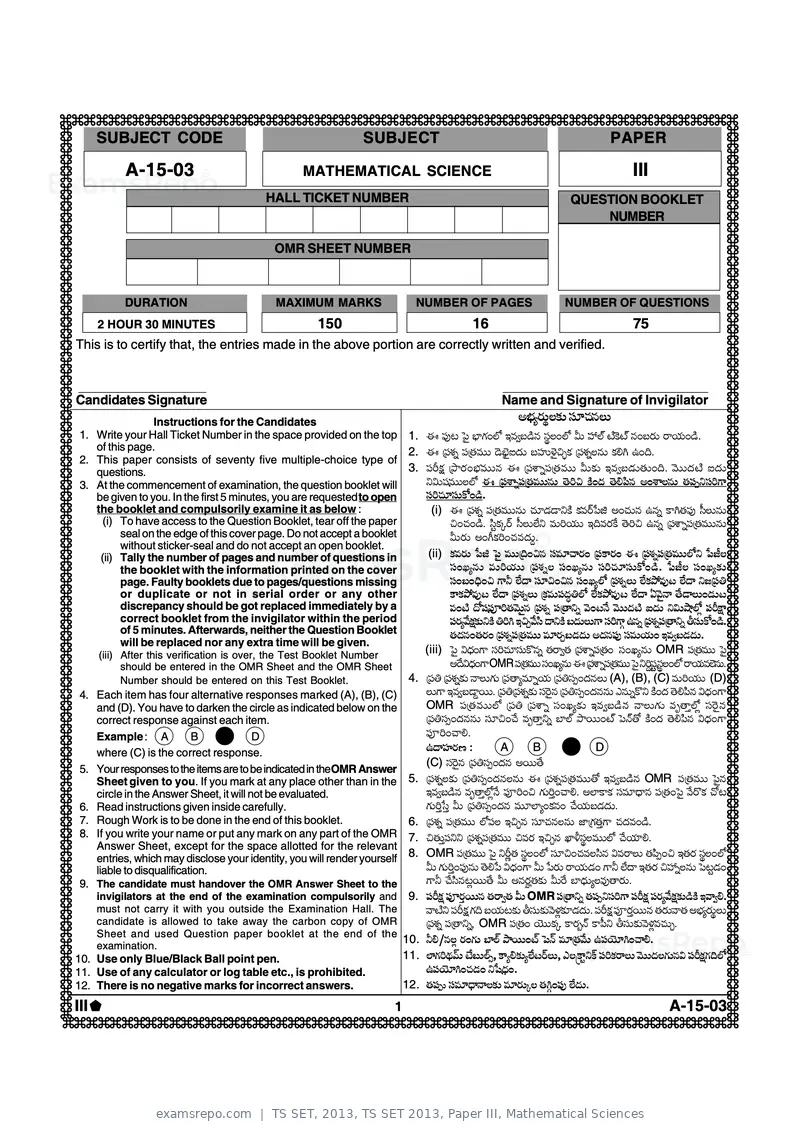
Text of page 1
aaaaaaaaaaaaaaaaaaaaaaaaaaaaaaaaaaaaaaaaaaaaaaaaaaaaaaaa
aaaaaaaaaaaaaaaaaaaaaaaaaaaaaaaaaaaaaaaaaaaaaaaaaaaaaaaaaaaaaaaaaaaaaaaaaaaaa aaaaaaaaaaaaaaaaaaaaaaaaaaaaaaaaaaaaaaaaaaaaaaaaaaaaaaaaaaaaaaaaaaaaaaaaaaaaaaa
SUBJECT CODE SUBJECT PAPER
A-15-03 MATHEMATICAL SCIENCE III
HALL TICKET NUMBER QUESTION BOOKLET
NUMBER
OMR SHEET NUMBER
DURATION MAXIMUM MARKS NUMBER OF PAGES NUMBER OF QUESTIONS
2 HOUR 30 MINUTES 150 16 75
This is to certify that, the entries made in the above portion are correctly written and verified.
Candidates Signature Name and Signature of Invigilator
Instructions for the Candidates A¿æýÅÆæÿ$¦ËMæü$ çÜ*^èþ¯èþË$
1. Write your Hall Ticket Number in the space provided on the top 1. D ç³#r ò³O ¿êVæü ÌZ CÐèþÓºyìþ¯èþ çÜ¦Ë ÌZ Ò$ çàÌý sìýMðüsý ¯èþ ºÆæÿ$ Æ>Äæý$ yìþ.
of this page. 2. D {ç³Ôèý² ç³{èþÐèþ$$ yðþ¿ñýOI§æþ$ ºçßý$âñýO_eMæü {ç³Ôèý²Ë¯èþ$ MæüÍW E ¨.
2. This paper consists of seventy five multiple-choice type of
questions. 3. ç³Èæü {´ëÆæÿ ¿æýÐèþ$$¯èþ D {ç³Ôé²ç³{èþÐèþ$$ Ò$Mæü$ CÐèþÓºyæþ$èþ$ ¨. Ððþ$$§æþsìý I§æþ$
3. At the commencement of examination, the question booklet will °Ñ$çÙÐèþ$$ËÌZ D {ç³Ôé²ç³{èþÐèþ$$¯èþ$ ðþÇ_ Mìü §æþ ðþÍí³¯èþ A Ôé˯èþ$ èþç³µ°çÜÇV>
be given to you. In the first 5 minutes, you are requested to open çÜÇ^èþ*çÜ$Mø yìþ.
the booklet and compulsorily examine it as below : (i) D {ç³Ôèý² ç³{èþÐèþ$$¯èþ$ ^èþ*yæþyé°Mìü MæüÐèþÆÿõ³h A ^èþ$¯èþ E¯èþ² M>Wèþç³# ïÜË$¯èþ$
(i) To have access to the Question Booklet, tear off the paper _ ^èþ yìþ. íÜtMæüPÆÿ ïÜË$Ìôý° Ðèþ$ÇÄæý$$ C¨ÐèþÆæÿMóü ðþÇ_ E¯èþ² {ç³Ôé²ç³{èþÐèþ$$¯èþ$
seal on the edge of this cover page. Do not accept a booklet Ò$Ææÿ$ A XMæüÇ ^èþÐèþ§æþ$ª.
without sticker-seal and do not accept an open booklet.
(ii) Tally the number of pages and number of questions in (ii) MæüÐèþÆæÿ$ õ³h ò³O Ðèþ$${¨ _¯èþ çÜÐèþ*^éÆæÿ {ç³M>Ææÿ D {ç³Ôèý²ç³{èþÐèþ$$ÌZ° õ³iË
the booklet with the information printed on the cover çÜ Qůèþ$ Ðèþ$ÇÄæý$$ {ç³Ôèý²Ë çÜ Qůèþ$ çÜÇ^èþ*çÜ$Mø yìþ. õ³iË çÜ QÅMæü$
page. Faulty booklets due to pages/questions missing çÜ º «¨ _ V>± Ìôý§é çÜ*_ _¯èþ çÜ QÅÌZ {ç³Ôèý²Ë$ ÌôýMæü´ùÐèþ#r Ìôý§é °f{ç³
or duplicate or not in serial order or any other M>Mæü´ùÐèþ#r Ìôý§é {ç³Ôèý²Ë$ {MæüÐèþ$糧æþ®ÌZ ÌôýMæü´ùÐèþ#r Ìôý§é HÐðþO¯é óþyéË$ yæþ$r
discrepancy should be got replaced immediately by a Ðèþ sìý §øçÙç³NÇèþÐðþ$O¯èþ {ç³Ôèý² ç³{é°² Ððþ r¯óþ Ððþ$$§æþsìý I§æþ$ °Ñ$ÚëÌZÏ ç³È>
correct booklet from the invigilator within the period ç³ÆæÿÅÐóþæüMæü$°Mìü ÇW C_aÐóþíÜ §é°Mìü º§æþ$Ë$V> çÜÇV>Y E¯èþ² {ç³Ôèý²ç³{é°² ¡çÜ$Mø yìþ.
of 5 minutes. Afterwards, neither the Question Booklet èþ§æþ¯èþ èþÆæÿ {ç³Ôèý²ç³{èþÐèþ$$ Ðèþ*Ææÿaºyæþ§æþ$ A§æþ¯èþç³# çÜÐèþ$Äæý$ CÐèþÓºyæþ§æþ$.
will be replaced nor any extra time will be given.
(iii) After this verification is over, the Test Booklet Number (iii) ò³O Ñ«§æþ V> çÜÇ^èþ*çÜ$Mö¯èþ² èþÆ>Óèþ {ç³Ôé²ç³{èþ çÜ Qůèþ$ OMR ç³{èþÐèþ$$ ò³O
should be entered in the OMR Sheet and the OMR Sheet A§óþÑ«§æþ V> OMR ç³{èþÐèþ$$ çÜ Qůèþ$ D {ç³Ôé²ç³{èþÐèþ$$ ò³O °ÇªçÙtt çÜ¦Ë ÌZ Æ>Äæý$ÐèþÌñý¯èþ$.
Number should be entered on this Test Booklet. 4. {ç ³ {ç ³ Ôèý²Mæü$ ¯éË$Væü$ {ç³éÅÐèþ*²Äæý$ {ç³çܵ §æþ¯èþË$ (A), (B), (C) Ðèþ$ÇÄæý$$ (D)
4. Each item has four alternative responses marked (A), (B), (C) Ë$V> CÐèþÓºyézÆÿ$$. {ç³{ç³Ôèý²Mæü$ çÜÆðÿO¯èþ {ç³çܵ §æþ¯èþ¯èþ$ G¯èþ$²Mö° Mìü §æþ ðþÍí³¯èþ Ñ«§æþ V>
and (D). You have to darken the circle as indicated below on the OMR ç³{èþÐèþ$$ÌZ {ç³ {ç³Ôé² çÜ QÅMæü$ CÐèþÓºyìþ¯èþ ¯éË$Væü$ Ðèþé¢ÌZÏ çÜÆðÿO¯èþ
correct response against each item. {ç³çܵ §æþ¯èþ¯èþ$ çÜ*_ ^óþ Ðèþ颰² »êÌý ´ëÆÿ$$ sý ò³¯þø Mìü §æþ ðþÍí³¯èþ Ñ«§æþ V>
Example : A B C D ç³NÇ ^éÍ.
where (C) is the correct response. E§éçßýÆæÿ×ý : A B C D
(C) çÜÆðÿO¯èþ {ç³çܵ §æþ¯èþ AÆÿ$$óþ
5. Your responses to the items are to be indicated in theOMR Answer
Sheet given to you. If you mark at any place other than in the5. {ç³Ôèý²ËMæü$ {ç³çܵ §æþ¯èþ˯èþ$ D {ç³Ôèý²ç³{èþÐèþ$$ø CÐèþÓºyìþ¯èþ OMR ç³{èþÐèþ$$ ò³O¯èþ
circle in the Answer Sheet, it will not be evaluated. CÐèþÓºyìþ¯èþ Ðèþé¢ÌZϯóþ ç³NÇ _ Væü$Ç¢ ^éÍ. AÌêM>Mæü çÜÐèþ*«§é¯èþ ç³{èþ ò³O ÐóþÆöMæü ^ør
6. Read instructions given inside carefully. Væü$Ç¢õÜ¢ Ò$ {ç³çܵ §æþ¯èþ Ðèþ$*ÌêÅ Mæü¯èþ ^óþÄæý$ºyæþ§æþ$.
7. Rough Work is to be done in the end of this booklet. 6. {ç³Ôèý² ç³{èþÐèþ$$ ÌZç³Ë C_a¯èþ çÜ*^èþ¯èþ˯èþ$ gê{Væüèþ¢V> ^èþ§æþÐèþ yìþ.
8. If you write your name or put any mark on any part of the OMR 7. _èþ$¢ç³°° {ç³Ôèý²ç³{èþÐèþ$$ _ÐèþÆæÿ C_a¯èþ RêäçܦËÐèþ$$ÌZ ^óþÄæý*Í.
Answer Sheet, except for the space allotted for the relevant
8. OMR ç³{èþÐèþ$$ ò³O °È~èþ çÜ¦Ë ÌZ çÜ*_ ^èþÐèþËíܯèþ ÑÐèþÆ>Ë$ èþí³µ _ CèþÆæÿ çÜ¦Ë ÌZ
entries, which may disclose your identity, you will render yourself
liable to disqualification. Ò$ Væü$Ç¢ ç³#¯èþ$ ðþÍõ³ Ñ«§æþ V> Ò$ õ³Ææÿ$ Æ>Äæý$yæþ V>± Ìôý§é CèþÆæÿ _à²Ë¯èþ$ ò³rtyæþ
9. The candidate must handover the OMR Answer Sheet to the V>± ^óþíܯèþrÏÆÿ$$óþ Ò$ A¯èþÆæÿáèþMæü$ Ò$Æóÿ »ê«§æþ$ÅËÐèþ#éÆæÿ$.
invigilators at the end of the examination compulsorily and 9. ç ³Èæü ç³NÆæÿ¢Æÿ$$¯èþ èþÆ>Óèþ Ò$ OMR ç³{é°² èþç³µ°çÜÇV> ç³Èæü ç³ÆæÿÅÐóþæüMæü$yìþMìü CÐéÓÍ.
must not carry it with you outside the Examination Hall. The Ðésìý° ç³Èæü Væü¨ ºÄæý$rMæü$ ¡çÜ$Mæü$ÐðþâæýÏMæü*yæþ§æþ$. ç³Èæü ç³NÆæÿ¢Æÿ$$¯èþ èþÆæÿ$Ðéèþ A¿æýÅÆæÿ$¦Ë$
candidate is allowed to take away the carbon copy of OMR {ç³Ôèý² ç³{é°², OMR ç³{èþ Äñý$$MæüP M>Ææÿ¾¯þ M>ï³° ¡çÜ$Mæü$ÐðþâæýÏÐèþ^èþ$a.
Sheet and used Question paper booklet at the end of the
10. ±Í/¯èþËÏ Ææÿ Væü$ »êÌý ´ëÆÿ$$ sý ò³¯þ Ðèþ*{èþÐóþ$ Eç³Äñý*W ^éÍ.
examination.
10. Use only Blue/Black Ball point pen. 11. ÌêVæüÇ£æþÐþ$ sôýº$ÌýÞ, M>ÅÍMæü$ÅÌôýrÆÿË$, GË[M>t°Mü ç³ÇMæüÆ>Ë$ Ððþ$$§æþËVæü$¯èþÑ ç³ÈæüVæü¨ÌZ
11. Use of any calculator or log table etc., is prohibited. Eç³Äñý*W ^èþyæþ °õÙ«§æþ .
12. There is no negative marks for incorrect answers. 12. èþç³ çÜÐèþ*«§é¯éËMæü$ Ðèþ*Ææÿ$PË èþWY ç³# Ìôý§æþ$.
IIIÀ 1 A-15-03
aaaaaaaaaaaaaaaaaaaaaaaaaaaaaaaaaaaaaaaaaaaaaaaaaaaaaaaaa
Text of page 2
*A1503*


                   HE
                     RE

            WR
              ITE

        NO
          T
       DO


IIIÀ           2             A-15-03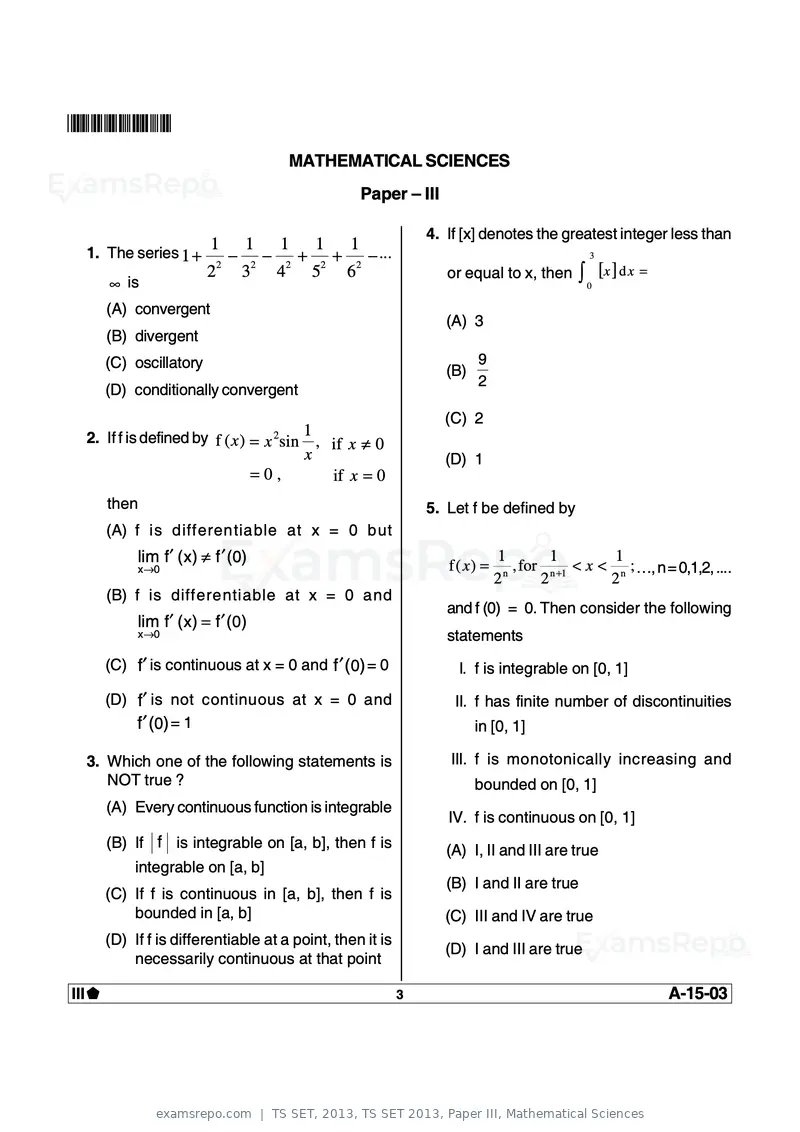
Text of page 3
*A1503*
                                               MATHEMATICAL SCIENCES
                                                                    Paper – III

                                                                                 4. If [x] denotes the greatest integer less than
                         1        1            1       1        1
 1. The series 1 +            −        −           +        +        − ...                                      3
                         22       32       42          52       62                  or equal to x, then ∫           [x ] d x =
       ∞ is                                                                                                    0

       (A) convergent
                                                                                    (A) 3
       (B) divergent
       (C) oscillatory                                                                    9
                                                                                    (B)
                                                                                          2
       (D) conditionally convergent
                                                                                   (C) 2
 2. If f is defined by f ( x ) = x sin 1 , if x ≠ 0
                                           2
                                       x                                           (D) 1
                               =0,         if x = 0
       then                                                                      5. Let f be defined by
       (A) f is differentiable at x = 0 but
            lim f′ ( x) ≠ f ′ (0)                                                   f ( x) =
                                                                                               1          1         1
                                                                                                   , for n +1 < x < n ; …, n = 0,1,2, ....
            x →0                                                                                 n
                                                                                               2        2          2
       (B) f is differentiable at x = 0 and
                                                                                    and f (0) = 0. Then consider the following
            lim f′ ( x) = f′ (0)
            x →0                                                                    statements
       (C) f′ is continuous at x = 0 and f ′ (0) = 0                                  I. f is integrable on [0, 1]
       (D) f′ is not continuous at x = 0 and                                         II. f has finite number of discontinuities
           f ′ (0) = 1                                                                    in [0, 1]

 3. Which one of the following statements is                                        III. f is monotonically increasing and
    NOT true ?                                                                            bounded on [0, 1]
       (A) Every continuous function is integrable
                                                                                    IV. f is continuous on [0, 1]
       (B) If f is integrable on [a, b], then f is                                  (A) I, II and III are true
            integrable on [a, b]
                                                                                    (B) I and II are true
       (C) If f is continuous in [a, b], then f is
           bounded in [a, b]                                                       (C) III and IV are true
       (D) If f is differentiable at a point, then it is
                                                                                   (D) I and III are true
           necessarily continuous at that point

IIIÀ                                                                         3                                                   A-15-03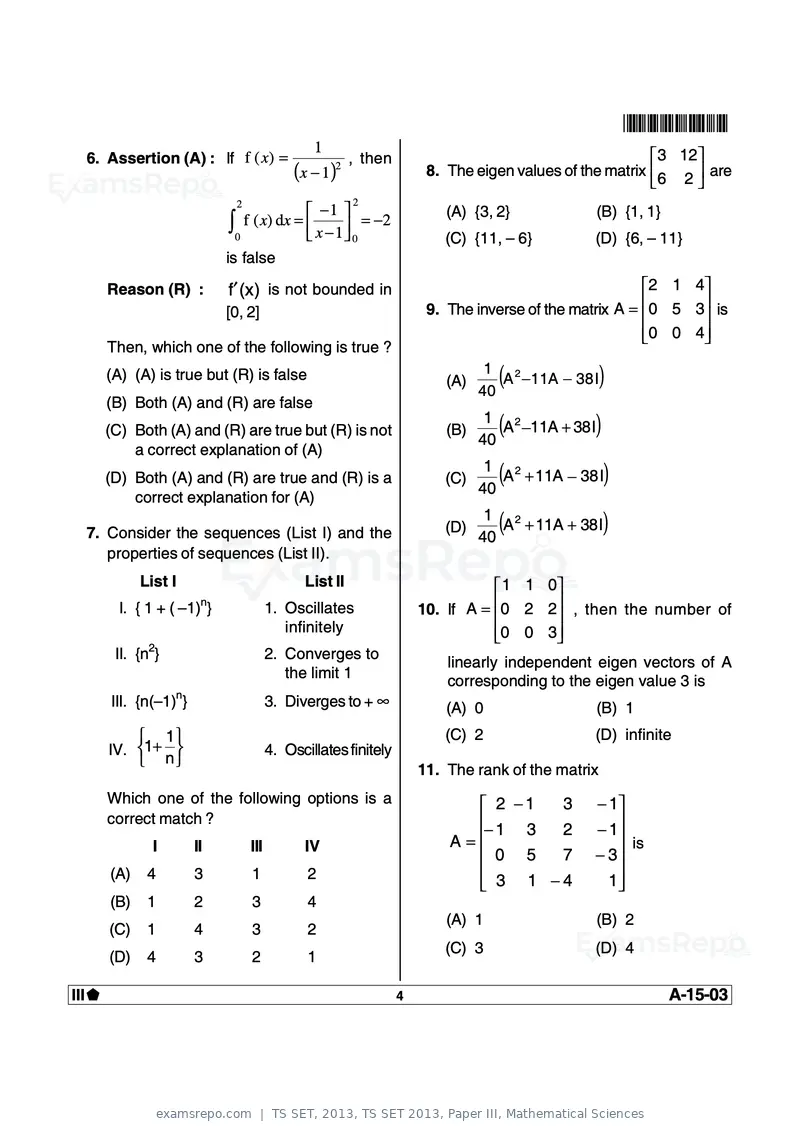
Text of page 4
*A1503*
                                                1
 6. Assertion (A) : If f ( x ) =                         , then                                          ⎡3 12⎤
                                             (x − 1 )
                                                    2
                                                                       8. The eigen values of the matrix ⎢    ⎥ are
                                                                                                         ⎣6 2 ⎦
                              2                          2
                                             ⎡ −1 ⎤                       (A) {3, 2}              (B) {1, 1}
                             ∫0 f ( x) dx = ⎢⎣ x − 1⎥⎦ 0 = −2
                                                                         (C) {11, – 6}         (D) {6, – 11}
                            is false
       Reason (R) :         f′ (x) is not bounded in                                                    ⎡2 1 4⎤
                                                                                                        ⎢       ⎥
                            [0, 2]                                     9. The inverse of the matrix A = ⎢0 5 3⎥ is
                                                                                                        ⎢⎣0 0 4⎥⎦
       Then, which one of the following is true ?
       (A) (A) is true but (R) is false                                   (A)     (
                                                                                 1 2_
                                                                                40
                                                                                   A 11A _ 38 I    )
       (B) Both (A) and (R) are false
       (C) Both (A) and (R) are true but (R) is not                       (B)     (
                                                                                 1 2_
                                                                                40
                                                                                   A 11A + 38 I)
           a correct explanation of (A)
       (D) Both (A) and (R) are true and (R) is a                        (C)      (
                                                                                 1 2
                                                                                40
                                                                                   A + 11A _ 38 I   )
           correct explanation for (A)

 7. Consider the sequences (List I) and the                              (D)      (
                                                                                 1 2
                                                                                40
                                                                                   A + 11A + 38 I   )
    properties of sequences (List II).
             List I                            List II                           ⎡ 1 1 0⎤
                        n
         I. { 1 + ( –1) }               1. Oscillates                            ⎢       ⎥
                                                                      10. If A = ⎢0 2 2⎥ , then the number of
                                           infinitely                            ⎢⎣0 0 3⎥⎦
        II. {n2}                        2. Converges to
                                                                          linearly independent eigen vectors of A
                                           the limit 1
                                                                          corresponding to the eigen value 3 is
                   n
       III. {n(–1) }                    3. Diverges to + ∞                (A) 0                   (B) 1
           ⎧ 1⎫                                                          (C) 2                 (D) infinite
       IV. ⎨1+ ⎬                        4. Oscillates finitely
           ⎩ n⎭
                                                                      11. The rank of the matrix
       Which one of the following options is a                              ⎡ 2 −1 3           − 1⎤
       correct match ?                                                      ⎢− 1 3 2           − 1⎥⎥
               I       II         III          IV                         A=⎢                        is
                                                                            ⎢ 0 5  7           − 3⎥
       (A)    4        3          1            2                            ⎢                      ⎥
                                                                            ⎣ 3 1 −4             1⎦
       (B)    1        2          3            4
                                                                          (A) 1                   (B) 2
       (C)    1        4          3            2
                                                                         (C) 3                 (D) 4
       (D)    4        3          2            1

IIIÀ                                                              4                                            A-15-03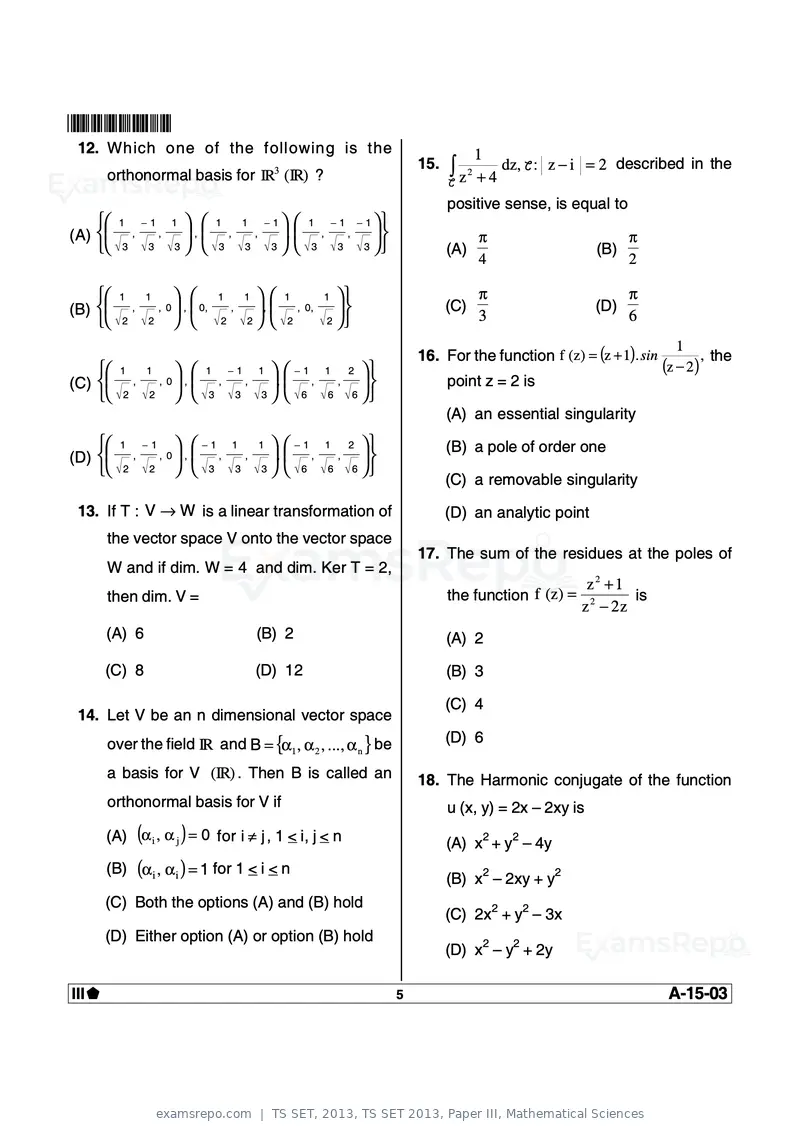
Text of page 5
*A1503*
12. Which one of the following is the 1
3 15. ∫ dz, : z − i = 2 described in the
orthonormal basis for IR (IR) ? 2
z +4
positive sense, is equal to
⎧⎛ 1 − 1 1 ⎞ ⎛ 1 1 − 1 ⎞ ⎛ 1 − 1 − 1 ⎞⎫
(A) ⎨⎜ , , ⎟ , ⎜ , , ⎟, ⎜ , , ⎟⎬ π π
⎩⎝ 3 3 3 ⎠ ⎝ 3 3 3 ⎠ ⎝ 3 3 3 ⎠⎭ (A) (B)
4 2
⎧⎛ 1 1 ⎞ ⎛ 1 1 ⎞ ⎛ 1 1 ⎞⎫ π π
(B) ⎨⎜ , , 0 ⎟ , ⎜ 0, , ⎟, ⎜ , 0, ⎟ ⎬ (C) (D)
⎩⎝ 2 2 ⎠ ⎝ 2 2 ⎠ ⎝ 2 2 ⎠⎭ 3 6
1
16. For the function f (z) = (z + 1). sin , the
⎧⎛ 1 1 ⎞ ⎛ 1 − 1 1 ⎞ ⎛ − 1 1 2 ⎞ ⎫ (z − 2 )
(C) ⎨⎜ , , 0⎟ , ⎜ , , ⎟, ⎜ , , ⎟ ⎬ point z = 2 is
⎩⎝ 2 2 ⎠ ⎝ 3 3 3 ⎠ ⎝ 6 6 6 ⎠ ⎭
(A) an essential singularity
⎧⎛ 1 − 1 ⎞ ⎛ − 1 1 1 ⎞ ⎛ − 1 1 2 ⎞ ⎫ (B) a pole of order one
(D) ⎨⎜ , , 0⎟ , ⎜ , , ⎟, ⎜ , , ⎟ ⎬
⎩⎝ 2 2 ⎠ ⎝ 3 3 3 ⎠ ⎝ 6 6 6 ⎠ ⎭
(C) a removable singularity
13. If T : V → W is a linear transformation of (D) an analytic point
the vector space V onto the vector space
17. The sum of the residues at the poles of
W and if dim. W = 4 and dim. Ker T = 2,
z2 + 1
then dim. V = the function f (z ) = is
z 2 − 2z
(A) 6 (B) 2 (A) 2
(C) 8 (D) 12 (B) 3
(C) 4
14. Let V be an n dimensional vector space
over the field IR and B = {α1 , α2 , ..., α n } be (D) 6
a basis for V (IR) . Then B is called an 18. The Harmonic conjugate of the function
orthonormal basis for V if u (x, y) = 2x – 2xy is
(A) (α i , α j ) = 0 for i ≠ j , 1 < i, j < n 2
(A) x + y – 4y
2
(B) (αi , αi ) = 1 for 1 < i < n 2 2
(B) x – 2xy + y
(C) Both the options (A) and (B) hold
(C) 2x2 + y2 – 3x
(D) Either option (A) or option (B) hold
(D) x2 – y2 + 2y
IIIÀ 5 A-15-03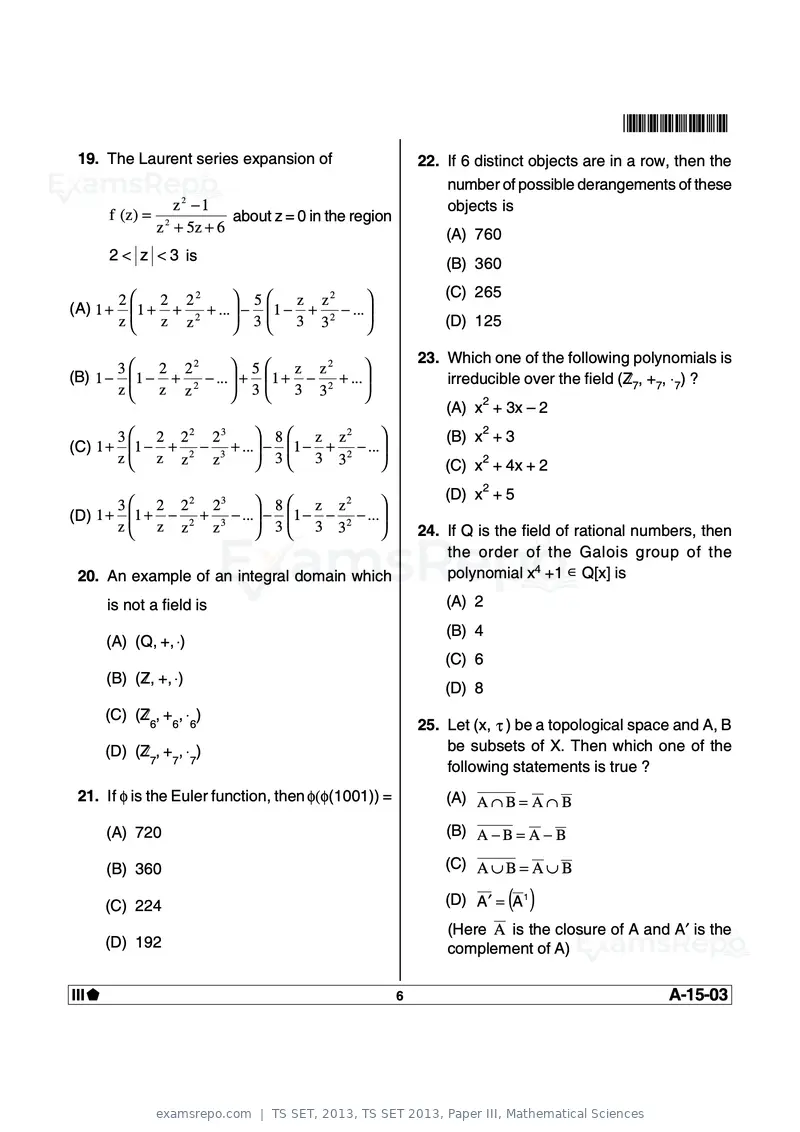
Text of page 6
*A1503*
 19. The Laurent series expansion of                           22. If 6 distinct objects are in a row, then the
                                                                   number of possible derangements of these
                      z2 −1                                        objects is
       f (z ) =                about z = 0 in the region
                  z 2 + 5z + 6                                     (A) 760
       2 < z < 3 is
                                                                   (B) 360

          2⎛   2 22        ⎞ 5⎛    z z2         ⎞                  (C) 265
(A) 1 +    ⎜1 + +    + ... ⎟ − ⎜1 − +    − ... ⎟⎟
           ⎜
          z⎝   z z 2       ⎟   ⎜       2
                                                                   (D) 125
                           ⎠ 3⎝    3 3          ⎠

                                                               23. Which one of the following polynomials is
       3⎛     2 22        ⎞ 5⎛      z z2        ⎞
(B) 1 − ⎜⎜ 1 − + 2 − ... ⎟⎟ + ⎜⎜ 1 + − 2 + ... ⎟⎟                  irreducible over the field (Z7, +7, ⋅7) ?
       z⎝     z z         ⎠ 3⎝      3 3         ⎠                       2
                                                                   (A) x + 3x – 2
        3 ⎛ 2 22 23          ⎞ 8 ⎛ z z2        ⎞                   (B) x2 + 3
(C) 1 +    ⎜ 1 − + −   + ... ⎟ − ⎜ 1 − + − ... ⎟
        z ⎜⎝ z z 2 z 3       ⎟ 3 ⎜ 3 32
                             ⎠   ⎝
                                               ⎟
                                               ⎠                        2
                                                                   (C) x + 4x + 2
                                                                        2
                                                                   (D) x + 5
       3 ⎛ 2 2 2 23          ⎞ 8 ⎛ z z2            ⎞
(D) 1 + ⎜⎜1 + − 2 + 3 − ... ⎟⎟ − ⎜⎜ 1 − − 2 − ... ⎟⎟
       z⎝ z z      z         ⎠ 3⎝ 3 3              ⎠           24. If Q is the field of rational numbers, then
                                                                   the order of the Galois group of the
 20. An example of an integral domain which                        polynomial x4 +1 ∈ Q[x] is

       is not a field is                                           (A) 2
                                                                   (B) 4
       (A) (Q, +, ⋅)
                                                                   (C) 6
       (B) (Z, +, ⋅)
                                                                   (D) 8
       (C) (Z6, +6, ⋅6)
                                                               25. Let (x, τ ) be a topological space and A, B
       (D) (Z , + , ⋅ )                                            be subsets of X. Then which one of the
              7     7   7
                                                                   following statements is true ?
 21. If φ is the Euler function, then φ(φ(1001)) =                 (A) A ∩ B = A ∩ B

       (A) 720                                                     (B) A − B = A − B

       (B) 360                                                     (C) A ∪ B = A ∪ B

       (C) 224                                                               ( )
                                                                   (D) A ′ = A 1
                                                                   (Here A is the closure of A and A′ is the
       (D) 192                                                     complement of A)

IIIÀ                                                       6                                         A-15-03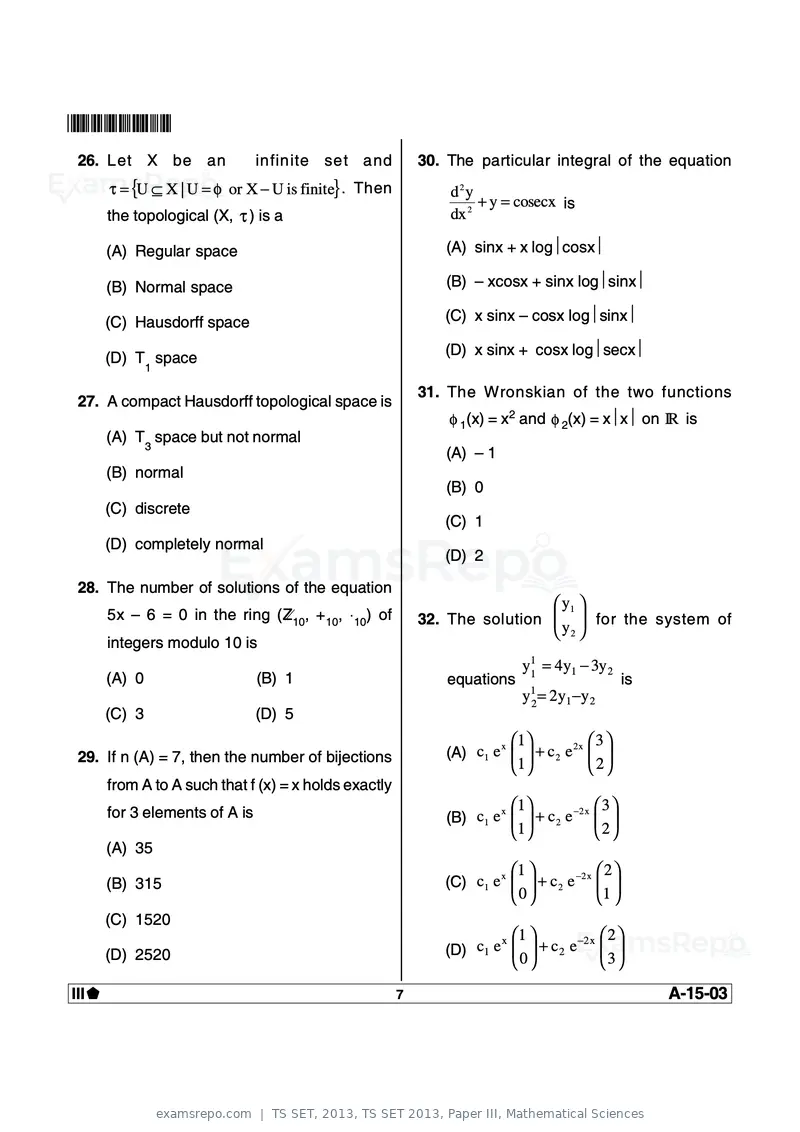
Text of page 7
*A1503*
26. Let X be an                 infinite set and           30. The particular integral of the equation
       τ = {U ⊆ X | U = φ or X − U is finite} . Then           d2 y
                                                                    + y = cosecx is
       the topological (X, τ ) is a                            dx 2

       (A) Regular space                                      (A) sinx + x log⏐cosx⏐

       (B) Normal space                                       (B) – xcosx + sinx log⏐sinx⏐

       (C) Hausdorff space                                    (C) x sinx – cosx log⏐sinx⏐

                                                              (D) x sinx + cosx log⏐secx⏐
       (D) T space
               1

                                                           31. The Wronskian of the two functions
27. A compact Hausdorff topological space is
                                                               φ 1(x) = x2 and φ 2(x) = x⏐x⏐ on IR is
       (A) T space but not normal
               3
                                                              (A) – 1
       (B) normal
                                                              (B) 0
       (C) discrete
                                                              (C) 1
       (D) completely normal
                                                              (D) 2

28. The number of solutions of the equation
                                                                             ⎛ y1 ⎞
       5x – 6 = 0 in the ring (Z10, +10, ⋅10) of           32. The solution ⎜⎜ ⎟⎟ for the system of
                                                                             ⎝ y2 ⎠
       integers modulo 10 is
                                                                            y11 = 4y1 − 3y 2
       (A) 0                    (B) 1                          equations                         is
                                                                            y12 = 2y1 −y 2
       (C) 3                    (D) 5
                                                                      x ⎛1⎞         2x ⎛ 3 ⎞
29. If n (A) = 7, then the number of bijections               (A) c1 e ⎜⎜ ⎟⎟ + c 2 e ⎜⎜ ⎟⎟
                                                                        ⎝1⎠            ⎝2⎠
       from A to A such that f (x) = x holds exactly
       for 3 elements of A is                                         x ⎛1⎞         −2 x ⎛ 3 ⎞
                                                              (B) c1 e ⎜⎜ ⎟⎟ + c 2 e ⎜⎜ ⎟⎟
                                                                        ⎝1⎠              ⎝2⎠
       (A) 35
                                                                      x ⎛1 ⎞        −2 x ⎛ 2 ⎞
       (B) 315                                                (C) c1 e ⎜⎜ ⎟⎟ + c 2 e ⎜⎜ ⎟⎟
                                                                        ⎝0⎠              ⎝1 ⎠
       (C) 1520
                                                                      x ⎛1 ⎞        −2 x ⎛ 2 ⎞
       (D) 2520                                               (D) c1 e ⎜⎜ ⎟⎟ + c 2 e ⎜⎜ ⎟⎟
                                                                        ⎝0⎠              ⎝3 ⎠

IIIÀ                                                   7                                              A-15-03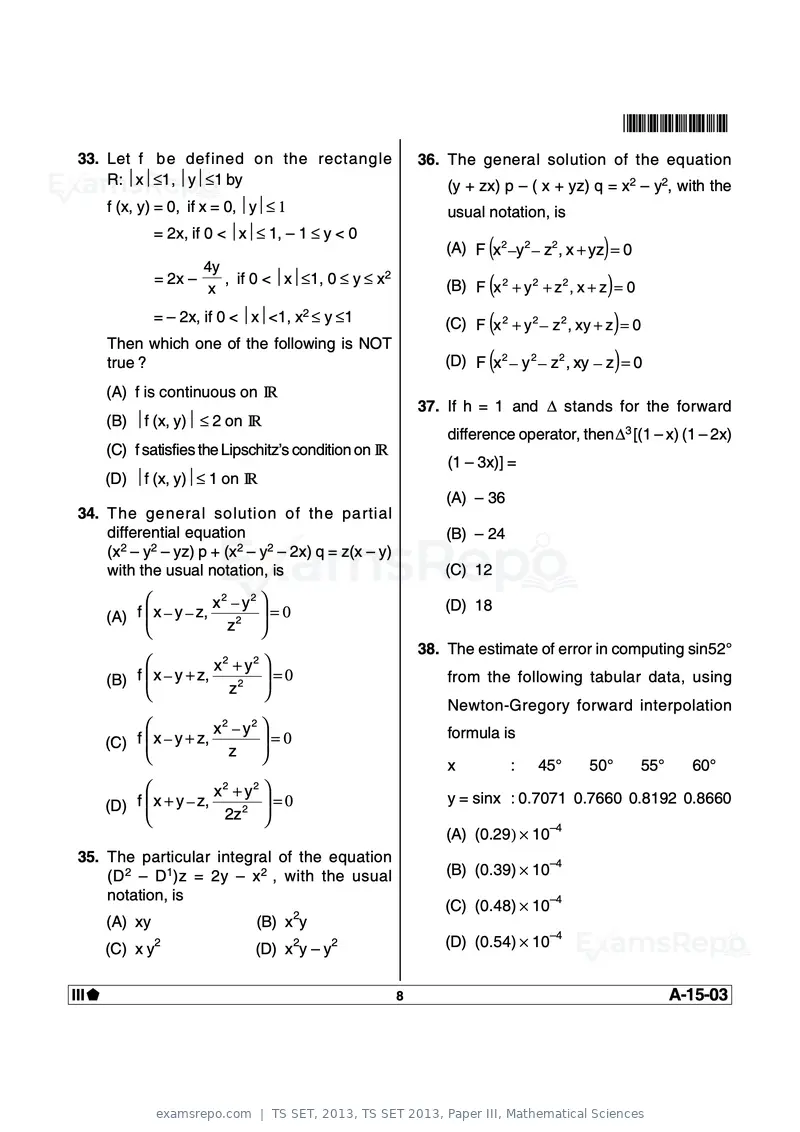
Text of page 8
*A1503*
33. Let f be defined on the rectangle                        36. The general solution of the equation
    R: ⏐x⏐≤1, ⏐y⏐≤1 by                                           (y + zx) p – ( x + yz) q = x2 – y2, with the
       f (x, y) = 0, if x = 0, ⏐y⏐≤ 1                            usual notation, is
                = 2x, if 0 < ⏐x⏐≤ 1, – 1 ≤ y < 0
                                                                      (                 )
                                                                 (A) F x2 _y2 _ z2 , x + yz = 0
                       4y
                = 2x –
                        x
                          , if 0 < ⏐x⏐≤1, 0 ≤ y ≤ x2            (B) F (x + y + z , x + z ) = 0
                                                                          2       2         2


                = – 2x, if 0 < ⏐x⏐<1, x2 ≤ y ≤1                 (C) F (x + y _ z , xy + z ) = 0
                                                                          2       2     2

       Then which one of the following is NOT
       true ?                                                   (D) F (x _ y _ z , xy _ z ) = 0
                                                                          2       2     2


       (A) f is continuous on IR
                                                             37. If h = 1 and Δ stands for the forward
       (B) ⏐f (x, y)⏐ ≤ 2 on IR
                                                                 difference operator, then Δ3 [(1 – x) (1 – 2x)
       (C) f satisfies the Lipschitz’s condition on IR
                                                                 (1 – 3x)] =
       (D) ⏐f (x, y)⏐≤ 1 on IR
                                                                 (A) – 36
34. The general solution of the partial
    differential equation                                        (B) – 24
    (x2 – y2 – yz) p + (x2 – y2 – 2x) q = z(x – y)
    with the usual notation, is                                 (C) 12
             ⎛ _ _ x2 _ y2 ⎞                                    (D) 18
       (A) ⎜⎜ x y z,
           f           2
                           ⎟=0
                           ⎟
             ⎝       z     ⎠
                                                             38. The estimate of error in computing sin52°
             ⎛ _        x 2 + y 2 ⎞⎟
           f
       (B) ⎜ ⎜ x y + z,              =0                          from the following tabular data, using
             ⎝             z 2 ⎟⎠
                                                                 Newton-Gregory forward interpolation
             ⎛ _
             ⎜          x 2 _ y 2 ⎞⎟                             formula is
           f
       (C) ⎜   x y + z,            ⎟=0
             ⎝             z       ⎠
                                                                 x            :       45°       50°    55°     60°
              ⎛      _ x + y ⎞⎟ = 0
                          2     2

       (D) f ⎜⎜ x + y z,                                         y = sinx : 0.7071 0.7660 0.8192 0.8660
              ⎝          2z 2 ⎟⎠
                                                                                       –4
                                                                 (A) (0.29) × 10
35. The particular integral of the equation                                            –4
    (D 2 – D1)z = 2y – x 2 , with the usual                      (B) (0.39) × 10
    notation, is                                                                       –4
                                                                (C) (0.48) × 10
                                         2
       (A) xy                   (B) x y
                                                                                       –4
       (C) x y  2
                                (D) x2y – y2                    (D) (0.54) × 10


IIIÀ                                                     8                                                   A-15-03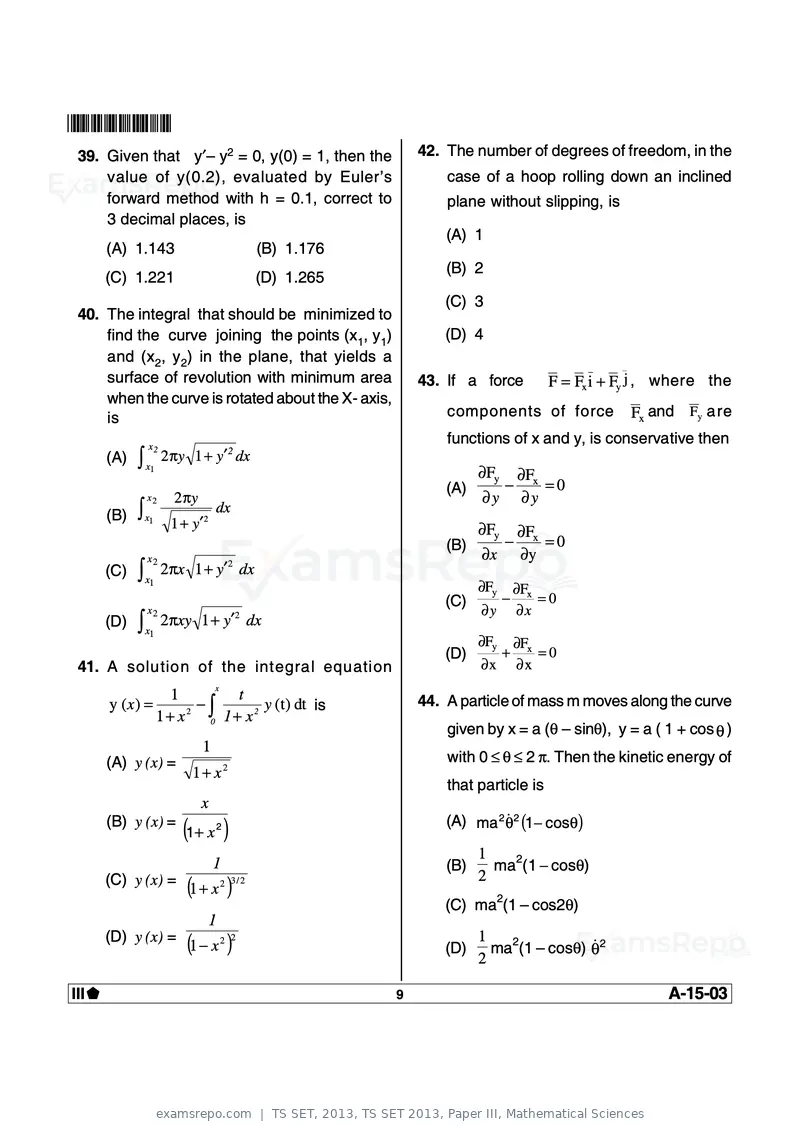
Text of page 9
*A1503*
39. Given that y′– y2 = 0, y(0) = 1, then the                    42. The number of degrees of freedom, in the
    value of y(0.2), evaluated by Euler’s                            case of a hoop rolling down an inclined
    forward method with h = 0.1, correct to                          plane without slipping, is
    3 decimal places, is
                                                                     (A) 1
       (A) 1.143                                 (B) 1.176
                                                                     (B) 2
       (C) 1.221                                 (D) 1.265
                                                                     (C) 3
40. The integral that should be minimized to
    find the curve joining the points (x1, y1)                       (D) 4
    and (x2, y2) in the plane, that yields a
    surface of revolution with minimum area                      43. If a force          F = Fx i + Fy j , where the
    when the curve is rotated about the X- axis,
    is                                                               components of force             Fx and Fy are
              x2
                                                                     functions of x and y, is conservative then
       (A) ∫ x 2 πy 1 + y′ dx
                                         2
                 1
                                                                           ∂Fy       ∂Fx
                                                                     (A)         −       =0
             x2         2 πy                                               ∂y         ∂y
       (B) ∫ x1
                                    dx
                       1 + y′   2
                                                                           ∂Fy       ∂Fx
                                                                     (B)         −       =0
             x2                                                            ∂x        ∂y
       (C) ∫ x       2πx 1 + y′2 dx
              1
                                                                           ∂Fy       ∂Fx
                                                                     (C)         −       =0
             x2                                                            ∂y        ∂x
       (D) ∫ x 2πxy 1 + y′ dx
                          2
              1
                                                                           ∂Fy       ∂Fx
                                                                     (D)         +       =0
41. A solution of the integral equation                                    ∂x        ∂x
                                    x
                       1         t                               44. A particle of mass m moves along the curve
       y ( x) =             −∫        y (t) dt is
                     1+ x 2
                             0 1+ x
                                    2

                                                                     given by x = a (θ – sinθ), y = a ( 1 + cos θ )
                               1
       (A) y (x) =                                                   with 0 ≤ θ ≤ 2 π. Then the kinetic energy of
                           1 + x2
                                                                     that particle is
                               x
                                                                     (A) ma 2 θ2 (1− cosθ)
       (B) y (x) =
                         (1+ x )    2


                                                                           1   2
                                    1                                (B)     ma (1 − cosθ)
                                                                           2
       (C) y (x) =
                          (1 + x )      2 3/ 2

                                                                     (C) ma2(1 – cos2θ)
                                    1
       (D) y (x) =
                          (1 − x )      2 2
                                                                     (D)
                                                                           1
                                                                           2
                                                                             ma (1 – cosθ) θ 2
                                                                               2


IIIÀ                                                         9                                            A-15-03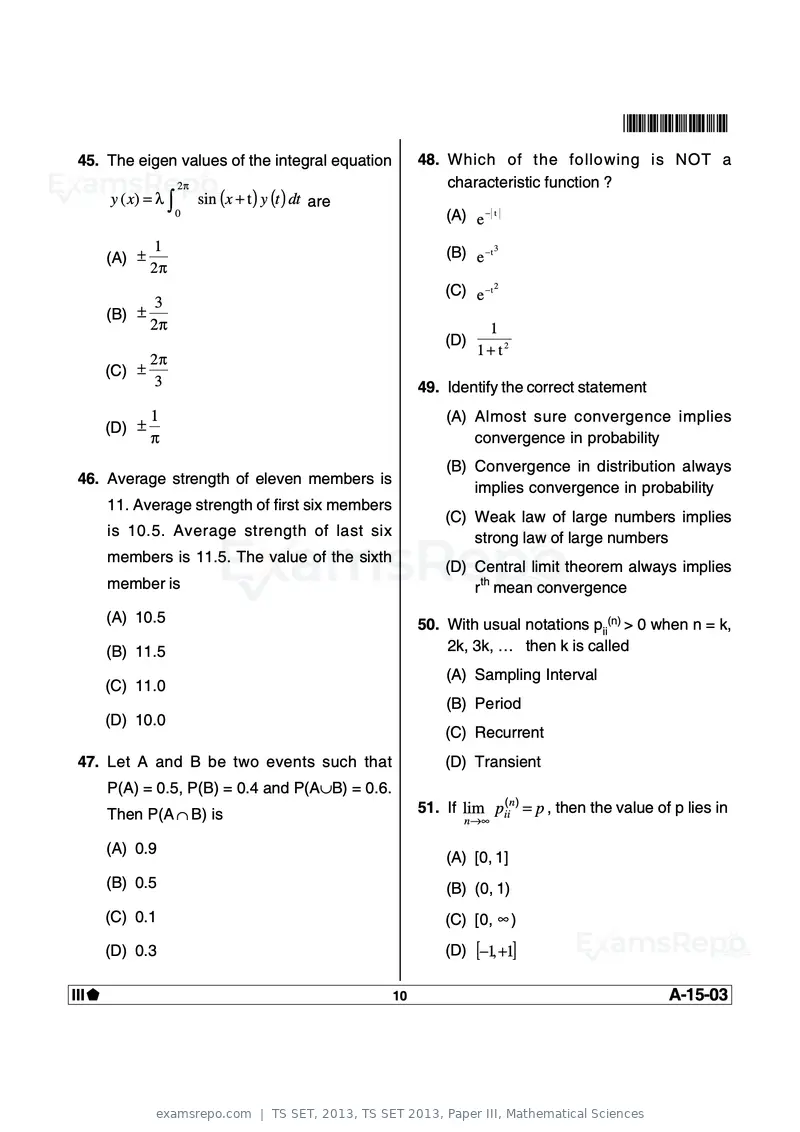
Text of page 10
*A1503*
45. The eigen values of the integral equation                48. Which of the following is NOT a
                      2π                                         characteristic function ?
       y ( x) = λ ∫        sin (x + t ) y (t ) dt are
                      0                                          (A) e − t
                1                                                (B) e − t 3
       (A) ±
               2π
                                                                 (C) e − t 2
                3
       (B) ±
               2π                                                       1
                                                                 (D)
                                                                       1+ t2
               2π
       (C) ±
                3                                            49. Identify the correct statement
               1                                                 (A) Almost sure convergence implies
       (D) ±
               π                                                     convergence in probability
                                                                 (B) Convergence in distribution always
46. Average strength of eleven members is
                                                                     implies convergence in probability
       11. Average strength of first six members
                                                                 (C) Weak law of large numbers implies
       is 10.5. Average strength of last six                         strong law of large numbers
       members is 11.5. The value of the sixth
                                                                 (D) Central limit theorem always implies
       member is                                                     rth mean convergence
       (A) 10.5                                              50. With usual notations pii(n) > 0 when n = k,
       (B) 11.5                                                  2k, 3k, … then k is called
                                                                 (A) Sampling Interval
       (C) 11.0
                                                                 (B) Period
       (D) 10.0
                                                                 (C) Recurrent
47. Let A and B be two events such that                          (D) Transient
       P(A) = 0.5, P(B) = 0.4 and P(A∪B) = 0.6.
       Then P(A ∩ B) is                                      51. If lim pii( n) = p , then the value of p lies in
                                                                    n →∞

       (A) 0.9
                                                                 (A) [0, 1]
       (B) 0.5                                                   (B) (0, 1)
       (C) 0.1                                                   (C) [0, ∞ )
       (D) 0.3                                                   (D) [−1, +1]

IIIÀ                                                    10                                             A-15-03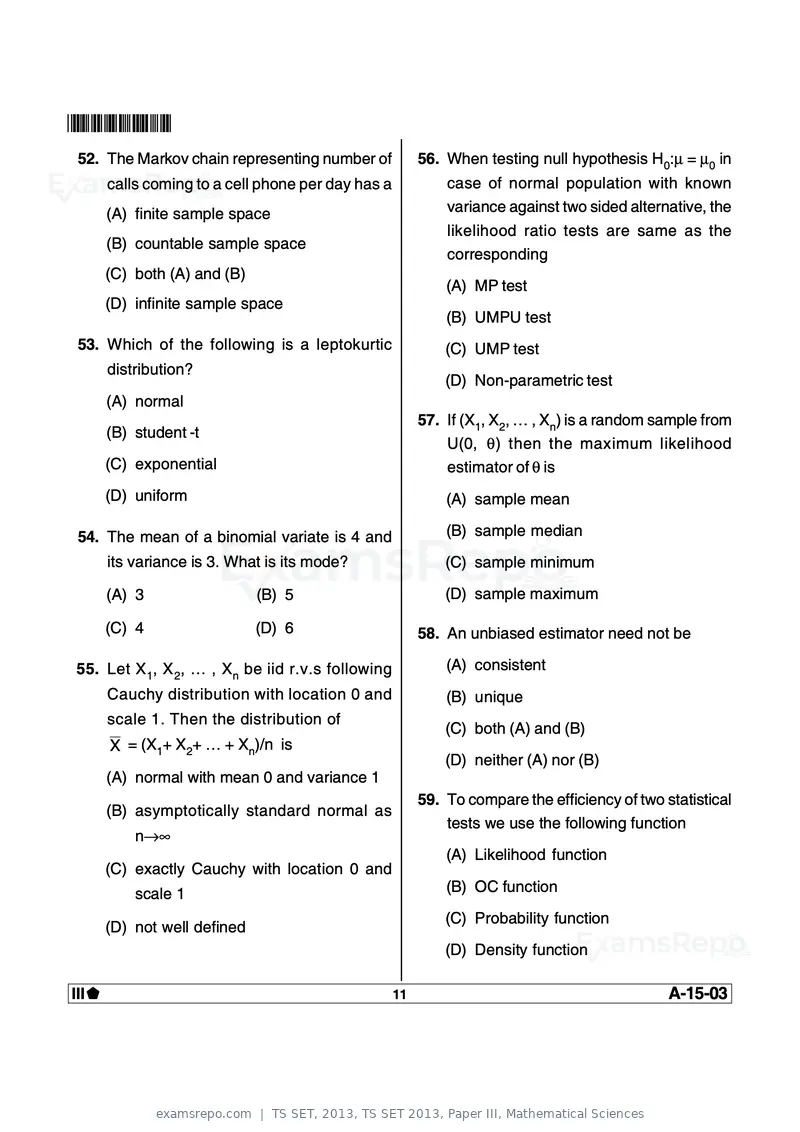
Text of page 11
*A1503*
52. The Markov chain representing number of              56. When testing null hypothesis H0:μ = μ0 in
       calls coming to a cell phone per day has a            case of normal population with known
       (A) finite sample space                               variance against two sided alternative, the
                                                             likelihood ratio tests are same as the
       (B) countable sample space
                                                             corresponding
       (C) both (A) and (B)
                                                             (A) MP test
       (D) infinite sample space
                                                             (B) UMPU test
53. Which of the following is a leptokurtic                  (C) UMP test
       distribution?
                                                             (D) Non-parametric test
       (A) normal
                                                         57. If (X1, X2, … , Xn) is a random sample from
       (B) student -t
                                                             U(0, θ) then the maximum likelihood
       (C) exponential                                       estimator of θ is
       (D) uniform                                           (A) sample mean

54. The mean of a binomial variate is 4 and                  (B) sample median
       its variance is 3. What is its mode?                  (C) sample minimum

       (A) 3                  (B) 5                          (D) sample maximum

       (C) 4                  (D) 6                      58. An unbiased estimator need not be

55. Let X 1, X 2, … , Xn be iid r.v.s following              (A) consistent
       Cauchy distribution with location 0 and               (B) unique
       scale 1. Then the distribution of
                                                             (C) both (A) and (B)
       X = (X1+ X2+ … + Xn)/n is
                                                             (D) neither (A) nor (B)
       (A) normal with mean 0 and variance 1
                                                         59. To compare the efficiency of two statistical
       (B) asymptotically standard normal as
                                                             tests we use the following function
           n→∞
                                                             (A) Likelihood function
       (C) exactly Cauchy with location 0 and
           scale 1                                           (B) OC function
                                                             (C) Probability function
       (D) not well defined
                                                             (D) Density function

IIIÀ                                                11                                         A-15-03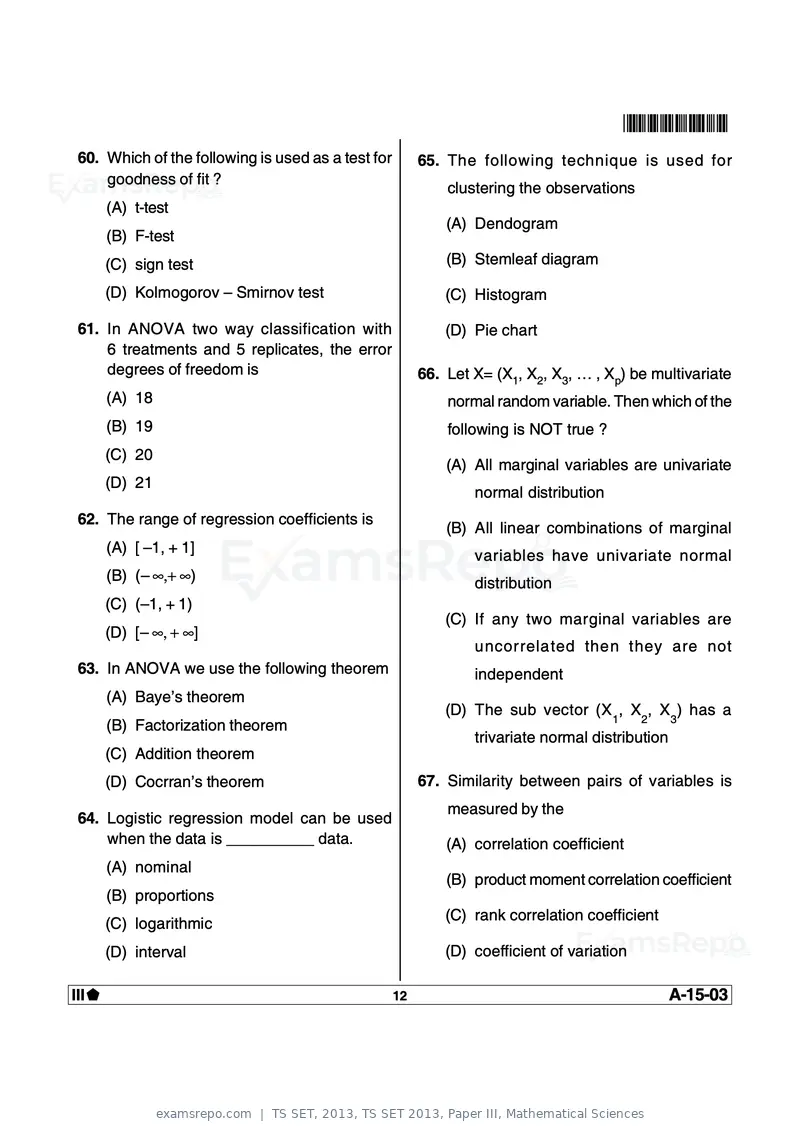
Text of page 12
*A1503*
60. Which of the following is used as a test for        65. The following technique is used for
    goodness of fit ?
                                                            clustering the observations
       (A) t-test
                                                            (A) Dendogram
       (B) F-test
       (C) sign test                                        (B) Stemleaf diagram

       (D) Kolmogorov – Smirnov test                        (C) Histogram

61. In ANOVA two way classification with                    (D) Pie chart
    6 treatments and 5 replicates, the error
    degrees of freedom is                               66. Let X= (X1, X2, X3, … , Xp) be multivariate
       (A) 18                                               normal random variable. Then which of the
       (B) 19                                               following is NOT true ?
       (C) 20
                                                            (A) All marginal variables are univariate
       (D) 21
                                                                normal distribution
62. The range of regression coefficients is
                                                            (B) All linear combinations of marginal
       (A) [ –1, + 1]
                                                                variables have univariate normal
       (B) (– ∞,+ ∞)                                            distribution
       (C) (–1, + 1)
                                                            (C) If any two marginal variables are
       (D) [– ∞, + ∞]
                                                                uncorrelated then they are not
63. In ANOVA we use the following theorem                       independent
       (A) Baye’s theorem
                                                            (D) The sub vector (X , X , X ) has a
                                                                                      1    2     3
       (B) Factorization theorem
                                                                trivariate normal distribution
       (C) Addition theorem
       (D) Cocrran’s theorem                            67. Similarity between pairs of variables is
                                                            measured by the
64. Logistic regression model can be used
    when the data is __________ data.                       (A) correlation coefficient
       (A) nominal
                                                            (B) product moment correlation coefficient
       (B) proportions
                                                            (C) rank correlation coefficient
       (C) logarithmic
       (D) interval                                         (D) coefficient of variation

IIIÀ                                               12                                            A-15-03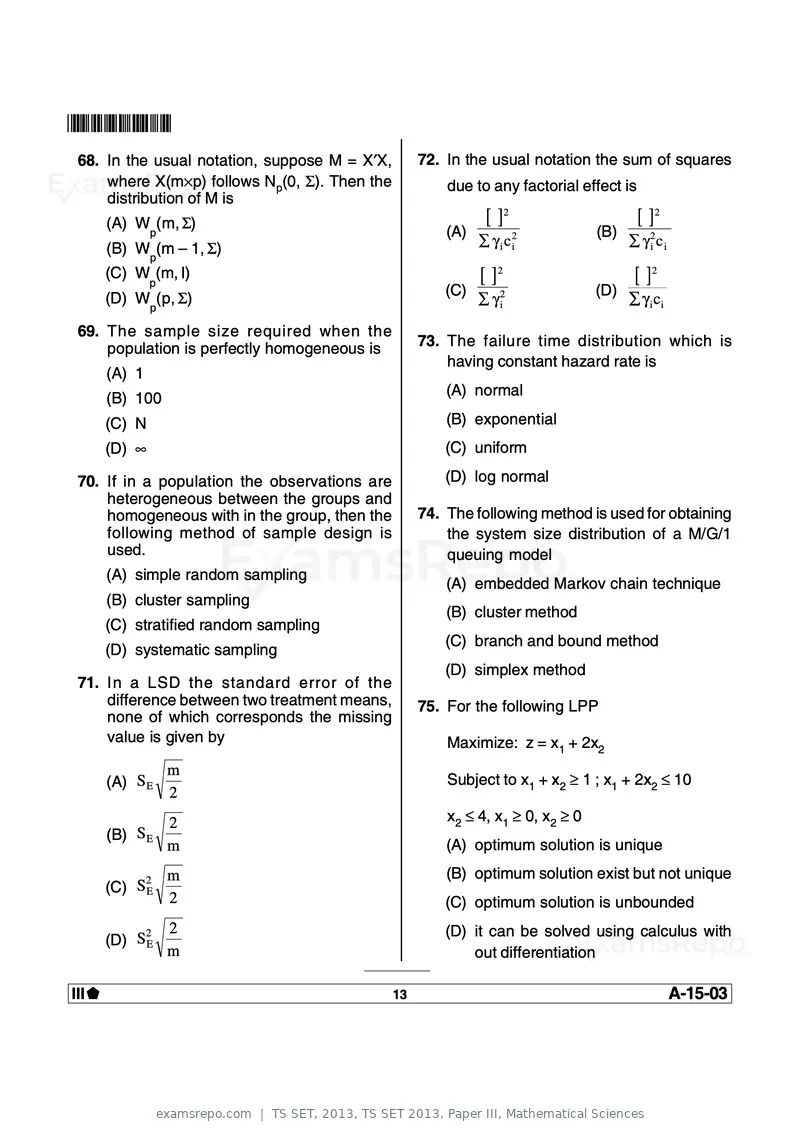
Text of page 13
*A1503*
68. In the usual notation, suppose M = X′X,        72. In the usual notation the sum of squares
    where X(m×p) follows Np(0, Σ). Then the            due to any factorial effect is
    distribution of M is
       (A) W (m, Σ)                                           [ ]2                      [ ]2
               p                                       (A)                      (B)
                                                             ∑ γ i c 2i               ∑ γ 2i c i
       (B) Wp(m – 1, Σ)
       (C) W (m, I)
               p                                             [ ]2                      [ ]2
                                                       (C)                      (D)
       (D) W (p, Σ)
               p
                                                             ∑ γ 2i                   ∑ γ i ci
69. The sample size required when the
    population is perfectly homogeneous is         73. The failure time distribution which is
                                                       having constant hazard rate is
       (A) 1
                                                       (A) normal
       (B) 100
       (C) N                                           (B) exponential
       (D) ∞                                           (C) uniform

70. If in a population the observations are            (D) log normal
    heterogeneous between the groups and
    homogeneous with in the group, then the        74. The following method is used for obtaining
    following method of sample design is               the system size distribution of a M/G/1
    used.                                              queuing model
       (A) simple random sampling
                                                       (A) embedded Markov chain technique
       (B) cluster sampling
                                                       (B) cluster method
       (C) stratified random sampling
                                                       (C) branch and bound method
       (D) systematic sampling
                                                       (D) simplex method
71. In a LSD the standard error of the
    difference between two treatment means,        75. For the following LPP
    none of which corresponds the missing
    value is given by                                  Maximize: z = x1 + 2x2
                   m
       (A) SE                                          Subject to x1 + x2 ≥ 1 ; x1 + 2x2 ≤ 10
                   2
                   2                                   x2 ≤ 4, x1 ≥ 0, x2 ≥ 0
       (B) SE
                   m                                   (A) optimum solution is unique

               2   m                                   (B) optimum solution exist but not unique
       (C) SE
                   2                                   (C) optimum solution is unbounded
               2   2                                   (D) it can be solved using calculus with
       (D) SE
                   m                                       out differentiation

IIIÀ                                          13                                                   A-15-03
Text of page 14
*A1503*
       Space for Rough Work


IIIÀ            14               A-15-03
Text of page 15
*A1503*
          Space for Rough Work


IIIÀ               15            A-15-03
Text of page 16
*A1503*
       Space for Rough Work


IIIÀ            16               A-15-03
Official key not published for this paper.
Page 1 of 16
Source: Telangana State Eligibility Test. Question paper published by Telangana State Eligibility Test.