
Machine-translated by Google. Questions are authored in English.
Top

AC Bridges Questions and Answers

1.

The Maxwell bridge shown in figure is at balance. The parameters of Inductive coil are :
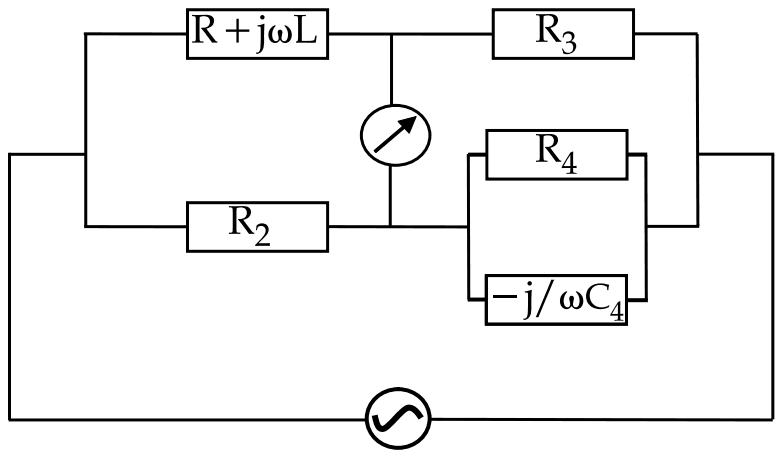
Maxwell bridge: R + jwL and R3 form the upper arms, R2 and the parallel pair R4 with minus j over w C4 form the lower arms; a detector joins the midpoints and the ac source is across the bridge

Exam Year(s)

RSMSSB JE - 2025, RSMSSB - 2025,

Answer: D

The coil parameters are \(R = R_{2}R_{3}/R_{4}\) and \(L = C_{4}R_{2}R_{3}\).

At balance the products of opposite arms are equal. The coil is opposite the parallel \(R_{4}C_{4}\) arm, whose admittance is \(\frac{1}{R_{4}} + j\omega C_{4}\), and \(R_{2}\) is opposite \(R_{3}\):

\[ \begin{aligned} (R + j\omega L) &= R_{2}R_{3}\left(\frac{1}{R_{4}} + j\omega C_{4}\right) \\ &= \frac{R_{2}R_{3}}{R_{4}} + j\omega C_{4}R_{2}R_{3} \end{aligned} \]

Equating real parts gives \(R = R_{2}R_{3}/R_{4}\), and equating imaginary parts gives \(L = C_{4}R_{2}R_{3}\). Balance is independent of frequency, which is the bridge's advantage. The first option swaps the two results, and the options with \(R_{4}/R_{2}R_{3}\) or \(1/(C_{4}R_{2}R_{3})\) invert them.

Please log in or register to report this question.

2.

Match the following lists :

List – IList – II
a. Maxwells bridgei. Measurement of unknown inductance
b. Hay’s bridgeii. Measurement of high Q of coils
c. Schering’s bridgeiii. Precision measurement of capacitance
d. Weins bridgeiv. To measure frequency

Codes : a b c d

Exam Year(s)

UGC NET - 2013,

Answer: A

Maxwell's bridge measures an unknown inductance (i), Hay's bridge is used for the measurement of coils with a high Q (ii), Schering's bridge is for precision measurement of capacitance (iii) and Wien's bridge measures frequency (iv). So the order is i, ii, iii, iv. The other codes swap the frequency measurement or the capacitance bridge with another.

Please log in or register to report this question.

Answer: A

The balance equation is an equality between two complex products, and a complex equation is two real equations. One fixes the magnitudes and the other the phase angles, so an alternating bridge always needs two independent adjustments worked alternately until the detector falls silent.

Please log in or register to report this question.

4.

The general balance condition of a four-arm alternating current bridge with arms \( Z_1 \), \( Z_2 \), \( Z_3 \) and \( Z_4 \) taken in order is

Answer: B

It is the same rule as for the Wheatstone bridge with impedances in place of resistances: the products of the opposite arms are equal. Written in polar form it separates at once into equal magnitude products and equal sums of phase angles.

Please log in or register to report this question.

Answer: C

With each impedance written as a magnitude at an angle, the two products give \( |Z_1||Z_4| = |Z_2||Z_3| \) together with \( \theta_1 + \theta_4 = \theta_2 + \theta_3 \). The second condition explains why a purely resistive arm cannot balance a purely reactive one.

Please log in or register to report this question.

Answer: D

The two resistive arms contribute zero to each side of the angle equation, so the sum of the angles of the other two must be zero on each side taken separately, which for arms on opposite sides means their angles must be equal. Both must therefore be inductive or both capacitive.

Please log in or register to report this question.

7.

If two opposite arms of an alternating bridge are pure resistances, the other two arms must be such that

Answer: A

Here one resistive arm falls in each product, so the angle of the remaining arm in one product must equal minus the angle of the remaining arm in the other for the sum to balance. One arm must therefore lag and the other lead, which is why the Maxwell-Wien bridge measures inductance against a capacitance.

Please log in or register to report this question.

Answer: B

The ear is remarkably good at detecting a minimum of tone, and headphones need no supply. Where greater sensitivity or a record is wanted, a tuned amplifier feeding an indicator or an oscilloscope is used instead. A moving coil galvanometer cannot respond to alternating unbalance at all.

Please log in or register to report this question.

Answer: C

Its moving system is mechanically resonant at the supply frequency, so it answers strongly to the fundamental and hardly at all to harmonics or to noise at other frequencies. That selectivity gives a sharp null, but it also confines the instrument to power and low audio frequencies.

Please log in or register to report this question.

Answer: D

The balance condition depends on the reactances, which vary with frequency, so a network balanced at the fundamental is not balanced for the harmonics. The residual harmonic voltage keeps the detector from going fully silent, which is why a tuned detector or a filtered source is used.

Please log in or register to report this question.

Loading…
Tags: AC Bridges Questions and Answers || AC Bridges MCQ Questions and Answers || AC Bridges GK Questions and Answers || AC Bridges GK MCQ Questions || AC Bridges Multiple Choice Questions and Answers || AC Bridges GK || GK on AC Bridges || Electrical Measurements Questions and Answers || Electrical Measurements MCQ Questions and Answers || Electrical Measurements GK Questions and Answers || GK on Electrical Measurements