81.
4, 8, 16, 32, 64… 256
Answer: A
Correct answer: 128
Each term is double the one before, so between 64 and 256 stands \( 64 \times 2 = \mathbf{128} \).
Please log in or register to report this question.
In each of the following questions, a number series is given with one term missing. Choose the correct alternative that will continue the same pattern.
4, 8, 16, 32, 64… 256
Answer: A
Correct answer: 128
Each term is double the one before, so between 64 and 256 stands \( 64 \times 2 = \mathbf{128} \).
Please log in or register to report this question.
5, 20, 80, 320, … 1280
Answer: A
Correct answer: 5120
Each term is four times the one before: \( 5, 20, 80, 320, 1280 \), so the term after 1280 is \[ 1280 \times 4 = \mathbf{5120} \]
Please log in or register to report this question.
3,6,9,12,15,…. 21
Answer: D
Correct answer: 18
The series rises by 3 each time, so between 15 and 21 stands \( 15 + 3 = \mathbf{18} \).
Please log in or register to report this question.
55, 50, 45, 40,….30
Answer: C
Correct answer: 35
The series falls by 5 each time, so between 40 and 30 stands \( 40 - 5 = \mathbf{35} \).
Please log in or register to report this question.
16, 24, 36,… 81
Answer: B
Correct answer: 54
Each term is one and a half times the one before: \( 16 \times \tfrac32 = 24 \), \( 24 \times \tfrac32 = 36 \), so \[ 36 \times \tfrac32 = \mathbf{54} \] and \( 54 \times \tfrac32 = 81 \), as shown.
Please log in or register to report this question.
Select the option that will replace the question mark (?) in the following series.

DSSSB - 2023,
Answer: A
The answer is option (A). Each of the four corner arrows turns by 90 degrees from one square to the next, and each corner has its own direction of turning. The top-left arrow turns clockwise (right, down, left, up) and the top-right arrow also turns clockwise (up, right, down, left). The bottom-left arrow turns anticlockwise (down, right, up, left) and the bottom-right arrow turns anticlockwise (left, down, right, up). One more step gives right at top-left, up at top-right, down at bottom-left and left at bottom-right. That is the arrangement shown in option (A). Options (B), (C) and (D) each have at least one corner arrow pointing the wrong way.
Please log in or register to report this question.
Select the figure from the given options that can replace the question mark (?) in the following series.

DSSSB - 2023,
Answer: D
In the three figures of the series the black wedge of the circle moves anticlockwise by one sector each time: it is at the lower right (between 3 and 4:30 on a clock face) in the first figure, then at the upper right (1:30 to 3), then at the top (12 to 1:30). One more step anticlockwise puts it at the upper left, from 10:30 to 12, which is the circle of option (D). Option (A) repeats the wedge position of the second figure, option (B) puts the wedge at the left, nine to ten-thirty, which skips a step, and option (C) puts it at the lower right again, so they do not continue the series. The answer is option (D).
Please log in or register to report this question.
Select the figure from the given options that can replace the question mark (?) in the following series.

DSSSB - 2023,
Answer: C
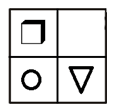
Follow each shape from figure to figure in the 2 by 2 grid. The circle moves clockwise from the top left to the top right, the bottom right and then the bottom left, and it alternates between open and filled. The square moves clockwise too, from the top right to the bottom right, the bottom left and then the top left. The triangle moves clockwise from the bottom left through the top left and top right, alternating between upright and inverted. In the fourth figure the square is therefore at the top left, the filled circle at the bottom left and an inverted triangle at the bottom right, which is option (C). The other options place the shapes in cells they cannot be in.
Please log in or register to report this question.
Select the figure from among the following options that can replace the question mark (?) in the given series.

DSSSB - 2023,
Answer: C
The missing figure is option 3.
In the three given figures, the filled circle moves one corner at a time, from the bottom right to the top right and then to the top left. The next corner in that direction is the bottom left. The other symbols keep their places in the pattern, so the figure with the filled circle at the bottom left is the one that continues the series, and that is option 3.
Options 1, 2 and 4 put the filled circle at the wrong corner.
The filled circle travels round the corners in a fixed direction: bottom right in the first figure, top right in the second and top left in the third. The fourth position in that direction is the bottom left. Among the answer figures only option 3 has the filled circle at the bottom left.
Please log in or register to report this question.
In the sequence of tiles shown below, the missing tile indicated by the question mark should be

GATE AE - 2026,
Answer: B
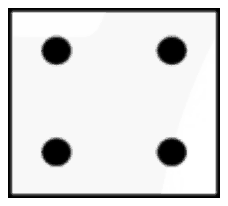
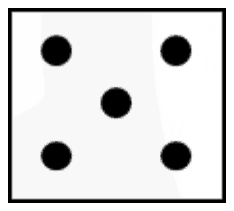
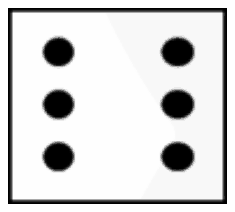
The missing tile is (B), the tile with five dots (four corners and the centre).
Count the dots in the given tiles: 2, 3, ?, 7, 11. These are consecutive prime numbers, and the prime between 3 and 7 is 5. The fourth tile holds 3 + 1 + 3 = 7 dots and the fifth 4 + 3 + 4 = 11, which confirms the pattern.
Tile (A) has 4 dots, (C) has 6 and (D) has 8, and none of 4, 6 or 8 is prime, so only (B) continues the sequence of primes 2, 3, 5, 7, 11.
Please log in or register to report this question.