
Machine-translated by Google. Questions are authored in English.
Top

Free Vibration of Single Degree Systems Questions and Answers

1.

A thin uniform rigid bar of length L and mass M is hinged at point O, located at a distance of \(\frac{L}{3}\) from one of its ends. The bar is further supported using springs, each of stiffness k, located at the two ends. A particle of mass \(m = \frac{M}{4}\) is fixed at one end of the bar, as shown in the figure. For small rotations of the bar about O, the natural frequency of the system is

Horizontal bar of length L hinged at O, L/3 from the left end; springs of stiffness k connect both ends to the ground; particle m sits at the right end, 2L/3 from O

Exam Year(s)

GATE ME - 2017,

Answer: B

The natural frequency is \(\sqrt{\frac{5k}{2M}}\).

Take moments about O for a small rotation \(\theta\). The bar's centre is L/6 from O, the left spring is L/3 from O, and the right spring and the particle are 2L/3 from O.

\[ \begin{aligned} I_{O} &= \tfrac{ML^{2}}{12} + M\left(\tfrac{L}{6}\right)^{2} + \tfrac{M}{4}\left(\tfrac{2L}{3}\right)^{2} = \tfrac{2ML^{2}}{9} \\ k_{\theta} &= k\left(\tfrac{L}{3}\right)^{2} + k\left(\tfrac{2L}{3}\right)^{2} = \tfrac{5kL^{2}}{9} \end{aligned} \]

\[ \begin{aligned} \omega_{n} &= \sqrt{\frac{k_{\theta}}{I_{O}}} \\ &= \sqrt{\frac{5k}{2M}} \end{aligned} \]

Leaving out the particle's inertia gives \(\sqrt{5k/M}\); the 3k forms come from miscounting the spring arms.

Please log in or register to report this question.
2.

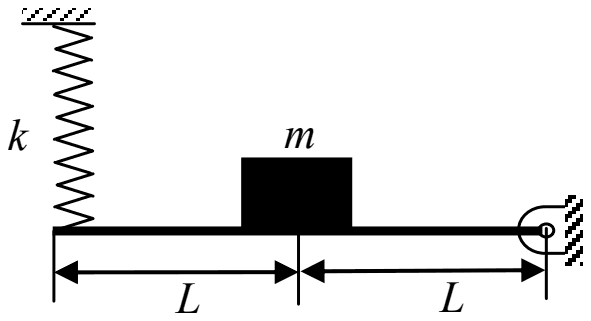
A concentrated mass m is attached at the centre of a rod of length 2L as shown in the figure. The rod is kept in a horizontal equilibrium position by a spring of stiffness k. For very small amplitude of vibration, neglecting the weights of the rod and spring, the undamped natural frequency of the system is

A horizontal rod hinged at its right end and hung from a vertical spring k at its left end, with the mass m at its midpoint, a distance L from each end

Exam Year(s)

GATE ME - 2012,

Answer: D

The natural frequency is \(\sqrt{\frac{4k}{m}}\).

The rod is hinged at its right end, the mass sits at distance L from the hinge, and the spring acts at distance 2L. For a small rotation \(\theta\) about the hinge, the mass moves \(L\theta\) and the spring stretches \(2L\theta\). Taking moments about the hinge:

\[ \begin{aligned} mL^{2}\ddot{\theta} + k(2L)^{2}\theta &= 0 \\ \omega_{n}^{2} &= \frac{4kL^{2}}{mL^{2}} = \frac{4k}{m} \end{aligned} \]

\(\sqrt{k/m}\) treats the spring as if it were attached at the mass; \(\sqrt{2k/m}\) and \(\sqrt{k/2m}\) use the lever ratio 2 without squaring it, or invert it. The spring's lever arm enters squared because it affects both the spring force and that force's moment.

Please log in or register to report this question.

3.

The system shown in the figure below consists of a cantilever beam (with flexural rigidity \(EI\) and negligible mass), a spring (with spring constant \(K\) and negligible mass) and a block of mass \(m\). Assuming a lumped parameter model for the system, the fundamental natural frequency (\(\omega_{n}\)) of the system is

Cantilever of length L fixed at O; its free end hangs from a spring K attached to a support above and carries a block of mass m below

Exam Year(s)

GATE ME - 2025,

Answer: A

The natural frequency is \(\sqrt{\left(\frac{3EI}{L^{3}} + K\right)/m}\).

The mass hangs from the cantilever tip, and the spring also acts at the tip. A tip displacement \(x\) is resisted by the beam, with stiffness \(3EI/L^{3}\), and by the spring, with stiffness \(K\), at the same time. The two are in parallel, so their stiffnesses add:

\[ \begin{aligned} k_{eq} &= \frac{3EI}{L^{3}} + K \\ \omega_{n} &= \sqrt{k_{eq}/m} \end{aligned} \]

\(EI/L^{3}\) is not the tip stiffness of a cantilever (that is \(3EI/L^{3}\)), and \(2m\) has no basis since only one mass is present and the beam and spring are massless.

Please log in or register to report this question.
4.

A rocket in the atmosphere is accelerating upwards with acceleration a m/s2. The natural frequency of a spring-mass system (with mass m kg and spring constant k N/m), suspended vertically inside the rocket, is (take g m/s2 to be the acceleration due to gravity)

Exam Year(s)

GATE XE - 2012,

Answer: B

The natural frequency is \(\sqrt{k/m}\), unchanged by the rocket's acceleration.

In the rocket's frame the mass feels an effective gravity \(g + a\). That only shifts the static equilibrium position: the spring stretches by \(m(g + a)/k\) instead of \(mg/k\). Measuring displacement x from the new equilibrium, the equation of motion is still

\[ \begin{aligned} m\ddot{x} + kx &= 0 \\ \omega_{n} &= \sqrt{\frac{k}{m}} \end{aligned} \]

because a constant force does not change the restoring stiffness. The options with a reduced stiffness \(\bar{k}\), with \(g/a\), or with \(1 - a/g\) all wrongly let a constant acceleration alter the frequency. A pendulum's frequency would change, since its restoring force comes from gravity; a spring's does not.

Please log in or register to report this question.
5.

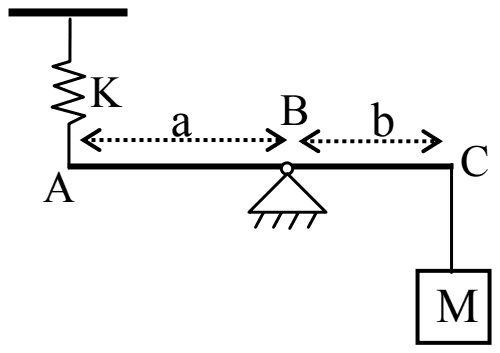
For small oscillations, the natural frequency of the system in terms of K, a, b and M is (assuming ideal joints and mass-less rigid rod ABC)

Horizontal rigid rod ABC pivoted at B; spring K hangs from a fixed support to end A, a distance a from B; mass M hangs from end C, a distance b from B

Exam Year(s)

GATE XE - 2012,

Answer: D

The natural frequency is \(\sqrt{\dfrac{Ka^{2}}{Mb^{2}}}\).

Let the rod turn through a small angle \(\theta\) about B. The spring at A stretches by \(a\theta\) and the mass at C moves by \(b\theta\). Taking moments about B (gravity only sets the static equilibrium):

\[ \begin{aligned} Mb^{2}\ddot{\theta} + Ka^{2}\theta &= 0 \\ \omega_{n} &= \sqrt{\frac{Ka^{2}}{Mb^{2}}} \end{aligned} \]

In effect the spring acts at C with stiffness \(K(a/b)^{2}\). \(\sqrt{K/M}\) ignores the lever, \(\sqrt{Ka/(Mb)}\) uses the ratio only once, and \(\sqrt{Kb^{2}/(Ma^{2})}\) inverts it.

Please log in or register to report this question.
6.

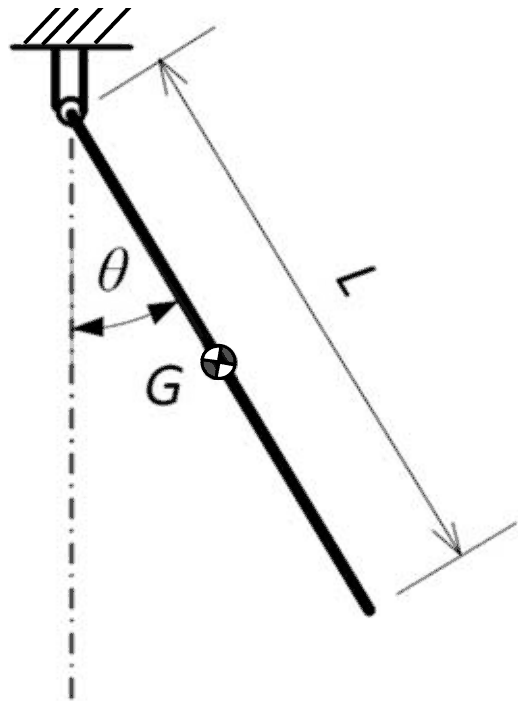
A rigid uniform rod with mass m, length L and center of gravity G is freely suspended from a hinge as shown in the figure. The rod is given a small angular displacement θ in the counter-clockwise direction from the position in which it hangs vertically (θ = 0). If g is the acceleration due to gravity, the natural frequency of oscillations (in rad/s) is

A uniform rod of length L hinged at its top end, displaced by a small angle theta from the vertical, with its centre of gravity G at mid-length

Exam Year(s)

GATE XE - 2018,

Answer: C

The natural frequency is \(\sqrt{\frac{3g}{2L}}\).

The rod is a compound pendulum. Its moment of inertia about the hinge at one end is \(mL^{2}/3\), and gravity acts at G, a distance \(L/2\) from the hinge. For small angles

\[ \begin{aligned} \frac{mL^{2}}{3}\ddot{\theta} + mg\frac{L}{2}\theta &= 0 \\ \omega_{n}^{2} &= \frac{mgL/2}{mL^{2}/3} = \frac{3g}{2L} \end{aligned} \]

\(\sqrt{g/L}\) treats the rod as a point mass at the tip, and \(\sqrt{2g/L}\) as a point mass at G; both ignore the rod's distributed inertia. \(\sqrt{6g/L}\) would follow from using the moment of inertia about G, \(mL^{2}/12\), instead of about the hinge.

Please log in or register to report this question.
7.

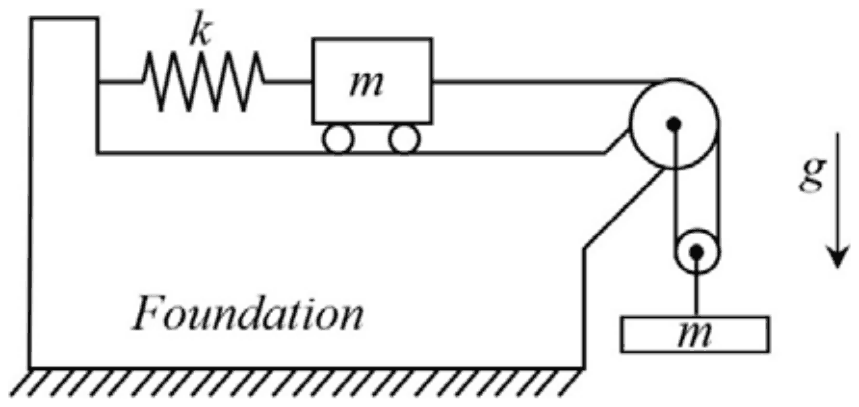
A spring-mass system having a mass \(m\) and spring constant \(k\), placed horizontally on a foundation, is connected to a vertically hanging mass \(m\) with the help of an inextensible string. Ignore the friction in the pulleys and also the inertia of pulleys, string and spring. Gravity is acting vertically downward as shown. The natural frequency of the system in rad/s is

A cart of mass m on a foundation, held by a spring k to a wall; a string from the cart passes over a fixed pulley, down around a movable pulley carrying a hanging mass m, and up to a fixed point

Exam Year(s)

GATE XE - 2022,

Answer: D

The natural frequency is \(\sqrt{\frac{4k}{5m}}\).

The string runs from the cart over the fixed pulley, down around the movable pulley that carries the hanging mass, and up to a fixed point. When the cart moves x, the hanging mass moves x/2. With gravity only shifting the equilibrium, the energies are

\[ \begin{aligned} T &= \frac{1}{2}m\dot{x}^{2} + \frac{1}{2}m\left(\frac{\dot{x}}{2}\right)^{2} = \frac{1}{2}\cdot\frac{5m}{4}\dot{x}^{2} \\ V &= \frac{1}{2}kx^{2} \\ \omega_{n} &= \sqrt{\frac{k}{5m/4}} = \sqrt{\frac{4k}{5m}} \end{aligned} \]

\(\sqrt{k/(2m)}\) treats both masses as moving x, and \(\sqrt{4k/(3m)}\) and \(\sqrt{k/(3m)}\) do not correspond to the effective mass \(5m/4\).

Please log in or register to report this question.

8.

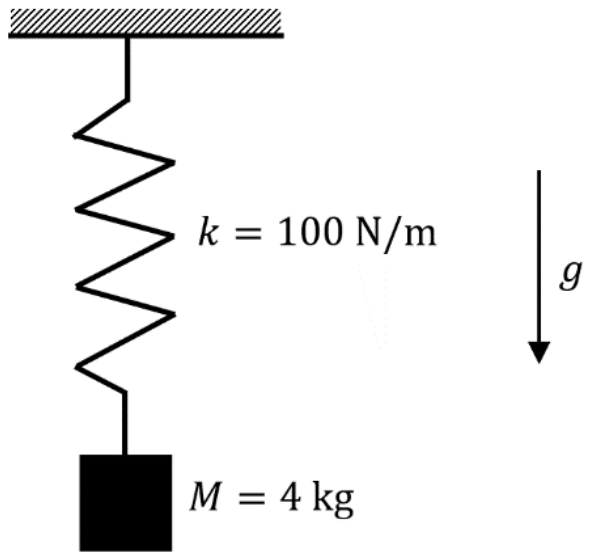
A spring mass system is shown in the figure below. Take the acceleration due to gravity as \(g = 9.81\ \text{m/s}^{2}\). The static deflection due to weight and the time period of oscillations, respectively, are

A mass M = 4 kg hanging from a fixed support on a spring of stiffness k = 100 N/m, with gravity g acting downward

Exam Year(s)

GATE XE - 2023,

Answer: A

The answer is 0.392 m and 1.26 s.

At static equilibrium the spring force balances the weight:

\[ \begin{aligned} \delta_{st} &= \frac{Mg}{k} = \frac{4 \times 9.81}{100} \\ &= 0.392\ \text{m} \end{aligned} \]

The natural period depends only on mass and stiffness:

\[ \begin{aligned} T &= 2\pi\sqrt{\frac{M}{k}} = 2\pi\sqrt{0.04} \\ &= 2\pi \times 0.2 = 1.26\ \text{s} \end{aligned} \]

(Equivalently \(T = 2\pi\sqrt{\delta_{st}/g}\), the same 1.26 s.) 0.626 m is \(\sqrt{0.392}\), a stray square root, and 3.52 s does not follow from \(2\pi\sqrt{M/k}\) with these values.

Please log in or register to report this question.

9.

A mass \(M\) is hung from a frictionless, massless pulley. The pulley is suspended by using an inextensible, massless rope of which one end is directly fixed to a support, and the other end is connected to the support through a linear spring of stiffness constant \(k\) (see figure). The natural frequency of this system is

(Figure: both strands of the rope hang vertically from the support, the left one fixed directly and the right one through the spring, with the mass hanging from the pulley axle.)

Exam Year(s)

GATE XE - 2024,

Answer: A

The natural frequency is \(\sqrt{\frac{4k}{M}}\).

If the mass moves down by x, the pulley moves down by x too, and both rope strands lengthen by x. The rope is inextensible, so the whole extra length 2x comes from the spring, whose tension rises by \(T = 2kx\). Both strands carry this tension, so the restoring force on the pulley and mass is

\[ \begin{aligned} F &= 2T = 4kx \\ k_{eq} &= 4k, \quad \omega_n = \sqrt{\frac{4k}{M}} \end{aligned} \]

\(\sqrt{2k/M}\) counts either the doubled spring extension or the two strands, but not both. \(\sqrt{k/M}\) treats the spring as if attached directly to the mass, and \(\sqrt{k/(2M)}\) inverts the mechanical advantage.

Please log in or register to report this question.

10.

Consider a spring-mass system with mass \(m\) and spring stiffness \(k\) as shown in the illustration. At time \(t = 0\), the mass is displaced by \(P\) units and the velocity of the mass is zero. The displacement of the mass, \(x(t)\), is measured from the equilibrium position.

[The illustration shows a horizontal spring \(k\) fixed to a wall at its left end and attached to the mass \(m\) at its right end, with \(x(t)\) measured to the right.]

Which one of the following functions represent \(x(t)\)?

Exam Year(s)

GATE XE - 2025,

Answer: D

The motion is \(x(t) = P\cos\left(\sqrt{k/m}\,t\right)\).

An undamped spring-mass system obeys \(m\ddot{x} + kx = 0\), whose general solution is a sum of a cosine and a sine at the natural frequency \(\omega_{n} = \sqrt{k/m}\):

\[ \begin{aligned} x(t) &= A\cos\omega_{n}t + B\sin\omega_{n}t \\ x(0) &= A = P \\ \dot{x}(0) &= B\omega_{n} = 0 \Rightarrow B = 0 \end{aligned} \]

So only the cosine term survives, with amplitude P.

The sine-only answer starts at zero displacement, not at P. The sum \(P\cos + P\sin\) starts at P but with velocity \(P\omega_{n}\), not zero. The answer with P/2 on each term starts at only half the given displacement and also has a non-zero initial velocity.

Please log in or register to report this question.

Loading…
Tags: Free Vibration of Single Degree Systems Questions and Answers || Free Vibration of Single Degree Systems MCQ Questions and Answers || Free Vibration of Single Degree Systems GK Questions and Answers || Free Vibration of Single Degree Systems GK MCQ Questions || Free Vibration of Single Degree Systems Multiple Choice Questions and Answers || Free Vibration of Single Degree Systems GK || GK on Free Vibration of Single Degree Systems || Mechanical Vibrations Questions and Answers || Mechanical Vibrations MCQ Questions and Answers || Mechanical Vibrations GK Questions and Answers || GK on Mechanical Vibrations