
TS SET 2012: Paper III, Anthropology
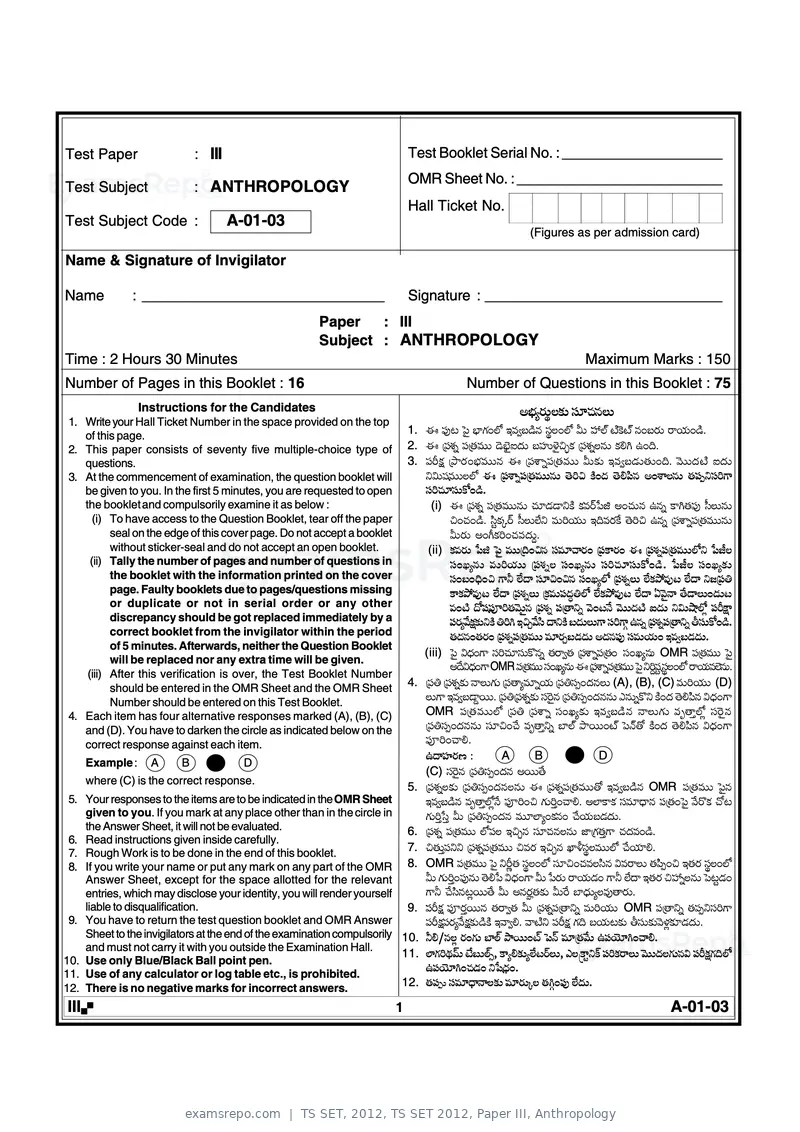
Text of page 1
Test Paper : III Test Booklet Serial No. : ______________________
OMR Sheet No. : ________________________________
Test Subject : ANTHROPOLOGY
Hall Ticket No.
Test Subject Code : A-01-03
(Figures as per admission card)
Name & Signature of Invigilator
Name : ____________________________________ Signature : ___________________________________
Paper : III
Subject : ANTHROPOLOGY
Time : 2 Hours 30 Minutes Maximum Marks : 150
Number of Pages in this Booklet : 16 Number of Questions in this Booklet : 75
Instructions for the Candidates A¿æýÅÆæÿ$¦ËMæü$ çÜ*^èþ¯èþË$
1. Write your Hall Ticket Number in the space provided on the top
1. D ç³#r ò³O ¿êVæü ÌZ CÐèþÓºyìþ¯èþ çÜ¦Ë ÌZ Ò$ çàÌý sìýMðüsý ¯èþ ºÆæÿ$ Æ>Äæý$ yìþ.
of this page.
2. This paper consists of seventy five multiple-choice type of 2. D {ç³Ôèý² ç³{èþÐèþ$$ yðþ¿ñýOI§æþ$ ºçßý$âñýO_eMæü {ç³Ôèý²Ë¯èþ$ MæüÍW E ¨.
questions. 3. ç³Èæü {´ëÆæÿ ¿æýÐèþ$$¯èþ D {ç³Ôé²ç³{èþÐèþ$$ Ò$Mæü$ CÐèþÓºyæþ$èþ$ ¨. Ððþ$$§æþsìý I§æþ$
3. At the commencement of examination, the question booklet will °Ñ$çÙÐèþ$$ËÌZ D {ç³Ôé²ç³{èþÐèþ$$¯èþ$ ðþÇ_ Mìü §æþ ðþÍí³¯èþ A Ôé˯èþ$ èþç³µ°çÜÇV>
be given to you. In the first 5 minutes, you are requested to open çÜÇ^èþ*çÜ$Mø yìþ.
the booklet and compulsorily examine it as below : (i) D {ç³Ôèý² ç³{èþÐèþ$$¯èþ$ ^èþ*yæþyé°Mìü MæüÐèþÆÿõ³h A ^èþ$¯èþ E¯èþ² M>Wèþç³# ïÜË$¯èþ$
(i) To have access to the Question Booklet, tear off the paper _ ^èþ yìþ. íÜtMæüPÆÿ ïÜË$Ìôý° Ðèþ$ÇÄæý$$ C¨ÐèþÆæÿMóü ðþÇ_ E¯èþ² {ç³Ôé²ç³{èþÐèþ$$¯èþ$
seal on the edge of this cover page. Do not accept a booklet Ò$Ææÿ$ A XMæüÇ ^èþÐèþ§æþ$ª.
without sticker-seal and do not accept an open booklet. (ii) MæüÐèþÆæÿ$ õ³h ò³O Ðèþ$${¨ _¯èþ çÜÐèþ*^éÆæÿ {ç³M>Ææÿ D {ç³Ôèý²ç³{èþÐèþ$$ÌZ° õ³iË
(ii) Tally the number of pages and number of questions in çÜ Qůèþ$ Ðèþ$ÇÄæý$$ {ç³Ôèý²Ë çÜ Qůèþ$ çÜÇ^èþ*çÜ$Mø yìþ. õ³iË çÜ QÅMæü$
the booklet with the information printed on the cover çÜ º «¨ _ V>± Ìôý§é çÜ*_ _¯èþ çÜ QÅÌZ {ç³Ôèý²Ë$ ÌôýMæü´ùÐèþ#r Ìôý§é °f{ç³
page. Faulty booklets due to pages/questions missing M>Mæü´ùÐèþ#r Ìôý§é {ç³Ôèý²Ë$ {MæüÐèþ$糧æþ®ÌZ ÌôýMæü´ùÐèþ#r Ìôý§é HÐðþO¯é óþyéË$ yæþ$r
or duplicate or not in serial order or any other Ðèþ sìý §øçÙç³NÇèþÐðþ$O¯èþ {ç³Ôèý² ç³{é°² Ððþ r¯óþ Ððþ$$§æþsìý I§æþ$ °Ñ$ÚëÌZÏ ç³È>
discrepancy should be got replaced immediately by a ç³ÆæÿÅÐóþæüMæü$°Mìü ÇW C_aÐóþíÜ §é°Mìü º§æþ$Ë$V> çÜÇV>Y E¯èþ² {ç³Ôèý²ç³{é°² ¡çÜ$Mø yìþ.
correct booklet from the invigilator within the period èþ§æþ¯èþ èþÆæÿ {ç³Ôèý²ç³{èþÐèþ$$ Ðèþ*Ææÿaºyæþ§æþ$ A§æþ¯èþç³# çÜÐèþ$Äæý$ CÐèþÓºyæþ§æþ$.
of 5 minutes. Afterwards, neither the Question Booklet
(iii) ò³O Ñ«§æþ V> çÜÇ^èþ*çÜ$Mö¯èþ² èþÆ>Óèþ {ç³Ôé²ç³{èþ çÜ Qůèþ$ OMR ç³{èþÐèþ$$ ò³O
will be replaced nor any extra time will be given.
A§óþÑ«§æþ V> OMR ç³{èþÐèþ$$ çÜ Qůèþ$ D {ç³Ôé²ç³{èþÐèþ$$ ò³O °ÇªçÙt çÜ¦Ë ÌZ Æ>Äæý$ÐèþÌñý¯èþ$.
(iii) After this verification is over, the Test Booklet Number
should be entered in the OMR Sheet and the OMR Sheet
4. {ç³ {ç³Ôèý²Mæü$ ¯éË$Væü$ {ç³éÅÐèþ*²Äæý$ {ç³çܵ §æþ¯èþË$ (A), (B), (C) Ðèþ$ÇÄæý$$ (D)
Number should be entered on this Test Booklet.
Ë$V> CÐèþÓºyézÆÿ$$. {ç³{ç³Ôèý²Mæü$ çÜÆðÿO¯èþ {ç³çܵ §æþ¯èþ¯èþ$ G¯èþ$²Mö° Mìü §æþ ðþÍí³¯èþ Ñ«§æþ V>
4. Each item has four alternative responses marked (A), (B), (C) OMR ç³{èþÐèþ$$ÌZ {ç³ {ç³Ôé² çÜ QÅMæü$ CÐèþÓºyìþ¯èþ ¯éË$Væü$ Ðèþé¢ÌZÏ çÜÆðÿO¯èþ
and (D). You have to darken the circle as indicated below on the {ç³çܵ §æþ¯èþ¯èþ$ çÜ*_ ^óþ Ðèþ颰² »êÌý ´ëÆÿ$$ sý ò³¯þø Mìü §æþ ðþÍí³¯èþ Ñ«§æþ V>
correct response against each item. ç³NÇ ^éÍ.
Example : A B C D
E§éçßýÆæÿ×ý : A B C D
(C) çÜÆðÿO¯èþ {ç³çܵ §æþ¯èþ AÆÿ$$óþ
where (C) is the correct response.
5. {ç³Ôèý²ËMæü$ {ç³çܵ §æþ¯èþ˯èþ$ D {ç³Ôèý²ç³{èþÐèþ$$ø CÐèþÓºyìþ¯èþ OMR ç³{èþÐèþ$$ ò³O¯èþ
5. Your responses to the items are to be indicated in the OMR Sheet CÐèþÓºyìþ¯èþ Ðèþé¢ÌZϯóþ ç³NÇ _ Væü$Ç¢ ^éÍ. AÌêM>Mæü çÜÐèþ*«§é¯èþ ç³{èþ ò³O ÐóþÆöMæü ^ør
given to you. If you mark at any place other than in the circle in Væü$Ç¢õÜ¢ Ò$ {ç³çܵ §æþ¯èþ Ðèþ$*ÌêÅ Mæü¯èþ ^óþÄæý$ºyæþ§æþ$.
the Answer Sheet, it will not be evaluated. 6. {ç³Ôèý² ç³{èþÐèþ$$ ÌZç³Ë C_a¯èþ çÜ*^èþ¯èþ˯èþ$ gê{Væüèþ¢V> ^èþ§æþÐèþ yìþ.
6. Read instructions given inside carefully.
7. Rough Work is to be done in the end of this booklet.
7. _èþ$¢ç³°° {ç³Ôèý²ç³{èþÐèþ$$ _ÐèþÆæÿ C_a¯èþ RêäçܦËÐèþ$$ÌZ ^óþÄæý*Í.
8. If you write your name or put any mark on any part of the OMR 8. OMR ç³{èþÐèþ$$ ò³O °È~èþ çÜ¦Ë ÌZ çÜ*_ ^èþÐèþËíܯèþ ÑÐèþÆ>Ë$ èþí³µ _ CèþÆæÿ çÜ¦Ë ÌZ
Answer Sheet, except for the space allotted for the relevant Ò$ Væü$Ç¢ ç³#¯èþ$ ðþÍõ³ Ñ«§æþ V> Ò$ õ³Ææÿ$ Æ>Äæý$yæþ V>± Ìôý§é CèþÆæÿ _à²Ë¯èþ$ ò³rtyæþ
entries, which may disclose your identity, you will render yourself V>± ^óþíܯèþrÏÆÿ$$óþ Ò$ A¯èþÆæÿáèþMæü$ Ò$Æóÿ »ê«§æþ$ÅËÐèþ#éÆæÿ$.
liable to disqualification. 9. çç³Èæü ç³NÆæÿ¢Æÿ$$¯èþ èþÆ>Óèþ Ò$ {ç³Ôèý²ç³{é°² Ðèþ$ÇÄæý$$ OMR ç³{é°² èþç³µ°çÜÇV>
9. You have to return the test question booklet and OMR Answer ç³Èæüç³ÆæÿÅÐóþæüMæü$yìþMìü CÐéÓÍ. Ðésìý° ç³Èæü Væü¨ ºÄæý$rMæü$ ¡çÜ$Mæü$ÐðþâæýÏMæü*yæþ§æþ$.
Sheet to the invigilators at the end of the examination compulsorily 10. ±Í/¯èþËÏ Ææÿ Væü$ »êÌý ´ëÆÿ$$ sý ò³¯þ Ðèþ*{èþÐóþ$ Eç³Äñý*W ^éÍ.
and must not carry it with you outside the Examination Hall.
11. ÌêVæüÇ£æþÐþ$ sôýº$ÌýÞ, M>ÅÍMæü$ÅÌôýrÆÿË$, GË[M>t°Mü ç³ÇMæüÆ>Ë$ Ððþ$$§æþËVæü$¯èþÑ ç³ÈæüVæü¨ÌZ
10. Use only Blue/Black Ball point pen.
11. Use of any calculator or log table etc., is prohibited.
Eç³Äñý*W ^èþyæþ °õÙ«§æþ .
12. There is no negative marks for incorrect answers.
12. èþç³ çÜÐèþ*«§é¯éËMæü$ Ðèþ*Ææÿ$PË èþWY ç³# Ìôý§æþ$.
III. 1 A-01-03
Text of page 2
*A0103*


III.   2      A-01-03
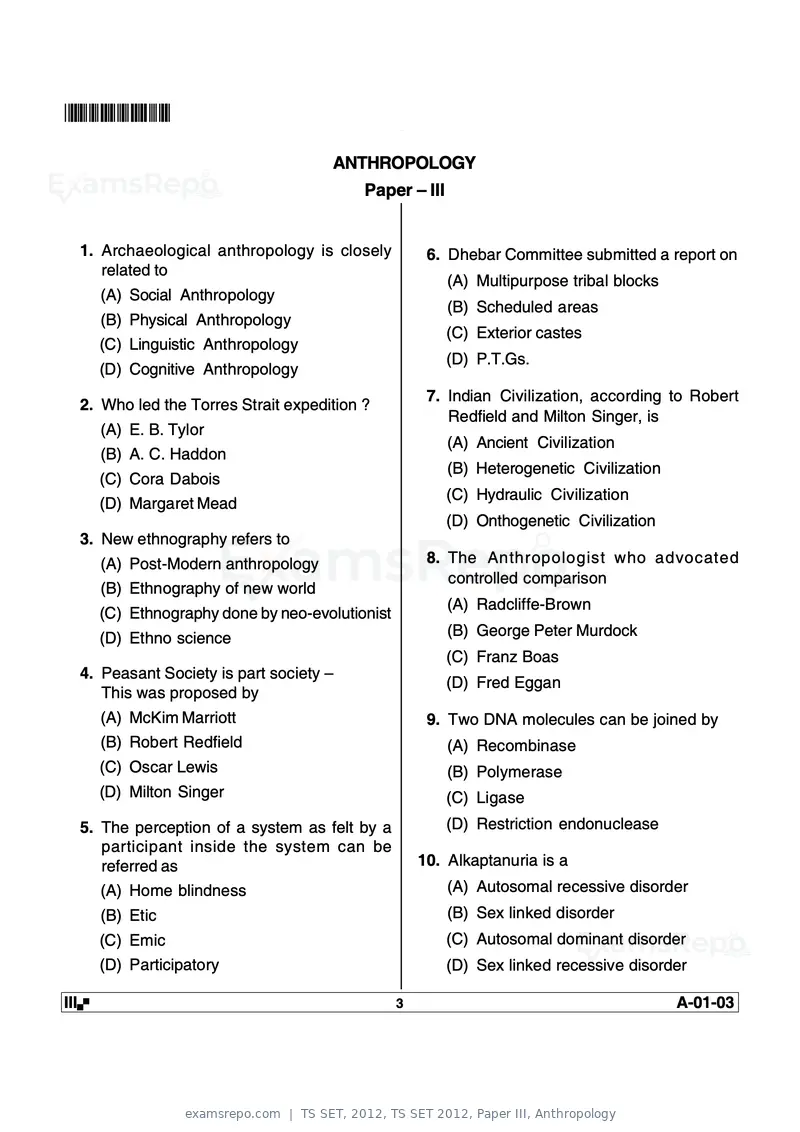
Text of page 3
*A0103*

                                       ANTHROPOLOGY
                                           Paper – III


  1. Archaeological anthropology is closely            6. Dhebar Committee submitted a report on
     related to
                                                          (A) Multipurpose tribal blocks
       (A) Social Anthropology
                                                          (B) Scheduled areas
       (B) Physical Anthropology
                                                         (C) Exterior castes
       (C) Linguistic Anthropology
                                                         (D) P.T.Gs.
       (D) Cognitive Anthropology
                                                       7. Indian Civilization, according to Robert
  2. Who led the Torres Strait expedition ?
                                                          Redfield and Milton Singer, is
       (A) E. B. Tylor
                                                          (A) Ancient Civilization
       (B) A. C. Haddon
                                                          (B) Heterogenetic Civilization
       (C) Cora Dabois
                                                         (C) Hydraulic Civilization
       (D) Margaret Mead
                                                         (D) Onthogenetic Civilization
  3. New ethnography refers to
       (A) Post-Modern anthropology                    8. The Anthropologist who advocated
                                                          controlled comparison
       (B) Ethnography of new world
                                                          (A) Radcliffe-Brown
       (C) Ethnography done by neo-evolutionist
       (D) Ethno science                                  (B) George Peter Murdock
                                                         (C) Franz Boas
  4. Peasant Society is part society –
                                                         (D) Fred Eggan
     This was proposed by
       (A) McKim Marriott                              9. Two DNA molecules can be joined by
       (B) Robert Redfield                                (A) Recombinase
       (C) Oscar Lewis                                    (B) Polymerase
       (D) Milton Singer                                 (C) Ligase
  5. The perception of a system as felt by a             (D) Restriction endonuclease
     participant inside the system can be
     referred as                                      10. Alkaptanuria is a
       (A) Home blindness                                 (A) Autosomal recessive disorder
       (B) Etic                                           (B) Sex linked disorder
       (C) Emic                                          (C) Autosomal dominant disorder
       (D) Participatory                                 (D) Sex linked recessive disorder

III.                                              3                                        A-01-03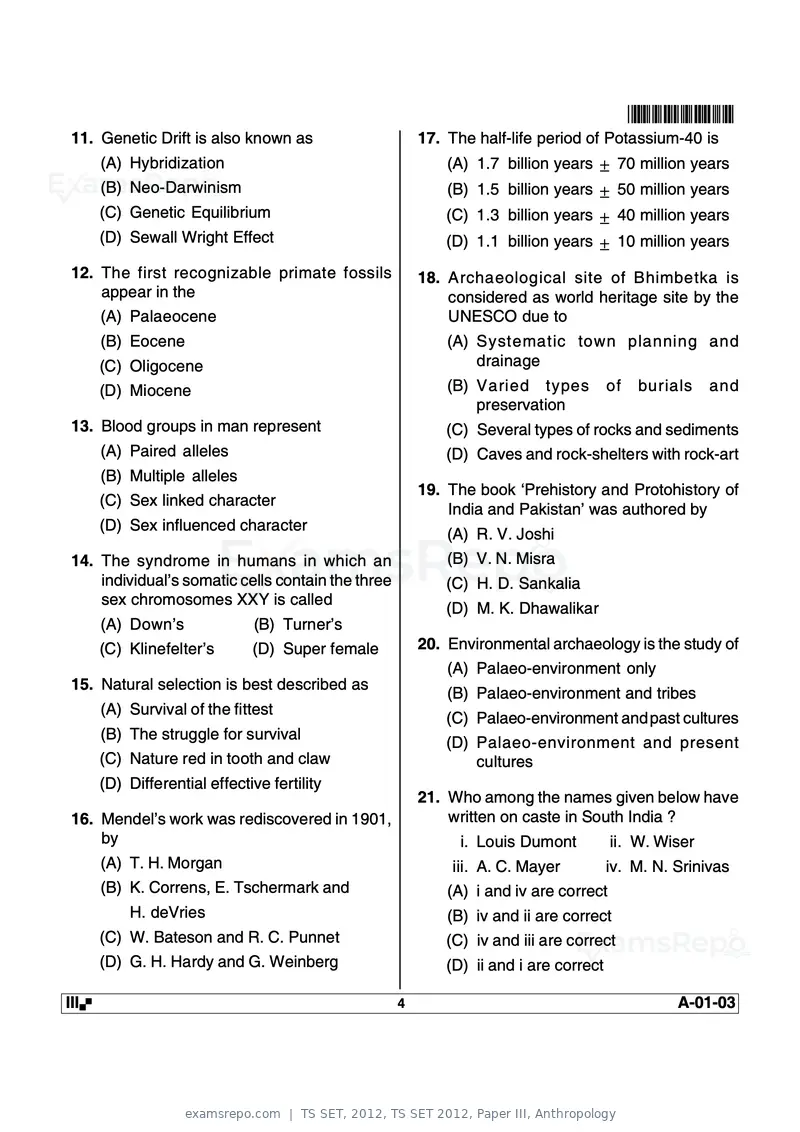
Text of page 4
*A0103*
11. Genetic Drift is also known as                     17. The half-life period of Potassium-40 is
       (A) Hybridization                                   (A) 1.7 billion years ± 70 million years
       (B) Neo-Darwinism                                   (B) 1.5 billion years ± 50 million years
       (C) Genetic Equilibrium                             (C) 1.3 billion years ± 40 million years
       (D) Sewall Wright Effect                            (D) 1.1 billion years ± 10 million years
12. The first recognizable primate fossils             18. Archaeological site of Bhimbetka is
    appear in the                                          considered as world heritage site by the
       (A) Palaeocene                                      UNESCO due to
       (B) Eocene                                          (A) Systematic town planning and
       (C) Oligocene                                           drainage
       (D) Miocene                                         (B) Varied types           of   burials   and
                                                               preservation
13. Blood groups in man represent                          (C) Several types of rocks and sediments
       (A) Paired alleles                                  (D) Caves and rock-shelters with rock-art
       (B) Multiple alleles
                                                       19. The book ‘Prehistory and Protohistory of
       (C) Sex linked character
                                                           India and Pakistan’ was authored by
       (D) Sex influenced character
                                                           (A) R. V. Joshi
14. The syndrome in humans in which an                     (B) V. N. Misra
    individual’s somatic cells contain the three           (C) H. D. Sankalia
    sex chromosomes XXY is called
                                                           (D) M. K. Dhawalikar
       (A) Down’s               (B) Turner’s
       (C) Klinefelter’s       (D) Super female        20. Environmental archaeology is the study of
                                                           (A) Palaeo-environment only
15. Natural selection is best described as
                                                           (B) Palaeo-environment and tribes
       (A) Survival of the fittest
                                                           (C) Palaeo-environment and past cultures
       (B) The struggle for survival
                                                           (D) Palaeo-environment and present
       (C) Nature red in tooth and claw                        cultures
       (D) Differential effective fertility
                                                       21. Who among the names given below have
16. Mendel’s work was rediscovered in 1901,                written on caste in South India ?
    by                                                       i. Louis Dumont          ii. W. Wiser
       (A) T. H. Morgan                                    iii. A. C. Mayer           iv. M. N. Srinivas
       (B) K. Correns, E. Tschermark and                   (A) i and iv are correct
           H. deVries                                      (B) iv and ii are correct
       (C) W. Bateson and R. C. Punnet                     (C) iv and iii are correct
       (D) G. H. Hardy and G. Weinberg                     (D) ii and i are correct

III.                                               4                                            A-01-03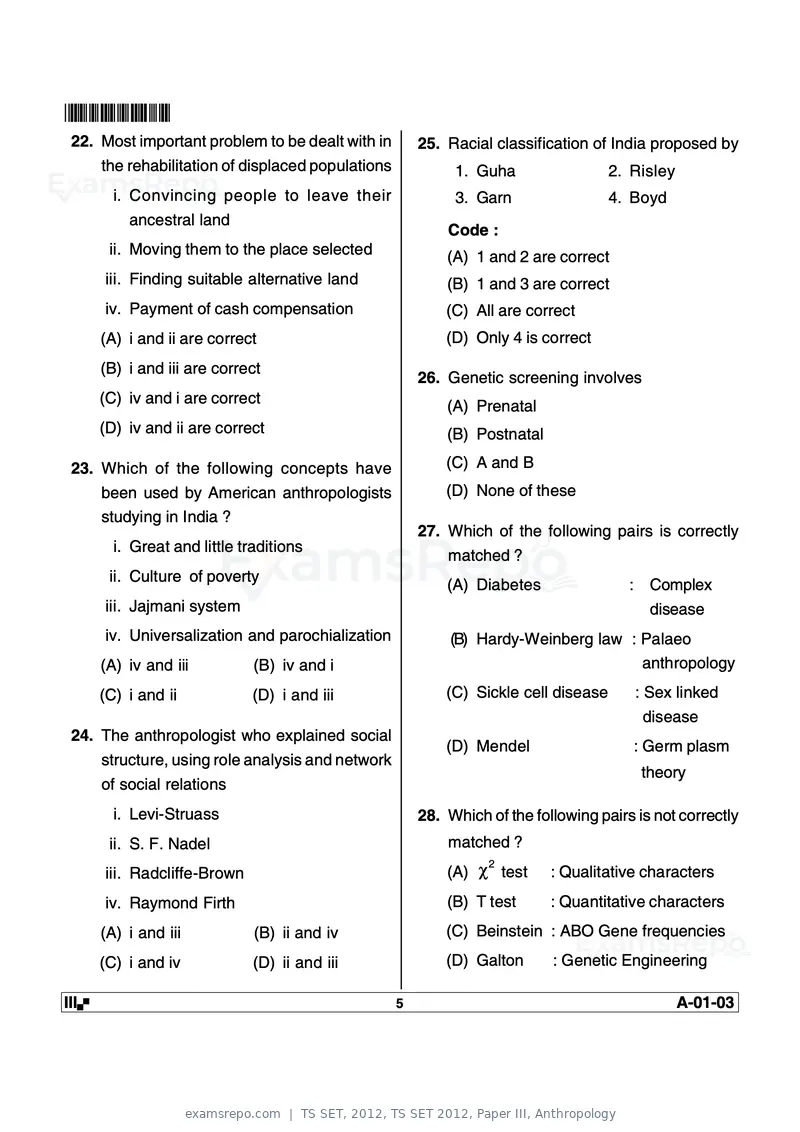
Text of page 5
*A0103*
 22. Most important problem to be dealt with in          25. Racial classification of India proposed by
       the rehabilitation of displaced populations            1. Guha                  2. Risley
         i. Convincing people to leave their                  3. Garn                  4. Boyd
            ancestral land
                                                             Code :
        ii. Moving them to the place selected                (A) 1 and 2 are correct
       iii. Finding suitable alternative land                (B) 1 and 3 are correct
       iv. Payment of cash compensation                      (C) All are correct
       (A) i and ii are correct                              (D) Only 4 is correct
       (B) i and iii are correct
                                                         26. Genetic screening involves
       (C) iv and i are correct
                                                             (A) Prenatal
       (D) iv and ii are correct                             (B) Postnatal

 23. Which of the following concepts have                    (C) A and B
       been used by American anthropologists                 (D) None of these
       studying in India ?
                                                         27. Which of the following pairs is correctly
         i. Great and little traditions
                                                             matched ?
        ii. Culture of poverty
                                                             (A) Diabetes                : Complex
       iii. Jajmani system                                                                 disease
       iv. Universalization and parochialization             (B) Hardy-Weinberg law : Palaeo
       (A) iv and iii          (B) iv and i                                           anthropology
       (C) i and ii            (D) i and iii                 (C) Sickle cell disease      : Sex linked
                                                                                            disease
 24. The anthropologist who explained social
                                                             (D) Mendel                   : Germ plasm
     structure, using role analysis and network
                                                                                           theory
       of social relations
         i. Levi-Struass                                 28. Which of the following pairs is not correctly
        ii. S. F. Nadel                                      matched ?
                                                                   2
       iii. Radcliffe-Brown                                  (A) χ test      : Qualitative characters
       iv. Raymond Firth                                     (B) T test      : Quantitative characters
       (A) i and iii           (B) ii and iv                 (C) Beinstein : ABO Gene frequencies
       (C) i and iv            (D) ii and iii                (D) Galton      : Genetic Engineering

III.                                                 5                                             A-01-03
Text of page 6
*A0103*
29. The Billasurgam caves characterized by               32. Assertion (A) : Cultural relativism
        I. Bone Tools                                                        teaches anthropologists
       II. Late Pleistocene Fauna                                            not to pass value
      III. Blade-burin Industry                                              judgement on cultures.
     IV. Rock-art
    Code :                                                   Reason (R)        : L. H. Morgan’s
    (A) I, III and IV are correct                                                evolutionary theory
    (B) I, II and IV are correct                                                 divides stages of
    (C) I, II and III are correct                                                evolution into Savagery,
                                                                                 Barbarism and Civilization.
    (D) II, III and IV are correct

30. The South Indian Neolithic Culture is                    In the context of the above statements,
    characterized by                                         which one of the following is correct ?
        I. Pit-dwellings                                     (A) A is correct, but R is not correct
       II. Blade industry
                                                             (B) Both A and R are not correct
      III. Terracotta objects
     IV. Pottery and polished tools                          (C) A and R are correct, but R is not the
    Code :                                                       correct explanation of A
    (A) I, II and III are correct                            (D) A and R are correct and R explains A
    (B) II, III and IV are correct
                                                         33. Assertion (A) : Acts prohibited by
    (C) III, IV and I are correct
                                                                             taboos are often anti-
    (D) IV, II and I are correct
                                                                             social in nature such as
31. Assertion (A) : Jajmani system is a                                      adultery, theft, homicide etc.
                    system of exchange of
                    goods and services. It is                Reason (R)       : There are food taboos
                    a socio-economic
                    system, said to be                                          which come in the way
                    existing in the past.                                       of getting adequate
    Reason (R) : In jajmani system the                                          nutrition. Thus there are
                    payments for goods and                                      taboos which are not
                    services were in cash.                                      always beneficial to
                    These payments
                    fluctuated whenever                                         society.
                    crops failed due to
                    famines and droughts.                    In the context of the above two statements,
                                                             which one of the following is correct ?
       In the context of the above two statements,
       which one of the following is correct ?               (A) A and R are correct
       (A) A is correct and R is wrong                       (B) A and R are wrong
       (B) A and R are correct
       (C) A and R are wrong                                 (C) A is correct and R is wrong
       (D) A is wrong and R is correct                       (D) A is wrong and R is correct

III.                                                 6                                            A-01-03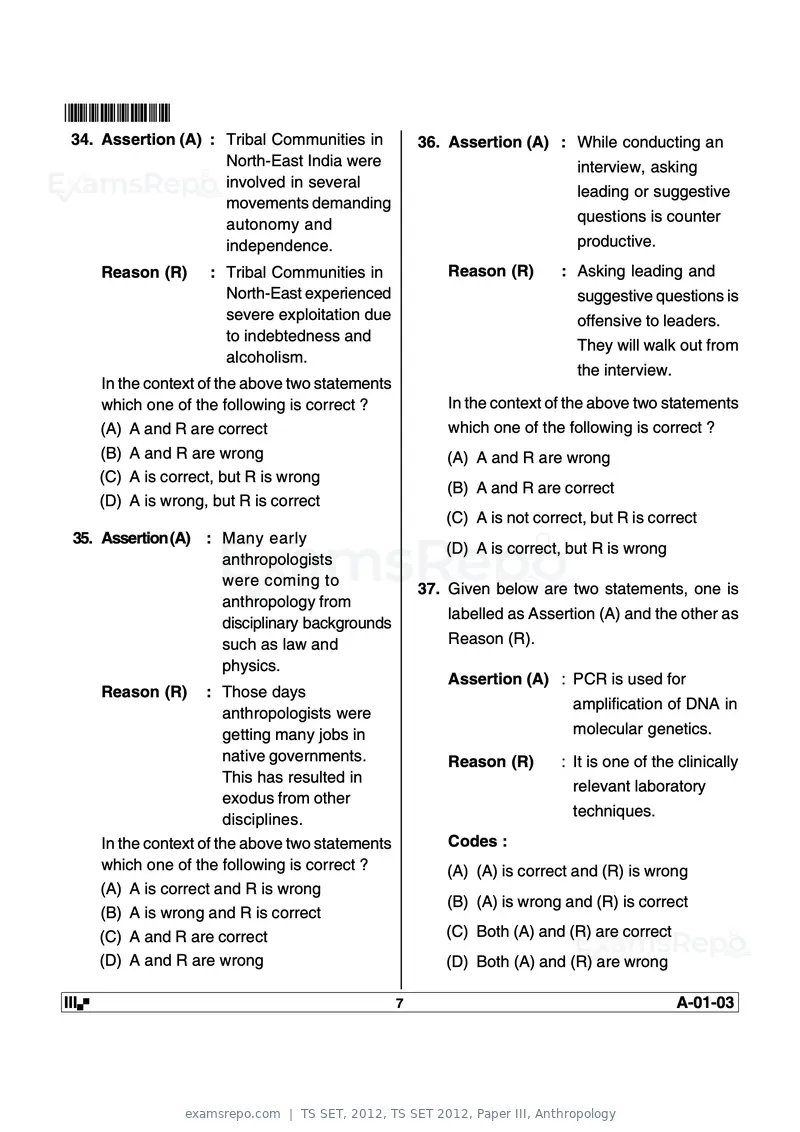
Text of page 7
*A0103*
 34. Assertion (A) : Tribal Communities in              36. Assertion (A) : While conducting an
                     North-East India were                                    interview, asking
                     involved in several
                                                                              leading or suggestive
                     movements demanding
                                                                              questions is counter
                     autonomy and
                     independence.                                            productive.
       Reason (R)     : Tribal Communities in              Reason (R)       : Asking leading and
                        North-East experienced                                suggestive questions is
                        severe exploitation due                               offensive to leaders.
                        to indebtedness and
                                                                              They will walk out from
                        alcoholism.
                                                                              the interview.
       In the context of the above two statements
       which one of the following is correct ?             In the context of the above two statements
       (A) A and R are correct                             which one of the following is correct ?
       (B) A and R are wrong                               (A) A and R are wrong
       (C) A is correct, but R is wrong
                                                           (B) A and R are correct
       (D) A is wrong, but R is correct
                                                           (C) A is not correct, but R is correct
 35. Assertion (A) : Many early
                                                           (D) A is correct, but R is wrong
                     anthropologists
                     were coming to
                                                        37. Given below are two statements, one is
                     anthropology from
                                                           labelled as Assertion (A) and the other as
                     disciplinary backgrounds
                     such as law and                       Reason (R).
                     physics.
                                                           Assertion (A) : PCR is used for
       Reason (R)      : Those days
                                                                              amplification of DNA in
                          anthropologists were
                          getting many jobs in                                molecular genetics.
                          native governments.              Reason (R)       : It is one of the clinically
                          This has resulted in
                                                                              relevant laboratory
                          exodus from other
                                                                              techniques.
                          disciplines.
       In the context of the above two statements          Codes :
       which one of the following is correct ?             (A) (A) is correct and (R) is wrong
       (A) A is correct and R is wrong
                                                           (B) (A) is wrong and (R) is correct
       (B) A is wrong and R is correct
       (C) A and R are correct                             (C) Both (A) and (R) are correct
       (D) A and R are wrong                               (D) Both (A) and (R) are wrong

III.                                                7                                          A-01-03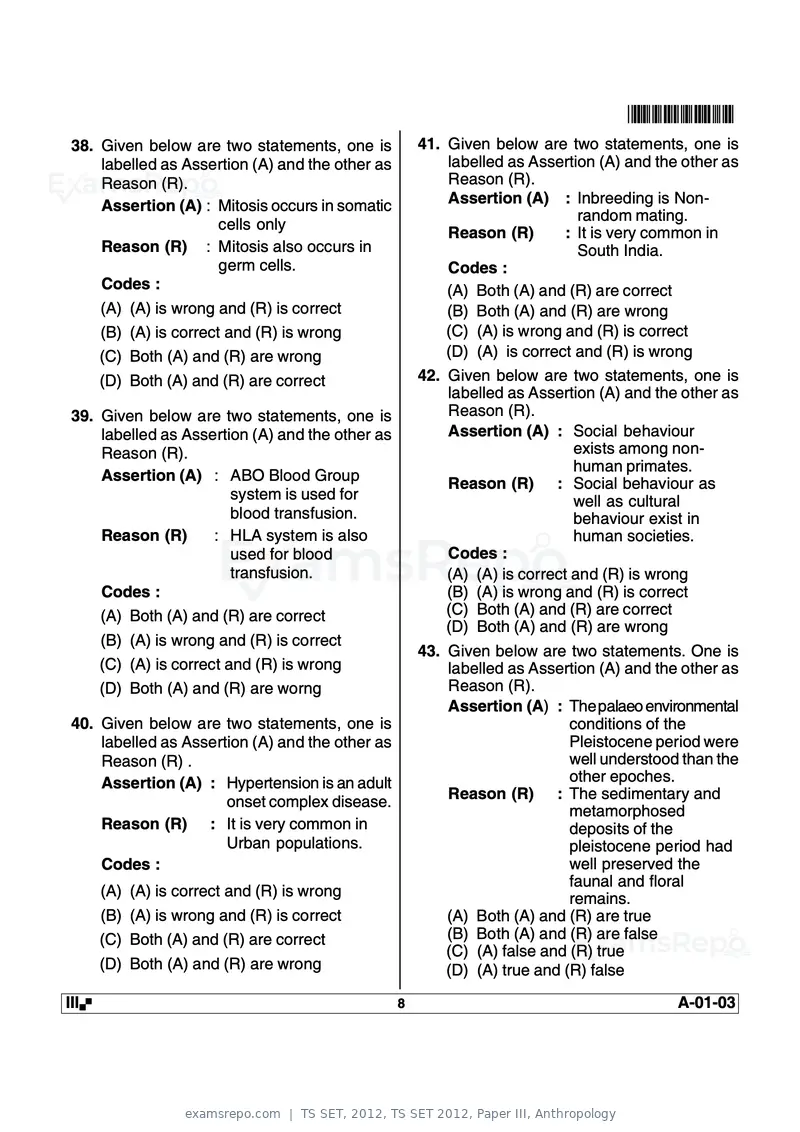
Text of page 8
*A0103*
38. Given below are two statements, one is           41. Given below are two statements, one is
    labelled as Assertion (A) and the other as           labelled as Assertion (A) and the other as
    Reason (R).                                          Reason (R).
    Assertion (A) : Mitosis occurs in somatic            Assertion (A) : Inbreeding is Non-
                                                                             random mating.
                      cells only
                                                         Reason (R)        : It is very common in
    Reason (R) : Mitosis also occurs in                                      South India.
                      germ cells.                        Codes :
    Codes :                                              (A) Both (A) and (R) are correct
    (A) (A) is wrong and (R) is correct                  (B) Both (A) and (R) are wrong
    (B) (A) is correct and (R) is wrong                  (C) (A) is wrong and (R) is correct
    (C) Both (A) and (R) are wrong                       (D) (A) is correct and (R) is wrong
    (D) Both (A) and (R) are correct                 42. Given below are two statements, one is
                                                         labelled as Assertion (A) and the other as
39. Given below are two statements, one is               Reason (R).
    labelled as Assertion (A) and the other as           Assertion (A) : Social behaviour
    Reason (R).                                                              exists among non-
                                                                             human primates.
    Assertion (A) : ABO Blood Group                      Reason (R) : Social behaviour as
                        system is used for                                   well as cultural
                        blood transfusion.                                   behaviour exist in
    Reason (R)       : HLA system is also                                    human societies.
                        used for blood                   Codes :
                        transfusion.                     (A) (A) is correct and (R) is wrong
    Codes :                                              (B) (A) is wrong and (R) is correct
    (A) Both (A) and (R) are correct                     (C) Both (A) and (R) are correct
                                                         (D) Both (A) and (R) are wrong
    (B) (A) is wrong and (R) is correct
                                                     43. Given below are two statements. One is
    (C) (A) is correct and (R) is wrong                  labelled as Assertion (A) and the other as
    (D) Both (A) and (R) are worng                       Reason (R).
                                                         Assertion (A) : The palaeo environmental
40. Given below are two statements, one is                                  conditions of the
    labelled as Assertion (A) and the other as                              Pleistocene period were
    Reason (R) .                                                            well understood than the
    Assertion (A) : Hypertension is an adult                                other epoches.
                                                         Reason (R) : The sedimentary and
                      onset complex disease.
                                                                            metamorphosed
    Reason (R) : It is very common in                                       deposits of the
                      Urban populations.                                    pleistocene period had
    Codes :                                                                 well preserved the
                                                                            faunal and floral
       (A) (A) is correct and (R) is wrong                                  remains.
       (B) (A) is wrong and (R) is correct               (A) Both (A) and (R) are true
       (C) Both (A) and (R) are correct                  (B) Both (A) and (R) are false
                                                         (C) (A) false and (R) true
       (D) Both (A) and (R) are wrong                    (D) (A) true and (R) false

III.                                             8                                         A-01-03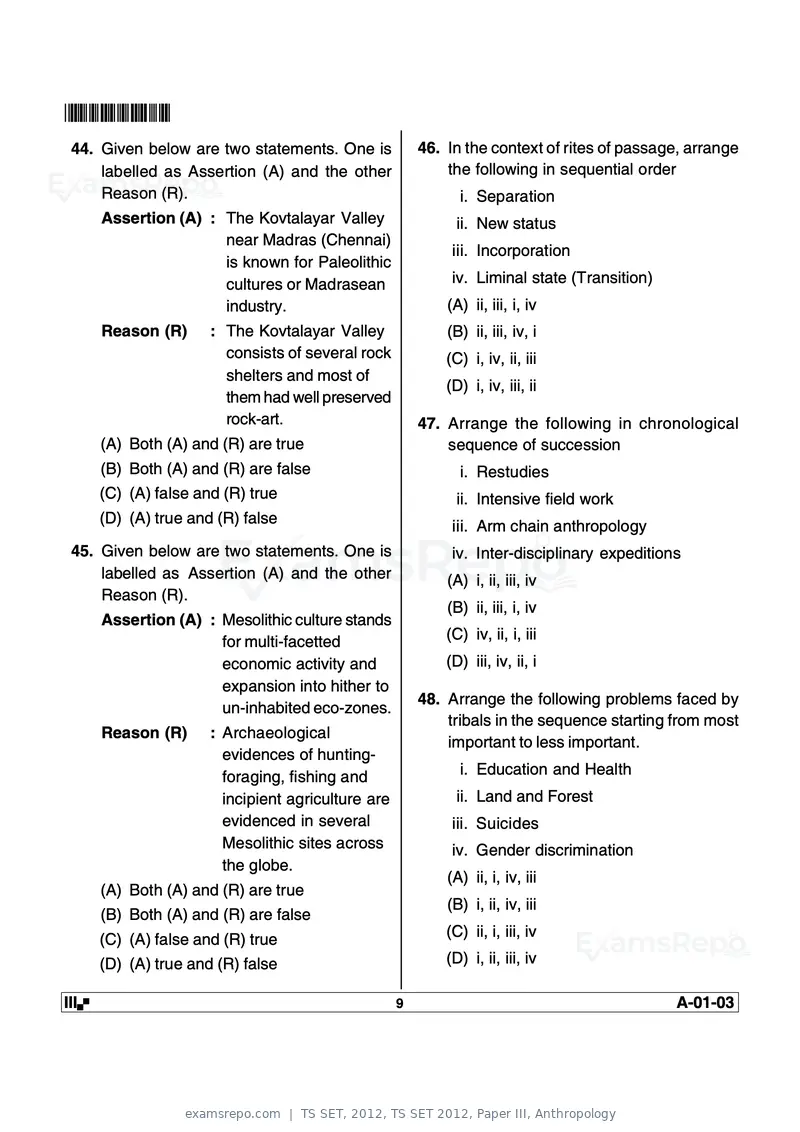
Text of page 9
*A0103*
 44. Given below are two statements. One is              46. In the context of rites of passage, arrange
     labelled as Assertion (A) and the other                 the following in sequential order
     Reason (R).                                               i. Separation
       Assertion (A) : The Kovtalayar Valley                  ii. New status
                       near Madras (Chennai)
                                                              iii. Incorporation
                       is known for Paleolithic
                       cultures or Madrasean                  iv. Liminal state (Transition)
                       industry.                             (A) ii, iii, i, iv
       Reason (R)      : The Kovtalayar Valley               (B) ii, iii, iv, i
                         consists of several rock            (C) i, iv, ii, iii
                         shelters and most of
                                                             (D) i, iv, iii, ii
                         them had well preserved
                         rock-art.                       47. Arrange the following in chronological
       (A) Both (A) and (R) are true                         sequence of succession
       (B) Both (A) and (R) are false                          i. Restudies
       (C) (A) false and (R) true                             ii. Intensive field work
       (D) (A) true and (R) false                             iii. Arm chain anthropology
 45. Given below are two statements. One is                   iv. Inter-disciplinary expeditions
     labelled as Assertion (A) and the other                 (A) i, ii, iii, iv
     Reason (R).
                                                             (B) ii, iii, i, iv
       Assertion (A) : Mesolithic culture stands
                       for multi-facetted                    (C) iv, ii, i, iii
                       economic activity and                 (D) iii, iv, ii, i
                       expansion into hither to
                                                         48. Arrange the following problems faced by
                       un-inhabited eco-zones.
                                                             tribals in the sequence starting from most
       Reason (R)      : Archaeological
                                                             important to less important.
                         evidences of hunting-
                         foraging, fishing and                 i. Education and Health
                         incipient agriculture are            ii. Land and Forest
                         evidenced in several                 iii. Suicides
                         Mesolithic sites across              iv. Gender discrimination
                         the globe.
                                                             (A) ii, i, iv, iii
       (A) Both (A) and (R) are true
                                                             (B) i, ii, iv, iii
       (B) Both (A) and (R) are false
       (C) (A) false and (R) true                            (C) ii, i, iii, iv

       (D) (A) true and (R) false                            (D) i, ii, iii, iv

III.                                                 9                                         A-01-03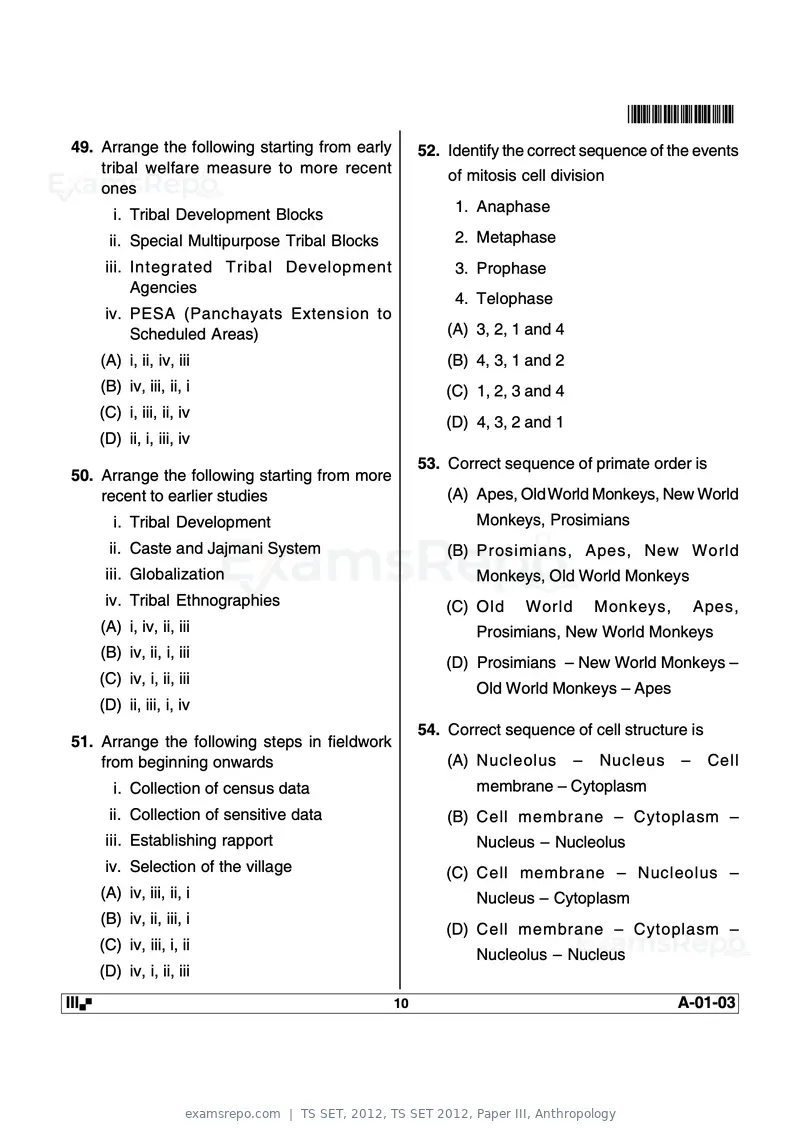
Text of page 10
*A0103*
49. Arrange the following starting from early         52. Identify the correct sequence of the events
    tribal welfare measure to more recent                 of mitosis cell division
    ones
         i. Tribal Development Blocks                      1. Anaphase

        ii. Special Multipurpose Tribal Blocks             2. Metaphase
        iii. Integrated Tribal Development                 3. Prophase
             Agencies
                                                           4. Telophase
        iv. PESA (Panchayats Extension to
            Scheduled Areas)                              (A) 3, 2, 1 and 4
       (A) i, ii, iv, iii                                 (B) 4, 3, 1 and 2
       (B) iv, iii, ii, i                                 (C) 1, 2, 3 and 4
       (C) i, iii, ii, iv
                                                          (D) 4, 3, 2 and 1
       (D) ii, i, iii, iv
                                                      53. Correct sequence of primate order is
50. Arrange the following starting from more
    recent to earlier studies                             (A) Apes, Old World Monkeys, New World
         i. Tribal Development                                Monkeys, Prosimians
        ii. Caste and Jajmani System                      (B) Prosimians, Apes, New World
        iii. Globalization                                    Monkeys, Old World Monkeys
        iv. Tribal Ethnographies                          (C) Old    World        Monkeys,       Apes,
       (A) i, iv, ii, iii                                     Prosimians, New World Monkeys
       (B) iv, ii, i, iii
                                                          (D) Prosimians – New World Monkeys –
       (C) iv, i, ii, iii
                                                              Old World Monkeys – Apes
       (D) ii, iii, i, iv
                                                      54. Correct sequence of cell structure is
51. Arrange the following steps in fieldwork
    from beginning onwards                                (A) Nucleolus       –   Nucleus    –    Cell
         i. Collection of census data                         membrane – Cytoplasm
        ii. Collection of sensitive data                  (B) Cell membrane – Cytoplasm –
        iii. Establishing rapport                             Nucleus – Nucleolus
        iv. Selection of the village                      (C) Cell membrane – Nucleolus –
       (A) iv, iii, ii, i                                     Nucleus – Cytoplasm
       (B) iv, ii, iii, i
                                                          (D) Cell membrane – Cytoplasm –
       (C) iv, iii, i, ii
                                                              Nucleolus – Nucleus
       (D) iv, i, ii, iii
III.                                             10                                          A-01-03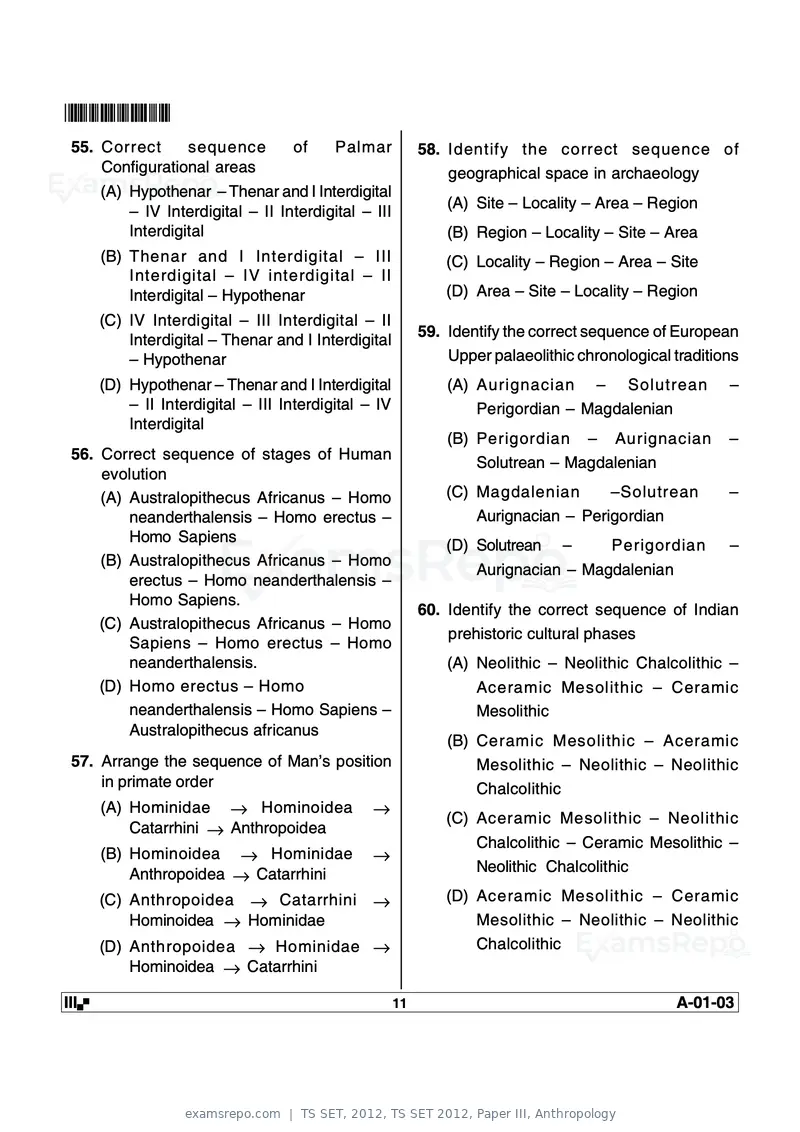
Text of page 11
*A0103*
 55. Correct     sequence           of     Palmar           58. Identify the correct sequence of
     Configurational areas                                      geographical space in archaeology
       (A) Hypothenar – Thenar and I Interdigital
                                                                (A) Site – Locality – Area – Region
           – IV Interdigital – II Interdigital – III
           Interdigital                                         (B) Region – Locality – Site – Area
       (B) Thenar and I Interdigital – III                      (C) Locality – Region – Area – Site
           Interdigital – IV interdigital – II
           Interdigital – Hypothenar                            (D) Area – Site – Locality – Region
       (C) IV Interdigital – III Interdigital – II
                                                            59. Identify the correct sequence of European
           Interdigital – Thenar and I Interdigital
           – Hypothenar                                         Upper palaeolithic chronological traditions
       (D) Hypothenar – Thenar and I Interdigital               (A) Aurignacian – Solutrean              –
           – II Interdigital – III Interdigital – IV                Perigordian – Magdalenian
           Interdigital
                                                                (B) Perigordian – Aurignacian            –
 56. Correct sequence of stages of Human                            Solutrean – Magdalenian
     evolution
     (A) Australopithecus Africanus – Homo                      (C) Magdalenian       –Solutrean         –
         neanderthalensis – Homo erectus –                          Aurignacian – Perigordian
         Homo Sapiens
                                                                (D) Solutrean –      Perigordian         –
     (B) Australopithecus Africanus – Homo
                                                                    Aurignacian – Magdalenian
         erectus – Homo neanderthalensis –
         Homo Sapiens.
                                                            60. Identify the correct sequence of Indian
     (C) Australopithecus Africanus – Homo
                                                                prehistoric cultural phases
         Sapiens – Homo erectus – Homo
         neanderthalensis.                                      (A) Neolithic – Neolithic Chalcolithic –
     (D) Homo erectus – Homo                                        Aceramic Mesolithic – Ceramic
         neanderthalensis – Homo Sapiens –                          Mesolithic
         Australopithecus africanus
                                                                (B) Ceramic Mesolithic – Aceramic
 57. Arrange the sequence of Man’s position                         Mesolithic – Neolithic – Neolithic
     in primate order                                               Chalcolithic
       (A) Hominidae → Hominoidea                →
                                                                (C) Aceramic Mesolithic – Neolithic
           Catarrhini → Anthropoidea
                                                                    Chalcolithic – Ceramic Mesolithic –
       (B) Hominoidea → Hominidae                →
           Anthropoidea → Catarrhini                                Neolithic Chalcolithic

       (C) Anthropoidea → Catarrhini             →              (D) Aceramic Mesolithic – Ceramic
           Hominoidea → Hominidae                                   Mesolithic – Neolithic – Neolithic
       (D) Anthropoidea → Hominidae →                               Chalcolithic
           Hominoidea → Catarrhini

III.                                                   11                                        A-01-03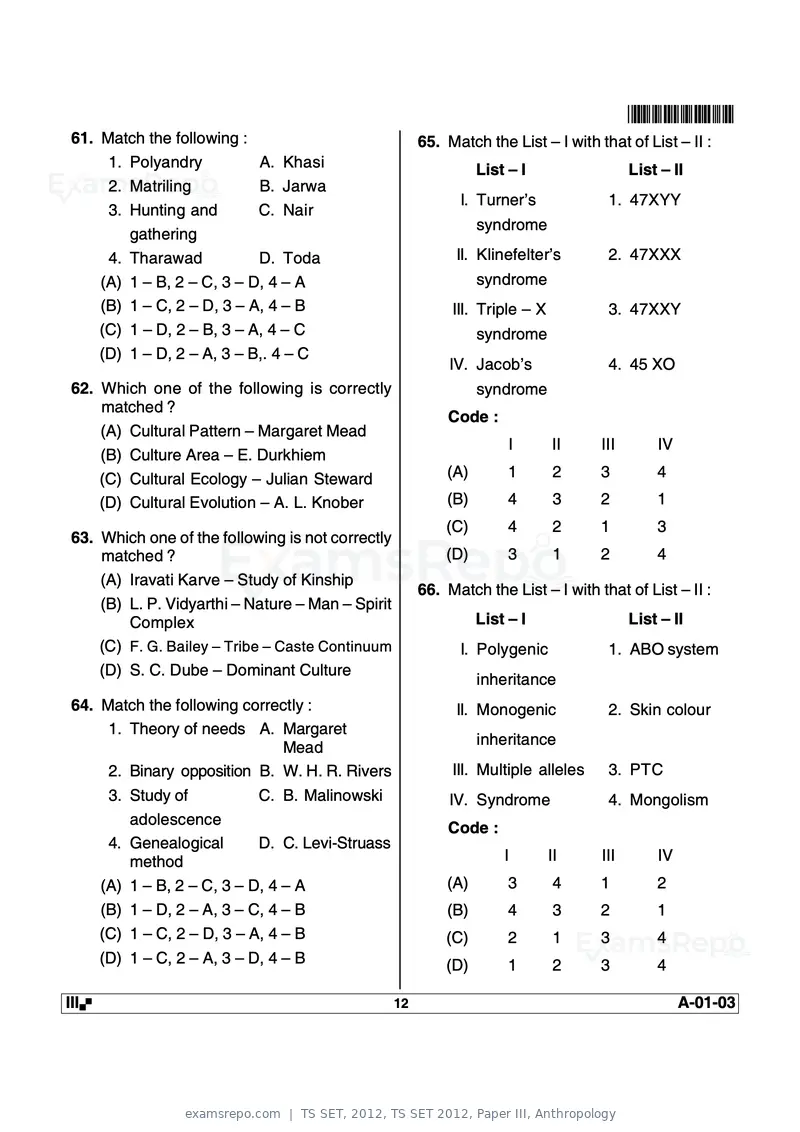
Text of page 12
*A0103*
61. Match the following :                              65. Match the List – I with that of List – II :
     1. Polyandry          A. Khasi                              List – I                 List – II
     2. Matriling          B. Jarwa
                                                             I. Turner’s             1. 47XYY
     3. Hunting and        C. Nair
                                                                 syndrome
        gathering
     4. Tharawad           D. Toda                           II. Klinefelter’s       2. 47XXX
    (A) 1 – B, 2 – C, 3 – D, 4 – A                               syndrome
    (B) 1 – C, 2 – D, 3 – A, 4 – B                          III. Triple – X          3. 47XXY
    (C) 1 – D, 2 – B, 3 – A, 4 – C                               syndrome
    (D) 1 – D, 2 – A, 3 – B,. 4 – C
                                                            IV. Jacob’s              4. 45 XO
62. Which one of the following is correctly                      syndrome
    matched ?
                                                           Code :
    (A) Cultural Pattern – Margaret Mead
                                                                      I       II    III       IV
    (B) Culture Area – E. Durkhiem
    (C) Cultural Ecology – Julian Steward                  (A)        1       2     3         4
    (D) Cultural Evolution – A. L. Knober                  (B)        4       3     2         1
                                                           (C)        4       2     1         3
63. Which one of the following is not correctly
    matched ?                                              (D)        3       1     2         4
    (A) Iravati Karve – Study of Kinship
                                                       66. Match the List – I with that of List – II :
    (B) L. P. Vidyarthi – Nature – Man – Spirit
        Complex                                                  List – I                 List – II
    (C) F. G. Bailey – Tribe – Caste Continuum               I. Polygenic            1. ABO system
    (D) S. C. Dube – Dominant Culture
                                                                 inheritance
64. Match the following correctly :                          II. Monogenic           2. Skin colour
     1. Theory of needs A. Margaret
                               Mead                              inheritance
     2. Binary opposition B. W. H. R. Rivers                III. Multiple alleles    3. PTC
     3. Study of           C. B. Malinowski                 IV. Syndrome             4. Mongolism
        adolescence
                                                           Code :
     4. Genealogical       D. C. Levi-Struass
        method                                                       I        II    III       IV
    (A) 1 – B, 2 – C, 3 – D, 4 – A                         (A)        3       4     1         2
    (B) 1 – D, 2 – A, 3 – C, 4 – B                         (B)        4       3     2         1
    (C) 1 – C, 2 – D, 3 – A, 4 – B                         (C)        2       1     3         4
       (D) 1 – C, 2 – A, 3 – D, 4 – B                      (D)        1       2     3         4

III.                                              12                                               A-01-03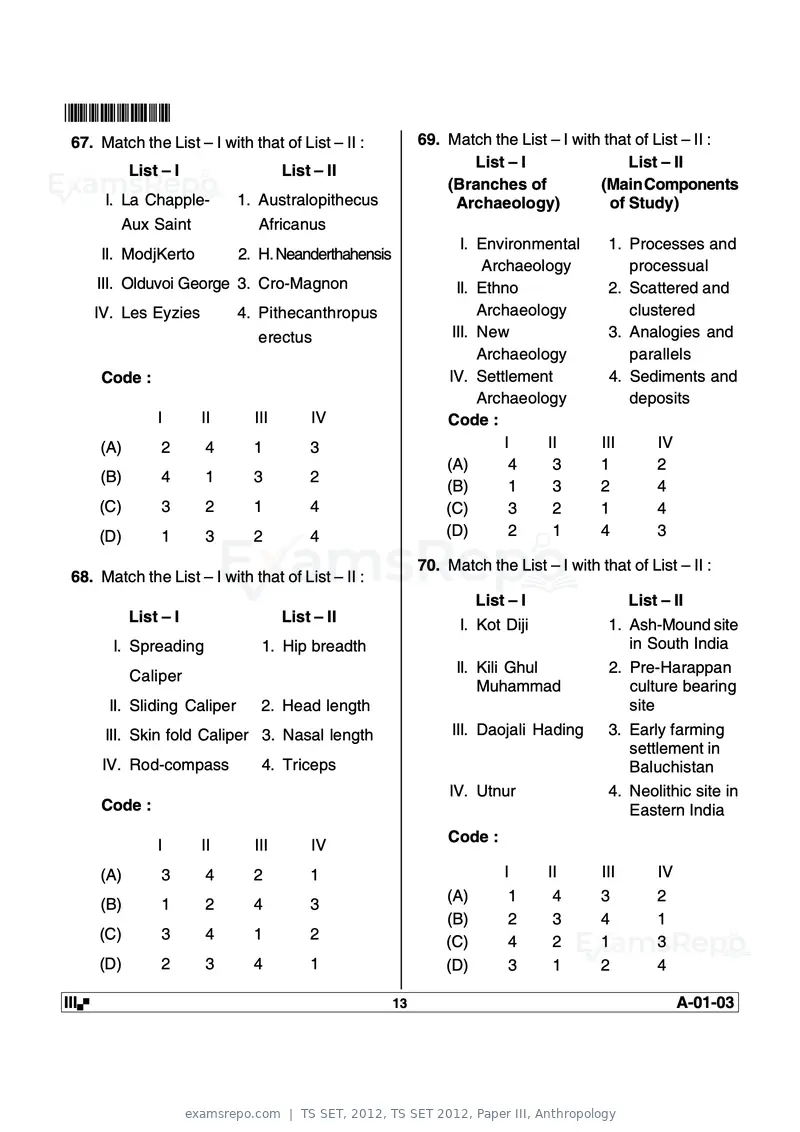
Text of page 13
*A0103*
 67. Match the List – I with that of List – II :             69. Match the List – I with that of List – II :
                                                                    List – I                 List – II
             List – I                  List – II
                                                                 (Branches of           (Main Components
        I. La Chapple-         1. Australopithecus                Archaeology)            of Study)
           Aux Saint              Africanus
                                                                     I. Environmental      1. Processes and
       II. ModjKerto           2. H. Neanderthahensis
                                                                        Archaeology           processual
       III. Olduvoi George 3. Cro-Magnon                            II. Ethno              2. Scattered and
       IV. Les Eyzies          4. Pithecanthropus                       Archaeology           clustered
                                  erectus                          III. New                3. Analogies and
                                                                        Archaeology           parallels
       Code :                                                     IV. Settlement           4. Sediments and
                                                                        Archaeology           deposits
                 I      II       III       IV                    Code :
       (A)        2     4        1         3                               I     II       III      IV
                                                                 (A)        4     3       1        2
       (B)        4     1        3         2
                                                                 (B)        1     3       2        4
       (C)        3     2        1         4                     (C)        3     2       1        4
       (D)        1     3        2         4                     (D)        2     1       4        3

                                                             70. Match the List – I with that of List – II :
 68. Match the List – I with that of List – II :
                                                                      List – I                List – II
             List – I                  List – II                   I. Kot Diji             1. Ash-Mound site
         I. Spreading             1. Hip breadth                                              in South India
                                                                   II. Kili Ghul           2. Pre-Harappan
             Caliper
                                                                       Muhammad               culture bearing
         II. Sliding Caliper      2. Head length                                              site
        III. Skin fold Caliper 3. Nasal length                    III. Daojali Hading      3. Early farming
                                                                                              settlement in
        IV. Rod-compass           4. Triceps                                                  Baluchistan
                                                                  IV. Utnur                4. Neolithic site in
       Code :                                                                                 Eastern India
                                                                 Code :
                 I      II       III       IV
       (A)        3     4        2         1                              I      II       III      IV
                                                                 (A)       1      4       3        2
       (B)        1     2        4         3
                                                                 (B)       2      3       4        1
       (C)        3     4        1         2                     (C)       4      2       1        3
       (D)        2     3        4         1                     (D)       3      1       2        4

III.                                                    13                                              A-01-03
Text of page 14
*A0103*
       71 – 75 :                                             71. Sub cultures are
       Read the passage below and answer the                     (A) Universals
       following questions based on your                         (B) Integrating elements
       understanding of the passage.                             (C) Specialities of groups and classes
       The specialities of one group may be                      (D) Simplest aspects of culture
       known to the other members of the society
       and yet not used by them, because they                72. Many Americans know about scouts
       are not patterns for their behavior. Many                 because
       American adult men know the Boy Scout
       salute, having once been scouts, but they                 (A) A boy scout salutes
       do not use it as a form of greeting after they            (B) It is part of their behaviour
       have left scouting behind. In a complex
       society, however, most specialities remain                (C) It is not secret and hidden knowledge
       unknown to most of the people. This may                   (D) They have been scouts when young
       be because the specialities require
       unique aptitudes or a rigorous course of              73. We can speak of ‘American Culture’
       training which is undertaken by only a few,               because
       or it may be that the specialities are the
       secret and hidden knowledge of a few,                     (A) Of the presence of shared and
       kept within their closed circle for the                       integrating elements
       benefits that may be derived from                         (B) Of the presence of identical behaviour
       secretiveness. The result is that no
                                                                 (C) Of the presence of minute differences
       individual can ever acquire or personally
       manifest all the elements of his or her                   (D) American personality is unique
       society’s culture. It means also that no
       anthropologist, even the most assiduous,              74. A person can not master all aspects of
       can ever make note of, to say nothing of                  culture, because
       record, all the aspects of any culture, even
                                                                 (A) Certain specialities are hidden and
       the simplest known to humanity.
                                                                     secretive
       This, then, provides one answer to the
       questions, often asked : “ How can one                    (B) No one is perfect
       speak of American culture when there is                   (C) His personality is not suited for it
       such a difference between the culture of
       New Yorkers and that of Kentucky                          (D) Time is not sufficient for him/her
       mountaineers ? – between the Italians of
       Lower Manhattan and the Scandinavians                 75. The specialities of a group are
       of Minnesota ? – between the Yankees of                   (A) Exclusively known to the members of
       Vermont and the paisanos of Monterey?”                        the group only
       The universals shared by all Americans
       are the common binding and integrating                    (B) Known to those who are in very
       elements of American culture and society.                     specialized positions
       The specialities of the different regional                (C) Known to very few exceptionally
       groups and socioeconomic classes are                          skilled people
       internally differentiating elements which
       when taken together, are referred to as                   (D) Not used by others as they are not for
       subcultures.                                                  them to make use of

III.                                                    14                                           A-01-03
Text of page 15
*A0103*
          Space for Rough Work


III.              15             A-01-03
Text of page 16
*A0103*
       Space for Rough Work


III.            16               A-01-03
Official key not published for this paper.
Page 1 of 16
Source: Telangana State Eligibility Test. Question paper published by Telangana State Eligibility Test.