
TS SET 2012: Paper III, Chemical Sciences
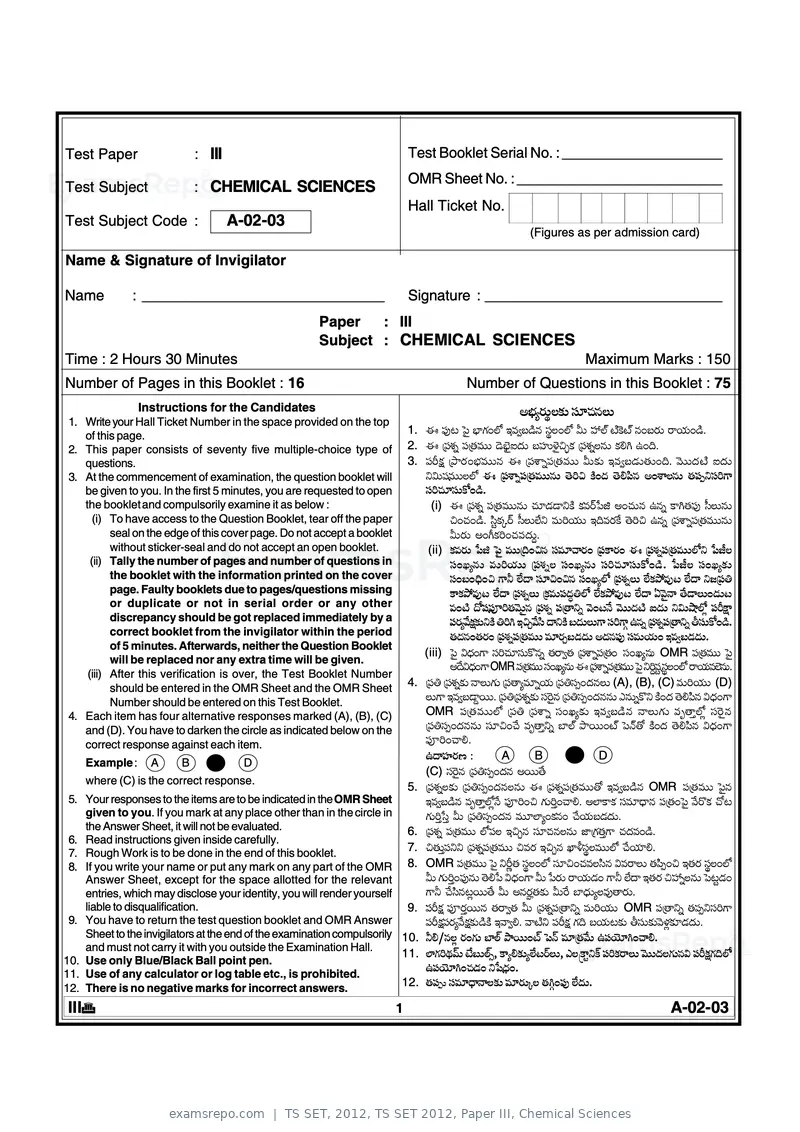
Text of page 1
Test Paper : III Test Booklet Serial No. : ______________________
OMR Sheet No. : ________________________________
Test Subject : CHEMICAL SCIENCES
Hall Ticket No.
Test Subject Code : A-02-03
(Figures as per admission card)
Name & Signature of Invigilator
Name : ____________________________________ Signature : ___________________________________
Paper : III
Subject : CHEMICAL SCIENCES
Time : 2 Hours 30 Minutes Maximum Marks : 150
Number of Pages in this Booklet : 16 Number of Questions in this Booklet : 75
Instructions for the Candidates A¿æýÅÆæÿ$¦ËMæü$ çÜ*^èþ¯èþË$
1. Write your Hall Ticket Number in the space provided on the top
1. D ç³#r ò³O ¿êVæü ÌZ CÐèþÓºyìþ¯èþ çÜ¦Ë ÌZ Ò$ çàÌý sìýMðüsý ¯èþ ºÆæÿ$ Æ>Äæý$ yìþ.
of this page.
2. This paper consists of seventy five multiple-choice type of 2. D {ç³Ôèý² ç³{èþÐèþ$$ yðþ¿ñýOI§æþ$ ºçßý$âñýO_eMæü {ç³Ôèý²Ë¯èþ$ MæüÍW E ¨.
questions. 3. ç³Èæü {´ëÆæÿ ¿æýÐèþ$$¯èþ D {ç³Ôé²ç³{èþÐèþ$$ Ò$Mæü$ CÐèþÓºyæþ$èþ$ ¨. Ððþ$$§æþsìý I§æþ$
3. At the commencement of examination, the question booklet will °Ñ$çÙÐèþ$$ËÌZ D {ç³Ôé²ç³{èþÐèþ$$¯èþ$ ðþÇ_ Mìü §æþ ðþÍí³¯èþ A Ôé˯èþ$ èþç³µ°çÜÇV>
be given to you. In the first 5 minutes, you are requested to open çÜÇ^èþ*çÜ$Mø yìþ.
the booklet and compulsorily examine it as below : (i) D {ç³Ôèý² ç³{èþÐèþ$$¯èþ$ ^èþ*yæþyé°Mìü MæüÐèþÆÿõ³h A ^èþ$¯èþ E¯èþ² M>Wèþç³# ïÜË$¯èþ$
(i) To have access to the Question Booklet, tear off the paper _ ^èþ yìþ. íÜtMæüPÆÿ ïÜË$Ìôý° Ðèþ$ÇÄæý$$ C¨ÐèþÆæÿMóü ðþÇ_ E¯èþ² {ç³Ôé²ç³{èþÐèþ$$¯èþ$
seal on the edge of this cover page. Do not accept a booklet Ò$Ææÿ$ A XMæüÇ ^èþÐèþ§æþ$ª.
without sticker-seal and do not accept an open booklet. (ii) MæüÐèþÆæÿ$ õ³h ò³O Ðèþ$${¨ _¯èþ çÜÐèþ*^éÆæÿ {ç³M>Ææÿ D {ç³Ôèý²ç³{èþÐèþ$$ÌZ° õ³iË
(ii) Tally the number of pages and number of questions in çÜ Qůèþ$ Ðèþ$ÇÄæý$$ {ç³Ôèý²Ë çÜ Qůèþ$ çÜÇ^èþ*çÜ$Mø yìþ. õ³iË çÜ QÅMæü$
the booklet with the information printed on the cover çÜ º «¨ _ V>± Ìôý§é çÜ*_ _¯èþ çÜ QÅÌZ {ç³Ôèý²Ë$ ÌôýMæü´ùÐèþ#r Ìôý§é °f{ç³
page. Faulty booklets due to pages/questions missing M>Mæü´ùÐèþ#r Ìôý§é {ç³Ôèý²Ë$ {MæüÐèþ$糧æþ®ÌZ ÌôýMæü´ùÐèþ#r Ìôý§é HÐðþO¯é óþyéË$ yæþ$r
or duplicate or not in serial order or any other Ðèþ sìý §øçÙç³NÇèþÐðþ$O¯èþ {ç³Ôèý² ç³{é°² Ððþ r¯óþ Ððþ$$§æþsìý I§æþ$ °Ñ$ÚëÌZÏ ç³È>
discrepancy should be got replaced immediately by a ç³ÆæÿÅÐóþæüMæü$°Mìü ÇW C_aÐóþíÜ §é°Mìü º§æþ$Ë$V> çÜÇV>Y E¯èþ² {ç³Ôèý²ç³{é°² ¡çÜ$Mø yìþ.
correct booklet from the invigilator within the period èþ§æþ¯èþ èþÆæÿ {ç³Ôèý²ç³{èþÐèþ$$ Ðèþ*Ææÿaºyæþ§æþ$ A§æþ¯èþç³# çÜÐèþ$Äæý$ CÐèþÓºyæþ§æþ$.
of 5 minutes. Afterwards, neither the Question Booklet
(iii) ò³O Ñ«§æþ V> çÜÇ^èþ*çÜ$Mö¯èþ² èþÆ>Óèþ {ç³Ôé²ç³{èþ çÜ Qůèþ$ OMR ç³{èþÐèþ$$ ò³O
will be replaced nor any extra time will be given.
A§óþÑ«§æþ V> OMR ç³{èþÐèþ$$ çÜ Qůèþ$ D {ç³Ôé²ç³{èþÐèþ$$ ò³O °ÇªçÙt çÜ¦Ë ÌZ Æ>Äæý$ÐèþÌñý¯èþ$.
(iii) After this verification is over, the Test Booklet Number
should be entered in the OMR Sheet and the OMR Sheet
4. {ç³ {ç³Ôèý²Mæü$ ¯éË$Væü$ {ç³éÅÐèþ*²Äæý$ {ç³çܵ §æþ¯èþË$ (A), (B), (C) Ðèþ$ÇÄæý$$ (D)
Number should be entered on this Test Booklet.
Ë$V> CÐèþÓºyézÆÿ$$. {ç³{ç³Ôèý²Mæü$ çÜÆðÿO¯èþ {ç³çܵ §æþ¯èþ¯èþ$ G¯èþ$²Mö° Mìü §æþ ðþÍí³¯èþ Ñ«§æþ V>
4. Each item has four alternative responses marked (A), (B), (C) OMR ç³{èþÐèþ$$ÌZ {ç³ {ç³Ôé² çÜ QÅMæü$ CÐèþÓºyìþ¯èþ ¯éË$Væü$ Ðèþé¢ÌZÏ çÜÆðÿO¯èþ
and (D). You have to darken the circle as indicated below on the {ç³çܵ §æþ¯èþ¯èþ$ çÜ*_ ^óþ Ðèþ颰² »êÌý ´ëÆÿ$$ sý ò³¯þø Mìü §æþ ðþÍí³¯èþ Ñ«§æþ V>
correct response against each item. ç³NÇ ^éÍ.
Example : A B C D
E§éçßýÆæÿ×ý : A B C D
(C) çÜÆðÿO¯èþ {ç³çܵ §æþ¯èþ AÆÿ$$óþ
where (C) is the correct response.
5. {ç³Ôèý²ËMæü$ {ç³çܵ §æþ¯èþ˯èþ$ D {ç³Ôèý²ç³{èþÐèþ$$ø CÐèþÓºyìþ¯èþ OMR ç³{èþÐèþ$$ ò³O¯èþ
5. Your responses to the items are to be indicated in the OMR Sheet CÐèþÓºyìþ¯èþ Ðèþé¢ÌZϯóþ ç³NÇ _ Væü$Ç¢ ^éÍ. AÌêM>Mæü çÜÐèþ*«§é¯èþ ç³{èþ ò³O ÐóþÆöMæü ^ør
given to you. If you mark at any place other than in the circle in Væü$Ç¢õÜ¢ Ò$ {ç³çܵ §æþ¯èþ Ðèþ$*ÌêÅ Mæü¯èþ ^óþÄæý$ºyæþ§æþ$.
the Answer Sheet, it will not be evaluated. 6. {ç³Ôèý² ç³{èþÐèþ$$ ÌZç³Ë C_a¯èþ çÜ*^èþ¯èþ˯èþ$ gê{Væüèþ¢V> ^èþ§æþÐèþ yìþ.
6. Read instructions given inside carefully.
7. Rough Work is to be done in the end of this booklet.
7. _èþ$¢ç³°° {ç³Ôèý²ç³{èþÐèþ$$ _ÐèþÆæÿ C_a¯èþ RêäçܦËÐèþ$$ÌZ ^óþÄæý*Í.
8. If you write your name or put any mark on any part of the OMR 8. OMR ç³{èþÐèþ$$ ò³O °È~èþ çÜ¦Ë ÌZ çÜ*_ ^èþÐèþËíܯèþ ÑÐèþÆ>Ë$ èþí³µ _ CèþÆæÿ çÜ¦Ë ÌZ
Answer Sheet, except for the space allotted for the relevant Ò$ Væü$Ç¢ ç³#¯èþ$ ðþÍõ³ Ñ«§æþ V> Ò$ õ³Ææÿ$ Æ>Äæý$yæþ V>± Ìôý§é CèþÆæÿ _à²Ë¯èþ$ ò³rtyæþ
entries, which may disclose your identity, you will render yourself V>± ^óþíܯèþrÏÆÿ$$óþ Ò$ A¯èþÆæÿáèþMæü$ Ò$Æóÿ »ê«§æþ$ÅËÐèþ#éÆæÿ$.
liable to disqualification. 9. çç³Èæü ç³NÆæÿ¢Æÿ$$¯èþ èþÆ>Óèþ Ò$ {ç³Ôèý²ç³{é°² Ðèþ$ÇÄæý$$ OMR ç³{é°² èþç³µ°çÜÇV>
9. You have to return the test question booklet and OMR Answer ç³Èæüç³ÆæÿÅÐóþæüMæü$yìþMìü CÐéÓÍ. Ðésìý° ç³Èæü Væü¨ ºÄæý$rMæü$ ¡çÜ$Mæü$ÐðþâæýÏMæü*yæþ§æþ$.
Sheet to the invigilators at the end of the examination compulsorily 10. ±Í/¯èþËÏ Ææÿ Væü$ »êÌý ´ëÆÿ$$ sý ò³¯þ Ðèþ*{èþÐóþ$ Eç³Äñý*W ^éÍ.
and must not carry it with you outside the Examination Hall.
11. ÌêVæüÇ£æþÐþ$ sôýº$ÌýÞ, M>ÅÍMæü$ÅÌôýrÆÿË$, GË[M>t°Mü ç³ÇMæüÆ>Ë$ Ððþ$$§æþËVæü$¯èþÑ ç³ÈæüVæü¨ÌZ
10. Use only Blue/Black Ball point pen.
11. Use of any calculator or log table etc., is prohibited.
Eç³Äñý*W ^èþyæþ °õÙ«§æþ .
12. There is no negative marks for incorrect answers.
12. èþç³ çÜÐèþ*«§é¯éËMæü$ Ðèþ*Ææÿ$PË èþWY ç³# Ìôý§æþ$.
IIIG 1 A-02-03
Text of page 2
*A0203*


IIIG   2      A-02-03
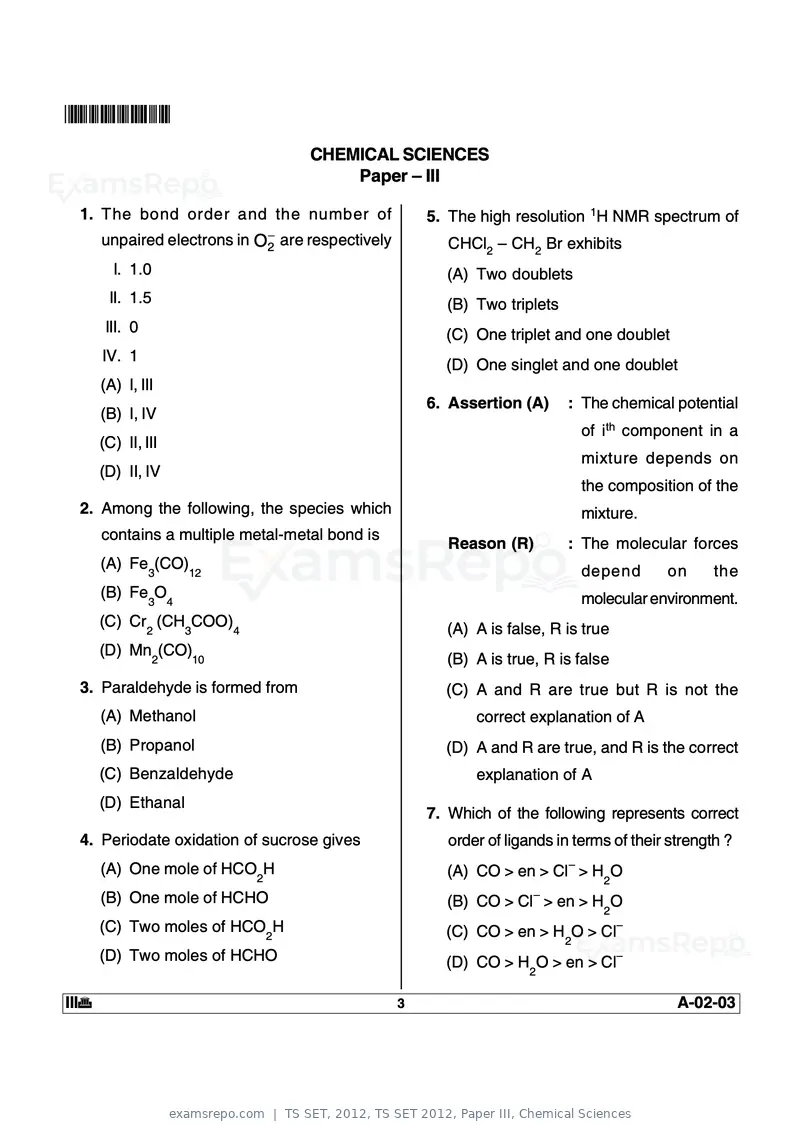
Text of page 3
*A0203*
                                     CHEMICAL SCIENCES
                                         Paper – III

  1. The bond order and the number of                   5. The high resolution 1H NMR spectrum of
       unpaired electrons in O2− are respectively          CHCl2 – CH2 Br exhibits
         I. 1.0                                           (A) Two doublets
        II. 1.5                                           (B) Two triplets
        III. 0                                            (C) One triplet and one doublet
       IV. 1
                                                          (D) One singlet and one doublet
       (A) I, III
                                                        6. Assertion (A)      : The chemical potential
       (B) I, IV
                                                                                  of ith component in a
       (C) II, III
                                                                                  mixture depends on
       (D) II, IV
                                                                                  the composition of the
  2. Among the following, the species which                                       mixture.
       contains a multiple metal-metal bond is
                                                           Reason (R)         : The molecular forces
       (A) Fe3(CO)12                                                              depend      on     the
       (B) Fe3O4                                                                  molecular environment.
       (C) Cr2 (CH3COO)4                                  (A) A is false, R is true
       (D) Mn2(CO)10
                                                          (B) A is true, R is false
  3. Paraldehyde is formed from                           (C) A and R are true but R is not the
       (A) Methanol                                            correct explanation of A
       (B) Propanol                                       (D) A and R are true, and R is the correct
       (C) Benzaldehyde                                        explanation of A
       (D) Ethanal
                                                        7. Which of the following represents correct
  4. Periodate oxidation of sucrose gives                  order of ligands in terms of their strength ?
                                                                              –
       (A) One mole of HCO2H                              (A) CO > en > Cl > H2O
       (B) One mole of HCHO                               (B) CO > Cl– > en > H2O
       (C) Two moles of HCO2H                             (C) CO > en > H2O > Cl–
       (D) Two moles of HCHO                              (D) CO > H2O > en > Cl–

IIIG                                                3                                          A-02-03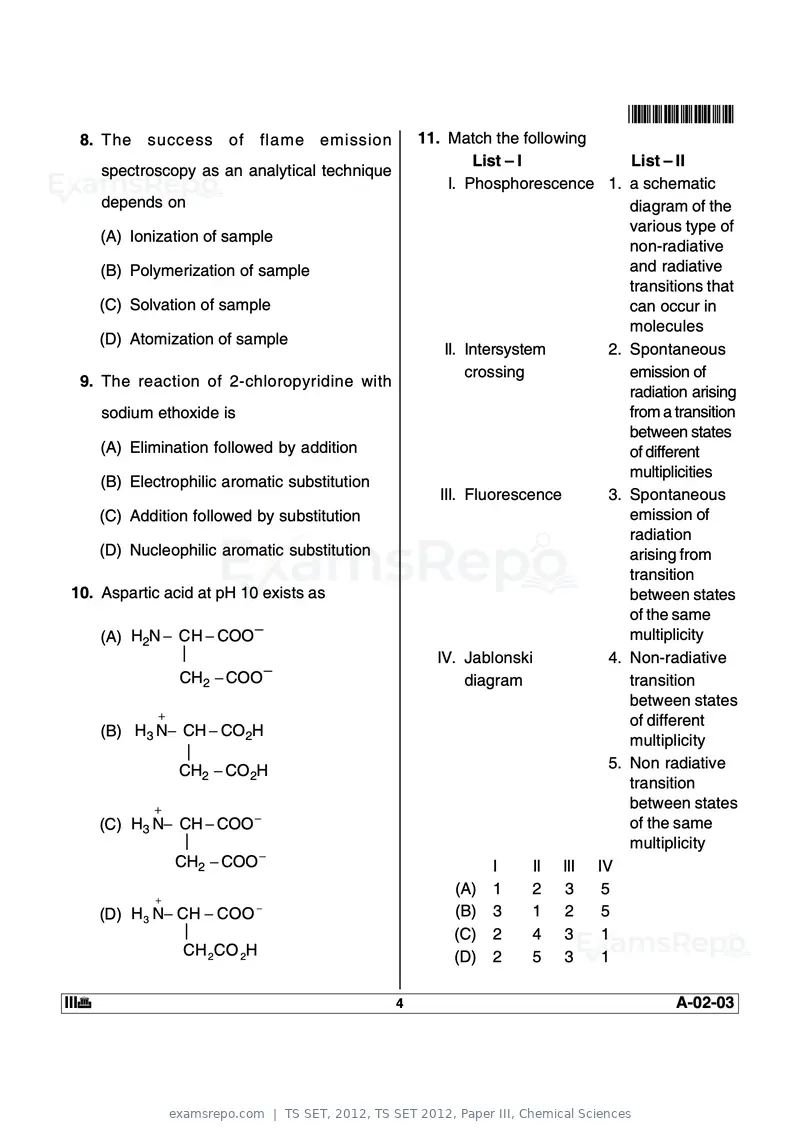
Text of page 4
*A0203*
  8. The     success     of   flame   emission       11. Match the following
                                                              List – I             List – II
       spectroscopy as an analytical technique
                                                          I. Phosphorescence 1. a schematic
       depends on                                                                  diagram of the
                                                                                   various type of
       (A) Ionization of sample
                                                                                   non-radiative
       (B) Polymerization of sample                                                and radiative
                                                                                   transitions that
       (C) Solvation of sample                                                     can occur in
                                                                                   molecules
       (D) Atomization of sample
                                                         II. Intersystem        2. Spontaneous
                                                             crossing              emission of
  9. The reaction of 2-chloropyridine with
                                                                                   radiation arising
       sodium ethoxide is                                                          from a transition
                                                                                   between states
       (A) Elimination followed by addition                                        of different
                                                                                   multiplicities
       (B) Electrophilic aromatic substitution
                                                        III. Fluorescence       3. Spontaneous
       (C) Addition followed by substitution                                       emission of
                                                                                   radiation
       (D) Nucleophilic aromatic substitution                                      arising from
                                                                                   transition
10. Aspartic acid at pH 10 exists as                                               between states
                                                                                   of the same
       (A) H2N − C H − COO −                                                       multiplicity
                 |                                     IV. Jablonski            4. Non-radiative
                   CH2 − COO −                               diagram               transition
                                                                                   between states
               +                                                                   of different
       (B) H3 N− CH − CO 2H
                                                                                   multiplicity
                 |
                CH2 − CO 2H                                                     5. Non radiative
                                                                                   transition
              +                                                                    between states
       (C) H3 N− CH − COO −                                                        of the same
                 |                                                                 multiplicity
                CH2 − COO −                                      I     II III IV
                                                            (A) 1      2 3     5
              +
       (D) H 3 N− CH − COO −                                (B) 3      1 2     5
                   |                                        (C) 2      4 3     1
                   CH 2 CO 2H                               (D) 2      5 3     1

IIIG                                             4                                        A-02-03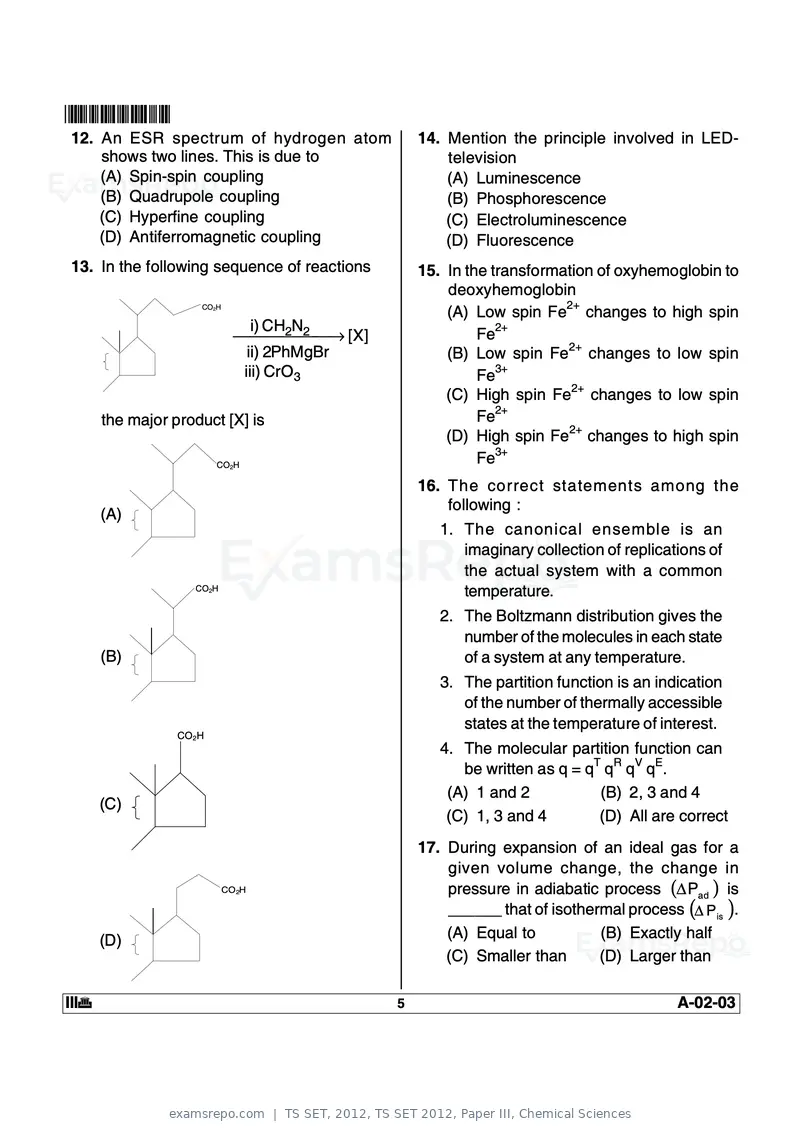
Text of page 5
*A0203*
12. An ESR spectrum of hydrogen atom                    14. Mention the principle involved in LED-
    shows two lines. This is due to                         television
    (A) Spin-spin coupling                                  (A) Luminescence
    (B) Quadrupole coupling                                 (B) Phosphorescence
    (C) Hyperfine coupling                                  (C) Electroluminescence
    (D) Antiferromagnetic coupling                          (D) Fluorescence
13. In the following sequence of reactions              15. In the transformation of oxyhemoglobin to
                                                            deoxyhemoglobin
                                                                             2+
                     CO2H
                                                            (A) Low spin Fe changes to high spin
                                 i) CH2N2
                              ⎯⎯ ⎯ ⎯     ⎯⎯→ [ X]                Fe2+
                                ii) 2PhMgBr                 (B) Low spin Fe2+ changes to low spin
                               iii) CrO3                         Fe
                                                                    3+

                                                            (C) High spin Fe2+ changes to low spin
                                                                    2+
       the major product [X] is                                  Fe
                                                            (D) High spin Fe2+ changes to high spin
                         CO2H
                                                                 Fe3+
                                                        16. The correct statements among the
                                                            following :
       (A)
                                                           1. The canonical ensemble is an
                                                               imaginary collection of replications of
                                                               the actual system with a common
                    CO2H
                                                               temperature.
                                                           2. The Boltzmann distribution gives the
                                                              number of the molecules in each state
       (B)                                                    of a system at any temperature.
                                                           3. The partition function is an indication
                                                              of the number of thermally accessible
                                                              states at the temperature of interest.
                  CO2H
                                                           4. The molecular partition function can
                                                              be written as q = qT qR qV qE.
                                                            (A) 1 and 2           (B) 2, 3 and 4
       (C)
                                                            (C) 1, 3 and 4        (D) All are correct
                                                        17. During expansion of an ideal gas for a
                                                            given volume change, the change in
                            CO 2H                           pressure in adiabatic process (Δ Pad ) is
                                                            ______ that of isothermal process (Δ P is ).
       (D)                                                  (A) Equal to          (B) Exactly half
                                                            (C) Smaller than      (D) Larger than

IIIG                                                5                                         A-02-03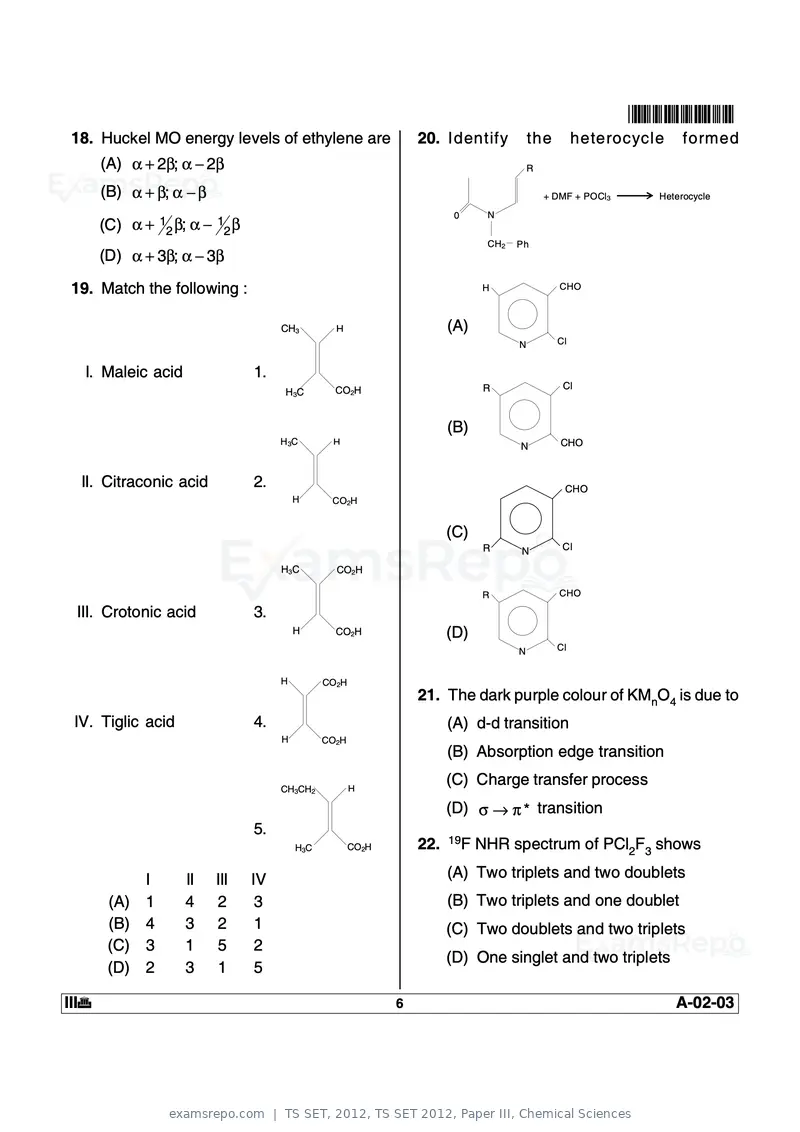
Text of page 6
*A0203*
18. Huckel MO energy levels of ethylene are                      20. Identify        the        heterocycle     formed
       (A) α + 2β; α − 2β                                                            R

       (B) α + β; α − β                                                                  + DMF + POCl3     Heterocycle

                                                                      0    N
       (C) α + 12 β; α − 12 β
                                                                           CH2   Ph
       (D) α + 3β; α − 3β

19. Match the following :                                                  H                CHO


                                     CH3         H                   (A)
                                                                                 N         Cl


   I. Maleic acid               1.
                                                 CO2H                      R                Cl
                                      H3C


                                                                     (B)
                                     H 3C       H                                           CHO
                                                                                 N


  II. Citraconic acid           2.                                                           CHO
                                         H      CO2H


                                                                    (C)
                                                                           R     N          Cl

                                     H3C         CO2H

                                                                           R                CHO

 III. Crotonic acid             3.
                                         H       CO2H               (D)
                                                                                 N         Cl


                                     H         CO2H
                                                                 21. The dark purple colour of KMnO4 is due to
 IV. Tiglic acid                4.                                   (A) d-d transition
                                     H         CO2H
                                                                     (B) Absorption edge transition

                                     CH3CH2           H
                                                                    (C) Charge transfer process
                                                                    (D) σ → π * transition
                                5.
                                         H3C          CO2H       22. 19F NHR spectrum of PCl2F3 shows

            I       II    III   IV                                   (A) Two triplets and two doublets
        (A) 1       4     2      3                                   (B) Two triplets and one doublet
        (B) 4       3     2      1                                  (C) Two doublets and two triplets
        (C) 3       1     5      2
                                                                    (D) One singlet and two triplets
        (D) 2       3     1      5

IIIG                                                         6                                                A-02-03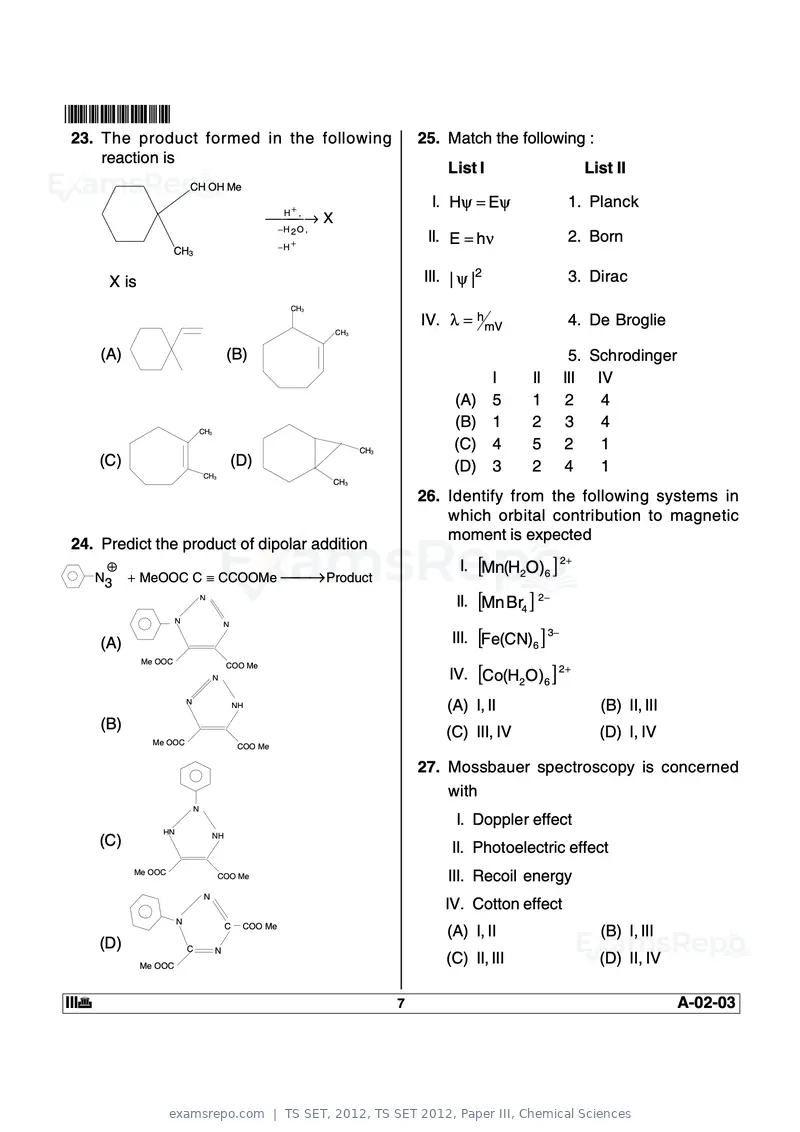
Text of page 7
*A0203*
23. The product formed in the following                                                 25. Match the following :
    reaction is
                                                                                            List I                  List II
                            CH OH Me
                                                                +
                                                                                          I. Hψ = Eψ              1. Planck
                                                         H ,
                                                        ⎯⎯⎯→ X
                                                             −H 2 O ,
                                                                                         II. E = hν               2. Born
                        CH3                                  −H +


        X is                                                                            III. | ψ |2               3. Dirac
                                                                CH3
                                                                                        IV. λ = h mV              4. De Broglie
                                                                        CH3


       (A)                                     (B)                                                                 5. Schrodinger
                                                                                                      I    II     III IV
                                                                                             (A)      5    1      2    4
                                    CH3
                                                                                             (B)      1    2      3    4
                                                                              CH3            (C)      4    5      2    1
       (C)                                        (D)                                        (D)      3    2      4    1
                                    CH3
                                                                        CH3

                                                                                        26. Identify from the following systems in
                                                                                            which orbital contribution to magnetic
                                                                                            moment is expected
24. Predict the product of dipolar addition
        ⊕                                                                                     I. [Mn(H2O)6 ] 2 +
       N3 + MeOOC C ≡ CCOOMe ⎯⎯→ Product
                                    N
                                                                                              II. [Mn Br4 ] 2−
                        N                     N

       (A)                                                                                   III. [Fe(CN)6 ] 3−
               Me OOC
                                                                                            IV. [Co(H2 O )6 ] 2 +
                                               COO Me
                                          N

                            N                      NH                                       (A) I, II                 (B) II, III
       (B)
                 Me OOC
                                                                                            (C) III, IV               (D) I, IV
                                                   COO Me

                                                                                        27. Mossbauer spectroscopy is concerned
                                                                                            with
                                N
                                                                                              I. Doppler effect
                   HN
       (C)                                NH
                                                                                             II. Photoelectric effect
             Me OOC                       COO Me                                            III. Recoil energy
                                     N
                                                                                            IV. Cotton effect
                        N                      C    COO Me
                                                                                            (A) I, II                 (B) I, III
       (D)                  C             N
               Me OOC
                                                                                            (C) II, III               (D) II, IV

IIIG                                                                                7                                               A-02-03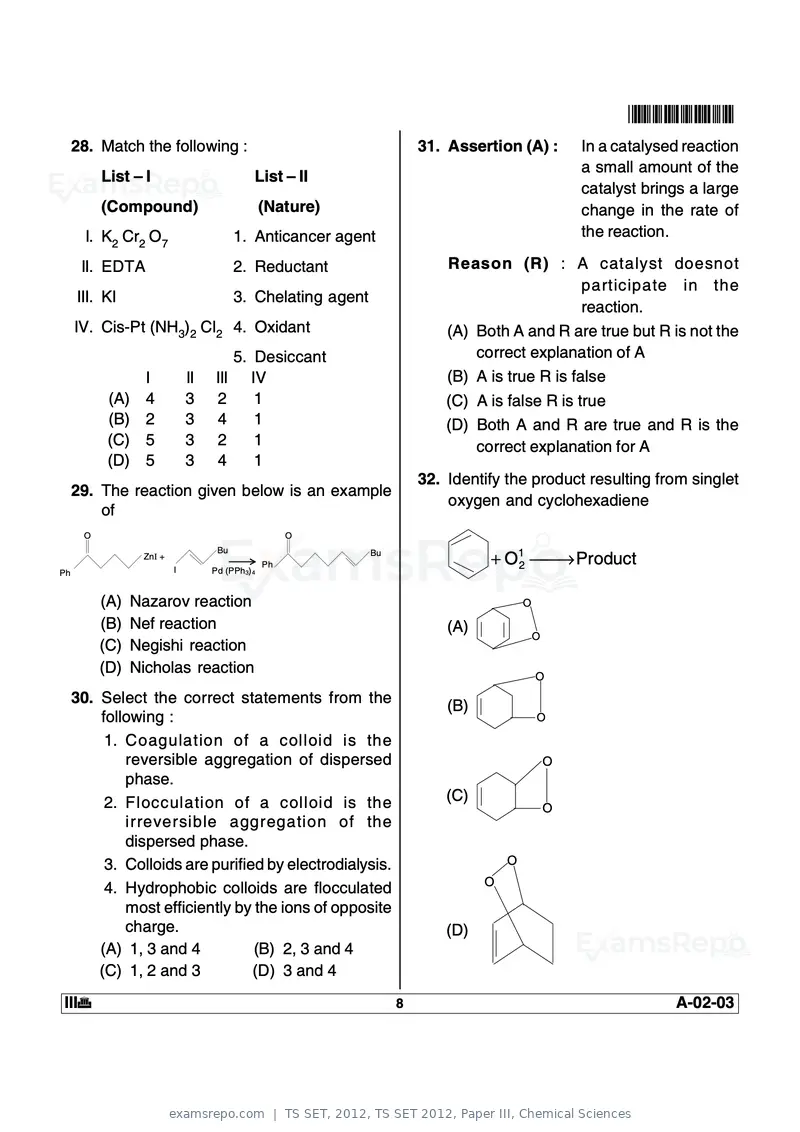
Text of page 8
*A0203*
     28. Match the following :                                       31. Assertion (A) :           In a catalysed reaction
                                                                                                   a small amount of the
          List – I                          List – II
                                                                                                   catalyst brings a large
          (Compound)                            (Nature)                                           change in the rate of
       I. K2 Cr2 O7                    1. Anticancer agent                                         the reaction.

      II. EDTA                         2. Reductant                      Reason (R) : A catalyst doesnot
                                                                                              participate in the
     III. KI                           3. Chelating agent
                                                                                              reaction.
     IV. Cis-Pt (NH3)2 Cl2 4. Oxidant                                    (A) Both A and R are true but R is not the
                                     5. Desiccant                            correct explanation of A
               I            II    III IV                                 (B) A is true R is false
           (A) 4            3     2     1                                (C) A is false R is true
           (B) 2            3     4     1                                (D) Both A and R are true and R is the
           (C) 5            3     2     1                                    correct explanation for A
           (D) 5            3     4     1
                                                                     32. Identify the product resulting from singlet
     29. The reaction given below is an example
                                                                         oxygen and cyclohexadiene
         of
      O                                              O
                                  Bu
                ZnI +
                        I
                                                Ph
                                                            Bu
                                                                               + O12 ⎯⎯→ Product
Ph                               Pd (PPh 3) 4


          (A) Nazarov reaction                                                         O

          (B) Nef reaction                                               (A)               O
          (C) Negishi reaction
          (D) Nicholas reaction                                                            O
     30. Select the correct statements from the                          (B)
         following :                                                                       O

          1. Coagulation of a colloid is the
             reversible aggregation of dispersed                                               O
             phase.
          2. Flocculation of a colloid is the                            (C)
                                                                                               O
             irreversible aggregation of the
             dispersed phase.
          3. Colloids are purified by electrodialysis.                             O
                                                                               O
          4. Hydrophobic colloids are flocculated
             most efficiently by the ions of opposite
             charge.                                                     (D)
         (A) 1, 3 and 4          (B) 2, 3 and 4
         (C) 1, 2 and 3          (D) 3 and 4
IIIG                                                             8                                              A-02-03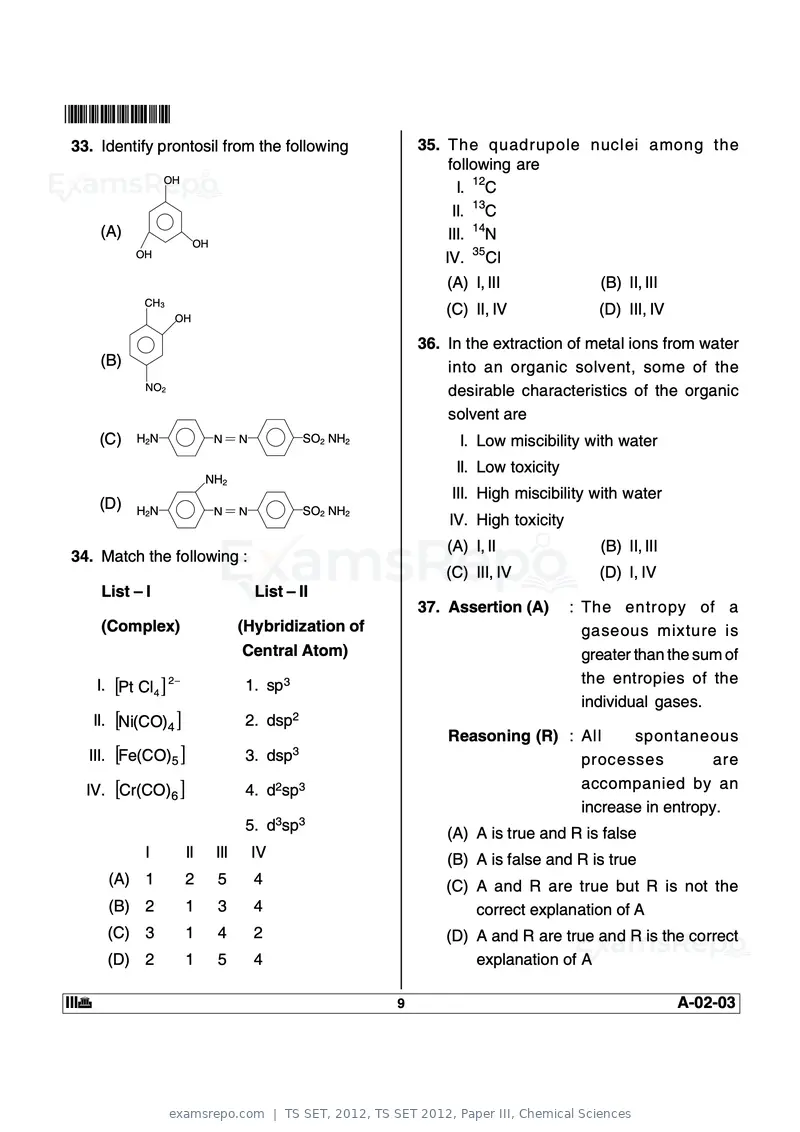
Text of page 9
*A0203*
33. Identify prontosil from the following                       35. The quadrupole nuclei among the
                                                                     following are
                    OH                                                    12
                                                                       I. C
                                                                      II. 13C
        (A)                                                          III. 14N
                           OH
              OH                                                    IV. 35Cl
                                                                    (A) I, III              (B) II, III
                CH3
                      OH
                                                                    (C) II, IV              (D) III, IV

                                                                36. In the extraction of metal ions from water
        (B)                                                         into an organic solvent, some of the
                NO2                                                 desirable characteristics of the organic
                                                                    solvent are
       (C)    H2N               N     N           SO2 NH2             I. Low miscibility with water
                                                                     II. Low toxicity
                               NH2
                                                                    III. High miscibility with water
       (D)    H2N               N     N           SO2 NH2
                                                                    IV. High toxicity
                                                                    (A) I, II               (B) II, III
34. Match the following :
                                                                    (C) III, IV             (D) I, IV
        List – I                          List – II
                                                                37. Assertion (A)       : The entropy of a
        (Complex)                     (Hybridization of                                   gaseous mixture is
                                       Central Atom)                                      greater than the sum of
       I. [Pt Cl4 ] 2 −                1. sp3                                             the entropies of the
                                                                                          individual gases.
       II. [Ni(CO)4 ]                  2. dsp2
                                                                    Reasoning (R) : All    spontaneous
   III. [Fe(CO)5 ]                     3. dsp3                                      processes          are
   IV. [Cr(CO)6 ]                      4. d2sp3                                     accompanied by an
                                                                                    increase in entropy.
                                       5. d3sp3
                                                                    (A) A is true and R is false
                I         II    III       IV                        (B) A is false and R is true
         (A) 1            2     5         4                         (C) A and R are true but R is not the
         (B) 2            1     3         4                             correct explanation of A
         (C) 3            1     4         2                         (D) A and R are true and R is the correct
         (D) 2            1     5         4                             explanation of A

IIIG                                                        9                                             A-02-03
Text of page 10
*A0203*
38. The correct statements among the                      40. The Z, Z, Z, Z, Z – isomer of [10] annulene
    following are                                             is
       1. A catalyst does not affect the                                 H
                                                              (A)            H
          equilibrium constant.
       2. Le Chatelier’s principle states that a
          system at equilibrium, when subjected
          to a disturbance responds in a way that             (B)
          minimizes the effect of the disturbance.
       3. Increase in temperature favours the
          reactants in endothermic reactions and              (C)
          products in exothermic reactions.
       4. Oxidation is the removal of electrons
          from a species and reduction is the                 (D)
          addition of electrons to a species.
       (A) 1, 2 and 3          (B) 1, 2 and 4
       (C) 1, 3 and 4          (D) 2, 3 and 4             41. When benzaldehyde is treated with SF4,
                                                              the product X is obtained. Identify ‘X’
39. Match the following :
                                                              among the following.
       List – I                 List II
                                                                                                      CHO
       (Species)               (Nature)                                      CHO


   I. Chlorophyll        1. Contains Co (III) ion             (A)                        (B)
                                                                             F
                                                                                                F
  II. Haemoglobin 2. Non-heme iron sulphur
                     protein                                                       CHO
                                                                                                       CHF2

 III. Vitamin B12        3. Contains Mg                       (C)                        (D)
 IV. Rubredoxin          4. Anticancer drug                         F


                         5. Contains Fe (II)              42. In quantum mechanical tunnelling the
                                                              transmission coefficient
              I     II   III   IV
                                                              (A) Increases with the thickness of the barrier
        (A)   1     2    5     4                              (B) Decreases exponentially with the
        (B)   3     5    1     2                                  thickness of the barrier
                                                              (C) Decreases with the square of the
        (C)   5     4    3     1                                  thickness of the barrier
        (D)   3     2    4     5                              (D) Doesnot depend on the thickness of
                                                                  the barrier
IIIG                                                 10                                             A-02-03
Text of page 11
*A0203*
43. Example of fermions are                                   46. Which of the following exhibit quadrupole
       (A) Electron and proton                                    splitting ?
                                                                   I. K 4 [Fe(CN)6 ]      II. K 3 [Fe(CN)6 ]
       (B) Photon and proton
                                                                  III. [Fe(H2O)6 ] Cl3   IV. Fe(CO)5
       (C) Electron and photon
                                                                 (A) I, II               (B) I, III
       (D) Photons                                               (C) II, III             (D) II, IV
44. The molecule H2O2 belongs to _______                      47. Assertion (A) : Zn2+ ion is zinc finger
                                                                                   proteins is bound to
       point group.
                                                                                   S2N2 system.
       (A) C2v                 (B) C2h
                                                                  Reason (R)       : Zn2+ ion is borderline
       (C) D2h                 (D) C2                                                acid and is stable with
                                                                                     borderline       S 2N 2
45. Match the following                                                              system.
       List – I                         List – II                (A) Both A and R are true and R is the
                                                                     correct explanation of A
   I. Joule-Thomson             1. PV = constant                 (B) Both A and R are true but R is not the
      coefficient                                                    correct explanation of A
                                     qrev                        (C) A is true but R is false
  II. Equation of state         2.                               (D) A is false but R is true
                                      T
       of a gas at its Boyle                                  48. Match the following :
       temperature                                                   List – I           List – II
                                     qirrev                          (Ion)       (Electron Configuration)
 III. Entropy change            3.                                        3+
                                       T                            I. Ce            1. [Xe] 4f4
       of a system during                                          II. Pm3+          2. [Xe] 4f1
       irreversible process                                       III. Gd3+          3. [Xe] 4f5
                                   ⎛ δT ⎞                        IV. Lu3+            4. [Xe] 4f7
 IV. Vant Haffs reaction        4. ⎜ δP ⎟                                            5. [Xe] 4f14
                                   ⎝ ⎠H
                                                                           I  II III IV
       isotherm
                                                                     (A) 2    4 1       3
                                5. K p α e − Δ G° / RT               (B) 1    2 5       4
                                                                     (C) 2    1 4       5
                                   ⎛ δP ⎞                            (D) 1    3 4       5
                                6. ⎜ δT ⎟
                                   ⎝ ⎠H
                                                              49. A linear molecule having N atoms has
              I    II   III    IV
                                                                  ________ number of independent modes
        (A)   3    2    1       4
                                                                  of vibration.
        (B)   4    1    2       5
                                                                  (A) 3N – 5          (B) 3N – 6
        (C)   6    1    2       5
                                                                  (C) 3N             (D) 3N – 3
        (D)   4    3    6       2

IIIG                                                     11                                           A-02-03
Text of page 12
*A0203*
50. Lowest allowed energy is equal to zero               54. The standard reduction potentials of Fe3+,
    for a                                                    Fe2+/Pt and Fe2+/Fe electrodes at 25°C
    (A) Harmonic oscillator                                  are +0.771V and – 0.440V respectively.
    (B) Particle in a two dimensional box                    The standard emf of the cell in which the
    (C) A rigid rotator                                      following reaction takes place is
    (D) Hydrogen atom                                        Fe + 2Fe3+ → 3Fe 2+
51. Identify the product in the following                    (A) + 0.331 V                            (B) – 0.331 V
    reaction                                                 (C) – 1.211 V                            (D) +1.211 V
                 Cro3                                    55. Assertion (A) : The pH of aqueous
                            X
                AcOH                                                            solution of NaCl is 7.0
                                                             Reason (R)       : Aqueous solutions of
       X is                           CO2H                                      all salts are neutral.
                                                             (A) A and R are true and R is the correct
                        CO 2H                                    explanation of A
       (A)                      (B)                          (B) A and R are true but R is not the
                     CO 2H                                       correct explanation of A
                                      CO2H                   (C) A is true and R is false
                                      CO2H                   (D) A is false and R is true
              CO2H

                                                         56. Predict the product formed under
       (C)                      (D)                          cyclization conditions
                                                                                                       COOME
                                                                   OAC
                                             CO2H
                                                                                COOME +
                                                              R
52. Match the following                                                                                NH2


      I. Aerosol         1. Cyclopropane                     + NaH + THF ⎯⎯→ Pr oduct
     II. Insecticide     2. Iodoform
                                                                    MeOOC                         R
    III. Anaesthetic     3. P-dichlorobenzene
                                                             (A)
   IV. Antiseptic        4. Freon                                                     N           O
                                                                                      H
                         5. CCl4
            I      II III IV                                        MeOOC
                                                                                              R
       (A) 4       3 1      2                                (B)
       (B) 2       3 4      1                                                     N
                                                                                  H
                                                                                          O


       (C) 3       2 1      4
                                                                    MeOOC
       (D) 4       5 3      2
                                                             (C)
                                                                            R     N       O
53. For a one component system the                                                H

    maximum number of phases that can
                                                                    MeOOC
    coexist at equilibrium are
    (A) 4                 (B) 3                              (D)
                                                                                      N       O
    (C) 2                 (D) 1                                             R
                                                                                      H


IIIG                                                12                                                          A-02-03
Text of page 13
*A0203*
 57. In the following reaction                            59. Assertion (A)     : CO is a strong ligand.
                                                              Reason (R)        : It acts only as a σ
                                                                                  donor.
              CHO        a) Alkaline KMNO4                    (A) Both A and R are true and R is the
                         b) Cromic acid                           correct explanation of A
                                                              (B) Both A and R are true but R is not the
                                                                  correct explanation of A
       One of the products is                                 (C) A is true but R is false
                                                              (D) A is false but R is true
                                             CHO
                  CHO                                     60. Which commercial product comes from
                                                O
                                                              cellulose ?
       (A)                          (B)
                  CO2H                                        (A) Nylon         (B) Rayon
                                          CH3
                                                              (C) Dacron        (D) Orlon

                  CO2H                                    61. Assertion (A) : Cluster formation by a
                                             CHO                              metal is inversely
                    O                                                         proportional to its
       (C)                          (D)                                       effective     nuclear
             CH3                                                              charge.
                                                              Reason (R)       : Nuclear        charge
 58. Match the following :                                                       contracts the metal
                                                                                 orbitals meant for
  List – I                          List – II                                    overlap.
                                                              (A) Both A and R are true and R is the
(Compound)                          (Nature)
                                                                  correct explanation of A
   I. HCl                1. Conjugate base of NH4+            (B) Both A and R are true but R is not the
                                                                  correct explanation of A
  II. NH3                2. Arrhenius base                    (C) A is true but R is false
 III. AlCl3              3. Conjugate acid of NH4+            (D) A is false but R is true

 IV. NaOH                4. Lewis acid                    62. An enzyme enhances the rate of the
                                                              reaction by
                         5. Bronsted acid                     (A) Increasing the number of collisions
              I          II   III   IV                            between the reactants
                                                              (B) Increasing the velocity of the reacting
        (A) 3            1    5     2                             molecules
        (B) 5            3    4     2                         (C) Providing energy to the reacting
        (C) 4            1    5     2                             molecules
                                                              (D) Decreasing the activation energy of
        (D) 5            1    4     2
                                                                  the reaction

IIIG                                                 13                                         A-02-03
Text of page 14
*A0203*
63. Assertion (A) : The d1 and d8 systems                67. Predict the [4+2] Diels-Alder cycloaddition
                    have the same number                     product with right stereochemistry
                    of microstates.
                                                                     O
       Reason (R)       : According to hole
                          formalism, dn ≡ d10 −n                             +       Product
                          where n is the number
                                                              MeO
                          of electrons                               O
       (A) Both A and R are true and R is the
           correct explanation of A
       (B) Both A and R are true but R is not the
           correct explanation of A
       (C) A is true but R is false
       (D) A is false but R is true

64. For the photolysis of HI → H2 + I2 , the
    following mechanism is proposed
    HI + hv → H. + I .
    H. + HI → H 2 + I .
        I. + I. → I2
       The quantum yield of this reaction is
       (A) 0.5              (B) 1.0
       (C) 2.0             (D) 4.0
65. Assertion (A) : ESR spectroscopy is
                    not applicable for H 2
                    molecule.
       Reason (R)       : H2 molecule contains a
                          single bond between
                          the H atoms.
       (A) Both A and R are true and R is the
           correct explanation of A
       (B) Both A and R are true but R is not the
           correct explanation of A                      68. An electron of mass ‘m’ is confined to a
       (C) A is true but R is false                          one dimensional box of length ‘l’. The
       (D) A is false but R is true                          frequency of the radiation absorbed during
                                                             its excitation from its second energy level
66. 1, 2 – Disubstituted olefins having E/z                  to third level is
    isomerism can be identified by 1H–nmr
    using                                                           5h                    h
                                                             (A)         2         (B)
    (A) Chemical shift                                              8ml                  8ml2
    (B) Deutereum exchange
                                                                    3h                     4h
    (C) Solvent                                              (C)         2         (D)
    (D) Coupling constant                                           8ml                  8ml2

IIIG                                                14                                          A-02-03
Text of page 15
*A0203*
69. The rate of the reaction is ___________                72. Predict the reagent required for the regio-
    the number of activated molecules, when                    selective transformation (1, 4 – addition)
    it is controlled by the steric factor.                           O                 O

       (A) Greater than       (B) Not related to
       (C) Less than          (D) Equal to

70. According to Wade’s rules, structures of                   (A) Me Mg Br         (B) MeLi
    B10 C2 H12 and (B9 C2 H12)2– are respectively              (C) [Me Mg Br + CuI] (D) LDA/MeI
         I. Closo               II. Nido
                                                           73. Indicate the catalyst used in the Wacker
        III. Arachno           IV. Hypho                       reaction having industrial importance
       (A) I, II              (B) II, III                      (A) Zn                (B) Cd
                                                               (C) Pd(II)            (D) Hg
       (C) I, IIII            (D) II, IV
                                                           74. Inform the selectivity of product formed in
71. Assertion (A)         : Both the complexes                 the Heck reaction
                            proceeding           by              I
                            dissociative mechanism,                                         Pd(OAc )2
                                                                         + H2C = CH − COOH ⎯⎯  ⎯ ⎯→
                            [Co(NH3 )4 Cl2 ]+                     Br                                     NEt3

                           undergoes much faster
                                                               Product
                           acid      hydrolysis
                                                                                   I
                           reaction        than
                            [Co(NH3 )5 Cl] 2+                  (A)
                                                                                   CH = CH − COOH

       Reason (R)         : The rate of loss of                                I

                           chloride decreases as               (B)
                                                                                Br
                           charge on the complex                                                    I
                                                                          CH = CH − COOH
                           increases.
                                                                                                    Br
                                                               (C)       HOOC – HC = HC
       (A) Both A and R are true and R is the

            correct explanation of A                                           CH = CH − COOH


                                                               (D)
       (B) Both A and R are true but R is not the                               Br


            correct explanation of A                       75. The number of ESR signals formed in the

       (C) A is true but R is false                            spectrum of benzene anion radical is
                                                               (A) 5                            (B) 6
       (D) A is false but R is true
                                                               (C) 7                            (D) 8

IIIG                                                  15                                                 A-02-03
Text of page 16
*A0203*
       Space for Rough Work


IIIG            16               A-02-03
Official key not published for this paper.
Page 1 of 16
Source: Telangana State Eligibility Test. Question paper published by Telangana State Eligibility Test.