
Machine-translated by Google. Questions are authored in English.
Top

Geometry (Lines, Angles, Triangles, Polygons) Questions and Answers

Important Instructions
91.

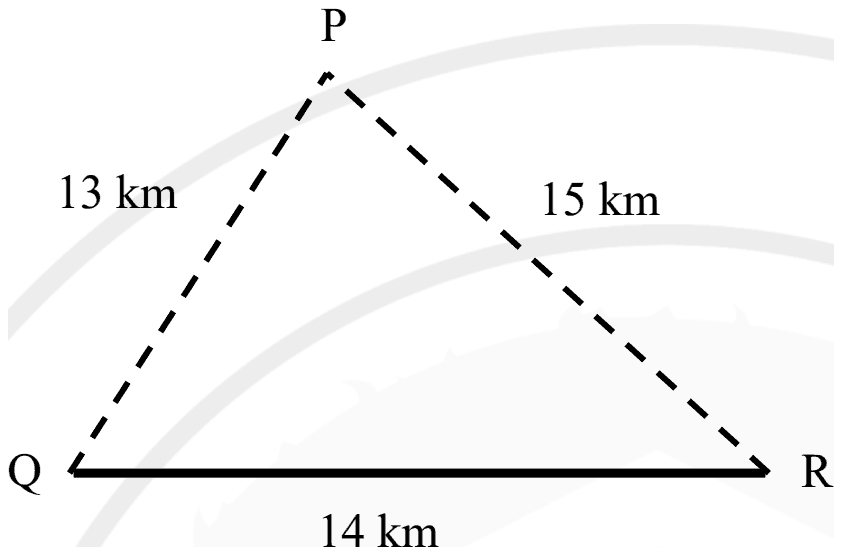
Three villages P, Q, and R are located in such a way that the distance PQ = 13 km, QR = 14 km, and RP = 15 km, as shown in the figure. A straight road joins Q and R. It is proposed to connect P to this road QR by constructing another road. What is the minimum possible length (in km) of this connecting road?

Note: The figure shown is representative.

[The figure is a triangle PQR with P at the top and QR as the base, its sides marked 13 km (PQ), 14 km (QR) and 15 km (RP).]

Exam Year(s)

GATE XE - 2025,

Answer: C

The shortest connecting road is 12.0 km.

The shortest road from P to the line QR is the perpendicular, the altitude of the triangle on base QR. Find the area by Heron's formula:

\[ \begin{aligned} s &= \frac{13+14+15}{2} = 21 \\ A &= \sqrt{21 \cdot 8 \cdot 7 \cdot 6} = 84\ \text{km}^{2} \end{aligned} \]

\[ h = \frac{2A}{QR} = \frac{168}{14} = 12\ \text{km} \]

The foot of this perpendicular lies between Q and R (5 km from Q), so the road meets QR itself. 12.5 and 11.0 are not the altitude, and 10.5 is shorter than any possible road from P.

Please log in or register to report this question.
92.

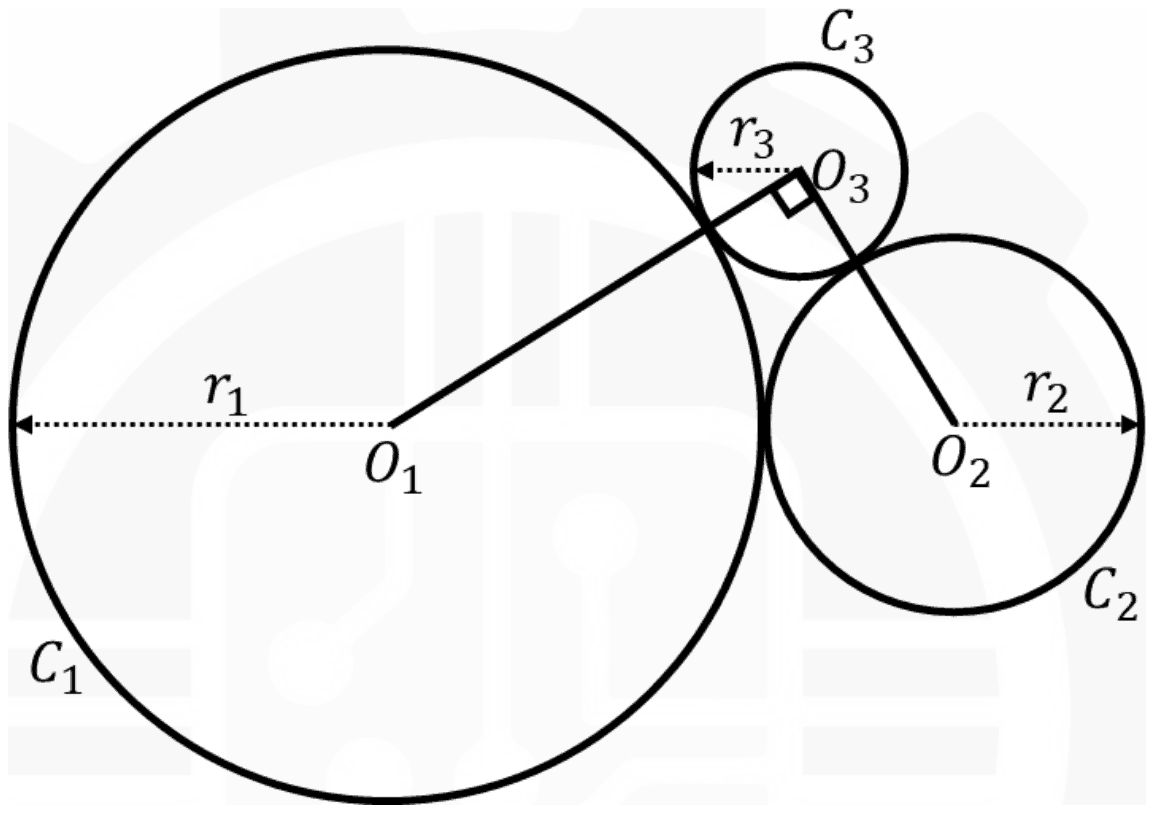
Circles C1, C2, and C3, with centers O1, O2, and O3, and radii r1, r2, and r3, respectively, touch each other as shown in the following figure. Given r1 = 2 cm, r2 = 1 cm and the angle \(\angle O_{1}O_{3}O_{2}\) is 90°, r3 = ___ cm.

Three circles touching externally: large C1 with centre O1 and radius r1, medium C2 with centre O2 and radius r2, and small C3 with centre O3 and radius r3 above the gap between them; segments O1O3 and O2O3 meet at a marked right angle at O3

Exam Year(s)

GATE XE - 2026,

Answer: A

The radius is \(r_{3} = \frac{1}{2}(-3+\sqrt{17})\) cm.

Circles that touch externally have their centres a distance apart equal to the sum of their radii, so \(O_{1}O_{3} = 2 + r_{3}\) and \(O_{2}O_{3} = 1 + r_{3}\), and \(O_{1}O_{2} = 3\). The angle at O3 is a right angle, so by Pythagoras:

\[ \begin{aligned} (2+r_{3})^{2}+(1+r_{3})^{2} &= 3^{2} \\ 2r_{3}^{2}+6r_{3}-4 &= 0 \\ r_{3}^{2}+3r_{3}-2 &= 0 \end{aligned} \]

\[ \begin{aligned} r_{3} &= \frac{-3 \pm \sqrt{9+8}}{2} \\ &= \frac{-3+\sqrt{17}}{2} \approx 0.56 \end{aligned} \]

The negative root is rejected. \(\frac{1}{2}(3+\sqrt{17}) \approx 3.56\) would be larger than C1; the other two forms do not satisfy the quadratic.

Please log in or register to report this question.
93.

Three villages P, Q, and R are located in such a way that the distance PQ = 13 km, QR = 14 km, and RP = 15 km, as shown in the figure. A straight road joins Q and R. It is proposed to connect P to this road QR by constructing another road. What is the minimum possible length (in km) of this connecting road?

Note: The figure shown is representative.

Triangle PQR with P at the top: PQ = 13 km and RP = 15 km drawn dashed, and QR = 14 km along the base drawn as a solid line

Exam Year(s)

GATE Life Sciences - 2025,

Answer: C

The shortest road is 12.0 km, the perpendicular from P to QR.

The shortest path from a point to a line is the perpendicular, so we need the altitude from P onto QR. Find the triangle's area with Heron's formula, where \(s = (13 + 14 + 15)/2 = 21\):

\[ \begin{aligned} \text{Area} &= \sqrt{21 \times 8 \times 7 \times 6} \\ &= \sqrt{7056} = 84\ \text{km}^{2} \\ h &= \frac{2 \times 84}{14} = 12\ \text{km} \end{aligned} \]

The foot of the perpendicular falls between Q and R, 5 km from Q (since \(\sqrt{13^{2} - 12^{2}} = 5\)), so the road meets QR itself. No road can be shorter than this perpendicular, which rules out 10.5 and 11.0 km, and 12.5 km is longer than the minimum.

Please log in or register to report this question.
94.

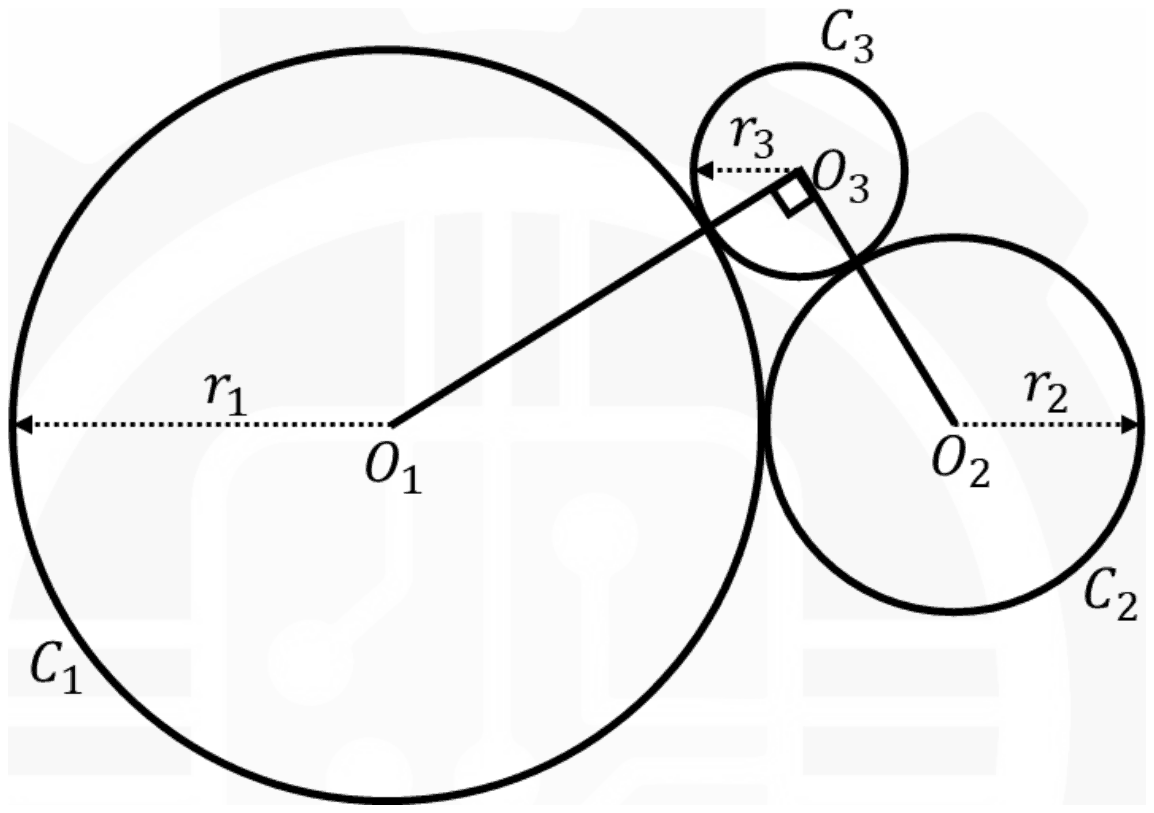
Circles \(C_{1}\), \(C_{2}\), and \(C_{3}\), with centers \(O_{1}\), \(O_{2}\), and \(O_{3}\), and radii \(r_{1}\), \(r_{2}\), and \(r_{3}\), respectively, touch each other as shown in the following figure. Given \(r_{1} = 2\) cm, \(r_{2} = 1\) cm and the angle \(\angle O_{1}O_{3}O_{2}\) is 90°, \(r_{3}\) = _____ cm.

Circles C1, C2 and C3 touching one another externally, with the radii marked and a right angle at O3 between the lines O3O1 and O3O2

Exam Year(s)

GATE Life Sciences - 2026,

Answer: A

The radius is \(r_{3} = \frac{1}{2}(-3 + \sqrt{17})\) cm.

The circles touch externally, so each distance between centres is the sum of the two radii: \(O_{1}O_{3} = 2 + r_{3}\), \(O_{2}O_{3} = 1 + r_{3}\) and \(O_{1}O_{2} = 2 + 1 = 3\). The angle at \(O_{3}\) is a right angle, so Pythagoras applies with \(O_{1}O_{2}\) as the hypotenuse:

\[ \begin{aligned} (2 + r)^{2} + (1 + r)^{2} &= 9 \\ 2r^{2} + 6r + 5 &= 9 \\ r^{2} + 3r - 2 &= 0 \end{aligned} \]

\[ \begin{aligned} r &= \frac{-3 + \sqrt{9 + 8}}{2} \\ &= \frac{-3 + \sqrt{17}}{2} \approx 0.56 \end{aligned} \]

The other root is negative and is rejected. \(\frac{1}{2}(3 + \sqrt{17})\) has the sign of the 3 reversed and would be about 3.56 cm, larger than both given circles; the remaining two options come from slips in the constant or the discriminant.

Please log in or register to report this question.

Answer: D

The statement that is not true is Each exterior angle of a regular octagon = 60°.

The exterior angles of any polygon add up to 360°, so each exterior angle of a regular octagon is \(360/8 = 45^{\circ}\), not 60° (60° belongs to a regular hexagon).

The other three are correct:

\[ \begin{aligned} \tfrac{12(12 - 3)}{2} &= 54 \text{ diagonals} \\ \tfrac{360}{13} &\approx 27.69^{\circ} \\ (9 - 2) \times 180^{\circ} &= 1260^{\circ} \end{aligned} \]

Please log in or register to report this question.

96.

Which one of the following statements about the rhombus is not true ?

Exam Year(s)

HPPSC HPAS - 2025,

Answer: D

The statement that is not true is Diagonals are equal.

A rhombus has four equal sides. Its diagonals bisect each other at right angles and bisect the interior angles, but they are generally of different lengths, one long and one short. They are equal only in the special case of a square.

The other statements are properties of a rhombus: the diagonals bisect the angles, adjacent sides are equal (all four are), and in general its angles are not right angles, which is what distinguishes it from a square.

Please log in or register to report this question.

Answer: C

The statement that is not true is One pair of opposite sides is parallel.

A kite has two pairs of equal adjacent (consecutive) sides. Its diagonals are perpendicular, and one diagonal bisects the other; the pair of opposite angles between the unequal sides is equal. A kite need have no parallel sides at all. A quadrilateral with one pair of parallel sides is a trapezium.

So perpendicular diagonals, one pair of congruent opposite angles and two pairs of congruent consecutive sides are all true of a kite.

Please log in or register to report this question.

98.

If one internal angle of a regular polygon is 135°, then the number of diagonals in the polygon is :

Exam Year(s)

HPPSC HPAS - 2025,

Answer: B

The polygon has 20 diagonals.

An interior angle of 135° means an exterior angle of 45°, and the exterior angles add up to 360°:

\[ \begin{aligned} n &= \frac{360}{45} = 8 \\ \text{Diagonals} &= \frac{n(n - 3)}{2} = \frac{8 \times 5}{2} = 20 \end{aligned} \]

The polygon is a regular octagon. None of 15, 18 and 25 is the number of diagonals of any polygon: the counts for 3 to 9 sides run 0, 2, 5, 9, 14, 20, 27.

Please log in or register to report this question.

Answer: C

The statement that is not true is Two congruent triangles are always similar and converse is also true.

The first half is correct: congruent triangles have the same shape and size, so they are also similar. The converse fails: similar triangles have the same shape but can differ in size, for example a triangle with sides 3, 4, 5 and another with sides 6, 8, 10. So similar triangles need not be congruent.

The other statements hold. Congruent triangles have equal area. Triangles of equal area need not be congruent (a 2 by 6 right triangle and a 3 by 4 right triangle both have area 6). And triangles on equal bases can be drawn with equal perpendicular heights, which gives them equal areas.

Please log in or register to report this question.

100.

If ΔABC is an isosceles triangles such that AB = BC = 8 cm and ∠ABC = 90°, then the length of the altitude drawn from B to AC is :

Exam Year(s)

HPPSC HPAS - 2025,

Answer: D

The altitude is \(4\sqrt{2}\) cm.

With AB = BC = 8 cm and the right angle at B, the hypotenuse is:

\[ AC = \sqrt{8^{2} + 8^{2}} = 8\sqrt{2} \]

The altitude from the right angle to the hypotenuse is the product of the legs divided by the hypotenuse:

\[ \begin{aligned} h &= \frac{8 \times 8}{8\sqrt{2}} \\ &= \frac{8}{\sqrt{2}} = 4\sqrt{2} \end{aligned} \]

In an isosceles right triangle this altitude is also the median, half the hypotenuse, which gives the same \(4\sqrt{2}\), about 5.66 cm. 3 cm, \(2\sqrt{2}\) and \(3\sqrt{2}\) are all too short.

Please log in or register to report this question.

Loading…
Tags: Geometry Lines, Angles, Triangles Questions || Polygons MCQ Questions and Answers || Geometry Quantitative Aptitude || Angles and Triangles GK Questions || Quantitative Aptitude Geometry GK