
Discussion
Three villages P, Q, and R are located in such a way that the distance PQ = 13 km, QR = 14 km, and RP = 15 km, as shown in the figure. A straight road joins Q and R. It is proposed to connect P to this road QR by constructing another road. What is the minimum possible length (in km) of this connecting road?
Note: The figure shown is representative.
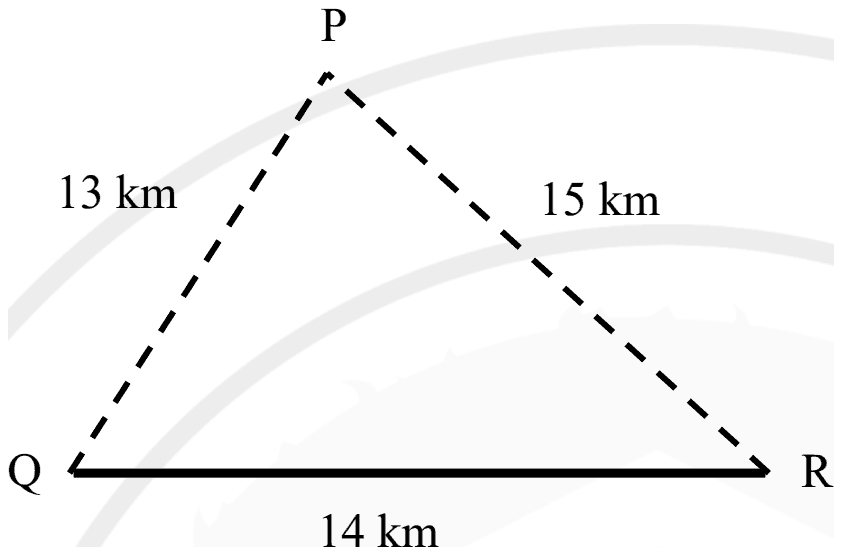
Answer: C
The shortest road is 12.0 km, the perpendicular from P to QR.
The shortest path from a point to a line is the perpendicular, so we need the altitude from P onto QR. Find the triangle's area with Heron's formula, where \(s = (13 + 14 + 15)/2 = 21\):
\[ \begin{aligned} \text{Area} &= \sqrt{21 \times 8 \times 7 \times 6} \\ &= \sqrt{7056} = 84\ \text{km}^{2} \\ h &= \frac{2 \times 84}{14} = 12\ \text{km} \end{aligned} \]
The foot of the perpendicular falls between Q and R, 5 km from Q (since \(\sqrt{13^{2} - 12^{2}} = 5\)), so the road meets QR itself. No road can be shorter than this perpendicular, which rules out 10.5 and 11.0 km, and 12.5 km is longer than the minimum.
Post your comment
Please log in or register to post a comment.
Examination Categories
- SSC Exams
- Banking Exams
- Teaching Exams
- Civil Services Exams
- Railways Exams
- Engineering Recruitment Exams
- Defence Exams
- State Government Exams
- Police Exams
- Insurance Exams
- Nursing Exams
- Other Government Exams
- NRA CET
- PG Entrance Exams
- Campus Placement
- MBA Entrance Exams
- CUET and UG Entrance
- Judiciary Exams
- Regulatory Body Exams
- Software Development