
BPSC Exam 2025: Integrated 70th Combined Main (Written) Competitive Examination, Optional, Philosophy

Text of page 1
Serial No.
                                                                                Booklet Series
    02/GO/CC/M-2025 – 21

I
                                           Candidate’s Roll Number


                                                    Question Booklet
                                                                                       I
                                                   PHILOSOPHY
    Time Allowed : 2 Hours                                                                      Maximum Marks : 100

         Read the following instructions carefully before you begin to answer the questions.

                                              IMPORTANT INSTRUCTIONS
     1. This Question Booklet contains 100 questions in all.
     2. All questions carry equal marks.
     3. Attempt all questions.
     4. An Answer Sheet has been supplied inside the Question Booklet to mark the answers. You must write your
        Roll Number and encode it and write other particulars in the space provided in the Answer Sheet, failing
        which your Answer Sheet will not be evaluated.
     5. Immediately after commencement of the examination, you should check up your Question Booklet and
        attached Answer Sheet and ensure that the Question Booklet Series is printed on the top right-hand corner
        of the Question Booklet and the series encoded in Answer Sheet are same. Also please check that the
        Question Booklet contains 32 printed pages including two pages (Page Nos. 30 and 31) for Rough Work and
        no page or question is missing or unprinted or torn or repeated or Question Booklet and Answer Sheet have                 I
                                                                                                Answer Sheet, get it replaced
        immediately by a complete Question Booklet with OMR sheet of the same series.
     6. If there is any sort of mistake either of printing or of factual nature, then out of English and Hindi versions of the
        questions, the English version will be treated as standard.
     7. You must write your Roll Number in the space provided on the top of this page. Do not write anything else on the
        Question Booklet.
     8. Questions and their responses are printed in English and Hindi versions in this Question Booklet. Each question
        comprises of four responses — (A), (B), (C) and (D). You are to select ONLY ONE correct response and mark it in
        your Answer Sheet. In case you feel that there are more than one correct response, mark the response which you
        consider the best. In any case choose ONLY ONE response for each question.
     9. In the Answer Sheet, there are four circles — A , B , C and D against each question. To answer the questions,
        you are to mark with Black/Blue ink ballpoint pen ONLY ONE circle of your choice for each question. Select only
        one response for each question and mark it in your Answer Sheet. If you mark more than one circle for one question,
        the answer will be treated as wrong. Use Black/Blue ink ballpoint pen only to mark the answer in the Answer
        Sheet. Any erasure or change is not allowed.
    10. You should not remove or tear off any sheet from the Question Booklet. You are not allowed to take this Question
        Booklet and the Answer Sheet out of the Examination Hall during the examination. After the examination has
        concluded, you must hand over your Answer Sheet to the Invigilator. Thereafter, you are permitted to take away
        the Question Booklet with you.
    11. Failure to comply with any of the above instructions will render you liable to such action or penalty as the Commission
        may decide at their discretion.
    12. Candidates must assure before leaving the Examination Hall that their Answer Sheets will be kept in Self Adhesive
        LDPE Bag and completely packed/sealed in their presence.

                          Ü`mZ X| : AZwXoem| H$m {hÝXr ê$nmÝVa Bg nwpñVH$m Ho$ ApÝV_ n¥îR> na N>nm h¡ &
                                                               -1-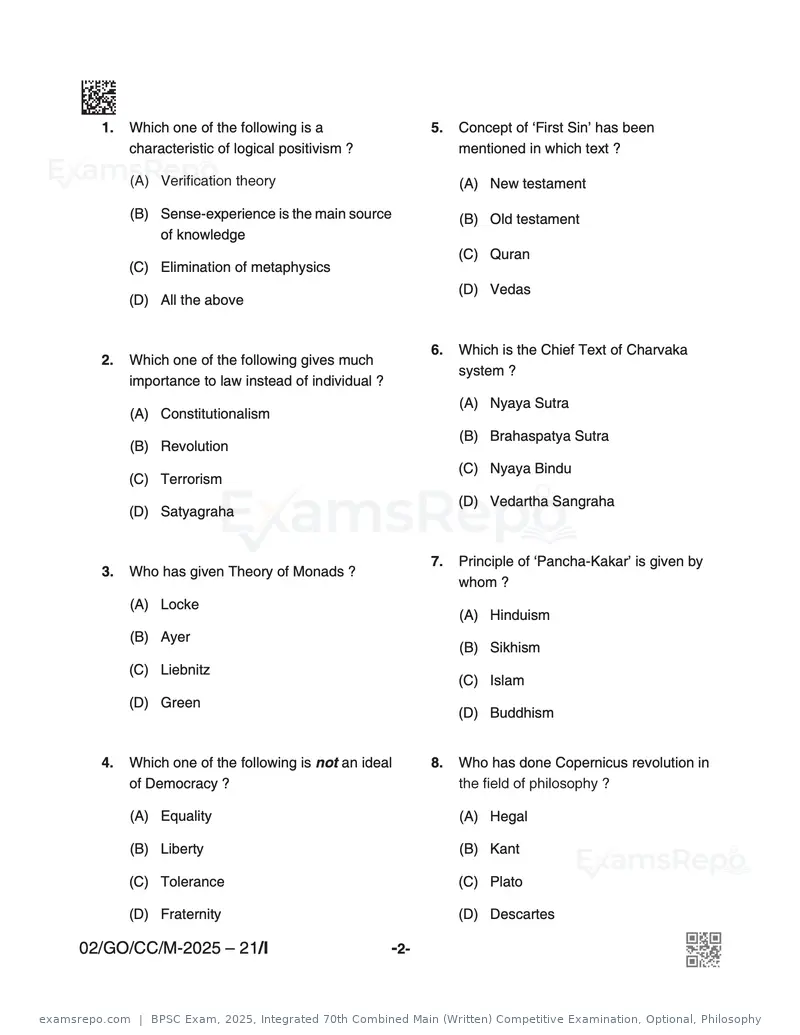
Text of page 2
1.   Which one of the following is a                   5.   Concept of ‘First Sin’ has been
       characteristic of logical positivism ?                 mentioned in which text ?

                                                              (A) New testament

       (B) Sense-experience is the main source                (B) Old testament
           of knowledge
                                                              (C) Quran
       (C) Elimination of metaphysics
                                                              (D) Vedas
       (D) All the above


                                                         6.   Which is the Chief Text of Charvaka
  2.   Which one of the following gives much
                                                              system ?
       importance to law instead of individual ?
                                                              (A) Nyaya Sutra
       (A) Constitutionalism
                                                              (B) Brahaspatya Sutra
       (B) Revolution
                                                              (C) Nyaya Bindu
       (C) Terrorism
                                                              (D) Vedartha Sangraha
       (D) Satyagraha


                                                         7.   Principle of ‘Pancha-Kakar’ is given by
  3.   Who has given Theory of Monads ?
                                                              whom ?
       (A) Locke
                                                              (A) Hinduism
       (B) Ayer
                                                              (B) Sikhism
       (C) Liebnitz
                                                              (C) Islam
       (D) Green
                                                              (D) Buddhism


  4.   Which one of the following is not an ideal        8.   Who has done Copernicus revolution in
       of Democracy ?

       (A) Equality                                           (A) Hegal

       (B) Liberty                                            (B) Kant

       (C) Tolerance                                          (C) Plato

       (D) Fraternity                                         (D) Descartes

02/GO/CC/M-2025 – 21/I                             -2-

Text of page 4
9.   Who is the founder of Judaism ?                   13.   Theory of ‘Negative Facts’ is given by
                                                               whom ?
       (A) Zarthustra
                                                               (A) Russell
       (B) Moses
                                                               (B) Moore
       (C) Ismile
                                                               (C) Ayer
       (D) Jesus Christ
                                                               (D) Wittgenstein


 10.   Which one of the following is a terrorist
                                                         14.   Who is known as the father of Western
       activity ?                                              philosophy ?
       (A) Assassination                                       (A) Aristotle
       (B) Hijacking                                           (B) Becon
       (C) Kidnapping                                          (C) Kant

       (D) All the above                                       (D) Descartes


 11.   Theory of Syadavada is associated with            15.   Does Purva-Mimamsa accept ‘Vidhi’ and
       whom ?                                                  ‘Nishedha’ ?

       (A) Nyaya Darshan                                       (A) Not clear

       (B) Samkhya Darshan                                     (B) Uncertain

       (C) Jaina Darshan                                       (C) True (Yes)

       (D) Yoga Darshan                                        (D) Not Known


 12.   Religious conversion is of how many               16.   What is the foundation of Constitutionism ?

       type ?
                                                               (A) Literacy

       (A) 3
                                                               (B) Freedom
       (B) 2
                                                               (C) Agreement of policy matters
       (C) 5

       (D) 4                                                   (D) Equality

02/GO/CC/M-2025 – 21/I                             -4-

Text of page 6
17.   Which theory is accepted by Spinoza ?           20.   Which one of the following is known as
                                                             ‘Prasthan Trayi’ ?
       (A) Interactionism
                                                             (A) Veda, Purana and Smriti
       (B) Parallelism
                                                             (B) Ramayan, Mahabharata and
                                                                  Upanishad

       (D) None of these                                     (C) Upanishad, Bhagvadgita and
                                                                  Brahma-Sutra

 18.   Who has denied law of causality ?                     (D) None of the above


       (A) Lord Buddha
                                                       21.   Which one of the following is a
       (B) Kapil                                             characteristic of mysticism, according to
                                                             William James ?
       (C) Mahaveer
                                                             (A) Noetic quality
       (D) Charvaka
                                                             (B) Tolerance


 19.   ‘Modernity has entered into Indian                    (C) Faith

       character and society by it has done so
                                                             (D) None of these
       through assimilation not replacement.’

       This statement is
                                                       22.   The book entitled, ‘Appearance and

       (A) Not known                                         Reality’ is written by whom ?

                                                             (A) Berkley
       (B) Not clear
                                                             (B) Green
       (C) Right
                                                             (C) Hegal

       (D) Wrong                                             (D) Bradley

02/GO/CC/M-2025 – 21/I                           -6-

Text of page 8
23.   Is Sikhism a revealed religion ?                   27.   In a Democratic State, Government is
                                                                based on the ________ of the people.
       (A) Doubtful
                                                                (A) Votes
       (B) Not known
                                                                (B) Will
       (C) No
                                                                (C) Understand
       (D) Yes
                                                                (D) None of these


 24.   Who gives importance to violence ?                 28.   Who has introduced seventh category in
                                                                the philosophy of Vaisheshika ?
       (A) Fascism
                                                                (A) Kanad
       (B) Gandhism
                                                                (B) Gangesh
       (C) Theocracy
                                                                (C) Udayan
       (D) Socialism
                                                                (D) Prashastapada


 25.   Which one of the following is an                   29.   Who among the following has given
       advocate of unity of religions ?

       (A) Ramkrishna Paramhans                                 religious language ?

       (B) Vivekananda                                          (A) A.J. Ayer

       (C) Bhagwan Das                                          (B) Plato

       (D) Iqbal                                                (C) William James

                                                                (D) Moore
 26.   ‘Philosophy of religion is a philosophical
       inquiry into the nature, function, value           30.   Hegal belongs to which one of the
       and truth of religious experience’ – Who
                                                                following ?
       said these words ?
                                                                (A) Objective idealism
       (A) John A. Nicholson

       (B) W.K. Right                                           (B) Subjective idealism

       (C) D.M. Edwards                                         (C) Absolute idealism

       (D) John Hick                                            (D) None of these

02/GO/CC/M-2025 – 21/I                              -8-

Text of page 10
31.   ‘Submission to God’ is the meaning of                35.   ‘Political obligation entails the notion of
                                                                  revolution.’ This statement is
       (A) Sthitaprajna
                                                                  (A) False

       (B) Bodhisattva                                            (B) True

                                                                  (C) Doubtful
       (C) Islam
                                                                  (D) Ambiguous
       (D) Kevali

                                                            36.   Which school of Indian philosophy has
 32.   ‘In its narrow sense tradition is a part of                propounded ‘Atomic Theory’ ?
       social heritage’. This statement is
                                                                  (A) Vaisheshika
       (A) False
                                                                  (B) Mimamsa
       (B) True
                                                                  (C) Baudha
       (C) Doubtful
                                                                  (D) Jaina
       (D) Ambiguous


                                                            37.   ‘Arhat’ is the ideal of which one of the
 33.   Which one of the following is not a                        following ?
       ‘mode’ ?
                                                                  (A) Mahayana
       (A) Soul
                                                                  (B) Hinayana
       (B) God
                                                                  (C) Upanishad
       (C) Devil
                                                                  (D) Bhagvadgita
       (D) None of these


                                                            38.   Which book belongs to later Wittgenstein ?
 34.   Who has rejected the idea of ‘Nirguna
       Brahma’ ?                                                  (A) Tractatus
       (A) Kumarila
                                                                  (B) Philosophical Investigations
       (B) Madhva

       (C) Prabhakar                                              (C) Both (A) and (B)

       (D) Shankara                                               (D) None of these

02/GO/CC/M-2025 – 21/I                               -10-

Text of page 12
39.   ‘Theology provides material to philosophy           43.   Change is a characteristic of which one
       of religion’ – This statement is                          of the following ?
       (A) False                                                 (A) Revolution
       (B) True
                                                                 (B) Sarvodaya
       (C) Ambiguous
                                                                 (C) Terrorism
       (D) Not known
                                                                 (D) None of these

 40.   Which one of the following accepts                  44.   According to Ramanuja, what is the
       ‘Asat-Khyativada’ ?
                                                                 relation between God and Soul ?
       (A) Mimamsa
                                                                 (A) Identical relation
       (B) Yoga
                                                                 (B) Aprathaka-Siddhi
       (C) Nyaya
                                                                 (C) Relation of difference
       (D) Samkhya
                                                                 (D) None of these

 41.   ‘By tradition is meant the transmission of
       thinking and believing’– Who has given              45.   Which one of the following is correctly
                                                                 matched ?
       (A) Ross                                                  (A) Rejection of             – Kant
                                                                     metaphysics

                                                                 (B) Dialectical method       – Ayer
       (C) Milton Singer
                                                                 (C) Theory of description – Moore
       (D) Ginsberg
                                                                 (D) Method of doubt          – Descartes

 42.   Who has accepted that ‘perception is an
       adequate source of knowledge’ ?                     46.   What is the chief value of socialism ?
       (A) Empiricist                                            (A) Justice
       (B) Idealist                                              (B) Equality

       (C) Spiritualist                                          (C) Liberty

       (D) Skeptic                                               (D) Reason

02/GO/CC/M-2025 – 21/I                              -12-

Text of page 14
47.   Who has written ‘Brahma-Sutra’ ?                51.   Which kind of difference is accepted by
                                                             Ramanuja, between Brahman and Soul ?
       (A) Ramanuja
                                                             (A) Sajatiya Bheda
       (B) Nagarjuna
                                                             (B) Swagat Bheda
       (C) Badrayan
                                                             (C) Vijatiya Bheda
       (D) Shankaracharya
                                                             (D) None of the above


 48.   Does ‘old testament’ supports
                                                       52.
       Theocracy ?                                           advancements promote Terrorism ?
       (A) No                                                (A) Uncertain
       (B) Yes                                               (B) Not known

       (C) Uncertain                                         (C) Yes

       (D) Doubtful                                          (D) Doubtful


 49.   According to Descartes, ‘mind’ is a/an          53.   Who has given picture theory of meaning ?

       (A) Independent substance                             (A) Ayer

       (B) Dependent substance                               (B) Wittgenstein

       (C) Neutral substance                                 (C) Russell

       (D) Both dependent and independent                    (D) G. E. Moore


 50.   Hetvabhasa is a fallacy of                      54.   Which one is a basic trait of Indian
                                                             tradition ?
       (A) Inference
                                                             (A) Honesty
       (B) Perception                                        (B) Summum Bonum

       (C) Testimony                                         (C) Austerity

       (D) Analogy

02/GO/CC/M-2025 – 21/I                          -14-

Text of page 16
55.   Who has written ‘Nyaya-Kusumanjali’ ?          59.   The negative meaning of ‘Nirvana’ is

       (A) Udayan                                           (A) Blownout

       (B) Gautam                                           (B) Cooling
       (C) Gangesh Upadhyaya
                                                            (C) Craving
       (D) Kanad
                                                            (D) Bliss


 56.   Which one of the following belongs to
                                                      60.   Buddhist philosophy accepts which two
       idealism ?                                           Pramanas ?

       (A) Aristotle                                        (A) Perception and Inference

       (B) Socrates                                         (B) Comparison and Testimony

       (C) Locke                                            (C) Perception and Analogy

       (D) Plato                                            (D) Inference and Testimony


                                                      61.   According to Locke, what are the two
 57.   Which one is known as philosophical
                                                            types of ideas ?
       anarchism ?

       (A) Communism                                        (A) Simple and complex

       (B) Socialism                                        (B) Ordinary and extra-ordinary

       (C) Fascism                                          (C) Positive and negative

       (D) Sarvodaya                                        (D) None of these


 58.   Who has given the concept of ‘Epoche’ ?        62.   ‘Religion is faith in the conservation of

       (A) Russell
                                                            (A) John Hick
       (B) Edmund Husserl
                                                            (B) D.M. Edwards
       (C) William James                                    (C) H. Hoffding

       (D) Sartre                                           (D) McTaggart

02/GO/CC/M-2025 – 21/I                         -16-

Text of page 18
63.   Which one of the following is correctly          66.   Which is not a cause according to
       matched ?
                                                              Aristotle’s philosophy ?

       (A) Jaina Darshan     – Theory of
                                                              (A) Necessary cause
                                Momentariness

       (B) Nyaya Darshan – Mayavada

       (C) Samkhya          –   Theory of                     (C) Material cause
            Darshan             Atomism
                                                              (D) Final cause
       (D) Mimamsa           – Apoorva
            Darshan             Theory

                                                        67.   What is the birth-place of Fascism ?

 64.   Which religion has given Trinitarian
                                                              (A) Russia
       concept of God ?
                                                              (B) Italy
       (A) Christianity

       (B) Judaism                                            (C) France


       (C) Jainism                                            (D) None of these

       (D) Islam

                                                        68.   Which one is not correctly matched ?
 65.   Who is the supporter of ‘A -Khyativada’ ?
                                                              (A) Samkhya – Kapil
       (A) Shankaracharya

                                                              (B) Charvaka – Brahaspati
       (B) Kumarila Bhatta

                                                              (C) Buddhism – Kanad
       (C) Shabar Swami


       (D) Prabhakar Mishra                                   (D) Mimamsa – Jaimini

02/GO/CC/M-2025 – 21/I                           -18-

Text of page 20
69.   Which one of the following is not a          72.   Whose theory of Justice is known as

       means of Satyagraha ?                              ‘Sarvodaya’ ?

                                                          (A) Bal Gangadhar Tilak
       (A) Non-cooperation

                                                          (B) M. K. Gandhi
       (B) Dialogue
                                                          (C) Sardar Ballabh Bhai Patel
       (C) Fasting
                                                          (D) Raja Ram Mohan Roy
       (D) Strike

                                                    73.   ‘Space and time are the spectacles of
 70.   Which one of the following is not a                reason’ – who said these words ?

       Theory of Truth ?
                                                          (A) Hegal

       (A) Coherence Theory
                                                          (B) Hume

       (B) Pragmatic Theory
                                                          (C) Kant

       (C) Sense-datum Theory
                                                          (D) Bradley

       (D) Correspondence Theory

                                                    74.   Who has refuted emotive theory of

 71.   Teachings of Jesus is known as                     religious language ?


       (A) Pancha-Mahavakya                               (A) Thomas Aquinas


       (B) Ten commandments                               (B) William James


       (C) Sermon on the mount                            (C) A.J. Ayer


       (D) None of these                                  (D) Braithwait

02/GO/CC/M-2025 – 21/I                       -20-

Text of page 22
75.   Dialectical materialism is a theory related      79.   Does Buddhism accept immortality of
       to whom ?                                              soul ?

                                                              (A) No
       (A) Democracy
                                                              (B) Yes
       (B) Socialism
                                                              (C) Not clear

       (C) Communism                                          (D) Not known

       (D) Facism
                                                        80.   Problem of evil is not a problem for

 76.   How many pramanas are accepted by                      (A) Pantheism
       Kumarila Bhatt ?
                                                              (B) Theism
       (A) 4
                                                              (C) Atheism
       (B) 2
                                                              (D) Polytheism
       (C) 6

       (D) 5
                                                        81.   Which one of the following is a
                                                              characteristic of Indian philosophy ?
 77.   Concept of ‘Tri-Ratna’ is given by whom ?
                                                              (A) Spiritual attitude
       (A) Islam
                                                              (B) Law of Karma
       (B) Sikhism
                                                              (C) Immortality of Soul
       (C) Judaism
                                                              (D) All the above
       (D) Jainism

                                                        82.   ‘Satyagraha is a non-violent resistance’ –
 78.   Plato’s chief concern of Universal was
                                                              who said these words ?
       associated to
                                                              (A) Jawahar Lal Nehru
       (A) Mathematical entities
                                                              (B) Vinoba Bhave
       (B) General properties
                                                              (C) M. K. Gandhi
       (C) Ideas of moral principles

       (D) Geometrical proof                                  (D) Jyotiba Phule

02/GO/CC/M-2025 – 21/I                           -22-

Text of page 24
83.   ‘I am proud to belong to a religion which          86.   Communism is a result of

       has taught the world both tolerance and
                                                                (A) Industrial revolution
       universal acceptance’– Who said these

       words ?                                                  (B) Class struggle


       (A) S. Radhakrishnan                                     (C) Increase of literacy


       (B) Gandhi                                               (D) Technical progress

       (C) Bhagwan Das
                                                          87.   What is the name of Aristotle’s theory of
       (D) Vivekananda
                                                                matter and form ?

                                                                (A) Realism
 84.   Who has advocated ‘Representative

       Realism’ ?                                               (B) Nominalism

       (A) Spinoza                                              (C) Hylomorphism

       (B) Descartes                                            (D) Idealism

       (C) Liebnitz

       (D) Locke                                          88.   Which one of the following is an atheistic

                                                                religion ?


 85.
                                                                (A) Islam

       (A) Rishabh Dev
                                                                (B) Christianity
       (B) Mahavir

                                                                (C) Buddhism
       (C) Parshvanath


       (D) None of these                                        (D) Hinduism

02/GO/CC/M-2025 – 21/I                             -24-

Text of page 26
89.   Which theory of Pramanyavada is                  92.   According to whom, ‘Religious language

       accepted by Mimamsa ?                                  is symbolical’ ?


       (A) Svatah – Pramanyavada                              (A) R. M. Hare


       (B) Partah – Pramanyavada                              (B) Paul Tillich


       (C) Svatah – Apramanyavada                             (C) Russell


       (D) Partah – Apramanyavada                             (D) None of these


 90.   Who has given the doctrine of ‘Triple -          93.   What is the basis of Theocracy ?

       Perception’ ?
                                                              (A) Freedom of the Will

       (A) Prabhakar
                                                              (B) Freedom of Speech

       (B) Ramanuja
                                                              (C) Freedom of Education
       (C) Jaimini
                                                              (D) Principle of Divine Right
       (D) Shabar Swami


                                                        94.   Which one of the following is a materialistic
 91.   Who has refuted theory of Idealism ?                   system of Indian philosophy ?

       (A) C. S. Pierce                                       (A) Vedanta

       (B) A. J. Ayer                                         (B) Samkhya

       (C) Moore                                              (C) Jaina philosophy

       (D) Ryle                                               (D) Charvaka

02/GO/CC/M-2025 – 21/I                           -26-

Text of page 28
95.   Who had introduced two types of                      98.   ‘Kevali-Gyan’ is accepted by whom ?

       Tradition : Great and little ?
                                                                  (A) Samkhya
       (A) Milton Singer
                                                                  (B) Shankaracharya
       (B) Ginsberg
                                                                  (C) Jaina Darshan
       (C) Ross
                                                                  (D) Nyaya


                                                            99.   Which of the following is not a
 96.   Which book contains Plato’s theory of

       innate ideas ?                                             characteristic of socialism ?


       (A) Phaedo                                                 (A) Importance of labour


       (B) Republic                                               (B) Societal control over economy

       (C) Crito                                                  (C) Opposition of capitalism

       (D) Meno
                                                                  (D) Promotion of individual property


 97.   Which one of the following is not a pillar
                                                           100.   Principle of ‘Artha-Kriya Karittvam Sat ’ is
       of Islam ?
                                                                  related with which one of the following ?

       (A) Pilgrimage
                                                                  (A) Theory of Momentariness


       (B) Prayer                                                 (B) Non-Soul Theory


       (C) Fasting                                                (C) Theory of Liberation


       (D) Idol worship                                           (D) Theory of Causation

02/GO/CC/M-2025 – 21/I                              -28-


Official key not published for this paper.
Page 1 of 32
Source: Bihar Public Service Commission. Question paper published by Bihar Public Service Commission.