
BPSC Exam 2025: Integrated 70th Combined Main (Written) Competitive Examination, Optional, Sociology

Text of page 1
Serial No.
                                                                                Booklet Series
    02/GO/CC/M-2025 – 26

I
                                           Candidate’s Roll Number


                                                    Question Booklet
                                                                                       I
                                                    SOCIOLOGY
    Time Allowed : 2 Hours                                                                      Maximum Marks : 100

         Read the following instructions carefully before you begin to answer the questions.

                                              IMPORTANT INSTRUCTIONS
     1. This Question Booklet contains 100 questions in all.
     2. All questions carry equal marks.
     3. Attempt all questions.
     4. An Answer Sheet has been supplied inside the Question Booklet to mark the answers. You must write your
        Roll Number and encode it and write other particulars in the space provided in the Answer Sheet, failing
        which your Answer Sheet will not be evaluated.
     5. Immediately after commencement of the examination, you should check up your Question Booklet and
        attached Answer Sheet and ensure that the Question Booklet Series is printed on the top right-hand corner
        of the Question Booklet and the series encoded in Answer Sheet are same. Also please check that the
        Question Booklet contains 32 printed pages including two pages (Page Nos. 30 and 31) for Rough Work and
        no page or question is missing or unprinted or torn or repeated or Question Booklet and Answer Sheet have                 I
                                                                                                Answer Sheet, get it replaced
        immediately by a complete Question Booklet with OMR sheet of the same series.
     6. If there is any sort of mistake either of printing or of factual nature, then out of English and Hindi versions of the
        questions, the English version will be treated as standard.
     7. You must write your Roll Number in the space provided on the top of this page. Do not write anything else on the
        Question Booklet.
     8. Questions and their responses are printed in English and Hindi versions in this Question Booklet. Each question
        comprises of four responses — (A), (B), (C) and (D). You are to select ONLY ONE correct response and mark it in
        your Answer Sheet. In case you feel that there are more than one correct response, mark the response which you
        consider the best. In any case choose ONLY ONE response for each question.
     9. In the Answer Sheet, there are four circles — A , B , C and D against each question. To answer the questions,
        you are to mark with Black/Blue ink ballpoint pen ONLY ONE circle of your choice for each question. Select only
        one response for each question and mark it in your Answer Sheet. If you mark more than one circle for one question,
        the answer will be treated as wrong. Use Black/Blue ink ballpoint pen only to mark the answer in the Answer
        Sheet. Any erasure or change is not allowed.
    10. You should not remove or tear off any sheet from the Question Booklet. You are not allowed to take this Question
        Booklet and the Answer Sheet out of the Examination Hall during the examination. After the examination has
        concluded, you must hand over your Answer Sheet to the Invigilator. Thereafter, you are permitted to take away
        the Question Booklet with you.
    11. Failure to comply with any of the above instructions will render you liable to such action or penalty as the Commission
        may decide at their discretion.
    12. Candidates must assure before leaving the Examination Hall that their Answer Sheets will be kept in Self Adhesive
        LDPE Bag and completely packed/sealed in their presence.

                          Ü`mZ X| : AZwXoem| H$m {hÝXr ê$nmÝVa Bg nwpñVH$m Ho$ ApÝV_ n¥îR> na N>nm h¡ &
                                                               -1-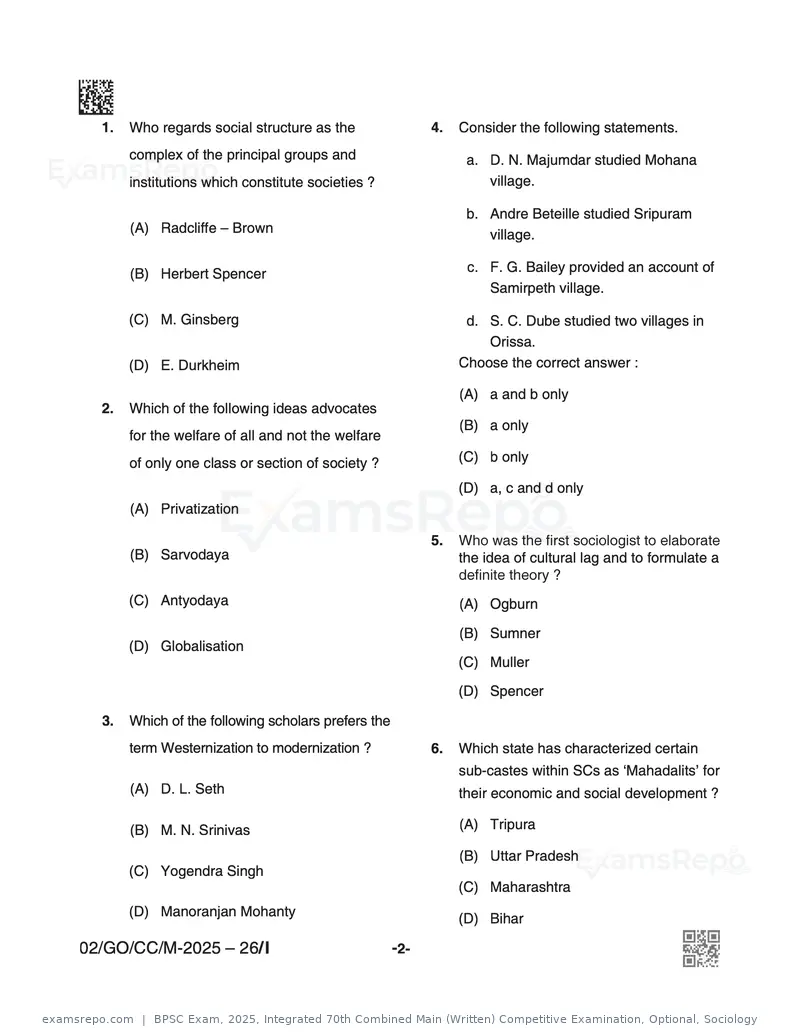
Text of page 2
1.   Who regards social structure as the                 4.   Consider the following statements.
       complex of the principal groups and                       a. D. N. Majumdar studied Mohana
       institutions which constitute societies ?                    village.

                                                                 b. Andre Beteille studied Sripuram
       (A) Radcliffe – Brown                                        village.

       (B) Herbert Spencer                                       c. F. G. Bailey provided an account of
                                                                    Samirpeth village.

       (C) M. Ginsberg                                           d. S. C. Dube studied two villages in
                                                                    Orissa.
       (D) E. Durkheim                                          Choose the correct answer :

                                                                (A) a and b only
  2.   Which of the following ideas advocates
                                                                (B) a only
       for the welfare of all and not the welfare
       of only one class or section of society ?                (C) b only

                                                                (D) a, c and d only
       (A) Privatization

                                                           5.
       (B) Sarvodaya                                            the idea of cultural lag and to formulate a

       (C) Antyodaya                                            (A) Ogburn

                                                                (B) Sumner
       (D) Globalisation
                                                                (C) Muller

                                                                (D) Spencer

  3.   Which of the following scholars prefers the
       term Westernization to modernization ?              6.   Which state has characterized certain
                                                                sub-castes within SCs as ‘Mahadalits’ for
       (A) D. L. Seth                                           their economic and social development ?

       (B) M. N. Srinivas                                       (A) Tripura

                                                                (B) Uttar Pradesh
       (C) Yogendra Singh
                                                                (C) Maharashtra
       (D) Manoranjan Mohanty                                   (D) Bihar

02/GO/CC/M-2025 – 26/I                               -2-

Text of page 4
7.   A list of points or topics which an               11.   Which of the following is a scheme
       interviewer must cover during the
       interview is called as
                                                               Rescue, Rehabilitation and
       (A) Interview guide
       (B) Interview-schedule                                  and Commercial Sexual Exploitation ?
       (C) Questionnaire
                                                               (A) SWADHAR Greh
       (D) Case study
                                                               (B) Mission Shakti

  8.   Who wanted to educate only those                        (C) UJJAWALA
       children whose parents could pay the
       fees ?                                                  (D) Beti Bachao Beti Padhao Scheme

       (A) Raymond Breton
                                                         12.   Which of the following committees
       (B) Karl Marx                                           recommended the establishment of
       (C) Herbert Spencer                                     Panchayati Raj ?

       (D) J. S. Coleman                                       (A) Kothari Committee
                                                               (B) Kaka Kalekar Committee
  9.   Which of the following scholars has                     (C) Balwant Rai Mehta Committee
       examined the interconnection between
                                                               (D) Radhakrishnan Committee
       caste, class and land in the context of
       agricultural production and technological
       inputs in Bihar ?                                 13.
                                                               three main levels of development
       (A) K. L. Sharma
                                                               primitive, intermediate and modern ?
       (B) Shaibal Gupta
                                                               (A) P. A. Sorokin
       (C) Yogendra Singh
                                                               (B) Talcott Parsons
       (D) Dipankar Gupta
                                                               (C) Auguste Comte

 10.   Who considered backward classes                         (D) Hegel
       (castes) of the northern, western and
       upper southern states as ‘Bullock
       capitalists’ ?                                    14.   What is the characteristic trait of
                                                               Spencer’s militant societies ?
       (A) T. K. Oommen
                                                               (A) External regulation
       (B) Gail Omvedt
                                                               (B) Complexity
       (C) Lloyd Rudolph and Suzanne
           Rudolph                                             (C) Freedom

       (D) P. C. Joshi                                         (D) Compulsion

02/GO/CC/M-2025 – 26/I                             -4-

Text of page 6
15.   Who is the author of the book, ‘The               19.   Which theory assumes that people try to
       Treatise on General Sociology’ ?                        determine what behavior will maximize
                                                               their reward and then act accordingly ?
       (A) E. S. Finer
                                                               (A) Contagion theory
       (B) George C. Homans
                                                               (B) Game theory
       (C) Talcott Parsons
                                                               (C) Emergent Norm theory
       (D) Vilfredo Pareto
                                                               (D) None of the above

 16.   Who said “Science begins with
       observation and must ultimately return to         20.   Who argues that the search for a


       (A) C. A. Moser                                         is bound to end in failure since the

       (B) P. V. Young
                                                               qualities is a cultural and not a natural
       (C) Lundberg
                                                               process’ ?
       (D) Goode and Hatt
                                                               (A) Talcott Parsons

 17.   Who made strict separation between the                  (B) Yogendra Singh
       profane and the sacred ?
                                                               (C) Karl Marx
       (A) Durkheim
                                                               (D) Andre Béteille
       (B) M. N. Srinivas

       (C) Max Weber
                                                         21.   The little tradition of Islamisation in
       (D) Tylor
                                                               India has one distinctive historical
                                                               characteristic – it consists mainly of
 18.   A relatively large, dense and permanent
       settlement of socially heterogenous                     (A) The converts from Christianity
       individuals according to Louis Wirth is
       known as                                                (B) The converts from Hinduism
       (A) Village
                                                               (C) The original believers of Islam
       (B) Urbanism
       (C) City                                                (D) The commercial middle class in the
       (D) Town                                                     18th century

02/GO/CC/M-2025 – 26/I                             -6-

Text of page 8
22.   Bihar Rural Livelihoods Project (BRLP)            25.   Who discussed in a fascinating essay
       with the objective of social and economic               on the European intelligentia about the
       empowerment of the rural poor is                        secularization of learning and its social
       known as                                                consequences ?

                                                               (A) E. Durkheim
       (A) Pahal
                                                               (B) Jack D. Douglas
       (B) JEEViKA
                                                               (C) Karl Mannheim
       (C) Saksham
                                                               (D) G. S. Sharma
       (D) Nissan

                                                         26.   Consider the following statements.

 23.   Consider the following statements.                       a. Under the Zamindari system, new
                                                                   intermediary proprietors were
        a. The Right to Education Act was
                                                                   recognized and the actual tillers of
           enacted in 2009.
                                                                   the soil were vested with a heritable
        b. RTE Act mandates free and                               and transferable right of property in
           compulsory education for children in                    their lands.
           8 to 16 years age group.
                                                                b. Under the Raiyatwari system the rights
       Choose the correct answer :                                 of property in land were conferred
                                                                   upon the native tax-gatherers.
       (A) Both a and b
                                                               Choose the correct answer :
       (B) a only
                                                               (A) Both a and b
       (C) b only
                                                               (B) a only
       (D) Neither a nor b
                                                               (C) b only

                                                               (D) Neither a nor b
 24.
       of which of the following ?                       27.   Who is the author of the book
                                                               ‘Deschooling Society (1971)’ ?
       (A) Economic capital
                                                               (A) Bowles and Gintis
       (B) Social capital
                                                               (B) Karl Marx
       (C) Cultural capital                                    (C) Louis Althusser
       (D) None of the above                                   (D) Ivan Illich

02/GO/CC/M-2025 – 26/I                             -8-

Text of page 10
28.   Who described three different types of           32.   How much percentage has Bihar
       authority with three different bases of                allocated of its expenditure on education
                                                              in 2024-25 ?
       legitimation ?

       (A) J. Boren                                           (A) 24%

       (B) P. Blau                                            (B) 21.4%

       (C) A. Etzioni                                         (C) 22.5%

       (D) Max Weber                                          (D) 25%


 29.   According to Pareto how many classes             33.   What percentage of Bihar’s population,
       of residues are there ?                                approximately, is engaged in higher
       (A) 8                                                  education as of recent reports ?
       (B) 6                                                  (A) 30-35%
       (C) 4
                                                              (B) 5-10%
       (D) 3
                                                              (C) 11-20%
 30.   What is a continuous urban spread                      (D) 50-55%
       constituting a town and its adjoining
       urban outgrowths (OGs) known as ?
       (A) Urbanism
                                                        34.   Who studied a community that he called
       (B) Urban Agglomeration
                                                              ‘Yankee city’ ?
       (C) Urbanization
       (D) None of the above                                  (A) W. E. Moore

 31.   Which of the following reasons is                      (B) M. M. Tumin
       primarily responsible for the demand
       of new states like Gorkhaland and                      (C) W. L. Warner
       Bodoland ?                                             (D) Louis Wirth
        a. Economic backwardness
        b. Protecting cultural identities
                                                        35.   Whose theory of social change is called
        c. Educational development
        d. National integration
       Choose the correct answer :                            (A) Daniel Bell
       (A) a and b only
                                                              (B) Max Weber
       (B) a only
       (C) b only                                             (C) Coser

       (D) a, c and d only                                    (D) Karl Marx

02/GO/CC/M-2025 – 26/I                           -10-

Text of page 12
36.   In urban areas, how does the caste                  39.   Which statement(s) is/are correct ?
       system typically differ from its rural
       counterpart ?
                                                                      found everywhere.
       (A) It completely disappears in urban
            settings                                                 degree.
                                                                 (A) 2
       (B) It remains rigid and unchanging
                                                                 (B) 1
                                                                 (C) 3
            often intersects with class-based                    (D) All of the above

                                                           40.   Which of the following is true regarding
                                                                 Harris observation about caste in the
            competition among groups                             study of village in Tamil Nadu ?

                                                                 (A) Caste is an open system of
 37.   Who claimed that the state is the
       organization that has a monopoly on                       (B) Caste is both an actual structure of
       the legitimate use of violence in a given                     social relationships and an ideology
       territory ?                                               (C) Caste hardly effects social
       (A) R. D. Laing                                               relationship

                                                                 (D) None of the above
       (B) Talcott Parsons

       (C) Max Weber                                       41.   Who among the following emphasised
                                                                 the emotional aspects of religion ?
       (D) Robert Nisbet
                                                                 (A) Paul Radin
                                                                 (B) Calvin
 38.   Which of the following sociologists in
                                                                 (C) Max Weber
       ‘India’s Villages’ highlights that in the
       context of development planning, it was                   (D) Milton Singer
       necessary to provide a portrait to the
                                                           42.   Who among the following distinguished
       layman of the social life lived by village                four major functions of family’s
       people ?                                                  reproduction, maintenance (of immature
                                                                 children), placement and socialization ?
       (A) G. S. Ghurye
                                                                 (A) I. P. Desai
       (B) M. N. Srinivas
                                                                 (B) Kingsley Davis
       (C) F. G. Bailey                                          (C) K. M. Kapadia
       (D) A. R. Desai                                           (D) R. H. Lowie

02/GO/CC/M-2025 – 26/I                              -12-

Text of page 14
43.   Which of the following Constitutional            46.
       Amendments added the term ‘secular’ to                 distinction between Gemeinschaft
       the Preamble of our Constitution ?                     (Community) and Gesellschaft (Society
                                                              or association) ?
       (A) 52nd Amendment
                                                              (A) C. H. Cooley
       (B) 32nd Amendment
                                                              (B) F. Tonnies
       (C) 42nd Amendment
                                                              (C) Kingsley Davis
       (D)   62nd Amendment
                                                              (D) G. C. Homans


 44.   Consider the following statements.               47.   Arrange in chronological order the
                                                              regional aspiration for formation of new
        a. Caste has not disappeared but
                                                              state.
           rather has reconstituted itself.

        b. Caste operate as a system of social                a. Nagaland
           hierarchy in some backward areas                   b. Andhra Pradesh
           but as a means of identity it persists
           throughout India.                                  c. Arunachal Pradesh

       Choose the correct answer :                            d. Meghalaya
       (A) Both a and b
                                                              Choose the correct order :
       (B) a only
                                                              (A) b, a, d, c
       (C) b only
                                                              (B) a, d, c, b
       (D) Neither a nor b
                                                              (C) b, a, c, d

                                                              (D) a, b, c, d
 45.   The key agency for promoting population
       education in India is                            48.   Which book discussed the principle of
       (A) All India Institute of Medical Sciences
           (AIIMS)
                                                              (A) Human Society
       (B) National Council of Educational
                                                              (B) The American Soldier
           Research and Training (NCERT)

       (C) Reserve Bank of India (RBI)                        (C) The New Society

       (D) Indian Space Research Organisation
           (lSRO)                                                  Research

02/GO/CC/M-2025 – 26/I                           -14-

Text of page 16
49.   Who among the following studied the                53.
       family in the West, Arabic Islam,                        family planning program in India ?
       Sub-Saharan Africa, India, China and
       Japan ?                                                  (A) Third Five-Year Plan

       (A) Mason                                                (B) First Five-Year Plan
       (B) K. M. Kapadia                                        (C) Second Five-Year Plan
       (C) W. J. Goode                                          (D) Fourth Five-Year Plan
       (D) Blood and Wolfe
                                                          54.   Yogendra Singh in his book
                                                                ‘Modernization of Indian Tradition’
 50.   Who among the following is not                           considers Islamization resulting out of
       associated with the functionalist view of                which of the following ?
       education ?
                                                                (A) Heterogenetic changes
       (A) Talcott Parsons                                      (B) Orthogenetic changes
       (B) E. Durkheim                                          (C) Both (A) and (B)

       (C) Louis Althusser                                      (D) Neither (A) nor (B)

       (D) Kingsley Davis and W. E. Moore
                                                          55.   Consider the following statements.
                                                                a. The Varna system provides the
 51.   Who maintain that , ‘power is visible only                  system of values.
       through its consequences; they are the
                                                                b. The Jati provides the functional
       power’ ?                                                    organization and practice of Varna
                                                                   system.
       (A) Robert A. Dahl
                                                                Choose the correct answer :
       (B) Westergaard and Resler
                                                                (A) Both a and b
       (C) Max Weber
                                                                (B) a only
       (D) Karl Marx
                                                                (C) b only
                                                                (D) Neither a nor b
 52.   What are the functions of education ?

                                                          56.   Who among the following talked about
            job training, teaching values
       (B) The transmission of civilization                     (A) P. A. Sorokin
       (C) Establishing social relationship and                 (B) Max Weber
           baby-sitting                                         (C) Karl Marx
       (D) All of the above                                     (D) H. M. Johnson

02/GO/CC/M-2025 – 26/I                             -16-

Text of page 18
57.   Consider the following statements.                  60.   Who argued that there is a casual link
                                                                 between industrialization and the neo
        a. Hinduism, Buddhism, Jainism and                       local residence of nuclear families ?
            Zoroastrianism were born in India.                   (A) Neil Smelser
                                                                 (B) Talcott Parsons
        b. Christianity, Islam, Judaism and
                                                                 (C) William J. Goode
            Sikhism arrived in India from abroad
                                                                 (D) All of the above
            at different points of time.
       Choose the correct answer :                         61.   Who in his book, ‘Religion, Society and
                                                                 the Individual’ wrote that religion is a
       (A) Both a and b                                          social phenomenon, because it is “woven

       (B) a only                                                (A) Max Weber
                                                                 (B) Yinger
       (C) b only
                                                                 (C) Emile Durkheim
       (D) Neither a nor b                                       (D) E. B. Tylor

                                                           62.   Consider the following statements.
 58.   The new social science that Comte                         a. The Constitution of India does not


                                                                 b. The Constitution of India provides
       (A) Physical sociology                                       provision for the protection of
                                                                    minorities.
       (B) Social biology                                        Choose the correct answer :
                                                                 (A) Both a and b
       (C) Social physics
                                                                 (B) a only
       (D) Social zoology                                        (C) b only
                                                                 (D) Neither a nor b

                                                           63.   In analyzing components of social
 59.   Which of the following scholars has
                                                                 interaction, who distinguishes
       coined the idea of ‘politicization of caste’ ?            between unorganized, organized and
                                                                 disorganized form ?
       (A) D. L. Seth
                                                                 (A) Talcott Parsons
       (B) Rajni Kothari
                                                                 (B) R. K. Merton
       (C) Yogendra Singh                                        (C) P. A. Sorokin
       (D) Manoranjan Mohanty                                    (D) Kingsley Davis

02/GO/CC/M-2025 – 26/I                              -18-

Text of page 20
64.   Who was of the view that modern society            68.   Who is credited for beginning the study
       is organizational society ?                              of rural society in India ?
       (A) Robert Presthus                                      (A) Warren Wilson
                                                                (B) Sir Henry S. Maine
       (B) Karl Marx
                                                                (C) C. J. Galpin
       (C) E. Durkheim
                                                                (D) A. R. Desai
       (D) James S. Coleman
                                                          69.   Who authored the book ‘Hindu Society at
 65.   Amartya Sen’s concept of poverty                         Crossroads’ ?
       includes which of the following ?                        (A) F. G. Bailey
         a. Lack of capability to live minimally
            decent life                                         (B) M. N. Srinivas
         b. It is multidimensional
                                                                (C) K. M. Panikkar
         c. It is monocausal
         d. It is a form of social exclusion                    (D) J. H. Hutton
       Choose the correct answer :
       (A) a, c and d only                                70.   Consider the following statements.
       (B) a only
                                                                a. Every normal adult belongs to at
       (C) a and b only
       (D) a, b and d only                                         least two nuclear families – our
                                                                   family of orientation and a family of
                                                                   procreation.
 66.   According to Malthusian theory,                          b. Family of orientation is which one
       population grows at a _______ rate,
                                                                   establishes by his marriage.
       while food supply grows at a _______
       rate.                                                    Choose the correct answer :

       (A) Exponential; constant                                (A) Both a and b

       (B) Geometric; arithmetic                                (B) a only

       (C) Arithmetic; geometric                                (C) b only
       (D) Logarithmic; exponential                             (D) Neither a nor b

                                                          71.   Who distinguished the following class
 67.   Who said, ‘a political party is any                      groupings in capitalist society ?
       organization which nominates candidates                   1. The propertied upper class
       for election to a legislature’ ?                          2. The propertyless white-collar workers
                                                                 3. The petty bourgeoisie
       (A) Lipset
                                                                 4. The manual working class
       (B) A. M. Rose                                           (A) Max Weber
       (C) F. W. Riggs                                          (B) Karl Marx
                                                                (C) M. M. Tumin
       (D) H. M. Johnson                                        (D) T. B. Bottomore

02/GO/CC/M-2025 – 26/I                             -20-

Text of page 22
72.   According to whom, there is no sharp                76.   As per the recommendations which of
       difference between thinking about moral                   the following Finance Commission, the
       problems and thinking about other                         central government has been providing
       problems ? He held that being moral is                    grants to Urban Local Bodies (ULBs) of
       being rational.                                           Bihar ?
                                                                 (A) 17th
       (A) H. Blumer
                                                                 (B) 15th
       (B) C. H. Cooley                                          (C) 16th
       (C) G. H. Mead                                            (D) 18th


                                                           77.   According to Thomas Malthus in “An
 73.   Which of the following concepts suggests                  Essay on the Principle of Population
       that despite economic changes, the poor
       remains so because of their culture or                    check by
       subculture ?
                                                                 (A) Government-imposed policies
       (A) Economic structure of poverty
                                                                 (B) Unlimited natural resources
       (B) Poverty of culture
                                                                 (C) Positive checks and preventive
       (C) Culture of poverty                                        checks
       (D) Globalization of poverty                              (D) Technological advancements in
                                                                     agriculture
 74.   Who said that, “... The relative character

                                                           78.   Who mentioned three kinds of power :
                                                                 Coercive power, utilitarian power and
       (A) Herbert Spencer                                       identitive power ?
       (B) Karl Marx                                             (A) Kingsley Davis
       (C) Auguste Comte                                         (B) Lundberg and others
       (D) Max Weber                                             (C) Max Weber

                                                                 (D) MacIver
 75.   In the vast inquiry made about preliterate
       people who concluded clearly that
                                                           79.   Which status is assigned on the basis of
       among them ‘private property in personal
                                                                 performance ?
       matters, weapons, dress, ornaments,
       appears to exist everywhere’ ?                            (A) Ascribed
       (A) W. F. Whyte and Karl Marx
                                                                 (B) Achieved
       (B) Hobhouse, Wheeler and Ginsberg
       (C) Marx and Max Weber                                    (C) Both (A) and (B)

       (D) A. Radcliffe-Brown                                    (D) None of the above

02/GO/CC/M-2025 – 26/I                              -22-

Text of page 24
80.   Arrange the following religious groups             83.   Consider the following statements
       from smallest to largest group in India.                 regarding ‘Okka’.
        a. Buddhists                                            a. It is found amongst the Coorgs of
        b. Jains                                                   South India.

        c. Christians                                           b. Membership of an Okka is acquired by
        d. Sikhs                                                   birth.

       Choose the correct order :                               Choose the correct answer :
                                                                (A) Both a and b
       (A) b, a, d, c
                                                                (B) a only
       (B) a, d, c, b
                                                                (C) b only
       (C) b, a, c, d
                                                                (D) Neither a nor b
       (D) a, b, c, d
                                                          84.   Who is the author of the book, ‘What is
                                                                Science ?’ ?

 81.   Who pointed out that, one gains a certain                (A) Campbell, Norman
       amount of prestige by showing off one’s                  (B) P. V. Young
       wealth and to do that one must display it                (C) M. R. Cohen
       in the form of property ?
                                                                (D) Goode and Hatt
       (A) M. N. Srinivas                                 85.   Who coined the term symbolic
                                                                interactionism ?
       (B) Thorestein Veblen
                                                                (A) H. Blumer
       (C) Max Weber                                            (B) C. H. Cooley

       (D) Auguste Comte                                        (C) G. H. Mead
                                                                (D) R. Brown
 82.   Which one is an example of normative
                                                          86.   The need for a population policy in India
       organization ?
                                                                is primarily due to
       (A) Prisons                                              (A) The increasing death rates
                                                                (B) The declining birth rates
       (B) Hospitals
                                                                (C) Population explosion and its impact
       (C) Factories                                                on resources
                                                                (D) Immigration from neighboring
       (D) None of the above                                        countries

02/GO/CC/M-2025 – 26/I                             -24-

Text of page 26
87.   Who among the following argue that                  91.   Which of the following constitutes the
       ‘the major role of education in capitalist                characteristics of traditional joint family in
       society is the reproduction of labour                     India according to Iravati Karve ?
       power’ ?                                                   a. Common residence
       (A) Bowles and Gintis                                      b. Common puja celebration
       (B) Talcott Parsons                                        c. Common kitchen
       (C) Arthur Jensen
                                                                  d. Common property
       (D) Philip Vernon
                                                                 Choose the correct answer :
 88.   Which of the following tribal movements                   (A) a, c and d only
       is an example of reform movement ?
                                                                 (B) a only
       (A) Naga movement
                                                                 (C) a and b only
       (B) Bhagat movement among the
           Oraon                                                 (D) a, b, c, d

       (C) Santhal movement
                                                           92.   Who argued that the bureaucratization
       (D) Jharkhand movement
                                                                 of the modern world has led to its
                                                                 depersonalization ?
 89.   Sometimes a leader gains power on the
       basis of his or her personality. What type                (A) Max Weber
       of authority it is ?
       (A) Charismatic authority                                 (B) Gumplowiez

       (B) Traditional authority                                 (C) Dahrendorf
       (C) Rational-legal authority
                                                                 (D) Morgan
       (D) None of the above

 90.   Which of the following is/are the cause(s)          93.   Who said, “ Technology changes society
       for the emergence of a social movement ?                  by changing our environments to which
         a. To meet a ‘new felt need’                            we in turn adapt. This change is usually
                                                                 in the material environment and the
        c. When the participants of a culture feel               adjustment we make with changes
           that the system is unsatisfactory
        d. Due to certain mal-integration in
           society                                               (A) P. A. Sorokin
       Choose the correct answer :
       (A) a, c and d only                                       (B) MacIver and Page
       (B) a only
                                                                 (C) Ogburn and Nimkoff
       (C) a and b only
       (D) a, b, c and d                                         (D) Kingsley Davis

02/GO/CC/M-2025 – 26/I                              -26-

Text of page 28
94.   The autonomous dalit political movement             97.
       can be traced back to 1937 with the                       of friendship and social groupings of
       establishment of which of the following ?                 workers for the organization ?

       (A) Republican Party of India                             (A) Human Relations Theory

       (B) Independent Labour Party

       (C) Scheduled Caste Federation                            (C) Structural Theory

       (D) Bahujan Samaj Party                                   (D) All of the above


 95.   Consider the following statements.
                                                           98.   Which of the following is not a feature of
        a. Iravati Karve proposed four kinship                   caste as a unit ?
            zones – northern, southern, central
                                                                 (A) Endogamy
            and eastern.
                                                                 (B) Caste council
        b. The basis of these four kinship zones
                                                                 (C) Achieved status
            were religious belief system.
                                                                 (D) Fixed occupation
       Choose the correct answer :

       (A) Both a and b                                    99.   In his book (1911) who described what

       (B) a only
                                                                 (A) Robert Michels
       (C) b only
                                                                 (B) V. Pareto
       (D) Neither a nor b                                       (C) Durkheim

                                                                 (D) Max Weber
 96.   According to Surajit Sinha, Birsa
       movement among the Munda is an                     100.   According to Kapadia, which of the
       example of                                                following is not the main aim of Hindu
                                                                 marriage ?
       (A) Ethnic rebellion
                                                                 (A) Moksha
       (B) Reform movement
                                                                 (B) Dharma
       (C) Political autonomy movement                           (C) Praja

       (D) None of the above                                     (D) Rati

02/GO/CC/M-2025 – 26/I                             -28-


Official key not published for this paper.
Page 1 of 32
Source: Bihar Public Service Commission. Question paper published by Bihar Public Service Commission.