
JEE Advanced 2026: Paper 2

Text of page 1
JEE (Advanced) 2026                                                                                                Paper 2


                                         SECTION 1 (Maximum Marks: 12)

  • This section contains FOUR (04) questions.
  • Each question has FOUR options (A), (B), (C) and (D). ONLY ONE of these four options is the correct
    answer.
  • For each question, choose the option corresponding to the correct answer.
  • Answer to each question will be evaluated according to the following marking scheme:
    Full Marks       : +3 If ONLY the correct option is chosen;
    Zero Marks      : 0 If none of the options is chosen (i.e. the question is unanswered);
    Negative Marks : −1 In all other cases.


  Q.1       Let a⃗, b⃗⃗ be two vectors, and let P, Q and R be the points with position vectors a⃗ , b⃗⃗ and a⃗ + b⃗⃗,
            respectively, with respect to the origin O . If |a⃗ + b⃗⃗| = √21 , |a⃗ − b⃗⃗| = 3 , and a⃗ and (a⃗ − b⃗⃗) are
            perpendicular to each other, then the area of the triangle OPR is


            (A)          √3           (B)            √3            (C)          3√3           (D)             3
                                                     2                           2                            2

  Q.2       Let T be the tangent to the parabola y 2 = 16x at the point (64, 32). Let L be the tangent to the same
            parabola at another point (x1 , y1 ) on the parabola. If L and T are perpendicular to each other, then
            the distance between the point (x1 , y1 ) and the focus of the parabola, is


            (A)           15          (B)             4            (C)           17           (D)             5
                          4                                                      4


  Q.3       Let y ∶ (−∞, ∞) → (0, ∞) be the solution of the differential equation

                                                          dy e 5x y 3 + y 3
                                                             = x            ,
                                                          dx  e + ex y4

                                1
            satisfying y(0) =      . Then the value of y(log e 2) is
                                √2


            (A)                                                    (B)
                                   √5 + √35                                                √7 + √53
                                       2                                                       2
            (C)                     7 + √53                        (D)                      5 + √35
                                       2                                                       2


                                                                                                                       1/9

Text of page 2
JEE (Advanced) 2026                                                                            Paper 2

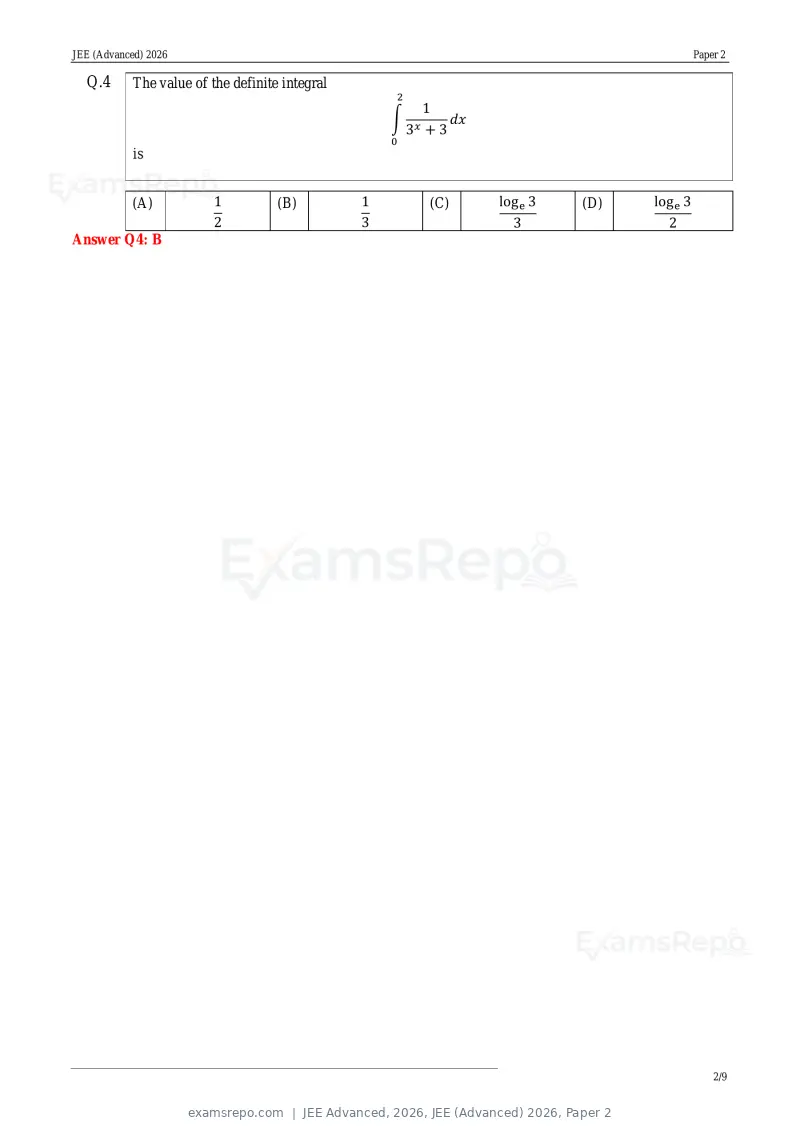
  Q.4       The value of the definite integral
                                                     2
                                                           1
                                                     ∫          dx
                                                         3x + 3
                                                     0
            is


            (A)           1          (B)         1          (C)      log e 3   (D)   log e 3
                          2                      3                     3               2


                                                                                                   2/9

Text of page 3
JEE (Advanced) 2026                                                                                   Paper 2


                                           SECTION 2 (Maximum Marks: 20)

  •    This section contains FIVE (05) questions.
  •    Each question has FOUR options (A), (B), (C) and (D). ONE OR MORE THAN ONE of these four option(s)
       is(are) correct answer(s).
  •    For each question, choose the option(s) corresponding to (all) the correct answer(s).
  •    Answer to each question will be evaluated according to the following marking scheme:
       Full Marks       : +4 ONLY if (all) the correct option(s) is(are) chosen;
       Partial Marks : +3 If all the four options are correct but ONLY three options are chosen;
       Partial Marks : +2 If three or more options are correct but ONLY two options are chosen, both of
                               which are correct;
       Partial Marks : +1 If two or more options are correct but ONLY one option is chosen and it is a
                               correct option;
       Zero Marks       : 0 If none of the options is chosen (i.e. the question is unanswered);
       Negative Marks : −1 In all other cases.
  •    For example, in a question, if (A), (B) and (D) are the ONLY three options corresponding to correct
       answers, then
       choosing ONLY (A), (B) and (D) will get +4 marks;
       choosing ONLY (A) and (B) will get +2 marks;
       choosing ONLY (A) and (D) will get +2 marks;
       choosing ONLY (B) and (D) will get +2 marks;
       choosing ONLY (A) will get +1 mark;
       choosing ONLY (B) will get +1 mark;
       choosing ONLY (D) will get +1 mark;
       choosing no option (i.e. the question is unanswered) will get 0 marks; and
       choosing any other combination of options will get −1 marks.


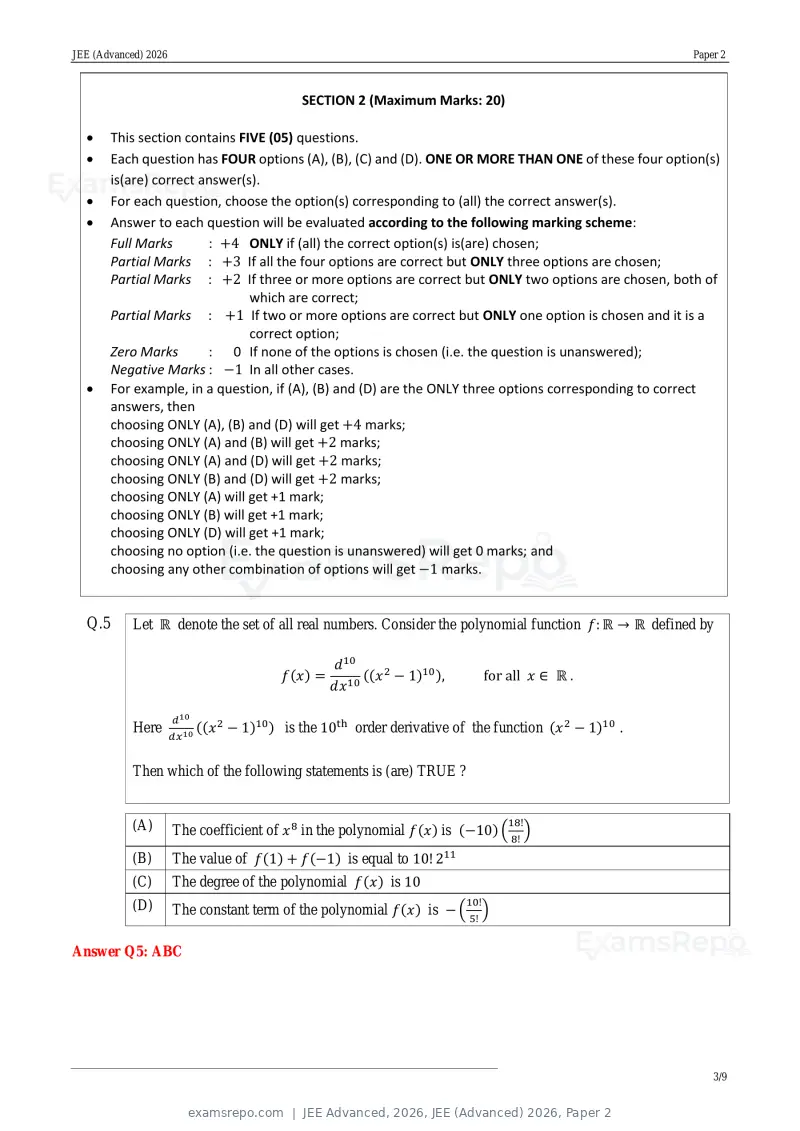
  Q.5       Let ℝ denote the set of all real numbers. Consider the polynomial function f: ℝ → ℝ defined by

                                                 d10
                                        f(x) =         ((x 2 − 1)10 ),         for all x ∈ ℝ .
                                                 dx 10

                      d 10
            Here dx 10 ((x 2 − 1)10 ) is the 10th order derivative of the function (x 2 − 1)10 .

            Then which of the following statements is (are) TRUE ?


            (A)                                                                    18!
                      The coefficient of x 8 in the polynomial f(x) is (−10) ( 8! )
            (B)       The value of f(1) + f(−1) is equal to 10! 211
            (C)       The degree of the polynomial f(x) is 10
            (D)                                                          10!
                      The constant term of the polynomial f(x) is − ( 5! )


                                                                                                          3/9

Text of page 4
JEE (Advanced) 2026                                                                                      Paper 2

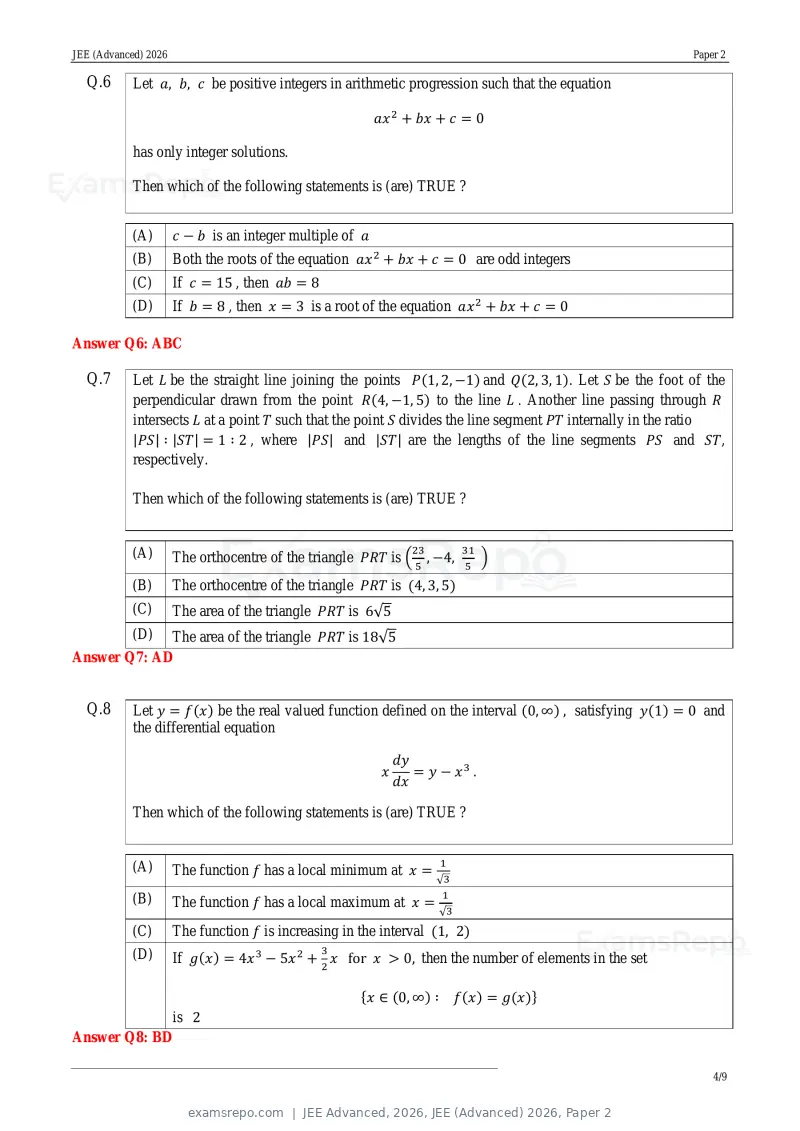
  Q.6       Let a, b, c be positive integers in arithmetic progression such that the equation

                                                          ax 2 + bx + c = 0

            has only integer solutions.

            Then which of the following statements is (are) TRUE ?


            (A)       c − b is an integer multiple of a
            (B)       Both the roots of the equation ax 2 + bx + c = 0 are odd integers
            (C)       If c = 15 , then ab = 8
            (D)       If b = 8 , then x = 3 is a root of the equation ax 2 + bx + c = 0


  Q.7       Let L be the straight line joining the points P(1, 2, −1) and Q(2, 3, 1). Let S be the foot of the
            perpendicular drawn from the point R(4, −1, 5) to the line L . Another line passing through R
            intersects L at a point T such that the point S divides the line segment PT internally in the ratio
            |PS| ∶ |ST| = 1 ∶ 2 , where |PS| and |ST| are the lengths of the line segments PS and ST,
            respectively.

            Then which of the following statements is (are) TRUE ?


            (A)                                                   23     31
                      The orthocentre of the triangle PRT is ( , −4,        )
                                                                  5      5
            (B)       The orthocentre of the triangle PRT is (4, 3, 5)
            (C)       The area of the triangle PRT is 6√5
            (D)       The area of the triangle PRT is 18√5


  Q.8       Let y = f(x) be the real valued function defined on the interval (0, ∞) , satisfying y(1) = 0 and
            the differential equation

                                                               dy
                                                           x      = y − x3 .
                                                               dx

            Then which of the following statements is (are) TRUE ?


            (A)                                                1
                      The function f has a local minimum at x =
                                                               √3
            (B)                                                 1
                      The function f has a local maximum at x = 3
                                                               √
            (C)       The function f is increasing in the interval (1, 2)
                                                3
            (D)       If g(x) = 4x 3 − 5x 2 + 2 x for x > 0, then the number of elements in the set

                                                      {x ∈ (0, ∞) ∶ f(x) = g(x)}
                      is 2


                                                                                                             4/9

Text of page 5
JEE (Advanced) 2026                                                                                        Paper 2

  Q.9       Let ℝ denote the set of all real numbers and let i = √−1 . Consider the matrices

                                                  0      −1            1     1
                                               S=[          ] and T = [        ].
                                                  1       0            0     1

            Let a, b, c, d be real numbers such that
                                                                  a   b
                                                         ST = [         ].
                                                                  c   d
            Let
                                          H = { x + iy ∶ x, y ∈ ℝ and y > 0 } .

            Then which of the following statements is (are) TRUE ?


            (A)       b+ia
                      d+ic
                           =i

            (B)                −1+i√3          aω+b
                      If ω =     2
                                      , then   cω+d
                                                    =ω

            (C)       If m is an integer greater than 2 such that (ST)2 = (ST)m , then m is an integer multiple
                      of 8

            (D)                         az+b
                      If z ∈ H , then        ∈H
                                        cz+d


                                                                                                               5/9

Text of page 6
JEE (Advanced) 2026                                                                                          Paper 2


                                       SECTION 3 (Maximum Marks: 20)

 •     This section contains FIVE (05) questions.
 •     The answer to each question is a NUMERICAL VALUE.
 •     For each question, enter the correct numerical value corresponding to the answer in the designated
       place using the mouse and the on-screen virtual numeric keypad.
 •     If the numerical value has more than two decimal places, truncate/round-off the value to TWO
       decimal places.
 •     Answer to each question will be evaluated according to the following marking scheme:
       Full Marks      : +4 If ONLY the correct numerical value is entered in the designated place;
       Zero Marks      : 0 In all other cases.


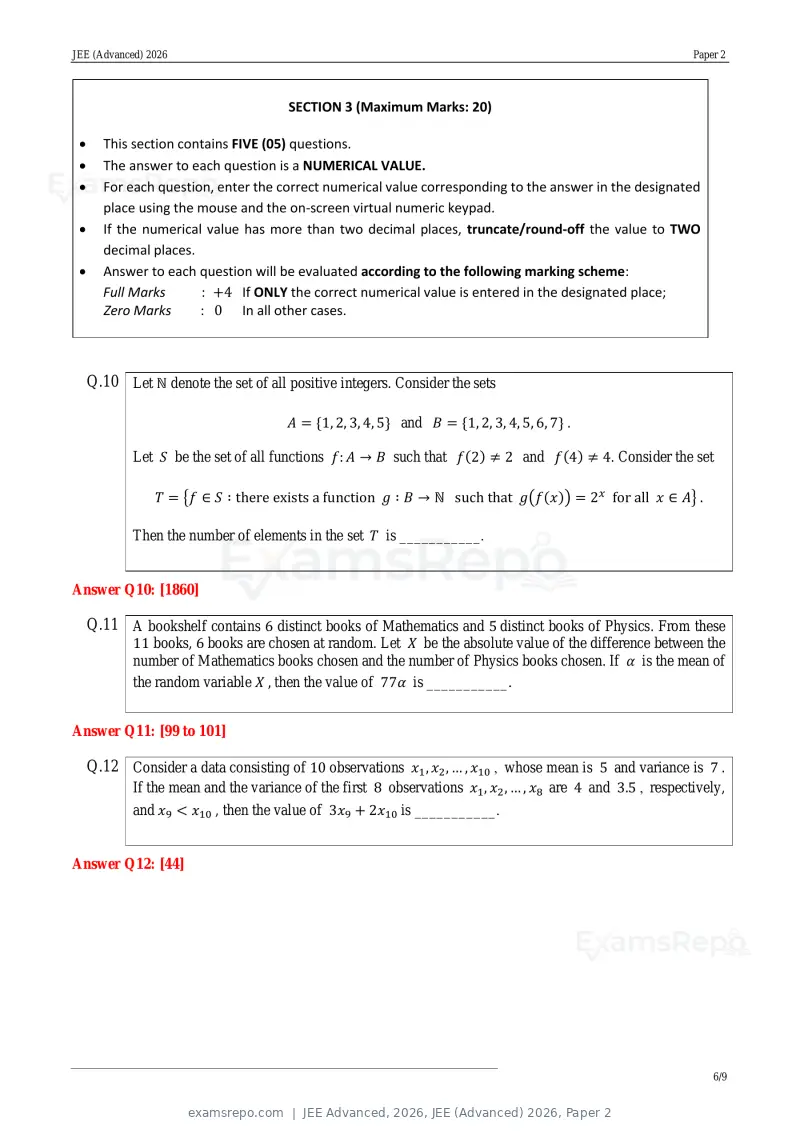
     Q.10 Let ℕ denote the set of all positive integers. Consider the sets

                                      A = {1, 2, 3, 4, 5} and B = {1, 2, 3, 4, 5, 6, 7} .

            Let S be the set of all functions f: A → B such that f(2) ≠ 2 and f(4) ≠ 4. Consider the set

                T = {f ∈ S ∶ there exists a function g ∶ B → ℕ such that g(f(x)) = 2x for all x ∈ A} .

            Then the number of elements in the set T is ___________.


     Q.11 A bookshelf contains 6 distinct books of Mathematics and 5 distinct books of Physics. From these
            11 books, 6 books are chosen at random. Let X be the absolute value of the difference between the
            number of Mathematics books chosen and the number of Physics books chosen. If α is the mean of
            the random variable X , then the value of 77α is ___________.


     Q.12 Consider a data consisting of 10 observations x1 , x2 , … , x10 , whose mean is 5 and variance is 7 .
            If the mean and the variance of the first 8 observations x1 , x2 , … , x8 are 4 and 3.5 , respectively,
            and x9 < x10 , then the value of 3x9 + 2x10 is ___________.


     Q.13 Consider the ellipse E given by x 2 + y2 = 1 . Let H be the hyperbola whose eccentricity is the
                                          18    12
            reciprocal of the eccentricity of E and whose foci are the same as that of E . Let P and Q be the
            points of intersection of H and the parabola √5 y = x 2 in the first quadrant. Let d be the distance
            between P and Q.

            If a and b are the integers such that d2 = a + b√5 , then the value of a − b is __________.


                                                                                                                 6/9

Text of page 7
JEE (Advanced) 2026                                                                                     Paper 2

  Q.14 For a real number α , let [α] denote the greatest integer less than or equal to α. For a finite set S ,
            let |S| denote the number of elements in the set S .

            Consider the functions f ∶ (−3, 3) → (−∞, ∞) and g ∶ (−3, 3) → (−∞, ∞) defined by

                                         f(x) = [x 3 ] log e (1 + sin2(π(x − [x])))
            and
                                         g(x) = x 3 sin2 (π log e (1 + x − [x])).

            Let
                                       A = {x ∈ (−3, 3) ∶ f is discontinuous at x}
            and
                                      B = {x ∈ (−3, 3) ∶ g is discontinuous at x}.

            Then the value of |A| + 2|B| − |A ∩ B| is ___________.


                                                                                                            7/9

Text of page 8
JEE (Advanced) 2026                                                                                            Paper 2


                                         SECTION 4 (Maximum Marks: 8)

 •     This section contains TWO (02) question stems.
 •     There are TWO (02) questions corresponding to each question stem.
 •     The answer to each question is a NUMERICAL VALUE.
 •     For each question, enter the correct numerical value corresponding to the answer in the
       designated place using the mouse and the on-screen virtual numeric keypad.
 •     If the numerical value has more than two decimal places, truncate/round-off the value to TWO
       decimal places.
 •     Answer to each question will be evaluated according to the following marking scheme:
       Full Marks : +2 If ONLY the correct numerical value is entered at the designated place;
       Zero Marks : 0 In all other cases.


                                   Question Stem for Question Nos. 15 and 16

     Consider the curve C1 given by
                                          y = e −x      for x ∈ [0, 10π] ,

     and the curve C2 given by

                                  y = e −x (sin x + cos x)      for x ∈ [0, 10π] .

     Let n be the total number of points of intersection of the curves C1 and C2 .

     Suppose that α1 , α2 , … , αn ∈ [0, 10π] are the x - coordinates of the points of intersection of the curves
     C1 and C2 such that
                                               α1 < α2 < ⋯ < αn .


     Q.15 The value of n is ___________.


     Q.16 Let β be the area of the region enclosed between the curves C1 , C2 , and the lines
             x = α1 and x = α4 . Then the value of

                                                   1                 π
                                                  − log e (β − 2 e − 2 )
                                                   π
             is ___________.


                                                                                                                    8/9

Text of page 9
JEE (Advanced) 2026                                                                                       Paper 2


                               Question Stem for Question Nos. 17 and 18

   Consider the ellipses given by

                                  x 2 + 4y 2 = 1   and    4x 2 + y 2 = 1 .


  Q.17 Let P be the point in the first quadrant where the given ellipses intersect. If θ is the acute angle
            between the tangents to the given ellipses at the point P, then the value of 4 tan θ is ___________.


  Q.18 If α is the area of the common region that lies inside both the given ellipses, then the value of
            cot α is ___________.


                                END OF THE QUESTION PAPER


                                                                                                              9/9

Text of page 10
JEE (Advanced) 2026 Paper 2
SECTION 1 (Maximum Marks: 12)
This section contains FOUR (04) questions.
Each question has FOUR options (A), (B), (C) and (D). ONLY ONE of these four options is the correct
answer.
For each question, choose the option corresponding to the correct answer.
Answer to each question will be evaluated according to the following marking scheme:
Full Marks : +3 If ONLY the correct option is chosen;
Zero Marks : 0 If none of the options is chosen (i.e. the question is unanswered);
Negative Marks : −1 In all other cases.
Q.1 A metal wire of cross-sectional area 0.5 mm2 and length 100 m is connected across a battery of
e.m.f. 2 V and internal resistance 1 Ω. The density, atomic mass and electrical conductivity of the
metal are 6.35 × 10³ kg m−3, 63.5 gm/mole and 2 × 10⁸ mho m−1, respectively. Assuming one
conduction electron per atom of the metal, the drift velocity (in mm s −1 ) of the electrons in the
wire is:
[Take Avogadro’s number as 6 × 10²³ and charge of the electron as 1.6 × 10⁻¹⁹ C.]
(A) 0.052 (B) 0.104 (C) 0.208 (D) 0.156
Q.2 A nuclear reactor starts producing a radioactive nuclide X from t = 0, at a constant rate of α per
second. Each decay of X produces energy E0 , which is utilized to heat a liquid of mass m and
specific heat s. Assuming no heat loss from the liquid and taking λ as the decay constant of X, the
rate of increase in the temperature of the liquid is:
(A) αE0 (B) αE0 λt
(1 − e −λt ) (e − 1)
ms ms
(C) λE0 (D) E0
(1 − e −λt ) (α − λe −λt )
ms ms
Q.3 A beam of polychromatic light passes through a thin prism of prism angle 6°. The refractive index
β
of the material of the prism varies with wavelength (λ) as n(λ) = αλ + λ2 , where α = 3 μm−1 and
β = 0.096 μm2 . If λmin is the wavelength at which the angle of minimum deviation Dm is
smallest, then the correct value of Dm at λmin is
(A) 6.4° (B) 4.8° (C) 3.2° (D) 2.4°
1/10

Text of page 11
JEE (Advanced) 2026                                                                                           Paper 2

  Q.4       A particle of mass m, and angular momentum ℓ is moving in a circular orbit of radius r0
                                                                  k
            under the influence of an attractive force F⃗ (r) = − 2 r̂ . Keeping its angular momentum
                                                                 r
            unchanged, the particle is displaced radially by a small distance δr ≪ r0 , due to which its radial
            distance varies periodically. The corresponding time period is:

            (A)         2πℓ3         (B)              m        (C)         2πℓ3           (D)         2πℓ3
                                                2π√
                        mk 2                          k                    3mk 2                      5mk 2


                                                                                                                  2/10

Text of page 12
JEE (Advanced) 2026 Paper 2
SECTION 2 (Maximum Marks: 20)
This section contains FIVE (05) questions.
Each question has FOUR options (A), (B), (C) and (D). ONE OR MORE THAN ONE of these four option(s)
is(are) correct answer(s).
For each question, choose the option(s) corresponding to (all) the correct answer(s).
Answer to each question will be evaluated according to the following marking scheme:
Full Marks : +4 ONLY if (all) the correct option(s) is(are) chosen;
Partial Marks : +3 If all the four options are correct but ONLY three options are chosen;
Partial Marks : +2 If three or more options are correct but ONLY two options are chosen, both of
which are correct;
Partial Marks : +1 If two or more options are correct but ONLY one option is chosen and it is a
correct option;
Zero Marks : 0 If none of the options is chosen (i.e. the question is unanswered);
Negative Marks : −1 In all other cases.
For example, in a question, if (A), (B) and (D) are the ONLY three options corresponding to correct
answers, then
choosing ONLY (A), (B) and (D) will get +4 marks;
choosing ONLY (A) and (B) will get +2 marks;
choosing ONLY (A) and (D) will get +2 marks;
choosing ONLY (B) and (D) will get +2 marks;
choosing ONLY (A) will get +1 mark;
choosing ONLY (B) will get +1 mark;
choosing ONLY (D) will get +1 mark;
choosing no option (i.e. the question is unanswered) will get 0 marks; and
choosing any other combination of options will get −1 marks.
3/10

Text of page 13
JEE (Advanced) 2026                                                                                                   Paper 2

  Q.5       Consider two isosceles prisms 1 and 2 with prism angles A1 and A2 and refractive indices n1 and
            n2 , respectively, as shown in the figure. The faces a1 b1 and a2 b2 are parallel to each other and
            perpendicular to the mirror M. If a ray of light is incident on the face a1 c1 and emerges from the
            face a2 c2 , then the correct statement(s) is/are:


            (A)                                                                      n           A        A
                      If both the prisms are at minimum deviation condition, then n2 = sin ( 21 ) / sin ( 22 ).
                                                                                         1

            (B)                                                                              A
                      If prism 2 is at minimum deviation condition, then sin i1 = n2 sin ( 22 ) is always true.
            (C)       If both the prisms 1 and 2 are thin and are at minimum deviation condition with angles of
                                                                         δ         δ
                      deviation δm1 and δm2 , respectively, then θ = 2(nm1 −1)
                                                                               + 2(nm2−1) .
                                                                            1        2

            (D)                                                                              A
                      If prism 1 is at minimum deviation condition, then sin i2 = n1 sin ( 21 ) is always true.


  Q.6       In a vacuum chamber, a particle of charge 1 μC and mass 1 mg is projected with a velocity
            (î + 2ĵ) ms−1 from the XZ plane at time t = 0 in an electric field of 1î Vm−1 . At t = 0.2 s, the
            electric field is switched off and a magnetic field of 6ĵ T is switched on. The acceleration due to
            gravity is −10ĵ ms−2. Correct option(s) is/are:

            (A)       The vertical distance of the particle from the XZ plane at t = 0.3 s is 15 cm.
            (B)       The vertical distance of the particle from the XZ plane at t = 0.4 s is 10 cm.
            (C)       The radius of the trajectory of the particle for t > 0.2 s is 20 cm.
            (D)       The particle will be in the XZ plane at t = 0.35 s.


  Q.7       Two charges Q1 = q and Q2 = mq are placed at the points P1 (a, b) and P2 (ma, mb), respectively,
            in the XY plane, where a, b ≠ 0 and m ≠ 0, 1. If V1 is the potential at a point in the XY plane due
            to charge Q1 and V2 is the potential at that point due to charge Q2 . Correct statement(s) for the
            points at which |V1 | = |V2 | is/are:

            (A)       For m = −1, locus of these points is ax + by = 0.
            (B)                                                                  2                         2      2
                      For m = 2, the locus of these points is a circle of radius 3 √a2 + b 2 centered at (3 a, 3 b)
            (C)       For m = −2, the locus of these points is a circle of radius 2√a2 + b 2 centered at (2a, 2b)
            (D)       For m = −3, locus of these points is 3bx + 3ay = 0.


                                                                                                                         4/10

Text of page 14
JEE (Advanced) 2026                                                                                             Paper 2


  Q.8       Consider an electric dipole comprising two charges +q and −q each with mass m, separated by a
            fixed distance d and initially at rest with its dipole moment pointing along î. A uniform electric
            field Eĵ is turned on at time t = 0 and it is turned off at t = tf , when the dipole moment makes an
            angle θf with î. Neglecting any sources of energy loss, correct option(s) is/are:

            (A)       The center of mass of the dipole is deflected towards ĵ in the presence of the field.
            (B)                                                               2qE             π
                      If the magnitude of the final angular velocity ωf = √ md , then θf = 6 .

            (C)       If θf = π/3, then the change in kinetic energy of the dipole is given by 2√3 qEd.
            (D)       For θf = π/4, the dipole rotates around its center of mass with a constant angular velocity
                      after t > tf .


  Q.9       Ten moles of an ideal monoatomic gas, initially in state a at atmospheric pressure and temperature
            Ta = 27°C, is enclosed in a metal cylinder of volume V0 fitted with a frictionless piston. The gas is
            suddenly compressed to state b with volume V0 /3. Now, keeping the piston stationary, the cylinder
            is submerged in a water bath of temperature 11℃ until the gas reaches the temperature of the water
            bath, which is denoted as state c. Finally, while still in the water bath, the piston is brought slowly
            to its initial position, which is denoted as state f. If R is universal gas constant, then the correct
            option(s) is/are:
            [Given: 91/3 = 2.08]

            (A)       The schematic P-V diagram of the processes described above is:


            (B)       The change in internal energy in going from state a to b is 4860R.
            (C)       The net change in the internal energy in the whole process is −240R.
            (D)       The pressure and temperature of the state b are 2.08 times the atmospheric pressure and
                      624 K, respectively.


                                                                                                                   5/10
Text of page 15
JEE (Advanced) 2026 Paper 2
SECTION 3 (Maximum Marks: 20)
This section contains FIVE (05) questions.
The answer to each question is a NUMERICAL VALUE.
For each question, enter the correct numerical value corresponding to the answer in the designated
place using the mouse and the on-screen virtual numeric keypad.
If the numerical value has more than two decimal places, truncate/round-off the value to TWO
decimal places.
Answer to each question will be evaluated according to the following marking scheme:
Full Marks : +4 If ONLY the correct numerical value is entered in the designated place;
Zero Marks : 0 In all other cases.
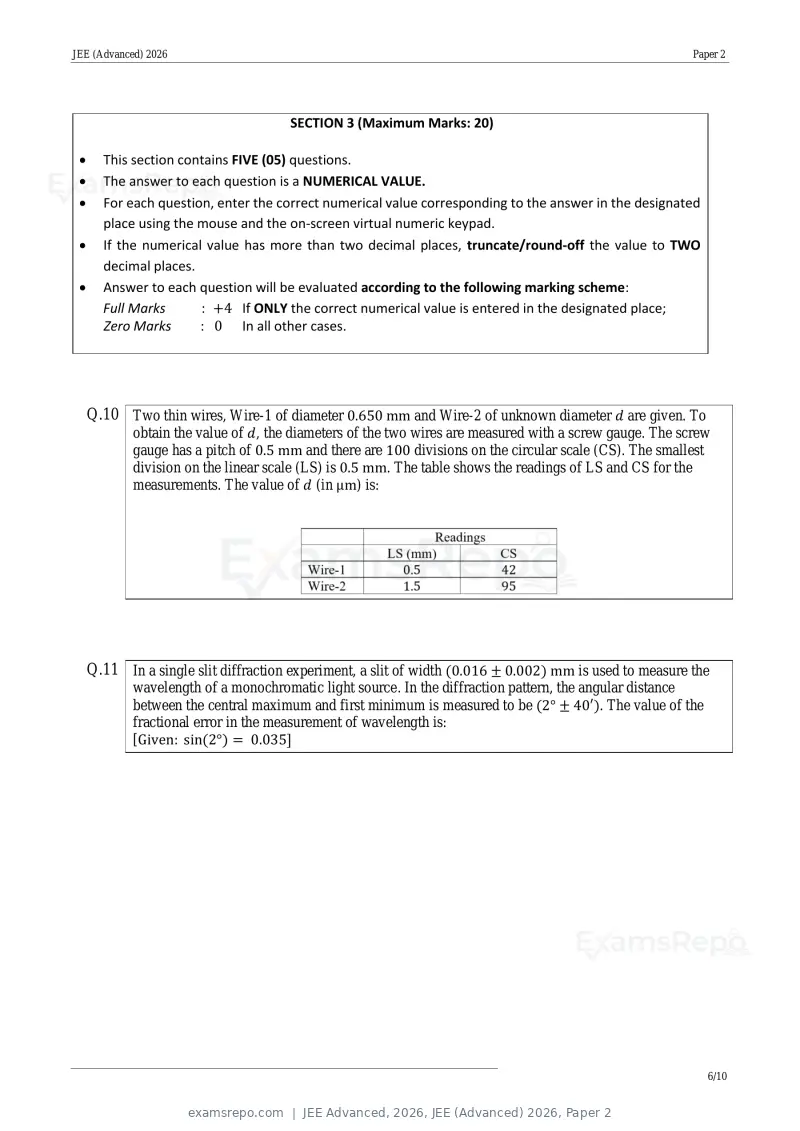
Q.10 Two thin wires, Wire-1 of diameter 0.650 mm and Wire-2 of unknown diameter d are given. To
obtain the value of d, the diameters of the two wires are measured with a screw gauge. The screw
gauge has a pitch of 0.5 mm and there are 100 divisions on the circular scale (CS). The smallest
division on the linear scale (LS) is 0.5 mm. The table shows the readings of LS and CS for the
measurements. The value of d (in µm) is:
Q.11 In a single slit diffraction experiment, a slit of width (0.016 ± 0.002) mm is used to measure the
wavelength of a monochromatic light source. In the diffraction pattern, the angular distance
between the central maximum and first minimum is measured to be (2° ± 40′). The value of the
fractional error in the measurement of wavelength is:
[Given: sin(2°) = 0.035]
6/10

Text of page 16
JEE (Advanced) 2026                                                                                             Paper 2

  Q.12 As shown in the figure, a ray AB of unpolarized light enters from water of refractive index nw =
            4/3 into a medium of refractive index np = 4/√3 after passing through a glass plate of refractive
            index ng = 1.5 and a layer of water. At a particular incident angle i the reflected ray CD is
            polarized in the direction as shown in the figure. The value of i (in degrees) is:


  Q.13 As shown in the figure, the resistance of a galvanometer G can be found by the half-deflection
            method. Here the resistance R2 is adjusted such that when the key K is closed the deflection in the
            galvanometer becomes half of the value as compared to when K is open. Half-deflection is obtained
            at R2 = 4 Ω and thus the galvanometer resistance is found to be 6 Ω. In this half-deflection
            condition the current (in mA) through the resistor R1 is:


  Q.14 In a new system of units, the units of mass, length, time and current are 5 kg, 5 m, 5 s and 5 A,
            respectively. If μ0 and ε0 are the permeability and permittivity of free space, respectively, then in this
            new system of units, the magnitude of one SI unit of √μ0 /ε0 , is:


                                                                                                                   7/10

Text of page 17
JEE (Advanced) 2026 Paper 2
SECTION 4 (Maximum Marks: 8)
This section contains TWO (02) question stems.
There are TWO (02) questions corresponding to each question stem.
The answer to each question is a NUMERICAL VALUE.
For each question, enter the correct numerical value corresponding to the answer in the
designated place using the mouse and the on-screen virtual numeric keypad.
If the numerical value has more than two decimal places, truncate/round-off the value to TWO
decimal places.
Answer to each question will be evaluated according to the following marking scheme:
Full Marks : +2 If ONLY the correct numerical value is entered at the designated place;
Zero Marks : 0 In all other cases.
8/10
Text of page 18
JEE (Advanced) 2026                                                                                        Paper 2

                                  Question Stem for Question Nos. 15 and 16

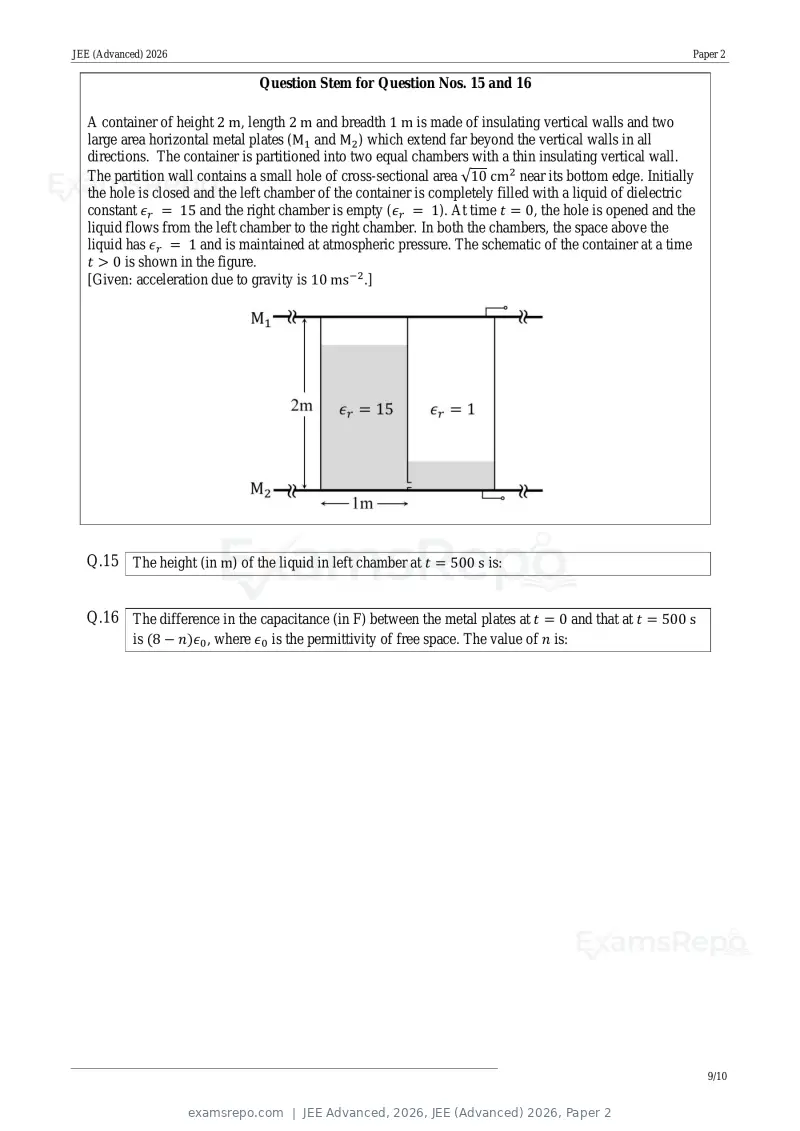
   A container of height 2 m, length 2 m and breadth 1 m is made of insulating vertical walls and two
   large area horizontal metal plates (M1 and M2 ) which extend far beyond the vertical walls in all
   directions. The container is partitioned into two equal chambers with a thin insulating vertical wall.
   The partition wall contains a small hole of cross-sectional area √10 cm2 near its bottom edge. Initially
   the hole is closed and the left chamber of the container is completely filled with a liquid of dielectric
   constant εr = 15 and the right chamber is empty (εr = 1). At time t = 0, the hole is opened and the
   liquid flows from the left chamber to the right chamber. In both the chambers, the space above the
   liquid has εr = 1 and is maintained at atmospheric pressure. The schematic of the container at a time
   t > 0 is shown in the figure.
   [Given: acceleration due to gravity is 10 ms−2 .]


  Q.15 The height (in m) of the liquid in left chamber at t = 500 s is:


  Q.16 The difference in the capacitance (in F) between the metal plates at t = 0 and that at t = 500 s
            is (8 − n)ε0 , where ε0 is the permittivity of free space. The value of n is:


                                                                                                               9/10

Text of page 19
JEE (Advanced) 2026                                                                                         Paper 2


                                Question Stem for Question Nos. 17 and 18

   A uniform circular disk of radius 0.2 m and mass 1 kg is pivoted at its top point C such that it can
   rotate freely around C in the XY plane, as shown in the figure. Initially, when the disk is at rest, a
   particle of mass 20 g, travelling along negative x direction in the XY plane with speed 100 ms−1,
   hits the circumference of the disk at a point P. After collision the particle moves along negative y
   direction at a speed of 90 ms −1.
   [Given: the acceleration due to gravity (g) = − 10 ĵ ms−2]


  Q.17 After the collision the disk starts to rotate around point C in the XY plane. The maximum change in
            the height (in m) of its center O is:


  Q.18 Amount of energy loss (in J) in the collision is:


                                  END OF THE QUESTION PAPER


                                                                                                              10/10

Text of page 20
JEE (Advanced) 2026 Paper 2
SECTION 1 (Maximum Marks: 12)
This section contains FOUR (04) questions.
Each question has FOUR options (A), (B), (C) and (D). ONLY ONE of these four options is the correct
answer.
For each question, choose the option corresponding to the correct answer.
Answer to each question will be evaluated according to the following marking scheme:
Full Marks : +3 If ONLY the correct option is chosen;
Zero Marks : 0 If none of the options is chosen (i.e. the question is unanswered);
Negative Marks : −1 In all other cases.
Q.1 At 300 K, the molar conductivities of the aqueous solutions of three salts at two different
concentrations are given below:
The conductivity of a saturated aqueous solution of AgCl is 1.40×10⁻⁶ S cm−1 at 300 K. If the
solubility of AgCl in water at 300 K is X mol L−1, then log10(X −1) is
(Assume that AgCl dissolved in water ionizes completely and that the molar conductivity of saturated
AgCl solution is equal to its limiting molar conductivity.)
(A) 3
(B) 4
(C) 5
(D) 6
Q.2 The correct order of ONO bond angle in the given species is
(A) NO2+ < NO2 < NO3– < NO2–
(B) NO2– < NO3– < NO2 < NO2+
(C) NO3– < NO2– < NO2 < NO2+
(D) NO2– < NO3– < NO2+ < NO2
1/10

Text of page 21
JEE (Advanced) 2026                                                                                     Paper 2

  Q.3       Natural rubber on complete ozonolysis (O3/Zn-H2O) gives compound X as the major product. X gives
            positive iodoform and Tollen’s tests. X on heating with aqueous NaOH gives Y as the major product.
            Y is

            (A)                                              (B)


            (C)                                              (D)


                                                                                                           2/10
Text of page 22
JEE (Advanced) 2026                                                                                     Paper 2

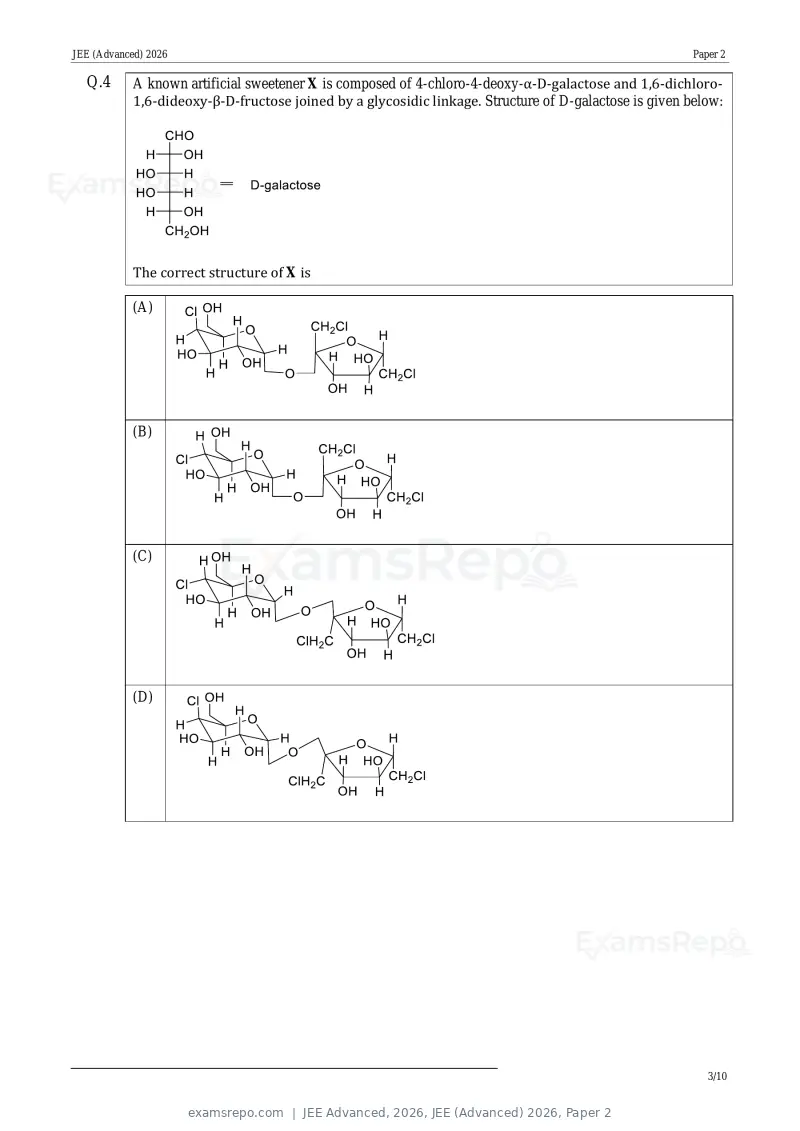
  Q.4       A known artificial sweetener X is composed of 4-chloro-4-deoxy-α-D-galactose and 1,6-dichloro-
            1,6-dideoxy-β-D-fructose joined by a glycosidic linkage. Structure of D-galactose is given below:


            The correct structure of X is

            (A)


            (B)


            (C)


            (D)


                                                                                                           3/10

Text of page 23
JEE (Advanced) 2026 Paper 2
SECTION 2 (Maximum Marks: 20)
This section contains FIVE (05) questions.
Each question has FOUR options (A), (B), (C) and (D). ONE OR MORE THAN ONE of these four
option(s) is(are) correct answer(s).
For each question, choose the option(s) corresponding to (all) the correct answer(s).
Answer to each question will be evaluated according to the following marking scheme:
Full Marks : +4 ONLY if (all) the correct option(s) is(are) chosen;
Partial Marks : +3 If all the four options are correct but ONLY three options are chosen;
Partial Marks : +2 If three or more options are correct but ONLY two options are chosen, both of
which are correct;
Partial Marks : +1 If two or more options are correct but ONLY one option is chosen and it is a
correct option;
Zero Marks : 0 If none of the options is chosen (i.e. the question is unanswered);
Negative Marks : −1 In all other cases.
For example, in a question, if (A), (B) and (D) are the ONLY three options corresponding to correct
answers, then
choosing ONLY (A), (B) and (D) will get +4 marks;
choosing ONLY (A) and (B) will get +2 marks;
choosing ONLY (A) and (D) will get +2 marks;
choosing ONLY (B) and (D) will get +2 marks;
choosing ONLY (A) will get +1 mark;
choosing ONLY (B) will get +1 mark;
choosing ONLY (D) will get +1 mark;
choosing no option (i.e. the question is unanswered) will get 0 marks; and
choosing any other combination of options will get −1 marks.
4/10

Text of page 24
JEE (Advanced) 2026                                                                                         Paper 2

  Q.5       For a first-order reaction R ⟶ P at a given temperature, k is the rate constant. For this reaction, at
            the given temperature, the concentrations of R and P at a time t are [R] and [P], respectively. The
            correct graphical representation(s) for this reaction is(are)

            (A)                                                   (B)


            (C)                                                   (D)


  Q.6       Correct statement(s) about the compounds P, Q and R is(are)


            (A)       P has two lone pairs of electrons on the central atom.
            (B)       Q has a perfect octahedral geometry.
            (C)       Q can act as a fluorinating agent.
            (D)       The molecular structure of R is trigonal pyramidal.


                                                                                                               5/10

Text of page 25
JEE (Advanced) 2026 Paper 2
Q.7 The correct statement(s) regarding the periodic properties of elements is(are)
(A) Second ionization enthalpy of carbon atom is less than that of boron atom.
(B) Increasing order of ionic radii: Al3+ < Mg2+ < Na+
(C) Under identical conditions, in solid state, the density of potassium metal is more than density
of sodium metal.
(D) The H–H bond is weaker than F–F bond.
Q.8 In the following reaction sequence, P, Q, S and T are the major products.
The correct statement(s) about P, Q, S and T is(are)
(A) Q on treatment with ethanol generates an aromatic aldehyde.
(B) S gives positive phthalein dye test.
(C) P is a dinitro compound.
(D) T is a coloured compound.
Q.9 The correct statement(s) regarding sugars is(are)
Given: Specific rotations of L-(−)-glucose and L-(+)-fructose are −52.5 and +92.5, respectively.
(A) On treatment with HNO3, gluconic acid is oxidized to saccharic acid, whereas glucose is not
oxidized to saccharic acid.
(B) Fructose gives a positive Fehling’s test because it isomerises to glucose and another
aldohexose in the presence of Fehling’s reagent.
(C) Invert sugar is an equimolar mixture of D-glucose and D-fructose formed after hydrolysis of
the corresponding disaccharide.
(D) Specific rotation of invert sugar is −40.
6/10

Text of page 26
JEE (Advanced) 2026 Paper 2
SECTION 3 (Maximum Marks: 20)
This section contains FIVE (05) questions.
The answer to each question is a NUMERICAL VALUE.
For each question, enter the correct numerical value corresponding to the answer in the
designated place using the mouse and the on-screen virtual numeric keypad.
If the numerical value has more than two decimal places, truncate/round-off the value to TWO
decimal places.
Answer to each question will be evaluated according to the following marking scheme:
Full Marks : +4 If ONLY the correct numerical value is entered in the designated place;
Zero Marks : 0 In all other cases.
Q.10 Xa+ and Yb+ are hydrogen-like species. The wavelength of light absorbed during the transition
between the states with principal quantum numbers n = 1 and n = 2 of Xa+ is λ. The wavelength of
light absorbed during the transition between the states with principal quantum numbers n = 2 and
n = 4 of Yb+ is 9λ. The lowest possible value of (a+b) is ____.
Q.11 At a given temperature, 0.45 g of acetic acid in 50 mL of water is shaken with 1.0 g of charcoal and
the pH of the resulting solution is 3.0. Assume, the adsorption of acetic acid from the aqueous solution
by charcoal follows Freundlich isotherm,
x
= kC 1/n
m
If the plot of log10(x/m) against log10C gives a straight line with slope 1, the value of k in
L mol−1 is ____.
Given: The molar mass of acetic acid is 60 g mol−1.
The acid dissociation constant of acetic acid is 1.0×10⁻⁵ at the given temperature.
x is the mass (in grams) of acetic acid adsorbed.
m is the mass (in grams) of charcoal.
C is the equilibrium concentration of acetic acid in the solution after the adsorption is complete.
k and n are constants for acetic acid–charcoal system at the given temperature.
7/10

Text of page 27
JEE (Advanced) 2026                                                                                         Paper 2

  Q.12 In a solvent S, a compound B is partially dissociated into C and D as given below:

                                                       B ⇌ 2C + 2D

            B, C and D are non-volatile in nature. The molar mass of B is 10 times the molar mass of S. The
            standard boiling point and the standard enthalpy of vaporization of S are 400 K and
            10R J mol−1, respectively (R is the gas constant in J K−1 mol−1). A solution of B in S with an initial
            concentration of B as 0.25% (mass/mass) has a boiling point of 408 K at 1 bar pressure. In this
            solution, the mole percent of B that has been dissociated is ____.


  Q.13 Consider that the coordinating atoms of the ligands in cis-[Co(NH3)4Cl2]Cl and mer-[Co(NH3)3Cl3]
            octahedral complexes are at the vertices of an octahedron. The sum of total number of the triangular
            faces in both the complexes having one N atom and two Cl atoms at their corners is____.


  Q.14 In the following reaction sequence, major products X and Y are acyclic monomers.


            500 mol of X completely reacts with 500 mol of Y to give 1 mol of a single biodegradable acyclic
            copolymer Z as the only product. The amount of Z formed in grams is ____.

            Given:
            Atomic mass (in amu): H : 1, C : 12, N : 14, O : 16, Br : 80


                                                                                                               8/10

Text of page 28
JEE (Advanced) 2026 Paper 2
SECTION 4 (Maximum Marks: 8)
This section contains TWO (02) question stems.
This section contains TWO (02) questions corresponding to each question stem.
The answer to each question is a NUMERICAL VALUE.
For each question, enter the correct numerical value corresponding to the answer in the
designated place using the mouse and the on-screen virtual numeric keypad.
If the numerical value has more than two decimal places, truncate/round-off the value to TWO
decimal places.
Answer to each question will be evaluated according to the following marking scheme:
Full Marks : +2 If ONLY the correct numerical value is entered in the designated place;
Zero Marks : 0 In all other cases.
Question Stem for Question Nos. 15 and 16
Two volatile liquids A and B form an ideal solution. Consider a 5 molal solution of B in A inside a closed
container having a total vapour pressure of 100 mm Hg at 300 K. The vapour pressure of pure A at 300K
is 105 mm Hg. Assume that A and B behave as ideal gases in the vapour phase.
Given:
The gas constant R = 0.08 L atm K−1 mol−1
Molar mass of A is 50 g mol−1
Molar mass of B is 57 g mol−1
Density of liquid B at 300 K is 0.5 g/mL
1 atm = 760 mm Hg
Q.15 At 300 K, the ratio of the molar volume of pure B in vapour phase to its molar volume in liquid
phase is ____.
Q.16 The mole fraction of B in vapour phase which is in equilibrium with this solution is ____.
9/10

Text of page 29
JEE (Advanced) 2026                                                                             Paper 2


                                Question Stem for Question Nos. 17 and 18

   Consider the following reaction sequence in which J, K, L and M are the major products.


   Given:
   Atomic mass (in amu): H : 1, C : 12, N : 14, O : 16, S : 32, Br : 80, Ba : 137


  Q.17 The volume of 1 M aqueous H2SO4 required to completely neutralize the ammonia evolved
            from 5.72 g of L in Kjeldahl’s method of nitrogen estimation is ____ mL.


  Q.18 In sulphur estimation by Carius method, the amount of BaSO4 formed from 3.79 g of M is
            ____ g.


                                END OF THE QUESTION PAPER


                                                                                                  10/10
Text of page 1
JEE (Advanced) 2026                                                                                                Paper 2


                                         SECTION 1 (Maximum Marks: 12)

  • This section contains FOUR (04) questions.
  • Each question has FOUR options (A), (B), (C) and (D). ONLY ONE of these four options is the correct
    answer.
  • For each question, choose the option corresponding to the correct answer.
  • Answer to each question will be evaluated according to the following marking scheme:
    Full Marks       : +3 If ONLY the correct option is chosen;
    Zero Marks      : 0 If none of the options is chosen (i.e. the question is unanswered);
    Negative Marks : −1 In all other cases.


  Q.1       Let a⃗, b⃗⃗ be two vectors, and let P, Q and R be the points with position vectors a⃗ , b⃗⃗ and a⃗ + b⃗⃗,
            respectively, with respect to the origin O . If |a⃗ + b⃗⃗| = √21 , |a⃗ − b⃗⃗| = 3 , and a⃗ and (a⃗ − b⃗⃗) are
            perpendicular to each other, then the area of the triangle OPR is


            (A)          √3           (B)            √3            (C)          3√3           (D)             3
                                                     2                           2                            2
Answer Q1: C

  Q.2       Let T be the tangent to the parabola y 2 = 16x at the point (64, 32). Let L be the tangent to the same
            parabola at another point (x1 , y1 ) on the parabola. If L and T are perpendicular to each other, then
            the distance between the point (x1 , y1 ) and the focus of the parabola, is


            (A)           15          (B)             4            (C)           17           (D)             5
                          4                                                      4

Answer Q2: C

  Q.3       Let y ∶ (−∞, ∞) → (0, ∞) be the solution of the differential equation

                                                          dy e 5x y 3 + y 3
                                                             = x            ,
                                                          dx  e + ex y4

                                1
            satisfying y(0) =      . Then the value of y(log e 2) is
                                √2


            (A)                                                    (B)
                                   √5 + √35                                                √7 + √53
                                       2                                                       2
            (C)                     7 + √53                        (D)                      5 + √35
                                       2                                                       2

Answer Q3: B


                                                                                                                       1/9
Text of page 2
JEE (Advanced) 2026                                                                            Paper 2

  Q.4       The value of the definite integral
                                                     2
                                                           1
                                                     ∫          dx
                                                         3x + 3
                                                     0
            is


            (A)           1          (B)         1          (C)      log e 3   (D)   log e 3
                          2                      3                     3               2
Answer Q4: B


                                                                                                   2/9
Text of page 3
JEE (Advanced) 2026                                                                                   Paper 2


                                           SECTION 2 (Maximum Marks: 20)

  •    This section contains FIVE (05) questions.
  •    Each question has FOUR options (A), (B), (C) and (D). ONE OR MORE THAN ONE of these four option(s)
       is(are) correct answer(s).
  •    For each question, choose the option(s) corresponding to (all) the correct answer(s).
  •    Answer to each question will be evaluated according to the following marking scheme:
       Full Marks       : +4 ONLY if (all) the correct option(s) is(are) chosen;
       Partial Marks : +3 If all the four options are correct but ONLY three options are chosen;
       Partial Marks : +2 If three or more options are correct but ONLY two options are chosen, both of
                               which are correct;
       Partial Marks : +1 If two or more options are correct but ONLY one option is chosen and it is a
                               correct option;
       Zero Marks       : 0 If none of the options is chosen (i.e. the question is unanswered);
       Negative Marks : −1 In all other cases.
  •    For example, in a question, if (A), (B) and (D) are the ONLY three options corresponding to correct
       answers, then
       choosing ONLY (A), (B) and (D) will get +4 marks;
       choosing ONLY (A) and (B) will get +2 marks;
       choosing ONLY (A) and (D) will get +2 marks;
       choosing ONLY (B) and (D) will get +2 marks;
       choosing ONLY (A) will get +1 mark;
       choosing ONLY (B) will get +1 mark;
       choosing ONLY (D) will get +1 mark;
       choosing no option (i.e. the question is unanswered) will get 0 marks; and
       choosing any other combination of options will get −1 marks.


  Q.5       Let ℝ denote the set of all real numbers. Consider the polynomial function f: ℝ → ℝ defined by

                                                 d10
                                        f(x) =         ((x 2 − 1)10 ),         for all x ∈ ℝ .
                                                 dx 10

                      d 10
            Here dx 10 ((x 2 − 1)10 ) is the 10th order derivative of the function (x 2 − 1)10 .

            Then which of the following statements is (are) TRUE ?


            (A)                                                                    18!
                      The coefficient of x 8 in the polynomial f(x) is (−10) ( 8! )
            (B)       The value of f(1) + f(−1) is equal to 10! 211
            (C)       The degree of the polynomial f(x) is 10
            (D)                                                          10!
                      The constant term of the polynomial f(x) is − ( 5! )

Answer Q5: ABC


                                                                                                          3/9
Text of page 4
JEE (Advanced) 2026                                                                                      Paper 2

  Q.6       Let a, b, c be positive integers in arithmetic progression such that the equation

                                                          ax 2 + bx + c = 0

            has only integer solutions.

            Then which of the following statements is (are) TRUE ?


            (A)       c − b is an integer multiple of a
            (B)       Both the roots of the equation ax 2 + bx + c = 0 are odd integers
            (C)       If c = 15 , then ab = 8
            (D)       If b = 8 , then x = 3 is a root of the equation ax 2 + bx + c = 0

Answer Q6: ABC

  Q.7       Let L be the straight line joining the points P(1, 2, −1) and Q(2, 3, 1). Let S be the foot of the
            perpendicular drawn from the point R(4, −1, 5) to the line L . Another line passing through R
            intersects L at a point T such that the point S divides the line segment PT internally in the ratio
            |PS| ∶ |ST| = 1 ∶ 2 , where |PS| and |ST| are the lengths of the line segments PS and ST,
            respectively.

            Then which of the following statements is (are) TRUE ?


            (A)                                                   23     31
                      The orthocentre of the triangle PRT is ( 5 , −4, 5 )
            (B)       The orthocentre of the triangle PRT is (4, 3, 5)
            (C)       The area of the triangle PRT is 6√5
            (D)
             The area of the triangle PRT is 18√5
Answer Q7: AD


  Q.8       Let y = f(x) be the real valued function defined on the interval (0, ∞) , satisfying y(1) = 0 and
            the differential equation

                                                               dy
                                                           x      = y − x3 .
                                                               dx

            Then which of the following statements is (are) TRUE ?


            (A)                                                1
                      The function f has a local minimum at x =
                                                               √3
            (B)                                                 1
                      The function f has a local maximum at x = 3
                                                               √
            (C)       The function f is increasing in the interval (1, 2)
                                                3
            (D)       If g(x) = 4x 3 − 5x 2 + 2 x for x > 0, then the number of elements in the set

                                                      {x ∈ (0, ∞) ∶ f(x) = g(x)}
             is 2
Answer Q8: BD

                                                                                                             4/9

Text of page 5
JEE (Advanced) 2026                                                                                        Paper 2


  Q.9       Let ℝ denote the set of all real numbers and let i = √−1 . Consider the matrices

                                                  0      −1            1     1
                                               S=[          ] and T = [        ].
                                                  1       0            0     1

            Let a, b, c, d be real numbers such that
                                                                  a   b
                                                         ST = [         ].
                                                                  c   d
            Let
                                          H = { x + iy ∶ x, y ∈ ℝ and y > 0 } .

            Then which of the following statements is (are) TRUE ?


            (A)       b+ia
                           =i
                      d+ic

            (B)                −1+i√3          aω+b
                      If ω =     2
                                      , then   cω+d
                                                    =ω

            (C)       If m is an integer greater than 2 such that (ST)2 = (ST)m , then m is an integer multiple
                      of 8

            (D)                         az+b
                      If z ∈ H , then        ∈H
                                        cz+d


Answer Q9: BD


                                                                                                               5/9
Text of page 6
JEE (Advanced) 2026                                                                                          Paper 2


                                       SECTION 3 (Maximum Marks: 20)

 •     This section contains FIVE (05) questions.
 •     The answer to each question is a NUMERICAL VALUE.
 •     For each question, enter the correct numerical value corresponding to the answer in the designated
       place using the mouse and the on-screen virtual numeric keypad.
 •     If the numerical value has more than two decimal places, truncate/round-off the value to TWO
       decimal places.
 •     Answer to each question will be evaluated according to the following marking scheme:
       Full Marks      : +4 If ONLY the correct numerical value is entered in the designated place;
       Zero Marks      : 0 In all other cases.


     Q.10 Let ℕ denote the set of all positive integers. Consider the sets

                                      A = {1, 2, 3, 4, 5} and B = {1, 2, 3, 4, 5, 6, 7} .

            Let S be the set of all functions f: A → B such that f(2) ≠ 2 and f(4) ≠ 4. Consider the set

                T = {f ∈ S ∶ there exists a function g ∶ B → ℕ such that g(f(x)) = 2x for all x ∈ A} .

            Then the number of elements in the set T is ___________.


Answer Q10: [1860]

     Q.11 A bookshelf contains 6 distinct books of Mathematics and 5 distinct books of Physics. From these
            11 books, 6 books are chosen at random. Let X be the absolute value of the difference between the
            number of Mathematics books chosen and the number of Physics books chosen. If α is the mean of
            the random variable X , then the value of 77α is ___________.


Answer Q11: [99 to 101]

     Q.12 Consider a data consisting of 10 observations x1 , x2 , … , x10 , whose mean is 5 and variance is 7 .
            If the mean and the variance of the first 8 observations x1 , x2 , … , x8 are 4 and 3.5 , respectively,
            and x9 < x10 , then the value of 3x9 + 2x10 is ___________.


Answer Q12: [44]


                                                                                                                 6/9
Text of page 7
JEE (Advanced) 2026                                                                                       Paper 2

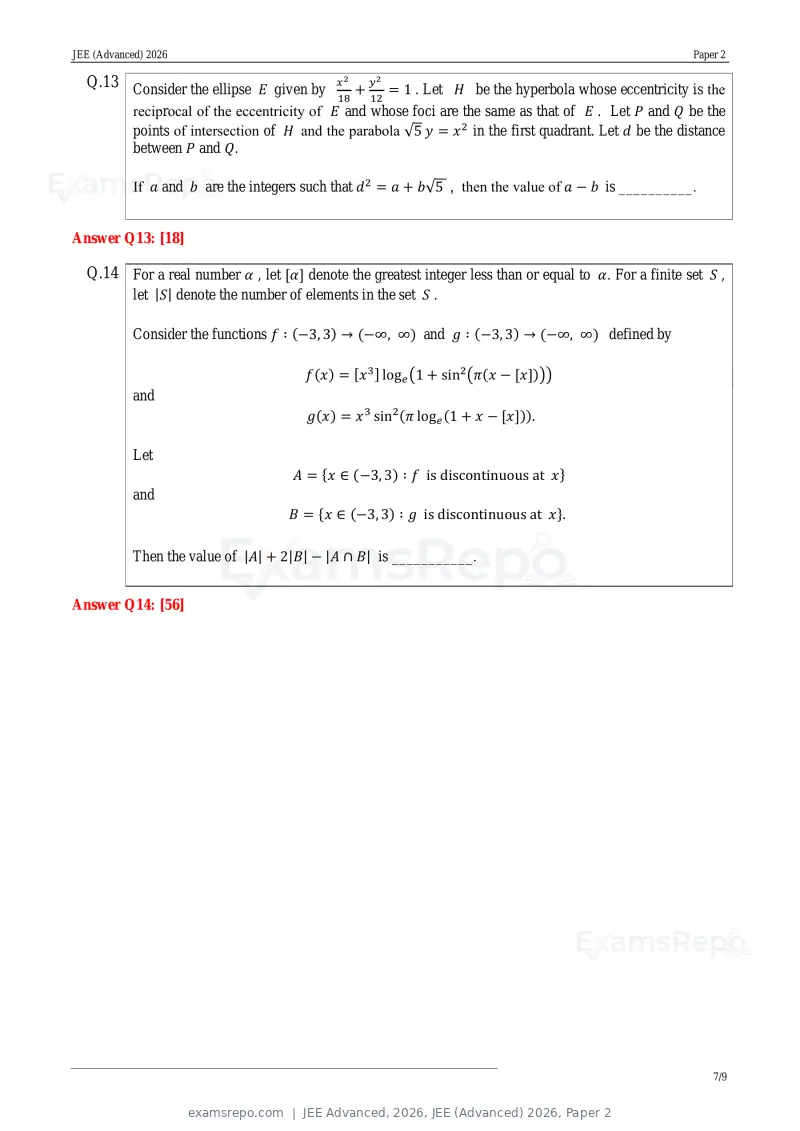
  Q.13 Consider the ellipse E given by x 2 + y2 = 1 . Let H be the hyperbola whose eccentricity is the
                                       18    12
            reciprocal of the eccentricity of E and whose foci are the same as that of E . Let P and Q be the
            points of intersection of H and the parabola √5 y = x 2 in the first quadrant. Let d be the distance
            between P and Q.

            If a and b are the integers such that d2 = a + b√5 , then the value of a − b is __________.


Answer Q13: [18]

  Q.14 For a real number α , let [α] denote the greatest integer less than or equal to α. For a finite set S ,
            let |S| denote the number of elements in the set S .

            Consider the functions f ∶ (−3, 3) → (−∞, ∞) and g ∶ (−3, 3) → (−∞, ∞) defined by

                                         f(x) = [x 3 ] log e (1 + sin2(π(x − [x])))
            and
                                         g(x) = x 3 sin2 (π log e (1 + x − [x])).

            Let
                                       A = {x ∈ (−3, 3) ∶ f is discontinuous at x}
            and
                                      B = {x ∈ (−3, 3) ∶ g is discontinuous at x}.

            Then the value of |A| + 2|B| − |A ∩ B| is ___________.


Answer Q14: [56]


                                                                                                              7/9
Text of page 8
JEE (Advanced) 2026                                                                                            Paper 2


                                         SECTION 4 (Maximum Marks: 8)

 •     This section contains TWO (02) question stems.
 •     There are TWO (02) questions corresponding to each question stem.
 •     The answer to each question is a NUMERICAL VALUE.
 •     For each question, enter the correct numerical value corresponding to the answer in the
       designated place using the mouse and the on-screen virtual numeric keypad.
 •     If the numerical value has more than two decimal places, truncate/round-off the value to TWO
       decimal places.
 •     Answer to each question will be evaluated according to the following marking scheme:
       Full Marks : +2 If ONLY the correct numerical value is entered at the designated place;
       Zero Marks : 0 In all other cases.


                                   Question Stem for Question Nos. 15 and 16

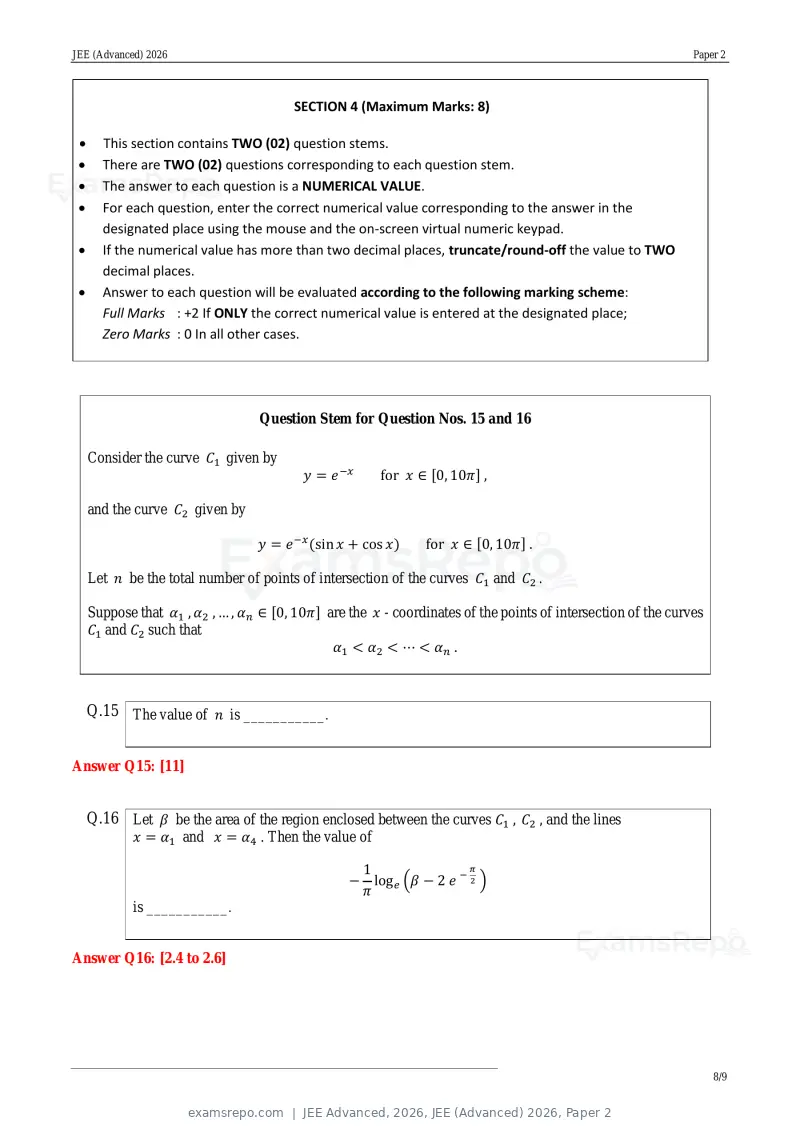
     Consider the curve C1 given by
                                          y = e −x      for x ∈ [0, 10π] ,

     and the curve C2 given by

                                  y = e −x (sin x + cos x)      for x ∈ [0, 10π] .

     Let n be the total number of points of intersection of the curves C1 and C2 .

     Suppose that α1 , α2 , … , αn ∈ [0, 10π] are the x - coordinates of the points of intersection of the curves
     C1 and C2 such that
                                               α1 < α2 < ⋯ < αn .


     Q.15 The value of n is ___________.


Answer Q15: [11]


     Q.16 Let β be the area of the region enclosed between the curves C1 , C2 , and the lines
             x = α1 and x = α4 . Then the value of

                                                   1                 π
                                                  − log e (β − 2 e − 2 )
                                                   π
             is ___________.


Answer Q16: [2.4 to 2.6]


                                                                                                                    8/9
Text of page 9
JEE (Advanced) 2026                                                                                       Paper 2


                               Question Stem for Question Nos. 17 and 18

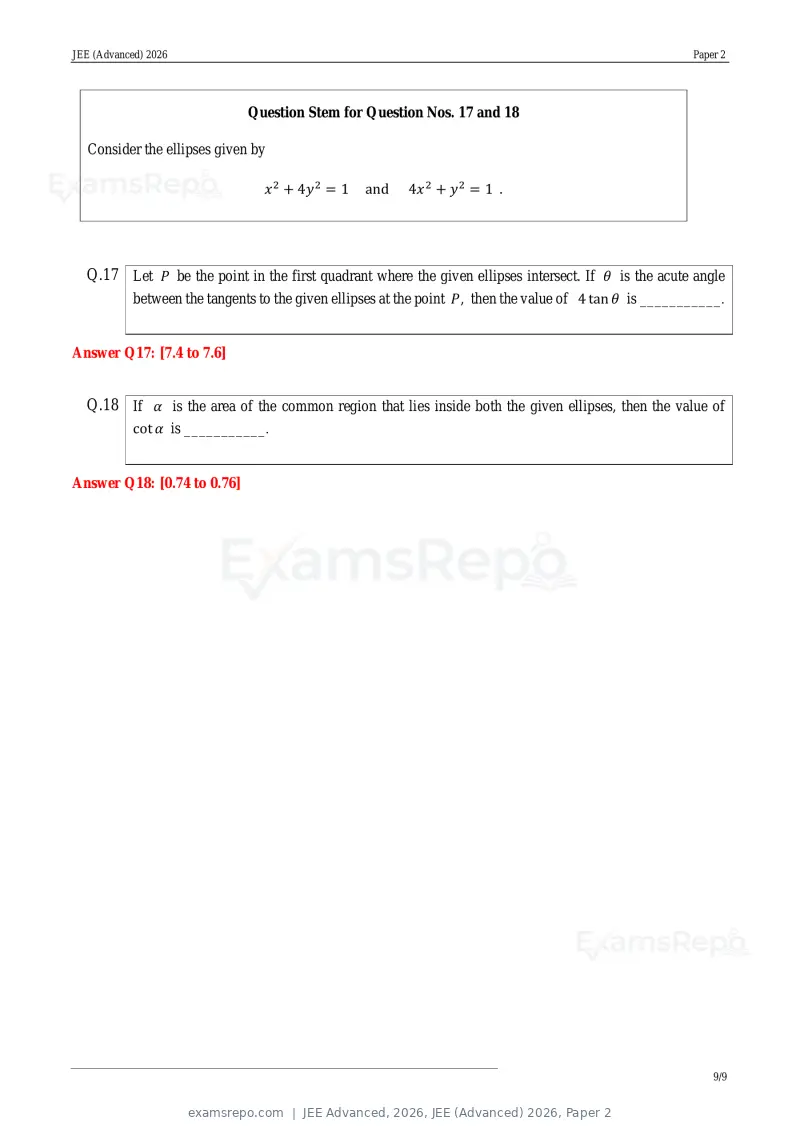
   Consider the ellipses given by

                                  x 2 + 4y 2 = 1   and    4x 2 + y 2 = 1 .


  Q.17 Let P be the point in the first quadrant where the given ellipses intersect. If θ is the acute angle
            between the tangents to the given ellipses at the point P, then the value of 4 tan θ is ___________.


Answer Q17: [7.4 to 7.6]


  Q.18 If α is the area of the common region that lies inside both the given ellipses, then the value of
            cot α is ___________.


Answer Q18: [0.74 to 0.76]


                                                                                                              9/9
Text of page 10
JEE (Advanced) 2026 Paper 2
SECTION 1 (Maximum Marks: 12)
This section contains FOUR (04) questions.
Each question has FOUR options (A), (B), (C) and (D). ONLY ONE of these four options is the correct
answer.
For each question, choose the option corresponding to the correct answer.
Answer to each question will be evaluated according to the following marking scheme:
Full Marks : +3 If ONLY the correct option is chosen;
Zero Marks : 0 If none of the options is chosen (i.e. the question is unanswered);
Negative Marks : −1 In all other cases.
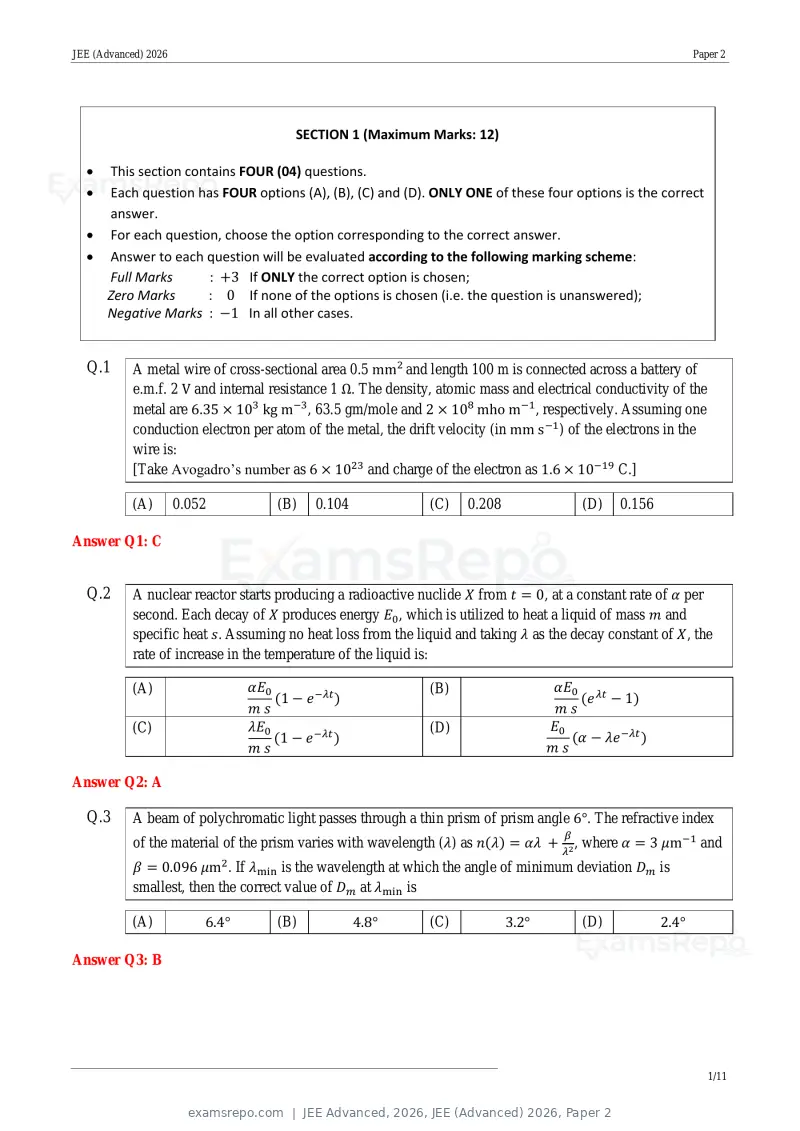
Q.1 A metal wire of cross-sectional area 0.5 mm2 and length 100 m is connected across a battery of
e.m.f. 2 V and internal resistance 1 Ω. The density, atomic mass and electrical conductivity of the
metal are 6.35 × 10³ kg m−3, 63.5 gm/mole and 2 × 10⁸ mho m−1, respectively. Assuming one
conduction electron per atom of the metal, the drift velocity (in mm s −1 ) of the electrons in the
wire is:
[Take Avogadro’s number as 6 × 10²³ and charge of the electron as 1.6 × 10⁻¹⁹ C.]
(A) 0.052 (B) 0.104 (C) 0.208 (D) 0.156
Answer Q1: C
Q.2 A nuclear reactor starts producing a radioactive nuclide X from t = 0, at a constant rate of α per
second. Each decay of X produces energy E0 , which is utilized to heat a liquid of mass m and
specific heat s. Assuming no heat loss from the liquid and taking λ as the decay constant of X, the
rate of increase in the temperature of the liquid is:
(A) αE0 (B) αE0 λt
(1 − e −λt ) (e − 1)
ms ms
(C) λE0 (D) E0
(1 − e −λt ) (α − λe −λt )
ms ms
Answer Q2: A
Q.3 A beam of polychromatic light passes through a thin prism of prism angle 6°. The refractive index
β
of the material of the prism varies with wavelength (λ) as n(λ) = αλ + λ2 , where α = 3 μm−1 and
β = 0.096 μm2 . If λmin is the wavelength at which the angle of minimum deviation Dm is
smallest, then the correct value of Dm at λmin is
(A) 6.4° (B) 4.8° (C) 3.2° (D) 2.4°
Answer Q3: B
1/11
Text of page 11
JEE (Advanced) 2026                                                                                           Paper 2

  Q.4       A particle of mass m, and angular momentum ℓ is moving in a circular orbit of radius r0
                                                                  k
            under the influence of an attractive force F⃗ (r) = − 2 r̂ . Keeping its angular momentum
                                                                 r
            unchanged, the particle is displaced radially by a small distance δr ≪ r0 , due to which its radial
            distance varies periodically. The corresponding time period is:

            (A)         2πℓ3         (B)              m        (C)         2πℓ3           (D)         2πℓ3
                                                2π√
                        mk 2                          k                    3mk 2                      5mk 2


Answer Q4: A


                                                                                                                  2/11
Text of page 12
JEE (Advanced) 2026 Paper 2
SECTION 2 (Maximum Marks: 20)
This section contains FIVE (05) questions.
Each question has FOUR options (A), (B), (C) and (D). ONE OR MORE THAN ONE of these four option(s)
is(are) correct answer(s).
For each question, choose the option(s) corresponding to (all) the correct answer(s).
Answer to each question will be evaluated according to the following marking scheme:
Full Marks : +4 ONLY if (all) the correct option(s) is(are) chosen;
Partial Marks : +3 If all the four options are correct but ONLY three options are chosen;
Partial Marks : +2 If three or more options are correct but ONLY two options are chosen, both of
which are correct;
Partial Marks : +1 If two or more options are correct but ONLY one option is chosen and it is a
correct option;
Zero Marks : 0 If none of the options is chosen (i.e. the question is unanswered);
Negative Marks : −1 In all other cases.
For example, in a question, if (A), (B) and (D) are the ONLY three options corresponding to correct
answers, then
choosing ONLY (A), (B) and (D) will get +4 marks;
choosing ONLY (A) and (B) will get +2 marks;
choosing ONLY (A) and (D) will get +2 marks;
choosing ONLY (B) and (D) will get +2 marks;
choosing ONLY (A) will get +1 mark;
choosing ONLY (B) will get +1 mark;
choosing ONLY (D) will get +1 mark;
choosing no option (i.e. the question is unanswered) will get 0 marks; and
choosing any other combination of options will get −1 marks.
3/11
Text of page 13
JEE (Advanced) 2026                                                                                               Paper 2

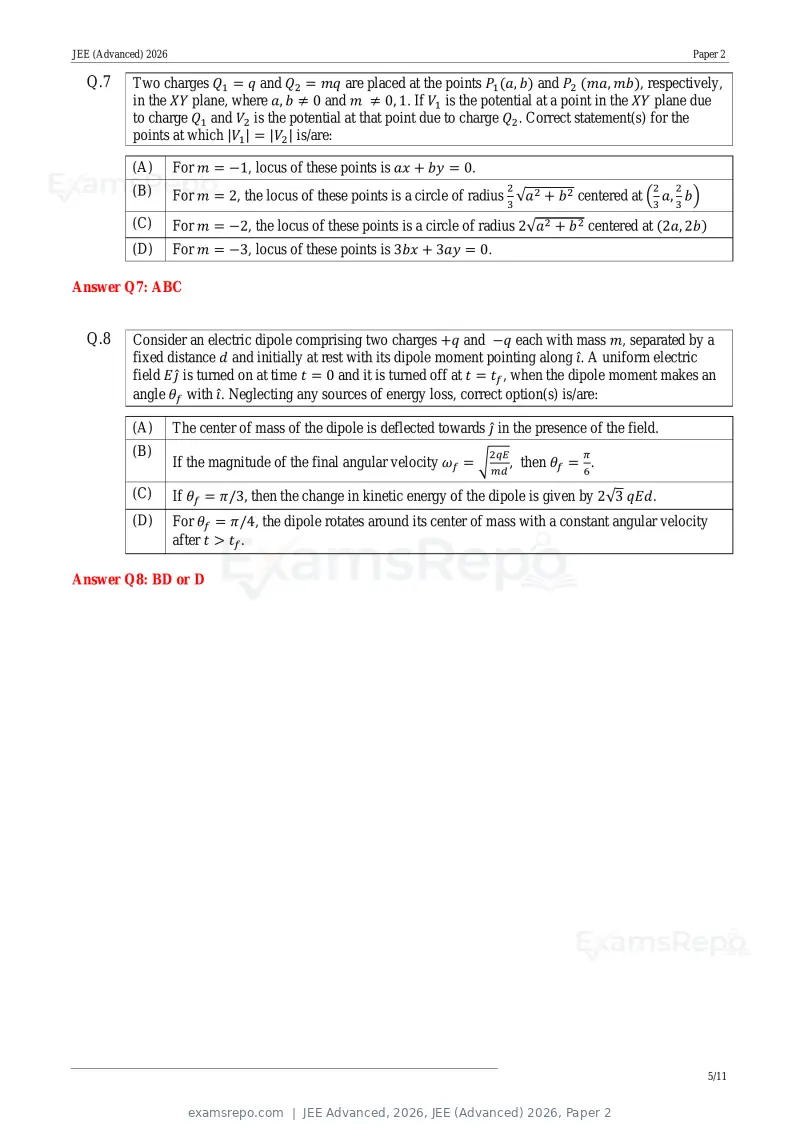
  Q.5       Consider two isosceles prisms 1 and 2 with prism angles A1 and A2 and refractive indices n1 and
            n2 , respectively, as shown in the figure. The faces a1 b1 and a2 b2 are parallel to each other and
            perpendicular to the mirror M. If a ray of light is incident on the face a1 c1 and emerges from the
            face a2 c2 , then the correct statement(s) is/are:


            (A)                                                                      n           A        A
                      If both the prisms are at minimum deviation condition, then n2 = sin ( 21 ) / sin ( 22 ).
                                                                                         1

            (B)                                                                              A
                      If prism 2 is at minimum deviation condition, then sin i1 = n2 sin ( 22 ) is always true.
            (C)       If both the prisms 1 and 2 are thin and are at minimum deviation condition with angles of
                                                                         δ         δ
                      deviation δm1 and δm2 , respectively, then θ = 2(nm1 −1)
                                                                               + 2(nm2−1) .
                                                                            1        2

            (D)                                                                              A
                      If prism 1 is at minimum deviation condition, then sin i2 = n1 sin ( 21 ) is always true.

Answer Q5: ACD

  Q.6       In a vacuum chamber, a particle of charge 1 μC and mass 1 mg is projected with a velocity
            (î + 2ĵ) ms−1 from the XZ plane at time t = 0 in an electric field of 1î Vm−1 . At t = 0.2 s, the
            electric field is switched off and a magnetic field of 6ĵ T is switched on. The acceleration due to
            gravity is −10ĵ ms−2. Correct option(s) is/are:

            (A)       The vertical distance of the particle from the XZ plane at t = 0.3 s is 15 cm.
            (B)       The vertical distance of the particle from the XZ plane at t = 0.4 s is 10 cm.
            (C)       The radius of the trajectory of the particle for t > 0.2 s is 20 cm.
            (D)       The particle will be in the XZ plane at t = 0.35 s.

Answer Q6: AC


                                                                                                                     4/11
Text of page 14
JEE (Advanced) 2026                                                                                                Paper 2

  Q.7       Two charges Q1 = q and Q2 = mq are placed at the points P1 (a, b) and P2 (ma, mb), respectively,
            in the XY plane, where a, b ≠ 0 and m ≠ 0, 1. If V1 is the potential at a point in the XY plane due
            to charge Q1 and V2 is the potential at that point due to charge Q2 . Correct statement(s) for the
            points at which |V1 | = |V2 | is/are:

            (A)       For m = −1, locus of these points is ax + by = 0.
            (B)                                                                  2                        2    2
                      For m = 2, the locus of these points is a circle of radius √a2 + b 2 centered at ( a, b)
                                                                                3                       3  3
            (C)       For m = −2, the locus of these points is a circle of radius 2√a2 + b 2 centered at (2a, 2b)
            (D)       For m = −3, locus of these points is 3bx + 3ay = 0.

Answer Q7: ABC


  Q.8       Consider an electric dipole comprising two charges +q and −q each with mass m, separated by a
            fixed distance d and initially at rest with its dipole moment pointing along î. A uniform electric
            field Eĵ is turned on at time t = 0 and it is turned off at t = tf , when the dipole moment makes an
            angle θf with î. Neglecting any sources of energy loss, correct option(s) is/are:

            (A)       The center of mass of the dipole is deflected towards ĵ in the presence of the field.
            (B)                                                               2qE             π
                      If the magnitude of the final angular velocity ωf = √ md , then θf = 6 .

            (C)       If θf = π/3, then the change in kinetic energy of the dipole is given by 2√3 qEd.
            (D)       For θf = π/4, the dipole rotates around its center of mass with a constant angular velocity
                      after t > tf .

Answer Q8: BD or D


                                                                                                                      5/11

Text of page 15
JEE (Advanced) 2026                                                                                             Paper 2

  Q.9       Ten moles of an ideal monoatomic gas, initially in state a at atmospheric pressure and temperature
            Ta = 27°C, is enclosed in a metal cylinder of volume V0 fitted with a frictionless piston. The gas is
            suddenly compressed to state b with volume V0 /3. Now, keeping the piston stationary, the cylinder
            is submerged in a water bath of temperature 11℃ until the gas reaches the temperature of the water
            bath, which is denoted as state c. Finally, while still in the water bath, the piston is brought slowly
            to its initial position, which is denoted as state f. If R is universal gas constant, then the correct
            option(s) is/are:
            [Given: 91/3 = 2.08]

            (A)       The schematic P-V diagram of the processes described above is:


            (B)       The change in internal energy in going from state a to b is 4860R.
            (C)       The net change in the internal energy in the whole process is −240R.
            (D)       The pressure and temperature of the state b are 2.08 times the atmospheric pressure and
                      624 K, respectively.

Answer Q9: ABC


                                                                                                                   6/11
Text of page 16
JEE (Advanced) 2026 Paper 2
SECTION 3 (Maximum Marks: 20)
This section contains FIVE (05) questions.
The answer to each question is a NUMERICAL VALUE.
For each question, enter the correct numerical value corresponding to the answer in the designated
place using the mouse and the on-screen virtual numeric keypad.
If the numerical value has more than two decimal places, truncate/round-off the value to TWO
decimal places.
Answer to each question will be evaluated according to the following marking scheme:
Full Marks : +4 If ONLY the correct numerical value is entered in the designated place;
Zero Marks : 0 In all other cases.
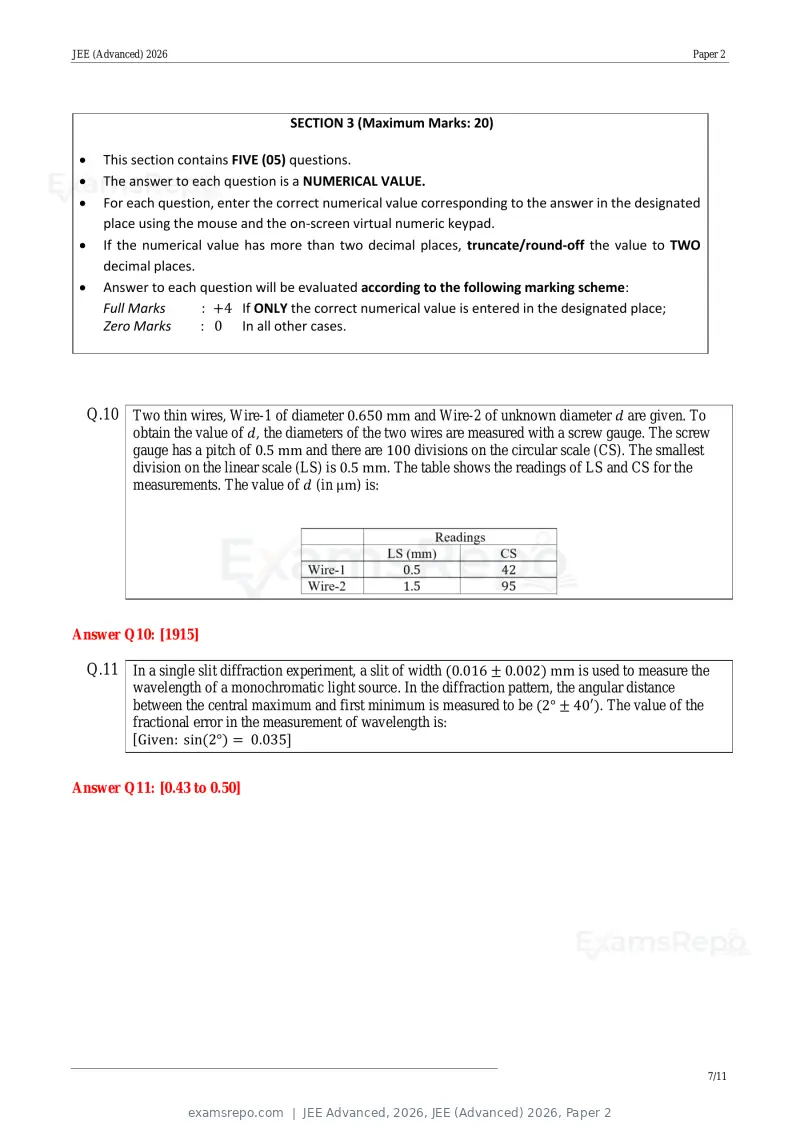
Q.10 Two thin wires, Wire-1 of diameter 0.650 mm and Wire-2 of unknown diameter d are given. To
obtain the value of d, the diameters of the two wires are measured with a screw gauge. The screw
gauge has a pitch of 0.5 mm and there are 100 divisions on the circular scale (CS). The smallest
division on the linear scale (LS) is 0.5 mm. The table shows the readings of LS and CS for the
measurements. The value of d (in µm) is:
Answer Q10: [1915]
Q.11 In a single slit diffraction experiment, a slit of width (0.016 ± 0.002) mm is used to measure the
wavelength of a monochromatic light source. In the diffraction pattern, the angular distance
between the central maximum and first minimum is measured to be (2° ± 40′). The value of the
fractional error in the measurement of wavelength is:
[Given: sin(2°) = 0.035]
Answer Q11: [0.43 to 0.50]
7/11
Text of page 17
JEE (Advanced) 2026                                                                                             Paper 2

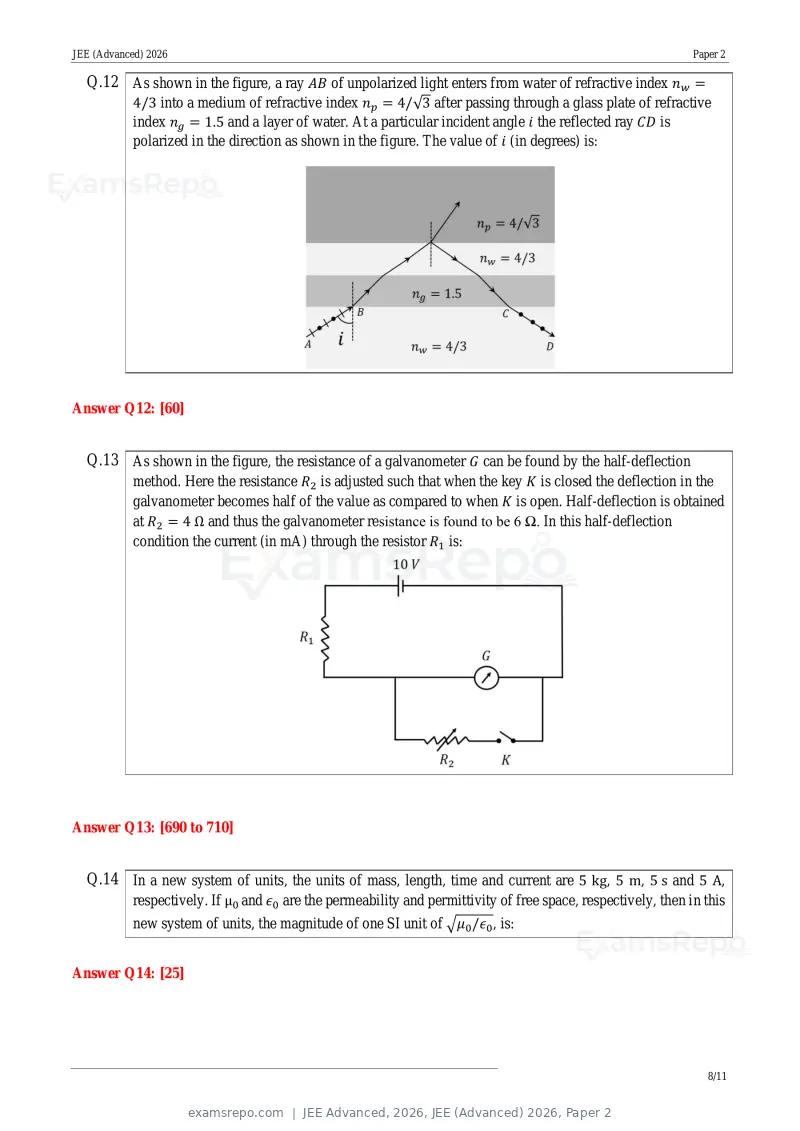
  Q.12 As shown in the figure, a ray AB of unpolarized light enters from water of refractive index nw =
            4/3 into a medium of refractive index np = 4/√3 after passing through a glass plate of refractive
            index ng = 1.5 and a layer of water. At a particular incident angle i the reflected ray CD is
            polarized in the direction as shown in the figure. The value of i (in degrees) is:


Answer Q12: [60]


  Q.13 As shown in the figure, the resistance of a galvanometer G can be found by the half-deflection
            method. Here the resistance R2 is adjusted such that when the key K is closed the deflection in the
            galvanometer becomes half of the value as compared to when K is open. Half-deflection is obtained
            at R2 = 4 Ω and thus the galvanometer resistance is found to be 6 Ω. In this half-deflection
            condition the current (in mA) through the resistor R1 is:


Answer Q13: [690 to 710]


  Q.14 In a new system of units, the units of mass, length, time and current are 5 kg, 5 m, 5 s and 5 A,
            respectively. If μ0 and ε0 are the permeability and permittivity of free space, respectively, then in this
            new system of units, the magnitude of one SI unit of √μ0 /ε0 , is:


Answer Q14: [25]


                                                                                                                   8/11

Text of page 18
JEE (Advanced) 2026 Paper 2
SECTION 4 (Maximum Marks: 8)
This section contains TWO (02) question stems.
There are TWO (02) questions corresponding to each question stem.
The answer to each question is a NUMERICAL VALUE.
For each question, enter the correct numerical value corresponding to the answer in the
designated place using the mouse and the on-screen virtual numeric keypad.
If the numerical value has more than two decimal places, truncate/round-off the value to TWO
decimal places.
Answer to each question will be evaluated according to the following marking scheme:
Full Marks : +2 If ONLY the correct numerical value is entered at the designated place;
Zero Marks : 0 In all other cases.
9/11
Text of page 19
JEE (Advanced) 2026                                                                                        Paper 2

                                  Question Stem for Question Nos. 15 and 16

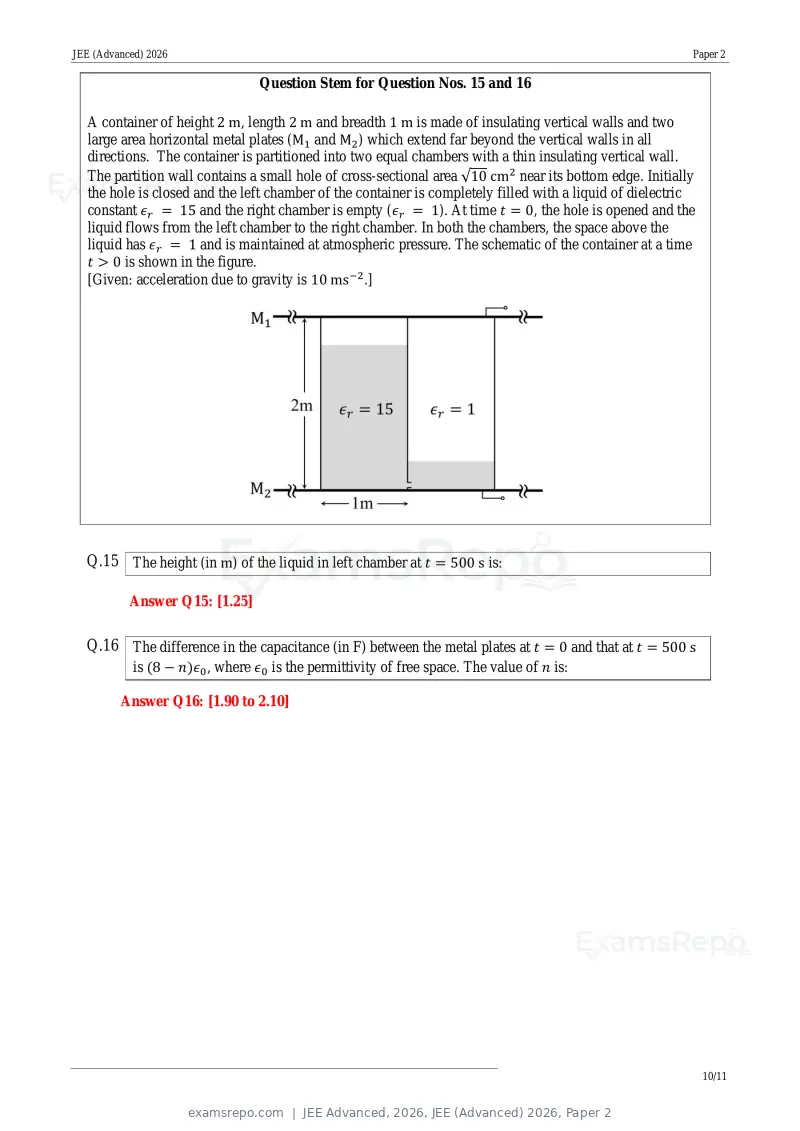
   A container of height 2 m, length 2 m and breadth 1 m is made of insulating vertical walls and two
   large area horizontal metal plates (M1 and M2 ) which extend far beyond the vertical walls in all
   directions. The container is partitioned into two equal chambers with a thin insulating vertical wall.
   The partition wall contains a small hole of cross-sectional area √10 cm2 near its bottom edge. Initially
   the hole is closed and the left chamber of the container is completely filled with a liquid of dielectric
   constant εr = 15 and the right chamber is empty (εr = 1). At time t = 0, the hole is opened and the
   liquid flows from the left chamber to the right chamber. In both the chambers, the space above the
   liquid has εr = 1 and is maintained at atmospheric pressure. The schematic of the container at a time
   t > 0 is shown in the figure.
   [Given: acceleration due to gravity is 10 ms−2 .]


  Q.15 The height (in m) of the liquid in left chamber at t = 500 s is:

           Answer Q15: [1.25]


  Q.16 The difference in the capacitance (in F) between the metal plates at t = 0 and that at t = 500 s
            is (8 − n)ε0 , where ε0 is the permittivity of free space. The value of n is:

         Answer Q16: [1.90 to 2.10]


                                                                                                               10/11

Text of page 20
JEE (Advanced) 2026                                                                                         Paper 2


                                Question Stem for Question Nos. 17 and 18

   A uniform circular disk of radius 0.2 m and mass 1 kg is pivoted at its top point C such that it can
   rotate freely around C in the XY plane, as shown in the figure. Initially, when the disk is at rest, a
   particle of mass 20 g, travelling along negative x direction in the XY plane with speed 100 ms−1,
   hits the circumference of the disk at a point P. After collision the particle moves along negative y
   direction at a speed of 90 ms −1.
   [Given: the acceleration due to gravity (g) = − 10 ĵ ms−2]


  Q.17 After the collision the disk starts to rotate around point C in the XY plane. The maximum change in
            the height (in m) of its center O is:

Answer Q17: [0.14 to 0.16]


  Q.18 Amount of energy loss (in J) in the collision is:

Answer Q18: [17 to 18]


                                                                                                              11/11
Text of page 21
JEE (Advanced) 2026 Paper 2
SECTION 1 (Maximum Marks: 12)
This section contains FOUR (04) questions.
Each question has FOUR options (A), (B), (C) and (D). ONLY ONE of these four options is the correct
answer.
For each question, choose the option corresponding to the correct answer.
Answer to each question will be evaluated according to the following marking scheme:
Full Marks : +3 If ONLY the correct option is chosen;
Zero Marks : 0 If none of the options is chosen (i.e. the question is unanswered);
Negative Marks : −1 In all other cases.
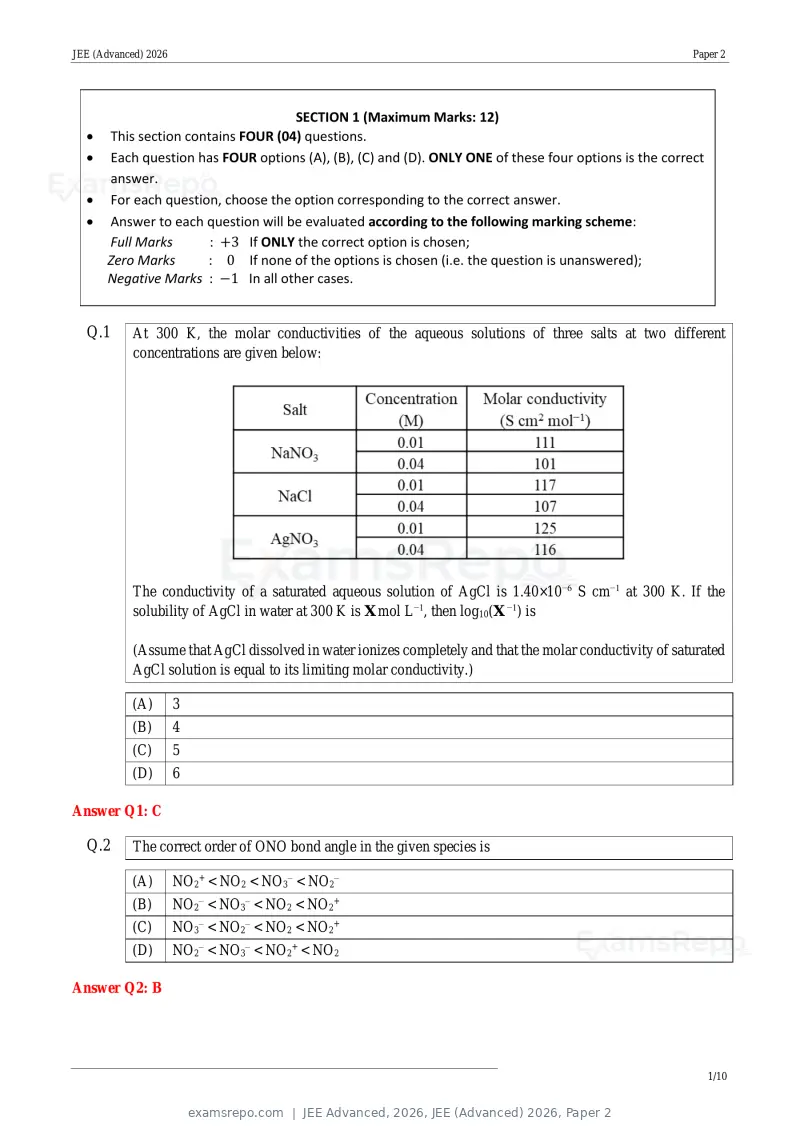
Q.1 At 300 K, the molar conductivities of the aqueous solutions of three salts at two different
concentrations are given below:
The conductivity of a saturated aqueous solution of AgCl is 1.40×10⁻⁶ S cm−1 at 300 K. If the
solubility of AgCl in water at 300 K is X mol L−1, then log10(X −1) is
(Assume that AgCl dissolved in water ionizes completely and that the molar conductivity of saturated
AgCl solution is equal to its limiting molar conductivity.)
(A) 3
(B) 4
(C) 5
(D) 6
Answer Q1: C
Q.2 The correct order of ONO bond angle in the given species is
(A) NO2+ < NO2 < NO3– < NO2–
(B) NO2– < NO3– < NO2 < NO2+
(C) NO3– < NO2– < NO2 < NO2+
(D) NO2– < NO3– < NO2+ < NO2
Answer Q2: B
1/10
Text of page 22
JEE (Advanced) 2026                                                                                     Paper 2

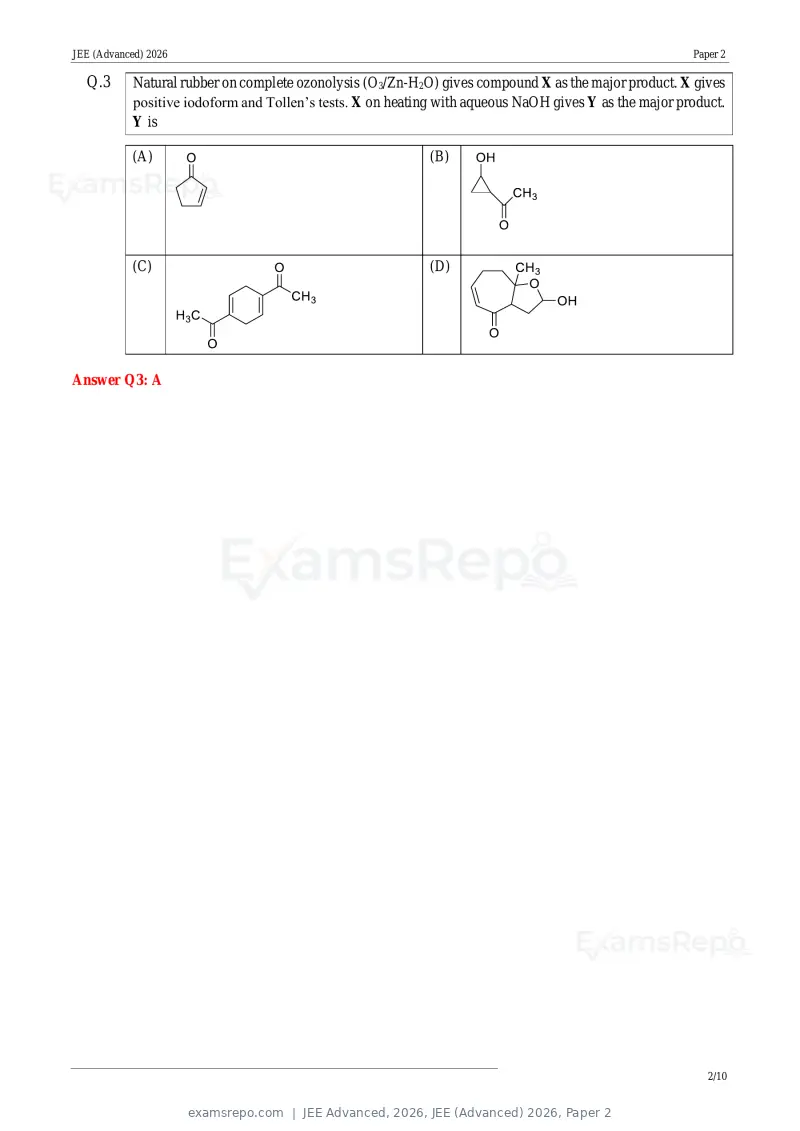
  Q.3       Natural rubber on complete ozonolysis (O3/Zn-H2O) gives compound X as the major product. X gives
            positive iodoform and Tollen’s tests. X on heating with aqueous NaOH gives Y as the major product.
            Y is

            (A)                                              (B)


            (C)                                              (D)


Answer Q3: A


                                                                                                           2/10
Text of page 23
JEE (Advanced) 2026                                                                                    Paper 2

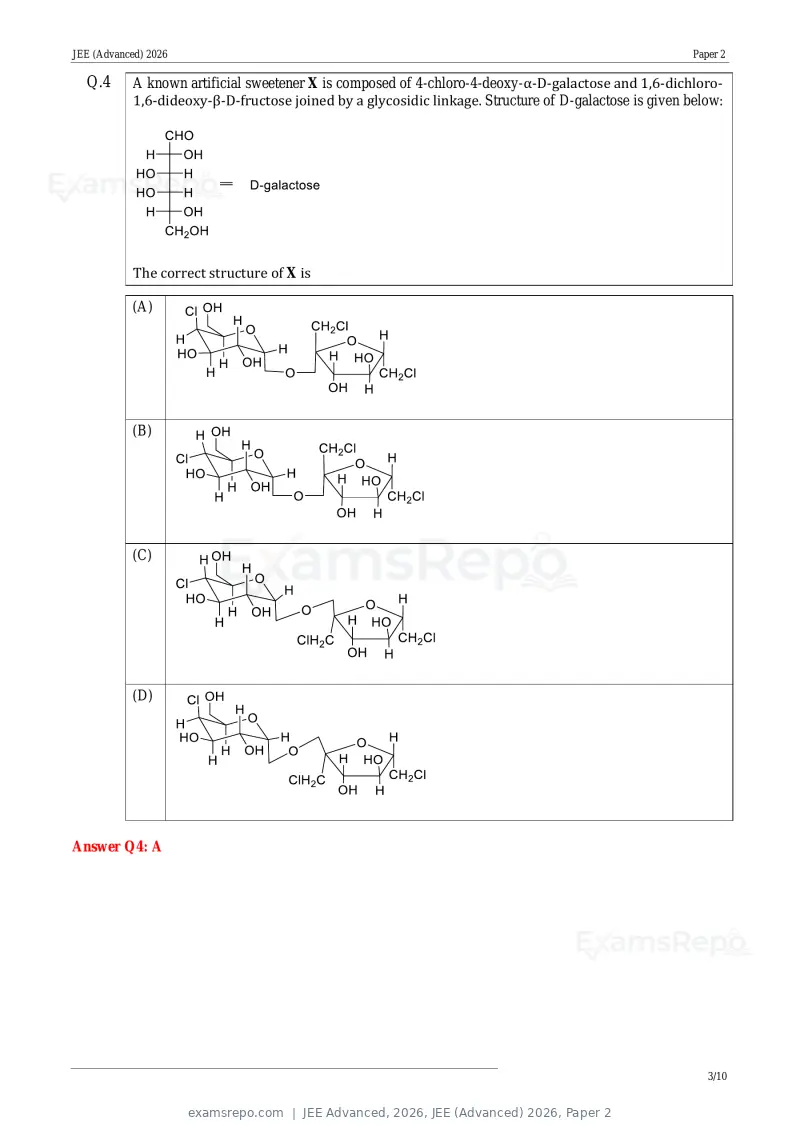
  Q.4       A known artificial sweetener X is composed of 4-chloro-4-deoxy-α-D-galactose and 1,6-dichloro-
            1,6-dideoxy-β-D-fructose joined by a glycosidic linkage. Structure of D-galactose is given below:


            The correct structure of X is

            (A)


            (B)


            (C)


            (D)


Answer Q4: A


                                                                                                          3/10

Text of page 24
JEE (Advanced) 2026 Paper 2
SECTION 2 (Maximum Marks: 20)
This section contains FIVE (05) questions.
Each question has FOUR options (A), (B), (C) and (D). ONE OR MORE THAN ONE of these four
option(s) is(are) correct answer(s).
For each question, choose the option(s) corresponding to (all) the correct answer(s).
Answer to each question will be evaluated according to the following marking scheme:
Full Marks : +4 ONLY if (all) the correct option(s) is(are) chosen;
Partial Marks : +3 If all the four options are correct but ONLY three options are chosen;
Partial Marks : +2 If three or more options are correct but ONLY two options are chosen, both of
which are correct;
Partial Marks : +1 If two or more options are correct but ONLY one option is chosen and it is a
correct option;
Zero Marks : 0 If none of the options is chosen (i.e. the question is unanswered);
Negative Marks : −1 In all other cases.
For example, in a question, if (A), (B) and (D) are the ONLY three options corresponding to correct
answers, then
choosing ONLY (A), (B) and (D) will get +4 marks;
choosing ONLY (A) and (B) will get +2 marks;
choosing ONLY (A) and (D) will get +2 marks;
choosing ONLY (B) and (D) will get +2 marks;
choosing ONLY (A) will get +1 mark;
choosing ONLY (B) will get +1 mark;
choosing ONLY (D) will get +1 mark;
choosing no option (i.e. the question is unanswered) will get 0 marks; and
choosing any other combination of options will get −1 marks.
4/10
Text of page 25
JEE (Advanced) 2026                                                                                         Paper 2

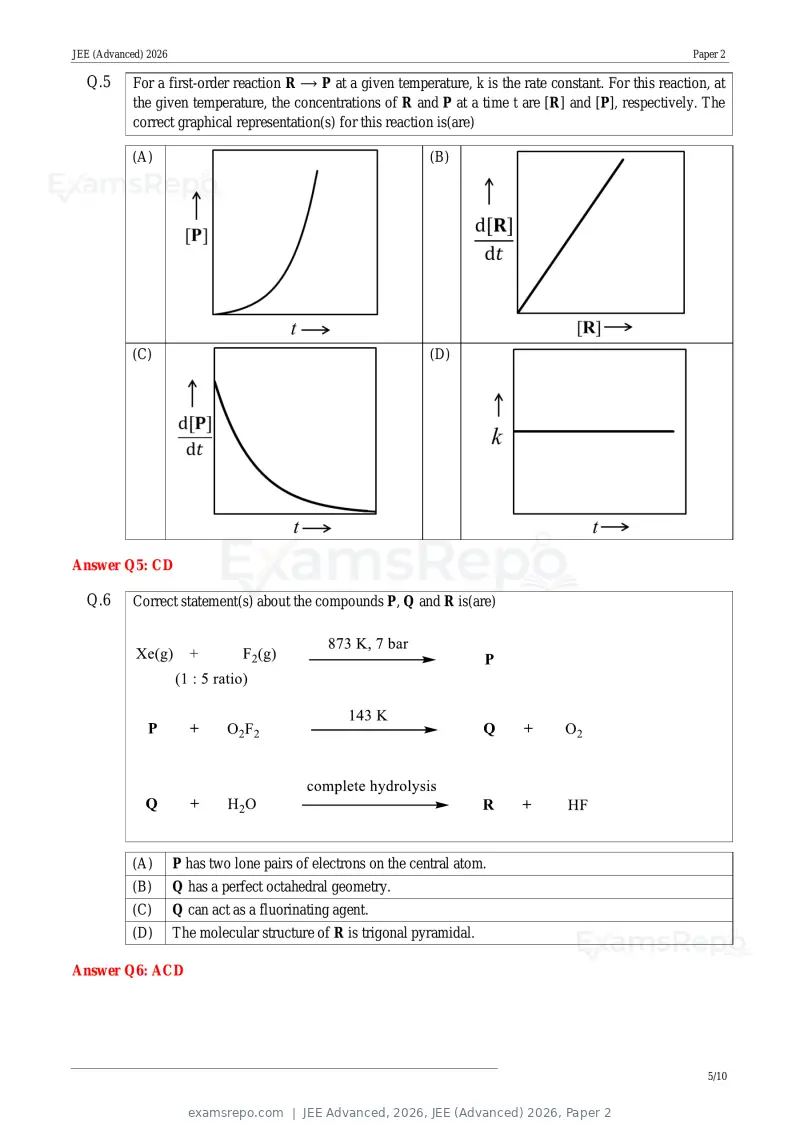
  Q.5       For a first-order reaction R ⟶ P at a given temperature, k is the rate constant. For this reaction, at
            the given temperature, the concentrations of R and P at a time t are [R] and [P], respectively. The
            correct graphical representation(s) for this reaction is(are)

            (A)                                                   (B)


            (C)                                                   (D)


Answer Q5: CD

  Q.6       Correct statement(s) about the compounds P, Q and R is(are)


            (A)       P has two lone pairs of electrons on the central atom.
            (B)       Q has a perfect octahedral geometry.
            (C)       Q can act as a fluorinating agent.
            (D)       The molecular structure of R is trigonal pyramidal.

Answer Q6: ACD


                                                                                                               5/10
Text of page 26
JEE (Advanced) 2026 Paper 2
Q.7 The correct statement(s) regarding the periodic properties of elements is(are)
(A) Second ionization enthalpy of carbon atom is less than that of boron atom.
(B) Increasing order of ionic radii: Al3+ < Mg2+ < Na+
(C) Under identical conditions, in solid state, the density of potassium metal is more than density
of sodium metal.
(D) The H–H bond is weaker than F–F bond.
Answer Q7: AB
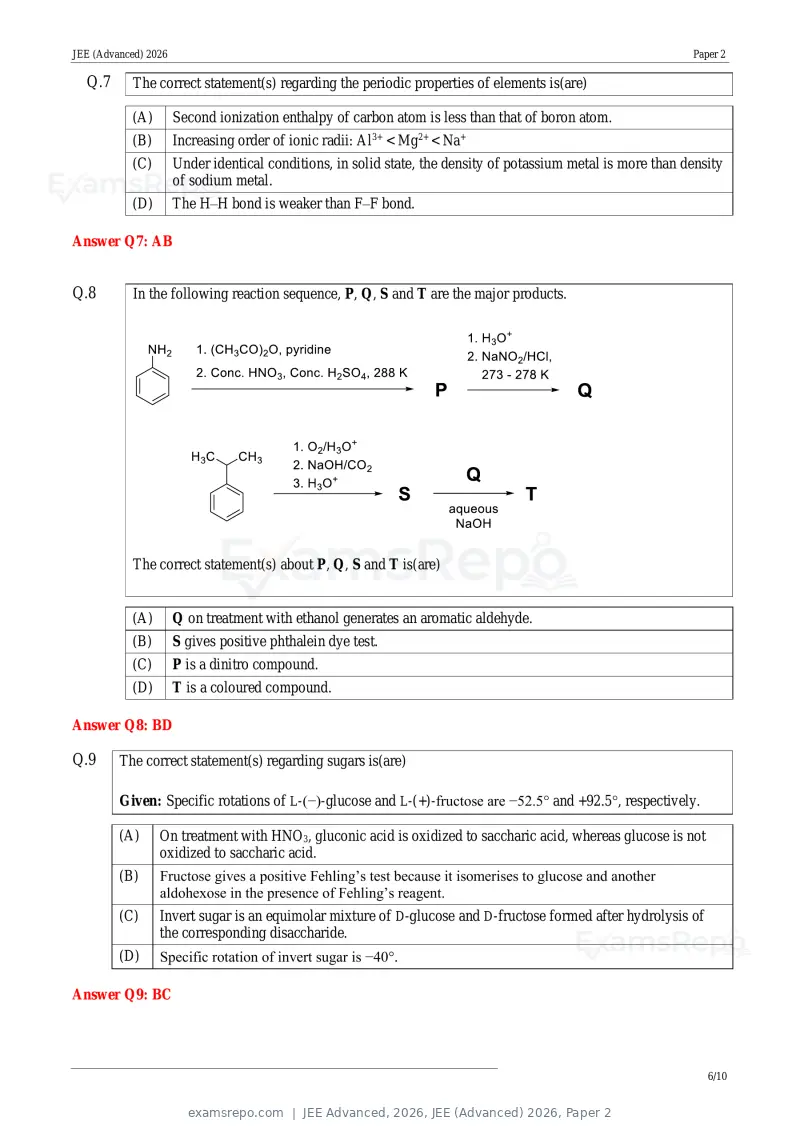
Q.8 In the following reaction sequence, P, Q, S and T are the major products.
The correct statement(s) about P, Q, S and T is(are)
(A) Q on treatment with ethanol generates an aromatic aldehyde.
(B) S gives positive phthalein dye test.
(C) P is a dinitro compound.
(D) T is a coloured compound.
Answer Q8: BD
Q.9 The correct statement(s) regarding sugars is(are)
Given: Specific rotations of L-(−)-glucose and L-(+)-fructose are −52.5 and +92.5, respectively.
(A) On treatment with HNO3, gluconic acid is oxidized to saccharic acid, whereas glucose is not
oxidized to saccharic acid.
(B) Fructose gives a positive Fehling’s test because it isomerises to glucose and another
aldohexose in the presence of Fehling’s reagent.
(C) Invert sugar is an equimolar mixture of D-glucose and D-fructose formed after hydrolysis of
the corresponding disaccharide.
(D) Specific rotation of invert sugar is −40.
Answer Q9: BC
6/10
Text of page 27
JEE (Advanced) 2026 Paper 2
SECTION 3 (Maximum Marks: 20)
This section contains FIVE (05) questions.
The answer to each question is a NUMERICAL VALUE.
For each question, enter the correct numerical value corresponding to the answer in the
designated place using the mouse and the on-screen virtual numeric keypad.
If the numerical value has more than two decimal places, truncate/round-off the value to TWO
decimal places.
Answer to each question will be evaluated according to the following marking scheme:
Full Marks : +4 If ONLY the correct numerical value is entered in the designated place;
Zero Marks : 0 In all other cases.
Q.10 Xa+ and Yb+ are hydrogen-like species. The wavelength of light absorbed during the transition
between the states with principal quantum numbers n = 1 and n = 2 of Xa+ is λ. The wavelength of
light absorbed during the transition between the states with principal quantum numbers n = 2 and
n = 4 of Yb+ is 9λ. The lowest possible value of (a+b) is ____.
Answer Q10: [3]
Q.11 At a given temperature, 0.45 g of acetic acid in 50 mL of water is shaken with 1.0 g of charcoal and
the pH of the resulting solution is 3.0. Assume, the adsorption of acetic acid from the aqueous solution
by charcoal follows Freundlich isotherm,
x
= kC 1/n
m
If the plot of log10(x/m) against log10C gives a straight line with slope 1, the value of k in
L mol−1 is ____.
Given: The molar mass of acetic acid is 60 g mol−1.
The acid dissociation constant of acetic acid is 1.0×10⁻⁵ at the given temperature.
x is the mass (in grams) of acetic acid adsorbed.
m is the mass (in grams) of charcoal.
C is the equilibrium concentration of acetic acid in the solution after the adsorption is complete.
k and n are constants for acetic acid–charcoal system at the given temperature.
Answer Q11: [1.45 to 1.52]
7/10
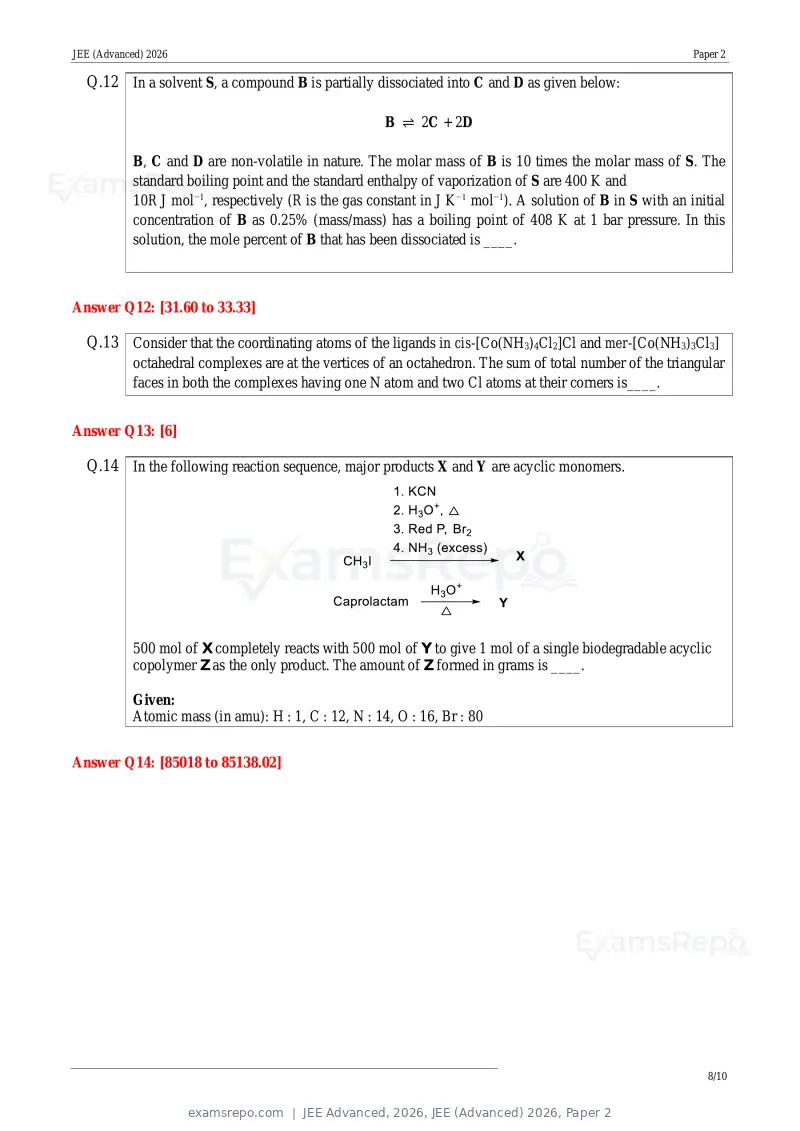
Text of page 28
JEE (Advanced) 2026                                                                                         Paper 2

  Q.12 In a solvent S, a compound B is partially dissociated into C and D as given below:

                                                       B ⇌ 2C + 2D

            B, C and D are non-volatile in nature. The molar mass of B is 10 times the molar mass of S. The
            standard boiling point and the standard enthalpy of vaporization of S are 400 K and
            10R J mol−1, respectively (R is the gas constant in J K−1 mol−1). A solution of B in S with an initial
            concentration of B as 0.25% (mass/mass) has a boiling point of 408 K at 1 bar pressure. In this
            solution, the mole percent of B that has been dissociated is ____.


Answer Q12: [31.60 to 33.33]

  Q.13 Consider that the coordinating atoms of the ligands in cis-[Co(NH3)4Cl2]Cl and mer-[Co(NH3)3Cl3]
            octahedral complexes are at the vertices of an octahedron. The sum of total number of the triangular
            faces in both the complexes having one N atom and two Cl atoms at their corners is____.


Answer Q13: [6]

  Q.14 In the following reaction sequence, major products X and Y are acyclic monomers.


            500 mol of X completely reacts with 500 mol of Y to give 1 mol of a single biodegradable acyclic
            copolymer Z as the only product. The amount of Z formed in grams is ____.

            Given:
            Atomic mass (in amu): H : 1, C : 12, N : 14, O : 16, Br : 80


Answer Q14: [85018 to 85138.02]


                                                                                                               8/10
Text of page 29
JEE (Advanced) 2026 Paper 2
SECTION 4 (Maximum Marks: 8)
This section contains TWO (02) question stems.
This section contains TWO (02) questions corresponding to each question stem.
The answer to each question is a NUMERICAL VALUE.
For each question, enter the correct numerical value corresponding to the answer in the
designated place using the mouse and the on-screen virtual numeric keypad.
If the numerical value has more than two decimal places, truncate/round-off the value to TWO
decimal places.
Answer to each question will be evaluated according to the following marking scheme:
Full Marks : +2 If ONLY the correct numerical value is entered in the designated place;
Zero Marks : 0 In all other cases.
Question Stem for Question Nos. 15 and 16
Two volatile liquids A and B form an ideal solution. Consider a 5 molal solution of B in A inside a closed
container having a total vapour pressure of 100 mm Hg at 300 K. The vapour pressure of pure A at 300K
is 105 mm Hg. Assume that A and B behave as ideal gases in the vapour phase.
Given:
The gas constant R = 0.08 L atm K−1 mol−1
Molar mass of A is 50 g mol−1
Molar mass of B is 57 g mol−1
Density of liquid B at 300 K is 0.5 g/mL
1 atm = 760 mm Hg
Q.15 At 300 K, the ratio of the molar volume of pure B in vapour phase to its molar volume in liquid
phase is ____.
Answer Q15: [1991 to 2053]
Q.16 The mole fraction of B in vapour phase which is in equilibrium with this solution is ____.
Answer Q16: [0.16]
9/10
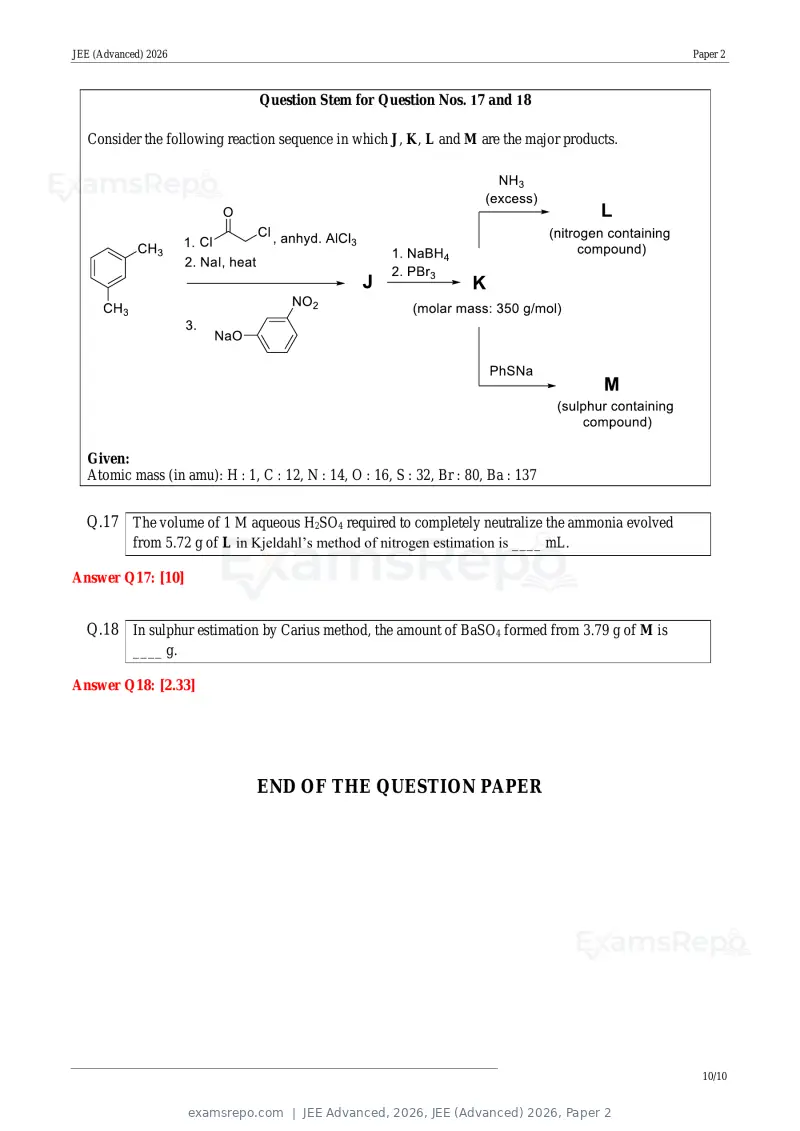
Text of page 30
JEE (Advanced) 2026                                                                             Paper 2


                                Question Stem for Question Nos. 17 and 18

   Consider the following reaction sequence in which J, K, L and M are the major products.


   Given:
   Atomic mass (in amu): H : 1, C : 12, N : 14, O : 16, S : 32, Br : 80, Ba : 137


  Q.17 The volume of 1 M aqueous H2SO4 required to completely neutralize the ammonia evolved
            from 5.72 g of L in Kjeldahl’s method of nitrogen estimation is ____ mL.

Answer Q17: [10]


  Q.18 In sulphur estimation by Carius method, the amount of BaSO4 formed from 3.79 g of M is
            ____ g.

Answer Q18: [2.33]


                                END OF THE QUESTION PAPER


                                                                                                  10/10
Page 1 of 29
Source: Organising IIT for the year. Question paper published by Organising IIT for the year.