
Machine-translated by Google. Questions are authored in English.
Top

Crystal Structures and Imperfections Questions and Answers

1.

In a BCC (Body-Centered Cubic) unit cell of a crystalline material, how many atoms are present at the corners and within the unit cell respectively?

Exam Year(s)

DSSSB - 2023,

Answer: A

A body-centred cubic unit cell has 8 atoms at the corners, each shared among 8 cells, and 1 atom in the centre of the cell, within it. The effective number of atoms per cell is \[ 8\times\frac{1}{8} + 1 = 2 \] The other options give wrong numbers of corner and centre atoms, and 4 at the corners with 1 within does not describe BCC.

Please log in or register to report this question.
2.

The number of atoms per unit cell and the number of slip systems, respectively, for a face-centered cubic (FCC) crystal are

Exam Year(s)

GATE ME - 2018,

Answer: C

An FCC crystal has 4 atoms per unit cell and 12 slip systems.

Atoms per cell: 8 corner atoms each shared by 8 cells give 1, and 6 face-centred atoms each shared by 2 cells give 3, a total of 4.

Slip in FCC occurs on the close-packed {111} planes in the close-packed 110-type directions. There are 4 distinct {111} planes, each with 3 slip directions, giving 4 × 3 = 12 slip systems.

3 atoms forgets the corners. 48 slip systems is the figure sometimes quoted for BCC when the {110}, {211} and {321} planes are all counted, not for FCC.

Please log in or register to report this question.
3.

Minimum symmetry that a cubic crystal must possess is

Exam Year(s)

GATE XE - 2018,

Answer: A

A cubic crystal must have four 3-fold rotation axes.

The defining symmetry of the cubic system is four three-fold axes along the body diagonals of the cube. Every cubic point group, including the lowest one (23, tetrahedral rotations only), has them.

Three 4-fold axes are present only in the higher cubic classes (432 and m3m), not in all, so they are not the minimum. Three orthogonal mirror planes or a centre of symmetry are likewise absent from some cubic classes (for example 23 has neither), and many non-cubic crystals have them.

Please log in or register to report this question.
Answer: A

A screw dislocation has its dislocation line and Burgers vector parallel.

In a screw dislocation the atomic planes form a helical ramp around the line, and the slip displacement (the Burgers vector) runs along the line itself. In an edge dislocation, by contrast, the Burgers vector is perpendicular to the line.

The other statements describe an edge dislocation: it moves parallel to its Burgers vector, the atoms are displaced in the direction the line moves, and because line and Burgers vector are not parallel they define a unique slip plane. A screw dislocation moves perpendicular to its Burgers vector and has no unique slip plane, which is why it can cross-slip.

Please log in or register to report this question.

5.

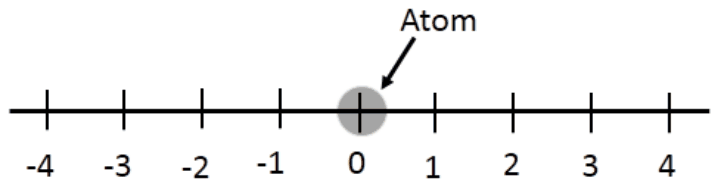
An atom is restricted to move in one dimension by making unit jumps either to the left or right, as shown in the figure. Assuming that a jump to the left or right is equally probable, the probability of the atom returning back to the starting point after four jumps is

A number line marked from -4 to 4 with the atom sitting at 0

Exam Year(s)

GATE XE - 2018,

Answer: C

The probability is 0.375.

Four jumps of +1 or -1, each equally likely, give \(2^{4} = 16\) equally likely sequences. To return to 0 the atom needs two jumps right and two left, in any order:

\[ P = \frac{\binom{4}{2}}{2^{4}} = \frac{6}{16} = 0.375 \]

0.250 (4 of 16) and 0.500 (8 of 16) miscount the six favourable orderings, and 0.333 cannot arise at all, since every probability here is a whole number of sixteenths.

Please log in or register to report this question.

6.

Number of atoms per unit area of the (110) plane of a body centered cubic crystal, with lattice parameter ‘\(a\)’, is

Exam Year(s)

GATE XE - 2022,

Answer: B

The planar density is \(\frac{\sqrt{2}}{a^{2}}\).

Within one unit cell the (110) plane is a rectangle a wide and \(a\sqrt{2}\) long, the face diagonal. It contains the four corner atoms, each shared by four such rectangles, and the body-centre atom, which lies in the plane:

\[ \begin{aligned} n &= 4 \times \frac{1}{4} + 1 = 2 \\ \frac{n}{\text{area}} &= \frac{2}{\sqrt{2}a^{2}} = \frac{\sqrt{2}}{a^{2}} \end{aligned} \]

\(1/a^{2}\) counts the atoms of a (100) face. \(1/(\sqrt{2}a^{2})\) forgets the body-centre atom, and \(1/(\sqrt{3}a^{2})\) is the density of the BCC (111) plane.

Please log in or register to report this question.

7.

Aliovalent doping of \(MgCl_{2}\) in \(NaCl\) leads to the formation of defects. Which one of the following is the correct defect reaction?

Exam Year(s)

GATE XE - 2023,

Answer: B

The correct defect reaction is \(Mg_{Na}^{\bullet} + Cl_{Cl} + V_{Na}' = \emptyset\).

In Kroger-Vink notation the subscript is the site and the superscript the charge relative to the perfect lattice (\(\bullet\) positive, \('\) negative). \(Mg^{2+}\) replaces \(Na^{+}\) on a sodium site, so it carries one extra positive charge, \(Mg_{Na}^{\bullet}\). The second chloride ion of \(MgCl_{2}\) occupies a normal chlorine site, \(Cl_{Cl}\), and to keep the lattice neutral and the site ratio right one sodium site is left vacant, a vacancy with effective negative charge, \(V_{Na}'\).

The other options fail on site or charge. Mg on a Cl site is a cation on an anion site. Writing \(Mg_{Na}\) with no charge ignores the valence difference that makes the doping aliovalent. \(Mg_{Na}'\) with \(V_{Na}^{\bullet}\) gives both defects the wrong sign.

Please log in or register to report this question.

8.

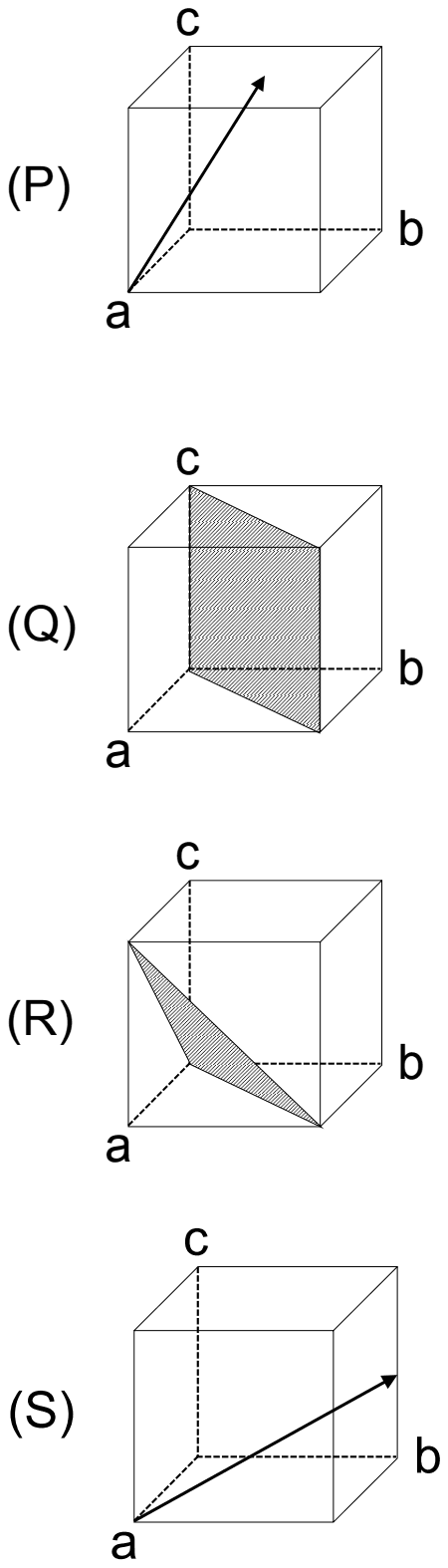
Match the lattice planes and directions (in Column I) with the corresponding Miller indices (in Column II):

Column I:

Four unit cubes, axes a, b, c from the back lower left corner. P: arrow from the end of a to the top-face centre. Q: plane through the c axis and the base diagonal. R: triangle through the origin and two corners of the front face. S: arrow from the end of a to the middle of the back right edge

Column II:
1. \((\bar{1}11)\)
2. \([\bar{1}12]\)
3. \([\bar{2}21]\)
4. \((\bar{1}10)\)

Exam Year(s)

GATE XE - 2023,

Answer: A

The correct match is P-2, Q-4, R-1, S-3.

Take the origin at the back lower left corner, where the three dashed axes meet, with \(a\), \(b\), \(c\) along the cube edges. A direction is the difference between its end and start points, cleared to integers; a plane's Miller indices are the reciprocals of its intercepts, or equivalently its normal.

  • P: from (1, 0, 0) to the top-face centre \((\tfrac{1}{2}, \tfrac{1}{2}, 1)\): \((-\tfrac{1}{2}, \tfrac{1}{2}, 1)\), i.e. \([\bar{1}12]\) (2).
  • Q: the plane contains the \(c\) axis and the [110] diagonal of the base, so its normal is \([\bar{1}10]\) and the plane is \((\bar{1}10)\) (4).
  • R: the triangle through (0, 0, 0), (1, 0, 1) and (1, 1, 0) has normal \((1,0,1) \times (1,1,0) = (-1, 1, 1)\): \((\bar{1}11)\) (1).
  • S: from (1, 0, 0) to \((0, 1, \tfrac{1}{2})\): \((-1, 1, \tfrac{1}{2})\), i.e. \([\bar{2}21]\) (3).

A useful first filter: P and S are arrows, so they must take the square-bracket directions 2 and 3, while the shaded Q and R take the round-bracket planes 1 and 4. Only P-2, Q-4, R-1, S-3 and P-3, Q-1, R-4, S-2 respect that, and the working above picks the first. The other two options pair a plane with a direction.

Please log in or register to report this question.

9.

Which one of the following unit cell parameters represents a tetragonal crystal system?

Exam Year(s)

GATE XE - 2024,

Answer: D

The tetragonal system has a = b ≠ c ; α = β = γ = 90.

A tetragonal cell is a cube stretched or squashed along one axis: two equal edges, a third of different length, and all three angles 90 degrees.

a = b = c with all angles equal but not 90 degrees is rhombohedral (trigonal). a ≠ b ≠ c with all angles 90 degrees is orthorhombic. a = b ≠ c with α = β = 90 and γ = 120 degrees is hexagonal.

Please log in or register to report this question.

10.

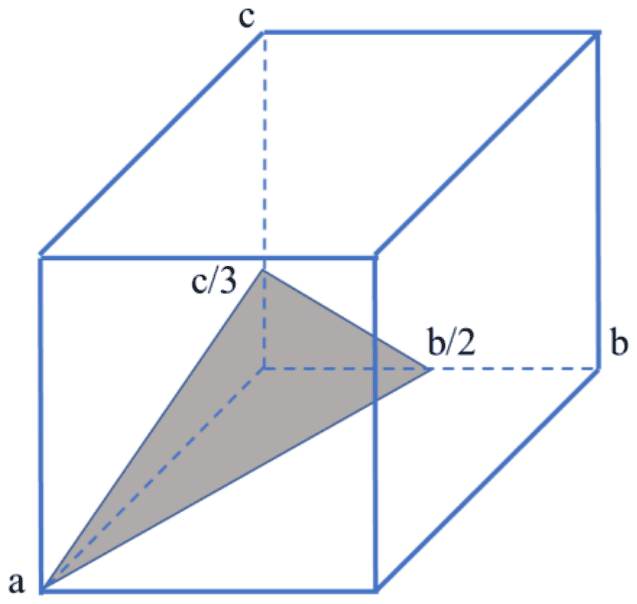
The Miller indices for the shaded plane shown in the unit cell below is

Cubic unit cell with axes a, b, c; the shaded triangular plane meets the a axis at a, the b axis at b/2 and the c axis at c/3

Exam Year(s)

GATE XE - 2024,

Answer: D

The Miller indices are (123).

The plane cuts the three axes at a, b/2 and c/3, that is at fractional intercepts 1, 1/2 and 1/3. The Miller indices are the reciprocals, cleared of fractions:

\(\left(\tfrac{1}{1}, \tfrac{1}{1/2}, \tfrac{1}{1/3}\right) = (1, 2, 3)\)

A plane is written in round brackets, (hkl); square brackets [uvw] denote a direction, so [123] and [632] are the wrong notation. (632) comes from taking the intercepts 1, 1/2, 1/3 and multiplying by 6 instead of inverting them.

Please log in or register to report this question.

Loading…
Tags: Crystal Structures and Imperfections Questions and Answers || Crystal Structures and Imperfections MCQ Questions and Answers || Crystal Structures and Imperfections GK Questions and Answers || Crystal Structures and Imperfections GK MCQ Questions || Crystal Structures and Imperfections Multiple Choice Questions and Answers || Crystal Structures and Imperfections GK || GK on Crystal Structures and Imperfections || Materials Science Questions and Answers || Materials Science MCQ Questions and Answers || Materials Science GK Questions and Answers || GK on Materials Science