
Discussion
Match the lattice planes and directions (in Column I) with the corresponding Miller indices (in Column II):
Column I:
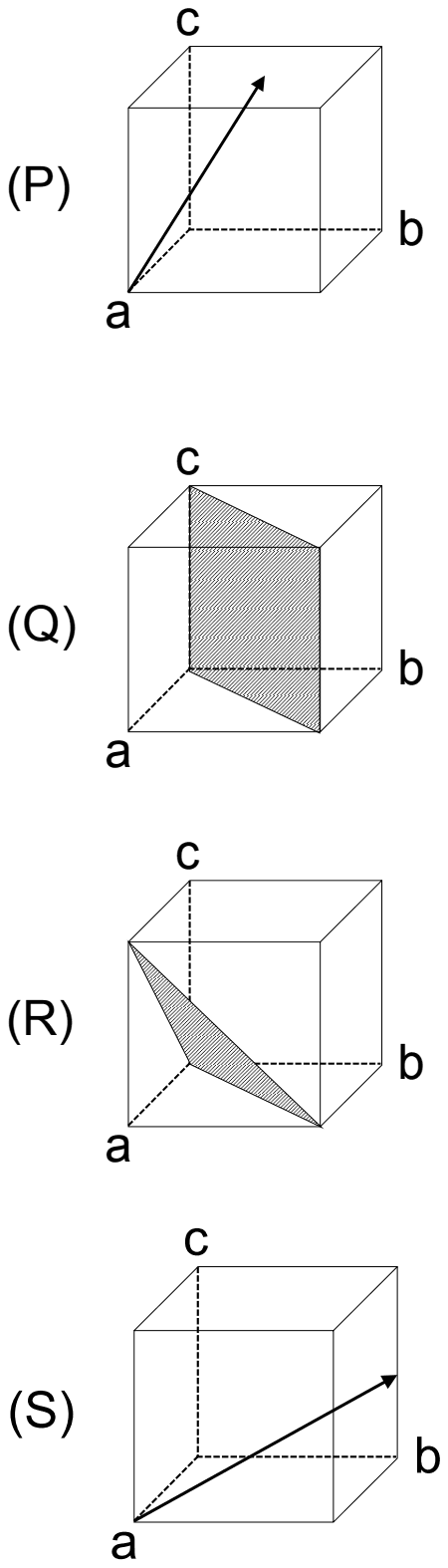
Column II:
1. \((\bar{1}11)\)
2. \([\bar{1}12]\)
3. \([\bar{2}21]\)
4. \((\bar{1}10)\)
Answer: A
The correct match is P-2, Q-4, R-1, S-3.
Take the origin at the back lower left corner, where the three dashed axes meet, with \(a\), \(b\), \(c\) along the cube edges. A direction is the difference between its end and start points, cleared to integers; a plane's Miller indices are the reciprocals of its intercepts, or equivalently its normal.
- P: from (1, 0, 0) to the top-face centre \((\tfrac{1}{2}, \tfrac{1}{2}, 1)\): \((-\tfrac{1}{2}, \tfrac{1}{2}, 1)\), i.e. \([\bar{1}12]\) (2).
- Q: the plane contains the \(c\) axis and the [110] diagonal of the base, so its normal is \([\bar{1}10]\) and the plane is \((\bar{1}10)\) (4).
- R: the triangle through (0, 0, 0), (1, 0, 1) and (1, 1, 0) has normal \((1,0,1) \times (1,1,0) = (-1, 1, 1)\): \((\bar{1}11)\) (1).
- S: from (1, 0, 0) to \((0, 1, \tfrac{1}{2})\): \((-1, 1, \tfrac{1}{2})\), i.e. \([\bar{2}21]\) (3).
A useful first filter: P and S are arrows, so they must take the square-bracket directions 2 and 3, while the shaded Q and R take the round-bracket planes 1 and 4. Only P-2, Q-4, R-1, S-3 and P-3, Q-1, R-4, S-2 respect that, and the working above picks the first. The other two options pair a plane with a direction.
Post your comment
Please log in or register to post a comment.
Examination Categories
- SSC Exams
- Banking Exams
- Teaching Exams
- Civil Services Exams
- Railways Exams
- Engineering Recruitment Exams
- Defence Exams
- State Government Exams
- Police Exams
- Insurance Exams
- Nursing Exams
- Other Government Exams
- NRA CET
- PG Entrance Exams
- Campus Placement
- MBA Entrance Exams
- CUET and UG Entrance
- Judiciary Exams
- Regulatory Body Exams
- Software Development