
Machine-translated by Google. Questions are authored in English.
Top

Fluid Dynamics and Bernoullis Equation Questions and Answers

11.

A steady incompressible laminar flow passes through a 90° tube bend placed on a horizontal surface. In horizontal diametric plane, two pressure taps \(P_{i}\) and \(P_{o}\) are provided across the cross-section at inner and outer walls of the bend, respectively. Which one of the following options is correct?

Exam Year(s)

GATE ME - 2026,

Answer: A

The correct option is \(P_{o} \gt P_{i}\).

Fluid going round a bend needs a net force towards the centre of curvature to supply its centripetal acceleration. That force comes from a pressure gradient across the section, with pressure rising outward: \(\partial p/\partial r = \rho V^{2}/r\). So the outer wall sees the higher pressure.

This makes \(P_{o} \lt P_{i}\) wrong. The difference grows roughly as \(\rho V^{2}/R\) times the tube width, so it is inversely, not directly, proportional to the bend radius, and it increases with velocity rather than being inversely proportional to it.

Please log in or register to report this question.
Answer: A

Bernoulli's equation cannot be applied between any two arbitrary points in the flow field for steady incompressible rotational flow.

For steady, incompressible, inviscid flow, the Bernoulli constant is the same along a streamline. Only if the flow is also irrotational is it the same throughout the field, so that any two points can be related.

The other three are valid uses: arbitrary points in irrotational flow, and two points on the same streamline, whether the flow is rotational or not.

Please log in or register to report this question.

13.

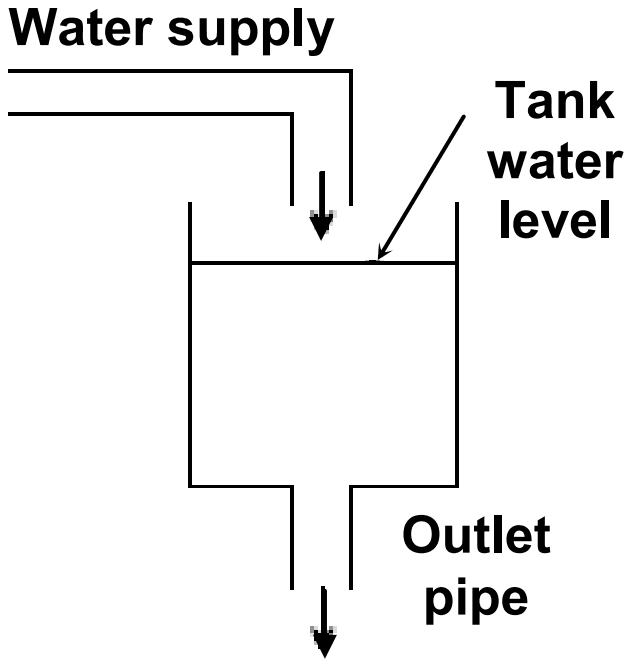
Water is supplied to a tank at the rate of 0.02 m3/s, as shown in the figure below. The cross-sectional area of the tank is 1 m2 and the inner diameter of the outlet pipe is 60 mm. At a time when the water level in the tank is increasing at the rate of 5 mm/s, the average velocity (in m/s) of water in the outlet pipe is approximately

Tank filled from above by a water supply pipe and drained by an outlet pipe at its base, with the tank water level marked

Exam Year(s)

GATE XE - 2012,

Answer: C

The outlet velocity is about 5.3 m/s.

Mass conservation: inflow equals outflow plus the rate of storage in the tank.

\[ \begin{aligned} Q_{out} &= 0.02 - (1)(0.005) = 0.015\ \text{m}^{3}\text{/s} \\ A_{pipe} &= \tfrac{\pi}{4}(0.06)^{2} = 2.827 \times 10^{-3}\ \text{m}^{2} \\ V &= \frac{0.015}{2.827 \times 10^{-3}} \approx 5.3\ \text{m/s} \end{aligned} \]

Ignoring the rising level and using the full 0.02 m3/s would give about 7.1 m/s, which is not offered. 0.005 is the rate of rise of the level itself, and 0.06 is the pipe diameter in metres, not a velocity.

Please log in or register to report this question.
14.

The water level in a gas-pressurized tank with a large cross-sectional area is maintained constant as shown in the figure below. The water level in the tank is 4.2 m above the pipe centerline as indicated in the figure. The gas pressure is 130 kPa. The atmospheric pressure, gravitational acceleration and density of water may be taken as 100 kPa, 10 m/s2 and 1000 kg/m3, respectively. Neglecting losses, the maximum velocity (in m/s) of water at any location in the horizontal portion of the delivery pipe for the pressure NOT to drop below atmospheric pressure, is

Closed tank with gas above the water, fed by a water supply pipe; a delivery pipe leaves the tank bottom and runs horizontally to an open end 4.2 m below the water level

Exam Year(s)

GATE XE - 2012,

Answer: D

The maximum velocity is 12 m/s.

Apply Bernoulli's equation from the free surface in the large tank (velocity negligible, pressure 130 kPa, 4.2 m above the pipe centerline) to a point in the horizontal pipe where the pressure is just atmospheric:

\[ \begin{aligned} p_{gas} + \rho g h &= p_{atm} + \tfrac{1}{2}\rho V^{2} \\ 130000 + 1000(10)(4.2) &= 100000 + 500V^{2} \\ 500V^{2} &= 72000 \Rightarrow V = 12\ \text{m/s} \end{aligned} \]

Any faster and the pressure would fall below atmospheric. 10 m/s ignores the 30 kPa of gas overpressure (\(\sqrt{2gh} \approx 9.2\)), and 4.2 is the head in metres, not a velocity.

Please log in or register to report this question.
15.

Let \(\vec{r}\), \(\vec{V}\), and \(m\) be position vector, velocity vector, and mass, respectively in a control mass system. Which one of the following properties is considered as conserved extensive property in Reynolds Transport Theorem to obtain the angular momentum equation?

Exam Year(s)

GATE XE - 2024,

Answer: A

The extensive property is the angular momentum \(\vec{r} \times m\vec{V}\).

The Reynolds Transport Theorem converts the rate of change of any extensive property B of a system into control-volume terms. Choosing \(B = \vec{r} \times m\vec{V}\), the moment of momentum, with its intensive form \(b = \vec{r} \times \vec{V}\), gives the angular momentum equation, whose system-level statement is that the net torque equals the rate of change of angular momentum.

\(\vec{r} \times \vec{V}\) is the intensive (per unit mass) form, not the extensive property. \(m\vec{V}\) gives the linear momentum equation and \(m\) gives continuity.

Please log in or register to report this question.

16.

Statement of Reynolds Transport Theorem is given below with three blanks.

The rate of change of ________ extensive property can be calculated by summing the rate of change of the amount of same property in the ________ and the rate at which the property is ________ the surface of the control volume.

Which one of the following options correctly fills the blanks by using its comma-separated phrases in sequence?

Exam Year(s)

GATE XE - 2025,

Answer: A

The blanks are system, control volume, exiting.

The Reynolds transport theorem links a system, a fixed collection of matter, to a control volume, a fixed region of space:

\[ \begin{aligned} \frac{dB_{sys}}{dt} &= \frac{d}{dt}\int_{CV} \rho b\,dV \\ &+ \int_{CS} \rho b\,(\vec{V} \cdot \vec{n})\,dA \end{aligned} \]

The left side is the rate of change of the system's extensive property; the first term on the right is the rate of change inside the control volume; the last term is the net rate at which the property leaves (exits) through the control surface, since \(\vec{n}\) points outward.

Swapping system and control volume reverses the theorem's meaning, and 'entering' would give the wrong sign for the flux term.

Please log in or register to report this question.

17.

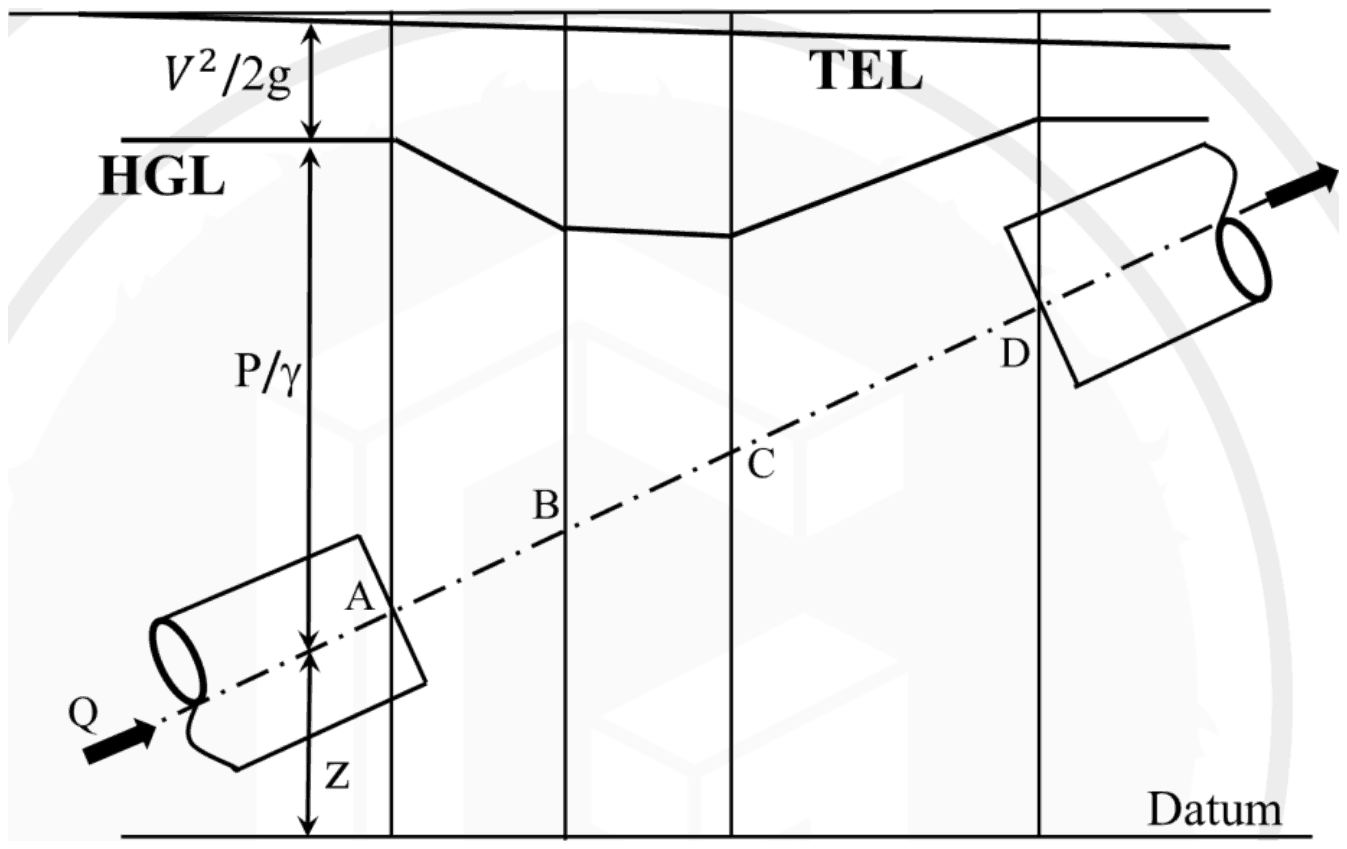
Figure shows the steady and incompressible flow of a fluid in the direction of arrow from section A to section D. Three pipe connectors are to be placed between sections at A and D having Total Energy Line (TEL) and Hydraulic Grade Line (HGL) as depicted in the figure. Consider, g, P, Q, \(V\), γ, and Z denote gravitational acceleration, pressure, volume flow rate, velocity, specific weight, and elevation of centerline of the pipe connectors from the datum, respectively.

An inclined pipe rising from section A through B and C to D, with a gently falling TEL above it; the HGL falls from A to B, stays nearly level from B to C and rises from C to D

Which one of the following options, in sequence, indicates the correct nature of connectors between sections A and B, B and C, and C and D in the direction of flow?

Exam Year(s)

GATE XE - 2025,

Answer: A

The connectors are converging, constant area, diverging.

The vertical gap between the TEL and the HGL is the velocity head \(V^{2}/2g\). The TEL falls only slightly (friction), so changes in that gap show how the velocity, and hence the area, changes.

  • A to B: the HGL drops away from the TEL, so the velocity head grows and the velocity rises: the pipe converges.
  • B to C: the HGL runs nearly parallel to the TEL, so the velocity head is constant: constant area.
  • C to D: the HGL climbs back toward the TEL, so the velocity falls: the pipe diverges.

The other sequences reverse at least one of these trends; for example a diverging first connector would make the HGL rise from A to B.

Please log in or register to report this question.

18.

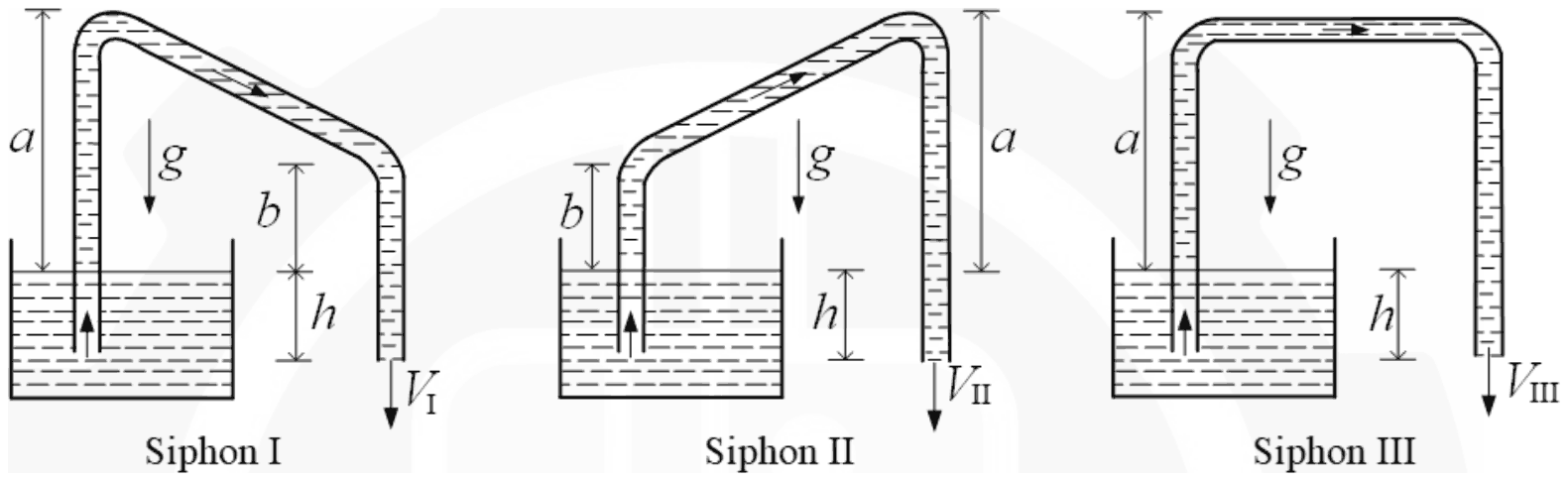
Three different siphons steadily discharge water at velocities VI, VII, and VIII, as shown in the figure. The tubes of the siphons are of same diameter. If the frictional losses are neglected, which one of the following options is correct?

In the figure, g is acceleration due to gravity; a, b, and h are different heights.

Three siphons drawing from open tanks with differently shaped tubes rising to heights a and b above the water surface; in each the outlet is a depth h below the tank's free surface

Exam Year(s)

GATE XE - 2026,

Answer: C

The discharge velocities are equal: \(V_{I} = V_{II} = V_{III}\).

Apply Bernoulli's equation along a streamline from the free surface of the tank (at rest, atmospheric pressure) to the outlet jet (atmospheric pressure). With no friction, the shape and highest point of the tube do not appear:

\[ \begin{aligned} z_{s} &= z_{out}+\frac{V^{2}}{2g} \\ V &= \sqrt{2gh} \end{aligned} \]

In all three siphons the outlet is the same depth h below the free surface, so all three velocities are \(\sqrt{2gh}\). The heights a and b only govern the pressure inside the tube at its crest, which must stay above vapour pressure for the siphon to run, not the outlet speed. The orderings in the other options assume those heights matter.

Please log in or register to report this question.

19.

If Y is unit weight of fluid in N/m3, Q is discharge in m3/s and Hm is head added to the flow in m. In case of work done over a fluid, the power input 'P' into the flow is________.

Exam Year(s)

RSMSSB JE - 2025, RSMSSB JE Agriculture - 2025, RSMSSB - 2025,

Answer: C

The power input is \(P = Q \cdot H_m \cdot Y\).

Each second a volume Q of fluid passes, weighing \(YQ\) newtons, and each newton of it gains \(H_m\) metres of head, that is \(H_m\) joules of energy. So the energy added per second is

\[ \begin{aligned} P &= Y Q H_m \\ &\to \text{N/m}^3 \times \text{m}^3/\text{s} \times \text{m} \\ &= \text{N m/s} = \text{W} \end{aligned} \]

The dimensions confirm it: the product gives N·m/s, which is watts. Every option that divides one of the three quantities by another gives the wrong units, so only the plain product can be power.

Please log in or register to report this question.

20.

Match List I with List II

List IList II
a. Euler's equation by a free jetI. Principle of momentum
b. Pressure exerted by gas moleculesII. Equation for conservation of momentum
c. Rotating lawn sprinklerIII. Momentum equation
d. Equation of motion along a stream lineIV. Bernouli's equation

Choose the correct answer from the options given below.

Exam Year(s)

RSMSSB JE - 2025, RSMSSB JE Agriculture - 2025, RSMSSB - 2025,

Answer: B

The Board's key is a-II, b-I, c-III, d-IV.

d matches IV at once: integrating the equation of motion along a streamline for steady ideal flow gives Bernoulli's equation. Every option pairs a with II, since Euler's equation is the momentum equation for an ideal fluid, so the choice is between B and C.

The key takes b with I: the pressure of a gas on a wall is explained by the change of momentum of molecules striking it, the principle of momentum. The rotating lawn sprinkler (c) is the standard application of the momentum equation in its moment-of-momentum form, matching III. Options pairing d with III are wrong because Bernoulli's equation belongs to the streamline.

Please log in or register to report this question.

Loading…
Tags: Fluid Dynamics and Bernoullis Equation Questions and Answers || Fluid Dynamics and Bernoullis Equation MCQ Questions and Answers || Fluid Dynamics and Bernoullis Equation GK Questions and Answers || Fluid Dynamics and Bernoullis Equation GK MCQ Questions || Fluid Dynamics and Bernoullis Equation Multiple Choice Questions and Answers || Fluid Dynamics and Bernoullis Equation GK || GK on Fluid Dynamics and Bernoullis Equation || Fluid Mechanics Questions and Answers || Fluid Mechanics MCQ Questions and Answers || Fluid Mechanics GK Questions and Answers || GK on Fluid Mechanics