
Machine-translated by Google. Questions are authored in English.
Top

Laminar Flow Questions and Answers

Direction for [ Question No: 1 To 1 ] :

Figure shows two parallel plates (upper plate at \(x = b\) and lower one at \(x = -b\)) of length L (aligned in \(z\) direction) and infinite width (in \(y\) direction, normal to the plane of the figure). Two immiscible, incompressible liquids are flowing steadily in the \(z\) direction through the thin passage between the plates under the influence of horizontal pressure gradient \((P_{0} - P_{L})/L\). During the flow, the passage is always half-filled with denser fluid I (viscosity \(\mu^{I}\)) at the bottom and rest is occupied by lighter fluid II (viscosity \(\mu^{II}\); \(\mu^{II} \lt \mu^{I}\)). Considering exactly planar interface between the fluids and no instabilities in the flow, the shear stress, \(\tau_{xz}\) is expressed as:

1.

\[ \begin{aligned} \tau_{xz} = \frac{(P_{0} - P_{L})b}{L} &\Bigg[ \left(\frac{x}{b}\right) \\ &- \frac{1}{2}\left(\frac{\mu^{I} - \mu^{II}}{\mu^{I} + \mu^{II}}\right) \Bigg] \end{aligned} \]

Which one of the following options correctly identifies the location of the point having maximum velocity of the flow?

Exam Year(s)

GATE XE - 2025,

Answer: A

The maximum velocity lies above the interface.

Velocity is greatest where \(du/dx = 0\), which is where the shear stress \(\tau_{xz}\) is zero. Setting the bracket to zero:

\[ \begin{aligned} \frac{x}{b} &= \frac{1}{2} \\ &\times \frac{\mu^{I} - \mu^{II}}{\mu^{I} + \mu^{II}} \end{aligned} \]

Since \(\mu^{II} \lt \mu^{I}\), the right side is positive, so the maximum lies at \(x \gt 0\). The interface is at \(x = 0\), because the passage between \(x = -b\) and \(x = b\) is half filled with fluid I at the bottom. The maximum is therefore in the less viscous fluid II, above the interface.

It would be at the interface only for equal viscosities, and it cannot be at the top plate, where no-slip makes the velocity zero. 'Below the interface' would need the lower fluid to be the less viscous one.

Please log in or register to report this question.
2.

What type of flow in pipes is characterized by fluid particles moving in parallel layers with minimal mixing or lateral crossover?

Exam Year(s)

DSSSB - 2023,

Answer: C

Laminar flow is the flow in which the fluid particles move in parallel layers with little mixing or lateral crossover. Turbulent flow has random mixing and eddies, transitional flow lies between the two, and compressible flow concerns the change of density, not the pattern of layers, so laminar flow is the answer.

Please log in or register to report this question.
3.

For steady flow of a viscous incompressible fluid through a circular pipe of constant diameter, the average velocity in the fully developed region is constant. Which one of the following statements about the average velocity in the developing region is TRUE?

Exam Year(s)

GATE ME - 2017,

Answer: B

The average velocity is constant and equal to the average velocity in the fully developed region.

For incompressible flow the volume flow rate is the same at every cross-section, and the pipe area is constant, so the average velocity Q/A cannot change anywhere along the pipe.

What changes in the entrance region is the velocity profile: the boundary layer grows, the fluid near the wall slows down and the core speeds up, until the parabolic profile of fully developed laminar flow is reached. The centreline velocity rises, but the average stays fixed. So the options saying the average increases, decreases or is lower all contradict continuity.

Please log in or register to report this question.
4.

In the case of a fully developed flow through a pipe, the shear stress at the centerline is

Exam Year(s)

GATE XE - 2012,

Answer: C

The shear stress at the centerline is zero.

In fully developed pipe flow the shear stress varies linearly with radius, from zero at the axis to its maximum at the wall:

\[ \tau(r) = \frac{r}{2}\left(-\frac{dp}{dx}\right) \]

This follows from a force balance on a cylinder of fluid of radius r, and holds for laminar and turbulent flow alike. At r = 0 the velocity profile has its maximum, so its slope, and hence the shear stress, is zero by symmetry.

It does not vary with axial distance, since the flow is fully developed; it does not depend on centerline velocity; and it is certainly not infinite.

Please log in or register to report this question.

5.

A fully developed laminar flow is taking place through a pipe. If the flow velocity is doubled maintaining the flow laminar, the pressure loss would be

Exam Year(s)

GATE XE - 2012,

Answer: C

The pressure loss is doubled.

For fully developed laminar flow in a pipe, the Hagen-Poiseuille equation gives the pressure drop over length L:

\[ \Delta p = \frac{32\mu L V}{D^{2}} \]

The loss is directly proportional to the average velocity, so doubling V doubles \(\Delta p\). Equivalently, the friction factor f = 64/Re halves as Re doubles while \(V^{2}\) quadruples.

'Halved' and 'unaltered' are wrong. A squared dependence on velocity applies to fully turbulent rough-pipe flow, which would give four times the loss; 'trebled' fits no regime.

Please log in or register to report this question.

6.

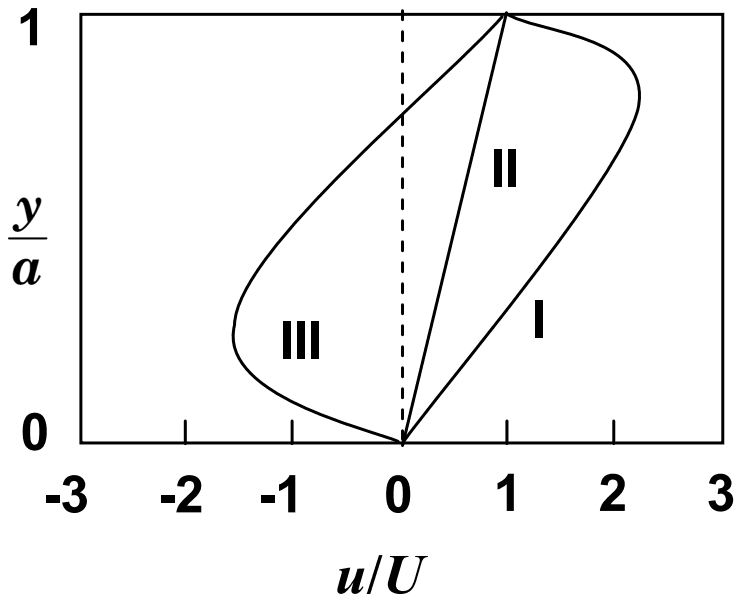
The figure given below shows typical non-dimensional velocity profiles for fully developed laminar flow between two infinitely long parallel plates separated by a distance a along y-direction. The upper plate is moving with a constant velocity U in the x-direction and the lower plate is stationary.

Plot of y/a against u/U with three profiles: II a straight line from 0 to 1, I bulging to about 2.2, III bulging back to about -1.5

Match the non-dimensional velocity profiles in Column I with the pressure gradients in Column II.

Column IColumn II
P. profile I1. \(\dfrac{\partial p}{\partial x} \gt 0\)
Q. profile II2. \(\dfrac{\partial p}{\partial x} \lt 0\)
R. profile III3. \(\dfrac{\partial p}{\partial x} = 0\)

Exam Year(s)

GATE XE - 2012,

Answer: A

The match is P - 2; Q - 3; R - 1.

Between a fixed lower plate and a moving upper plate the velocity profile is the linear Couette profile plus a parabola driven by the pressure gradient:

\[ \begin{aligned} \frac{u}{U} &= \frac{y}{a} \\ &\quad - \frac{a^{2}}{2\mu U}\frac{\partial p}{\partial x}\,\frac{y}{a}\left(1 - \frac{y}{a}\right) \end{aligned} \]

Profile II is the straight line, so \(\partial p/\partial x = 0\). Profile I bulges forward beyond the line, which needs the parabola to add velocity, that is \(\partial p/\partial x \lt 0\), a favourable gradient. Profile III bulges backward, with reversed flow near the lower plate, which needs an adverse gradient, \(\partial p/\partial x \gt 0\). The other options swap these pairings.

Please log in or register to report this question.

7.

Water is flowing in two different tubes of diameters D and 2D, with the same velocity. The ratio of laminar friction factors for the larger diameter tube to the smaller diameter tube is

Exam Year(s)

GATE XE - 2018,

Answer: A

The ratio is 0.5.

For laminar pipe flow the Darcy friction factor is \(f = 64/Re\), with \(Re = \rho V D/\mu\). At the same velocity and fluid, doubling the diameter doubles Re, so f halves:

\[ \frac{f_{2D}}{f_{D}} = \frac{Re_{D}}{Re_{2D}} = \frac{1}{2} \]

A ratio of 1.0 would mean f does not depend on Re, which is true only in fully rough turbulent flow, not laminar. 2.0 and 4.0 invert the dependence.

Please log in or register to report this question.

8.

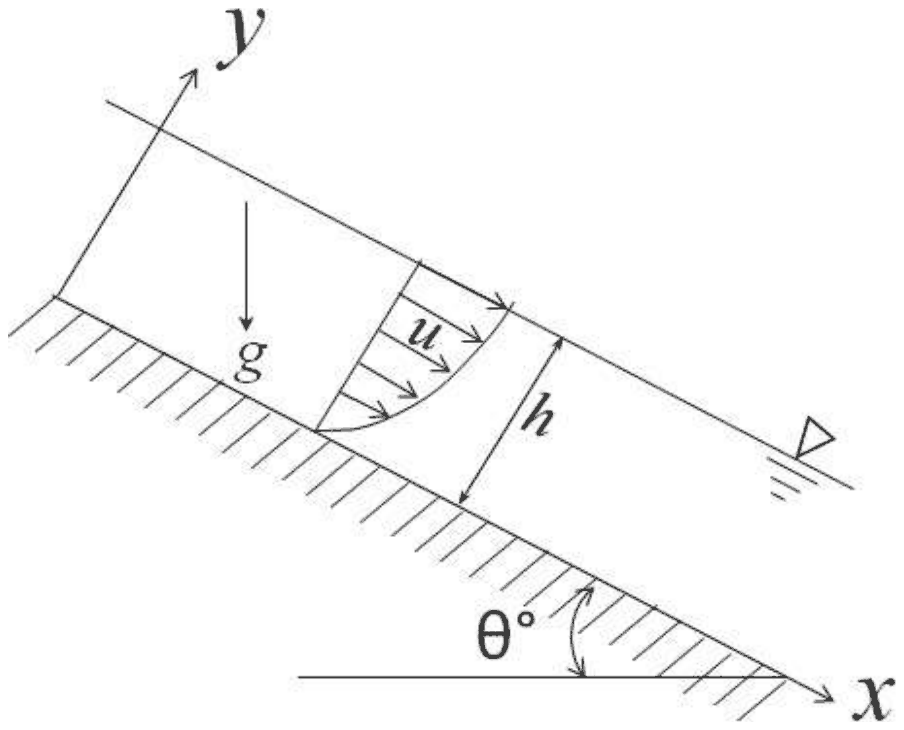
A two-dimensional laminar viscous liquid film of constant thickness (h) steadily flows down an incline as shown in figure. Acceleration due to gravity is g. If the velocity profile in the liquid film is given as, \(u = ky(2h - y)\); \(v = 0\), the value of constant k is

A liquid film of thickness h flowing down a plane inclined at angle theta to the horizontal, with x along the incline, y normal to it, gravity g vertical and a parabolic velocity profile u

Exam Year(s)

GATE XE - 2018,

Answer: A

The constant is \(k = \frac{\rho g \sin\theta}{2\mu}\).

For steady, fully developed film flow the momentum balance along the incline is between viscous stress and the component of gravity along the plate, \(\rho g\sin\theta\):

\[ \mu\frac{d^{2}u}{dy^{2}} = -\rho g\sin\theta \]

The given profile \(u = k(2hy - y^{2})\) has \(d^{2}u/dy^{2} = -2k\), so \(-2\mu k = -\rho g\sin\theta\) and \(k = \rho g\sin\theta/(2\mu)\). It also satisfies no slip at the wall (\(u = 0\) at \(y = 0\)) and zero shear at the free surface (\(du/dy = 0\) at \(y = h\)).

The cosine options use the gravity component normal to the plate, which only sets the pressure across the film, and the options without \(\mu\) do not even have the units of k, which must be 1/(m s) for \(ky(2h - y)\) to be a velocity.

Please log in or register to report this question.

9.

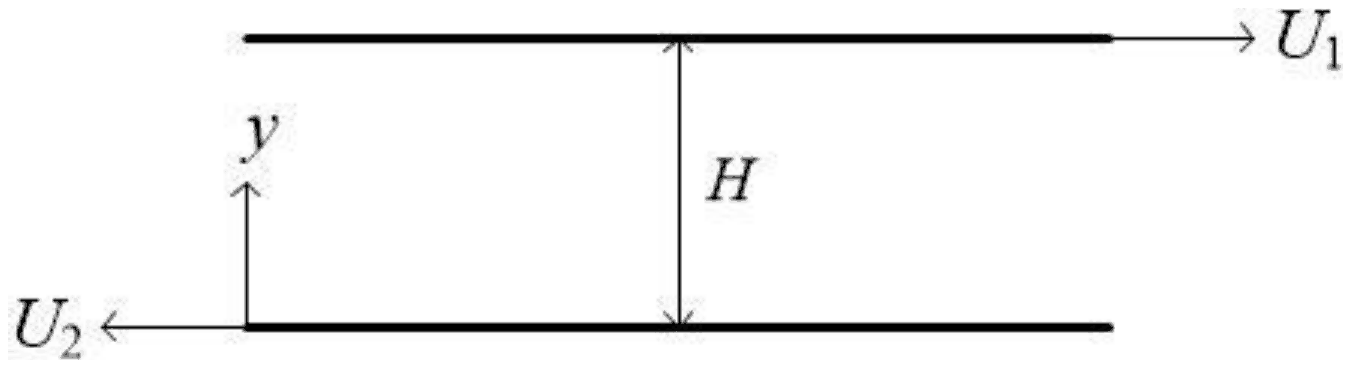
Consider steady fully-developed incompressible flow of a Newtonian fluid between two infinite parallel flat plates. The plates move in the opposite directions, as shown in the figure. In the absence of body force and pressure gradient, the ratio of shear stress at the top surface (\(y = H\)) to that at the bottom surface (\(y = 0\)) is

Two parallel plates a distance H apart; the top plate moves to the right with speed U1 and the bottom plate, at y = 0, moves to the left with speed U2

Exam Year(s)

GATE XE - 2023,

Answer: A

The ratio is 1.

With no pressure gradient and no body force, the x-momentum equation for fully developed flow reduces to

\[ \mu\frac{d^{2}u}{dy^{2}} = 0 \]

so the velocity is linear in \(y\) (Couette flow). With \(u(0) = -U_{2}\) and \(u(H) = U_{1}\), \(u = -U_{2} + (U_{1} + U_{2})\frac{y}{H}\), and the shear stress

\[ \tau = \mu\frac{du}{dy} = \frac{\mu(U_{1} + U_{2})}{H} \]

is the same at every \(y\), including both walls. Their ratio is therefore 1, whatever the plate speeds.

The options built from \(U_{1}\) and \(U_{2}\) would require a stress that varies across the gap, which happens only when a pressure gradient adds a parabolic part to the profile.

Please log in or register to report this question.

10.

For incompressible, laminar, fully-developed flow through a circular pipe, Darcy friction factor and Fanning friction factor are represented as \(f\) and \(C_f\), respectively. Which one of the following options is correct?

Exam Year(s)

GATE XE - 2024,

Answer: D

The relation is \(f = 4C_f\).

The Darcy factor appears in the head-loss equation \(h_f = f\frac{L}{D}\frac{V^{2}}{2g}\), while the Fanning factor is the wall shear stress scaled by dynamic pressure, \(C_f = \tau_w/(\tfrac{1}{2}\rho V^{2})\). A force balance on the pipe gives \(\tau_w = \frac{D}{4}\frac{\Delta p}{L}\), from which \(f = 4C_f\).

For laminar flow this reads \(f = 64/Re\) and \(C_f = 16/Re\). The other ratios (0.25, 0.5, 2) do not match these definitions.

Please log in or register to report this question.

Loading…
Tags: Laminar Flow Questions and Answers || Laminar Flow MCQ Questions and Answers || Laminar Flow GK Questions and Answers || Laminar Flow GK MCQ Questions || Laminar Flow Multiple Choice Questions and Answers || Laminar Flow GK || GK on Laminar Flow || Fluid Mechanics Questions and Answers || Fluid Mechanics MCQ Questions and Answers || Fluid Mechanics GK Questions and Answers || GK on Fluid Mechanics