
Discussion
The figure given below shows typical non-dimensional velocity profiles for fully developed laminar flow between two infinitely long parallel plates separated by a distance a along y-direction. The upper plate is moving with a constant velocity U in the x-direction and the lower plate is stationary.
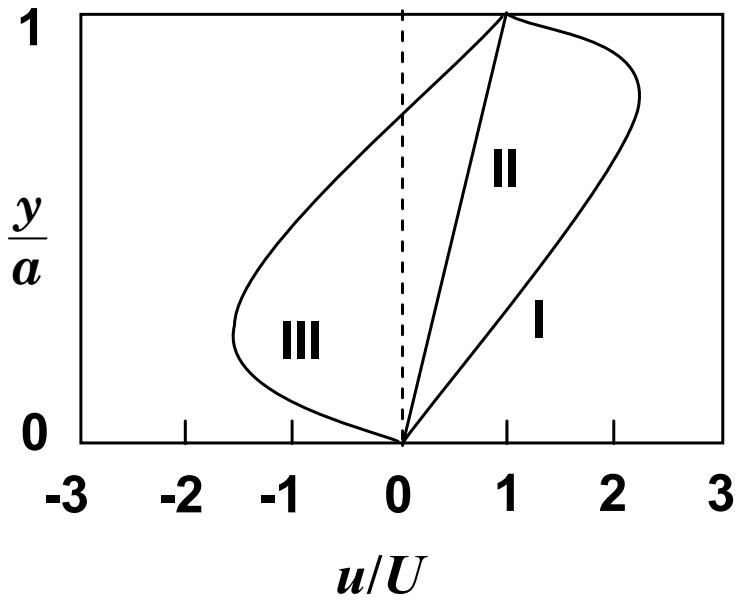
Match the non-dimensional velocity profiles in Column I with the pressure gradients in Column II.
| Column I | Column II |
|---|---|
| P. profile I | 1. \(\dfrac{\partial p}{\partial x} \gt 0\) |
| Q. profile II | 2. \(\dfrac{\partial p}{\partial x} \lt 0\) |
| R. profile III | 3. \(\dfrac{\partial p}{\partial x} = 0\) |
Answer: A
The match is P - 2; Q - 3; R - 1.
Between a fixed lower plate and a moving upper plate the velocity profile is the linear Couette profile plus a parabola driven by the pressure gradient:
\[ \begin{aligned} \frac{u}{U} &= \frac{y}{a} \\ &\quad - \frac{a^{2}}{2\mu U}\frac{\partial p}{\partial x}\,\frac{y}{a}\left(1 - \frac{y}{a}\right) \end{aligned} \]
Profile II is the straight line, so \(\partial p/\partial x = 0\). Profile I bulges forward beyond the line, which needs the parabola to add velocity, that is \(\partial p/\partial x \lt 0\), a favourable gradient. Profile III bulges backward, with reversed flow near the lower plate, which needs an adverse gradient, \(\partial p/\partial x \gt 0\). The other options swap these pairings.
Post your comment
Please log in or register to post a comment.
Examination Categories
- SSC Exams
- Banking Exams
- Teaching Exams
- Civil Services Exams
- Railways Exams
- Engineering Recruitment Exams
- Defence Exams
- State Government Exams
- Police Exams
- Insurance Exams
- Nursing Exams
- Other Government Exams
- NRA CET
- PG Entrance Exams
- Campus Placement
- MBA Entrance Exams
- CUET and UG Entrance
- Judiciary Exams
- Regulatory Body Exams
- Software Development