
Discussion
Consider steady fully-developed incompressible flow of a Newtonian fluid between two infinite parallel flat plates. The plates move in the opposite directions, as shown in the figure. In the absence of body force and pressure gradient, the ratio of shear stress at the top surface (\(y = H\)) to that at the bottom surface (\(y = 0\)) is
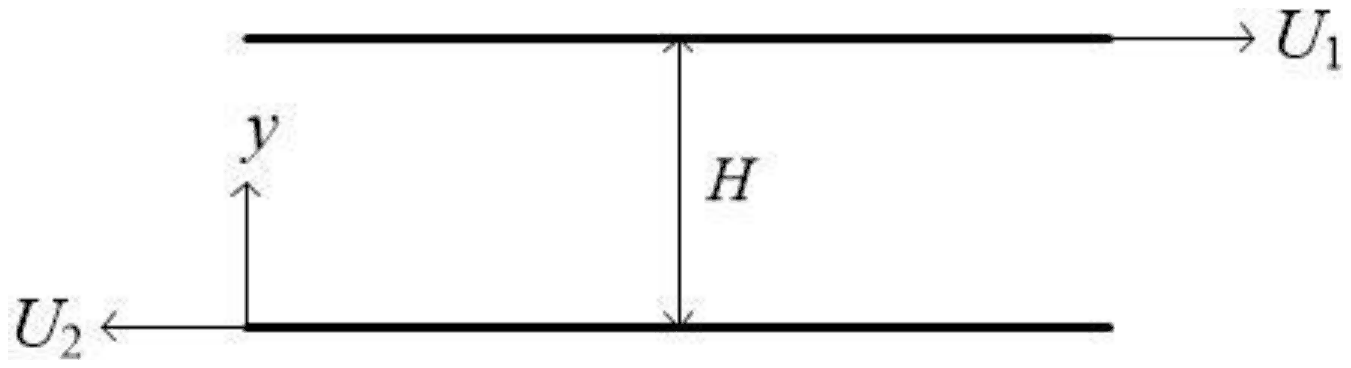
Answer: A
The ratio is 1.
With no pressure gradient and no body force, the x-momentum equation for fully developed flow reduces to
\[ \mu\frac{d^{2}u}{dy^{2}} = 0 \]
so the velocity is linear in \(y\) (Couette flow). With \(u(0) = -U_{2}\) and \(u(H) = U_{1}\), \(u = -U_{2} + (U_{1} + U_{2})\frac{y}{H}\), and the shear stress
\[ \tau = \mu\frac{du}{dy} = \frac{\mu(U_{1} + U_{2})}{H} \]
is the same at every \(y\), including both walls. Their ratio is therefore 1, whatever the plate speeds.
The options built from \(U_{1}\) and \(U_{2}\) would require a stress that varies across the gap, which happens only when a pressure gradient adds a parabolic part to the profile.
Post your comment
Please log in or register to post a comment.
Examination Categories
- SSC Exams
- Banking Exams
- Teaching Exams
- Civil Services Exams
- Railways Exams
- Engineering Recruitment Exams
- Defence Exams
- State Government Exams
- Police Exams
- Insurance Exams
- Nursing Exams
- Other Government Exams
- NRA CET
- PG Entrance Exams
- Campus Placement
- MBA Entrance Exams
- CUET and UG Entrance
- Judiciary Exams
- Regulatory Body Exams
- Software Development