Machine-translated by Google. Questions are authored in English.
Top

Compressible Flow Basics Questions and Answers

Direction for [ Question No: 1 To 2 ] :

Statement for Linked Answer Questions:

Air enters an adiabatic nozzle at 300 kPa, 500 K with a velocity of 10 m/s. It leaves the nozzle at 100 kPa with a velocity of 180 m/s. The inlet area is 80 cm2. The specific heat of air Cp is 1008 J/kg.K.

1.

The exit temperature of the air is

Exam Year(s)

GATE ME - 2012,

Answer: C

The exit temperature is about 484 K.

For an adiabatic nozzle with no work, the stagnation enthalpy is constant:

\[ \begin{aligned} T_{2} &= T_{1}+\frac{V_{1}^{2}-V_{2}^{2}}{2c_{p}} \\ &= 500+\frac{10^{2}-180^{2}}{2 \times 1008} \\ &= 500-16.0 = 484\ \text{K} \end{aligned} \]

The air speeds up, so its temperature must fall: 516 K and 532 K have the kinetic energy term with the wrong sign. 468 K doubles the drop.

Please log in or register to report this question.

2.

The exit area of the nozzle in cm2 is

Exam Year(s)

GATE ME - 2012,

Answer: D

The exit area is about 12.9 cm2.

Take R = 287 J/kg.K for air. The mass flow rate at inlet is:

\[ \begin{aligned} \rho_{1} &= \frac{300\,000}{287 \times 500} = 2.091\ \text{kg/m}^{3} \\ \dot{m} &= 2.091 \times 0.008 \times 10 = 0.1673\ \text{kg/s} \end{aligned} \]

At exit, with T2 = 484 K from the previous question:

\[ \begin{aligned} \rho_{2} &= \frac{100\,000}{287 \times 484} = 0.720\ \text{kg/m}^{3} \\ A_{2} &= \frac{0.1673}{0.720 \times 180} = 12.9\ \text{cm}^{2} \end{aligned} \]

4.4 cm2 is what results from ignoring the density change (80 × 10/180). 90.1 and 56.3 cm2 would make the exit larger than or close to the inlet, which an accelerating subsonic nozzle does not do.

Please log in or register to report this question.

3.

Consider steady, one-dimensional compressible flow of a gas in a pipe of diameter 1 m. At one location in the pipe, the density and velocity are 1 kg/m3 and 100 m/s, respectively. At a downstream location in the pipe, the velocity is 170 m/s. If the pressure drop between these two locations is 10 kPa, the force exerted by the gas on the pipe between these two locations is ____________ N.

Exam Year(s)

GATE ME - 2022,

Answer: B

The gas exerts a force of \(750\pi\) N on the pipe.

Apply the momentum equation to the gas between the two sections. The pipe area is \(A = \pi/4\) m2, and the mass flow is \(\dot{m} = \rho V A = 1 \times 100 \times \pi/4 = 25\pi\) kg/s, the same at both sections. With \(F\) the force of the pipe on the gas in the flow direction,

\[ \begin{aligned} (p_{1} - p_{2})A + F &= \dot{m}(V_{2} - V_{1}) \\ 10^{4} \times \frac{\pi}{4} + F &= 25\pi \times 70 \\ F &= 1750\pi - 2500\pi = -750\pi\ \text{N} \end{aligned} \]

The pipe pushes the gas backwards with \(750\pi\) N, so the gas pushes the pipe forwards with \(750\pi\) N.

The other values do not satisfy this balance; leaving out the momentum change would give \(2500\pi\), and leaving out the pressure force \(1750\pi\), neither of which is offered.

Please log in or register to report this question.

4.

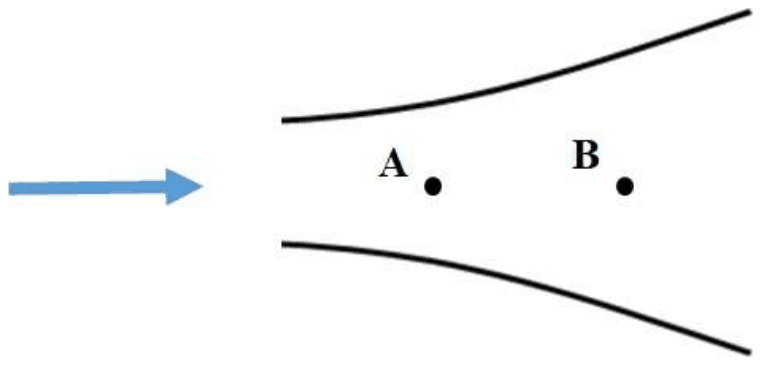
Consider a steady flow through a horizontal divergent channel, as shown in the figure, with supersonic flow at the inlet. The direction of flow is from left to right.

Channel whose walls diverge from left to right, flow arrow entering from the left; point A on the axis near the inlet and point B further downstream

Pressure at location B is observed to be higher than that at an upstream location A. Which among the following options can be the reason?

Exam Year(s)

GATE ME - 2022,

Answer: B

The reason is a normal shock.

For supersonic flow the area-velocity relation reverses the familiar subsonic behaviour: in a divergent channel a supersonic stream accelerates and its pressure falls. So in smooth, isentropic flow the pressure at B would be lower than at A. A higher pressure at B means the flow has been compressed abruptly between A and B, and the mechanism the standard theory gives for that is a normal shock: across it the flow drops to subsonic speed and the static pressure jumps.

The first option uses the incompressible rule that a wider channel slows the flow; that is true for subsonic flow and wrong for supersonic flow, where density changes dominate. Viscous effects and boundary layer separation are dissipative effects the textbook treatment of this channel leaves out; the official key accepts only the normal shock.

Please log in or register to report this question.

5.

Consider an isentropic flow of air (ratio of specific heats = 1.4) through a duct as shown in the figure.
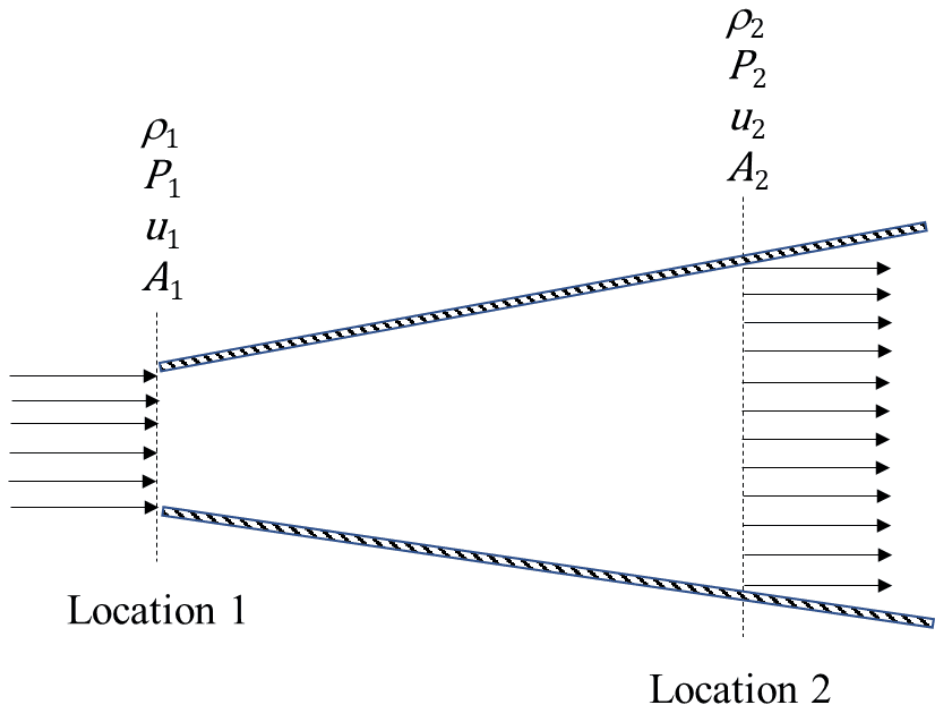
Duct whose cross-section widens in the direction of flow, from Location 1 (rho1, P1, u1, A1) to Location 2 (rho2, P2, u2, A2), with flow arrows entering at Location 1 and leaving at Location 2

The variations in the flow across the cross-section are negligible. The flow conditions at Location 1 are given as follows:

\(P_{1}\) = 100 kPa, \(\rho_{1}\) = 1.2 kg/m3, \(u_{1}\) = 400 m/s

The duct cross-sectional area at Location 2 is given by A2 = 2A1, where A1 denotes the duct cross-sectional area at Location 1. Which one of the given statements about the velocity \(u_{2}\) and pressure \(P_{2}\) at Location 2 is TRUE?

Exam Year(s)

GATE ME - 2023,

Answer: C

At Location 2, \(u_{2} \gt u_{1}\) and \(P_{2} \lt P_{1}\).

Find the Mach number at Location 1:

\[ \begin{aligned} a_{1} &= \sqrt{\gamma P_{1}/\rho_{1}} \\ &= \sqrt{1.4 \times 10^{5}/1.2} \\ &\approx 341.6\ \text{m/s} \\ M_{1} &= 400/341.6 \approx 1.17 \end{aligned} \]

The flow is supersonic. For isentropic flow in a duct, area and velocity are linked by

\[ \frac{dA}{A} = (M^{2} - 1)\frac{du}{u} \]

With \(M \gt 1\), an increasing area (\(dA \gt 0\)) gives \(du \gt 0\): a supersonic stream speeds up in a diverging duct. In isentropic flow pressure falls as velocity rises, so \(P_{2} \lt P_{1}\).

\(u_{2} \lt u_{1}\) with \(P_{2} \gt P_{1}\) is the subsonic diffuser behaviour, the trap if the Mach number is not checked. The two mixed options break the isentropic link between velocity and pressure.

Please log in or register to report this question.

6.

An ideal gas passes isothermally through a long horizontal uniform cross-section pipe under steady flow. Consider that the pressure gradient in the pipe is sufficient for a finite change in the density of the gas. If the flow of the gas is purely pressure driven and subsonic throughout, then the average flow velocity

Exam Year(s)

GATE ME - 2026,

Answer: A

The average velocity increases along the flow.

In steady flow through a uniform pipe the mass flow rate \(\rho VA\) is constant, so \(\rho V\) is constant. The flow is pressure driven, so pressure falls along the pipe, and at constant temperature an ideal gas's density \(\rho = p/RT\) falls with it. Hence \(V\) must rise.

Velocity would stay constant only for an incompressible fluid, which the question rules out by saying density changes. A decrease would need density to rise downstream. The entrance-region option describes the shape of the velocity profile, not the average velocity.

Please log in or register to report this question.

Loading…
Tags: Compressible Flow Basics Questions and Answers || Compressible Flow Basics MCQ Questions and Answers || Compressible Flow Basics GK Questions and Answers || Compressible Flow Basics GK MCQ Questions || Compressible Flow Basics Multiple Choice Questions and Answers || Compressible Flow Basics GK || GK on Compressible Flow Basics || Fluid Mechanics Questions and Answers || Fluid Mechanics MCQ Questions and Answers || Fluid Mechanics GK Questions and Answers || GK on Fluid Mechanics