
Discussion
Consider a steady flow through a horizontal divergent channel, as shown in the figure, with supersonic flow at the inlet. The direction of flow is from left to right.
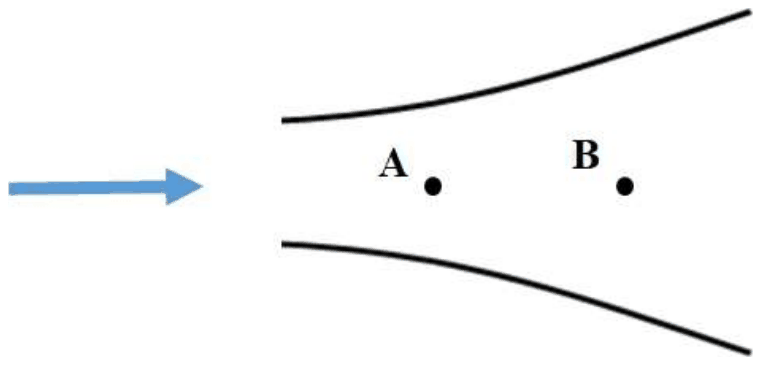
Pressure at location B is observed to be higher than that at an upstream location A. Which among the following options can be the reason?
Answer: B
The reason is a normal shock.
For supersonic flow the area-velocity relation reverses the familiar subsonic behaviour: in a divergent channel a supersonic stream accelerates and its pressure falls. So in smooth, isentropic flow the pressure at B would be lower than at A. A higher pressure at B means the flow has been compressed abruptly between A and B, and the mechanism the standard theory gives for that is a normal shock: across it the flow drops to subsonic speed and the static pressure jumps.
The first option uses the incompressible rule that a wider channel slows the flow; that is true for subsonic flow and wrong for supersonic flow, where density changes dominate. Viscous effects and boundary layer separation are dissipative effects the textbook treatment of this channel leaves out; the official key accepts only the normal shock.
Post your comment
Please log in or register to post a comment.
Examination Categories
- SSC Exams
- Banking Exams
- Teaching Exams
- Civil Services Exams
- Railways Exams
- Engineering Recruitment Exams
- Defence Exams
- State Government Exams
- Police Exams
- Insurance Exams
- Nursing Exams
- Other Government Exams
- NRA CET
- PG Entrance Exams
- Campus Placement
- MBA Entrance Exams
- CUET and UG Entrance
- Judiciary Exams
- Regulatory Body Exams
- Software Development