
Discussion
Consider an isentropic flow of air (ratio of specific heats = 1.4) through a duct as shown in the figure.
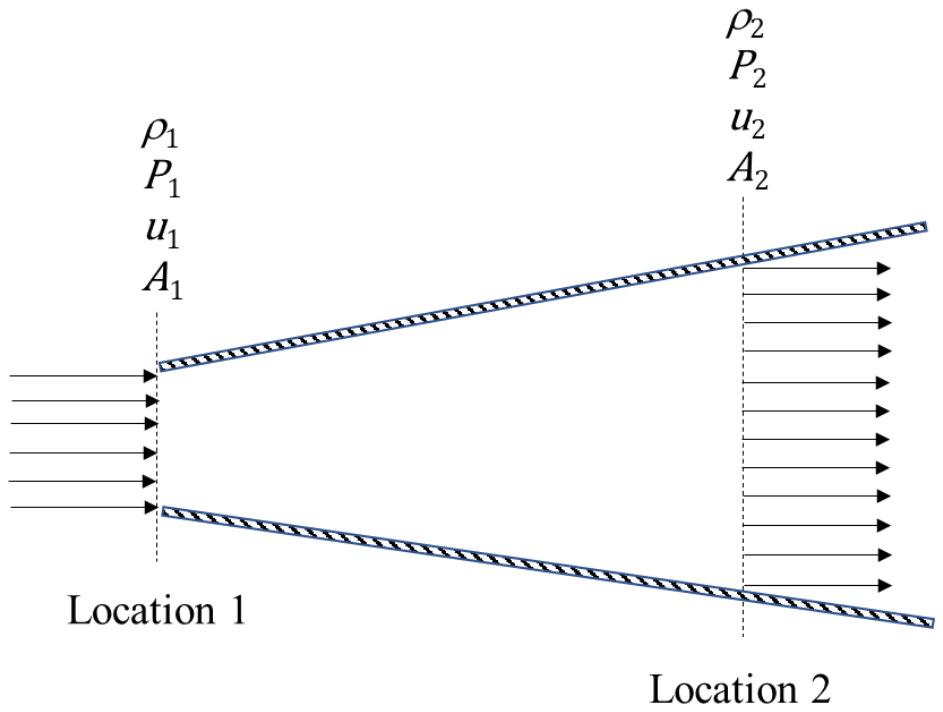
The variations in the flow across the cross-section are negligible. The flow conditions at Location 1 are given as follows:
\(P_{1}\) = 100 kPa, \(\rho_{1}\) = 1.2 kg/m3, \(u_{1}\) = 400 m/s
The duct cross-sectional area at Location 2 is given by A2 = 2A1, where A1 denotes the duct cross-sectional area at Location 1. Which one of the given statements about the velocity \(u_{2}\) and pressure \(P_{2}\) at Location 2 is TRUE?
Answer: C
At Location 2, \(u_{2} \gt u_{1}\) and \(P_{2} \lt P_{1}\).
Find the Mach number at Location 1:
\[ \begin{aligned} a_{1} &= \sqrt{\gamma P_{1}/\rho_{1}} \\ &= \sqrt{1.4 \times 10^{5}/1.2} \\ &\approx 341.6\ \text{m/s} \\ M_{1} &= 400/341.6 \approx 1.17 \end{aligned} \]
The flow is supersonic. For isentropic flow in a duct, area and velocity are linked by
\[ \frac{dA}{A} = (M^{2} - 1)\frac{du}{u} \]
With \(M \gt 1\), an increasing area (\(dA \gt 0\)) gives \(du \gt 0\): a supersonic stream speeds up in a diverging duct. In isentropic flow pressure falls as velocity rises, so \(P_{2} \lt P_{1}\).
\(u_{2} \lt u_{1}\) with \(P_{2} \gt P_{1}\) is the subsonic diffuser behaviour, the trap if the Mach number is not checked. The two mixed options break the isentropic link between velocity and pressure.
Post your comment
Please log in or register to post a comment.
Examination Categories
- SSC Exams
- Banking Exams
- Teaching Exams
- Civil Services Exams
- Railways Exams
- Engineering Recruitment Exams
- Defence Exams
- State Government Exams
- Police Exams
- Insurance Exams
- Nursing Exams
- Other Government Exams
- NRA CET
- PG Entrance Exams
- Campus Placement
- MBA Entrance Exams
- CUET and UG Entrance
- Judiciary Exams
- Regulatory Body Exams
- Software Development