
Discussion
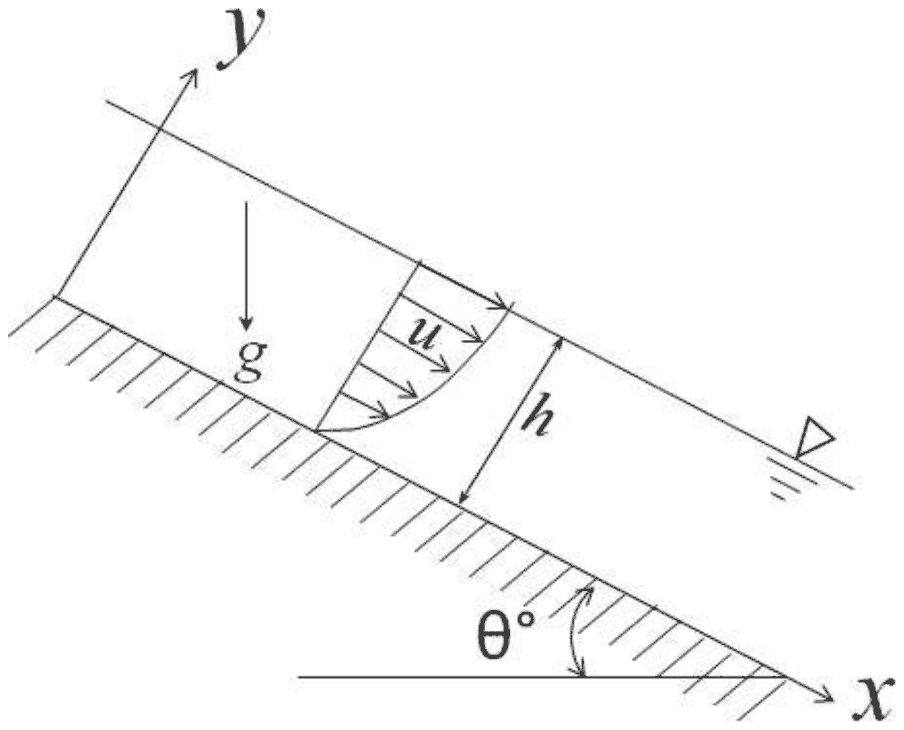
A two-dimensional laminar viscous liquid film of constant thickness (h) steadily flows down an incline as shown in figure. Acceleration due to gravity is g. If the velocity profile in the liquid film is given as, \(u = ky(2h - y)\); \(v = 0\), the value of constant k is
Answer: A
The constant is \(k = \frac{\rho g \sin\theta}{2\mu}\).
For steady, fully developed film flow the momentum balance along the incline is between viscous stress and the component of gravity along the plate, \(\rho g\sin\theta\):
\[ \mu\frac{d^{2}u}{dy^{2}} = -\rho g\sin\theta \]
The given profile \(u = k(2hy - y^{2})\) has \(d^{2}u/dy^{2} = -2k\), so \(-2\mu k = -\rho g\sin\theta\) and \(k = \rho g\sin\theta/(2\mu)\). It also satisfies no slip at the wall (\(u = 0\) at \(y = 0\)) and zero shear at the free surface (\(du/dy = 0\) at \(y = h\)).
The cosine options use the gravity component normal to the plate, which only sets the pressure across the film, and the options without \(\mu\) do not even have the units of k, which must be 1/(m s) for \(ky(2h - y)\) to be a velocity.
Post your comment
Please log in or register to post a comment.
Examination Categories
- SSC Exams
- Banking Exams
- Teaching Exams
- Civil Services Exams
- Railways Exams
- Engineering Recruitment Exams
- Defence Exams
- State Government Exams
- Police Exams
- Insurance Exams
- Nursing Exams
- Other Government Exams
- NRA CET
- PG Entrance Exams
- Campus Placement
- MBA Entrance Exams
- CUET and UG Entrance
- Judiciary Exams
- Regulatory Body Exams
- Software Development