
Discussion
The acid catalyzed cyclization of 5-ketodecan-1,9-diol is given below

(p-TSA = p-toluenesulfonic acid)
The most predominant spiroketal is
- A.
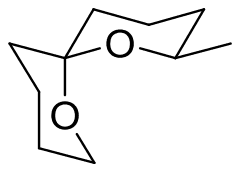
- B.
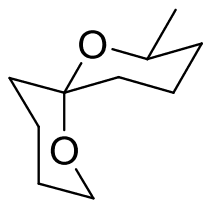
- C.
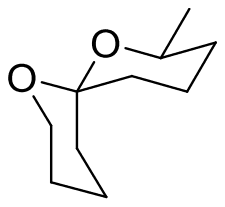
- D.
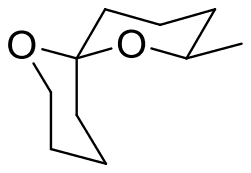
Answer: A
The predominant spiroketal is the one with both ring oxygens axial at the spiro carbon and the methyl group equatorial (A).
Under acid and heat the ketone and the two hydroxyl groups form 2-methyl-1,7-dioxaspiro[5.5]undecane, and the reaction is reversible, so the most stable isomer accumulates. Two effects decide which one that is:
- the anomeric effect: each C-O bond at the spiro carbon prefers to be axial with respect to the other ring, where an oxygen lone pair can donate into its σ* orbital. Structure A has this doubly anomeric arrangement;
- sterics: the methyl group prefers the equatorial position on its chair.
A satisfies both. B has the right anomeric arrangement but an axial methyl. C and D place the second ring's oxygen equatorial, losing anomeric stabilisation, and C also has the methyl axial.
No comment is present. Be the first to comment.
Loading…
Post your comment
Please log in or register to post a comment.
Examination Categories
- SSC Exams
- Banking Exams
- Teaching Exams
- Civil Services Exams
- Railways Exams
- Engineering Recruitment Exams
- Defence Exams
- State Government Exams
- Police Exams
- Insurance Exams
- Nursing Exams
- Other Government Exams
- NRA CET
- PG Entrance Exams
- Campus Placement
- MBA Entrance Exams
- CUET and UG Entrance
- Judiciary Exams
- Regulatory Body Exams
- Software Development