
Discussion
The major product formed in the following reaction
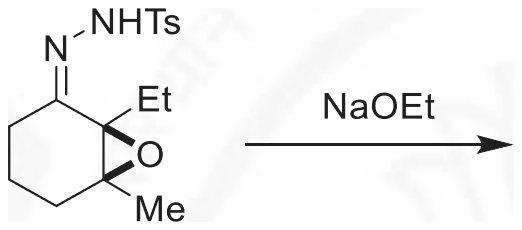
is:
Answer: A
The product is non-6-yn-2-one.
This is the Eschenmoser fragmentation of an alpha,beta-epoxy ketone tosylhydrazone. Base removes the N-H proton; the epoxide opens as the tosyl group leaves, and the ring bond between the two former epoxide carbons breaks, releasing N2 and Ts−.
The carbon bearing Et and the former C=N carbon become the two ends of a C≡C bond, and the carbon bearing Me and the epoxide oxygen becomes a ketone. Opening the six-membered ring gives a straight chain:
\[ \mathrm{CH_{3}CH_{2}C{\equiv}C(CH_{2})_{3}COCH_{3}} \]
Numbering from the ketone end gives the carbonyl at C2 and the triple bond at C6: non-6-yn-2-one, nine carbons. non-3-yn-8-one is the same chain numbered from the wrong end, non-2-yn-6-one puts the alkyne and ketone in the wrong places, and an alkene product would need hydrogen that the fragmentation does not supply.
Post your comment
Please log in or register to post a comment.
Examination Categories
- SSC Exams
- Banking Exams
- Teaching Exams
- Civil Services Exams
- Railways Exams
- Engineering Recruitment Exams
- Defence Exams
- State Government Exams
- Police Exams
- Insurance Exams
- Nursing Exams
- Other Government Exams
- NRA CET
- PG Entrance Exams
- Campus Placement
- MBA Entrance Exams
- CUET and UG Entrance
- Judiciary Exams
- Regulatory Body Exams
- Software Development