
Discussion
For positive real numbers S and K, the function \(H_{K}(S)\) is defined as: \(H_{K}(S) = \max(S-K, 0)\). The max function is defined as:
\[ \max(a,b) = \begin{cases} a, & \text{when } a \gt b \\ b, & \text{when } a \le b \end{cases} \]
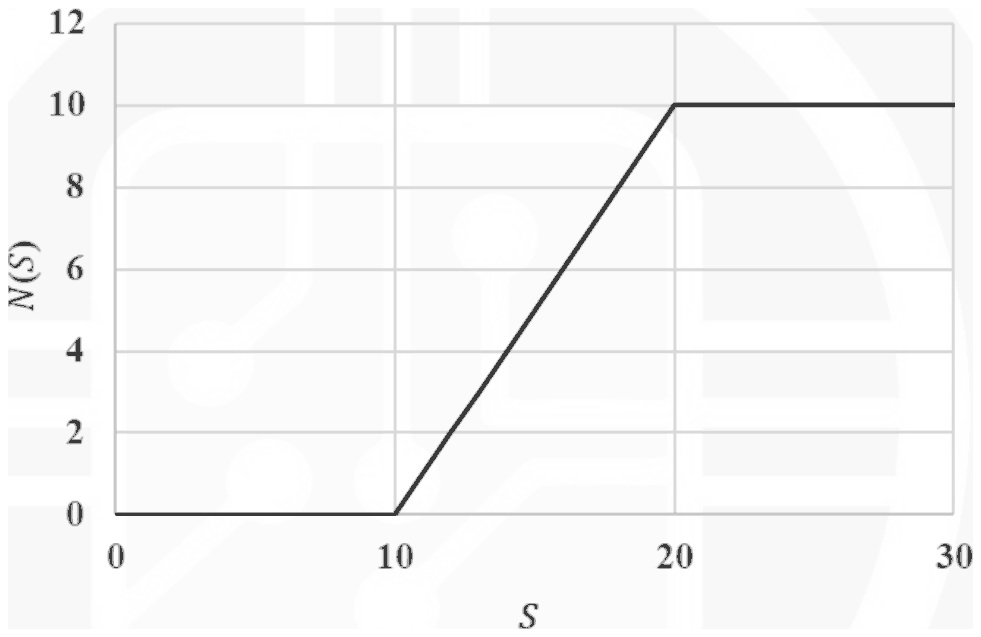
The graph below shows the plot of a function N(S) versus S.
N(S) can be expressed as ___.
Answer: A
N(S) is \(H_{10}(S) - H_{20}(S)\).
Each \(H_{K}(S)\) is zero up to S = K and then rises with slope 1. Check \(H_{10} - H_{20}\) on the three pieces of the graph:
\[ \begin{aligned} S \le 10:&\quad 0 - 0 = 0 \\ 10 \lt S \le 20:&\quad (S-10) - 0 = S - 10 \\ S \gt 20:&\quad (S-10)-(S-20) = 10 \end{aligned} \]
This is zero until 10, rises to 10 at S = 20, and stays at 10, exactly as plotted.
\(H_{10} - 2H_{20}\) would fall with slope -1 after S = 20. \(-H_{10} + H_{20}\) is the plotted function turned upside down, going down to -10. \(H_{15} - H_{20}\) starts rising only at 15 and levels off at 5.
Post your comment
Please log in or register to post a comment.
Examination Categories
- SSC Exams
- Banking Exams
- Teaching Exams
- Civil Services Exams
- Railways Exams
- Engineering Recruitment Exams
- Defence Exams
- State Government Exams
- Police Exams
- Insurance Exams
- Nursing Exams
- Other Government Exams
- NRA CET
- PG Entrance Exams
- Campus Placement
- MBA Entrance Exams
- CUET and UG Entrance
- Judiciary Exams
- Regulatory Body Exams
- Software Development