
Discussion
Which one of the following options represents the given graph?
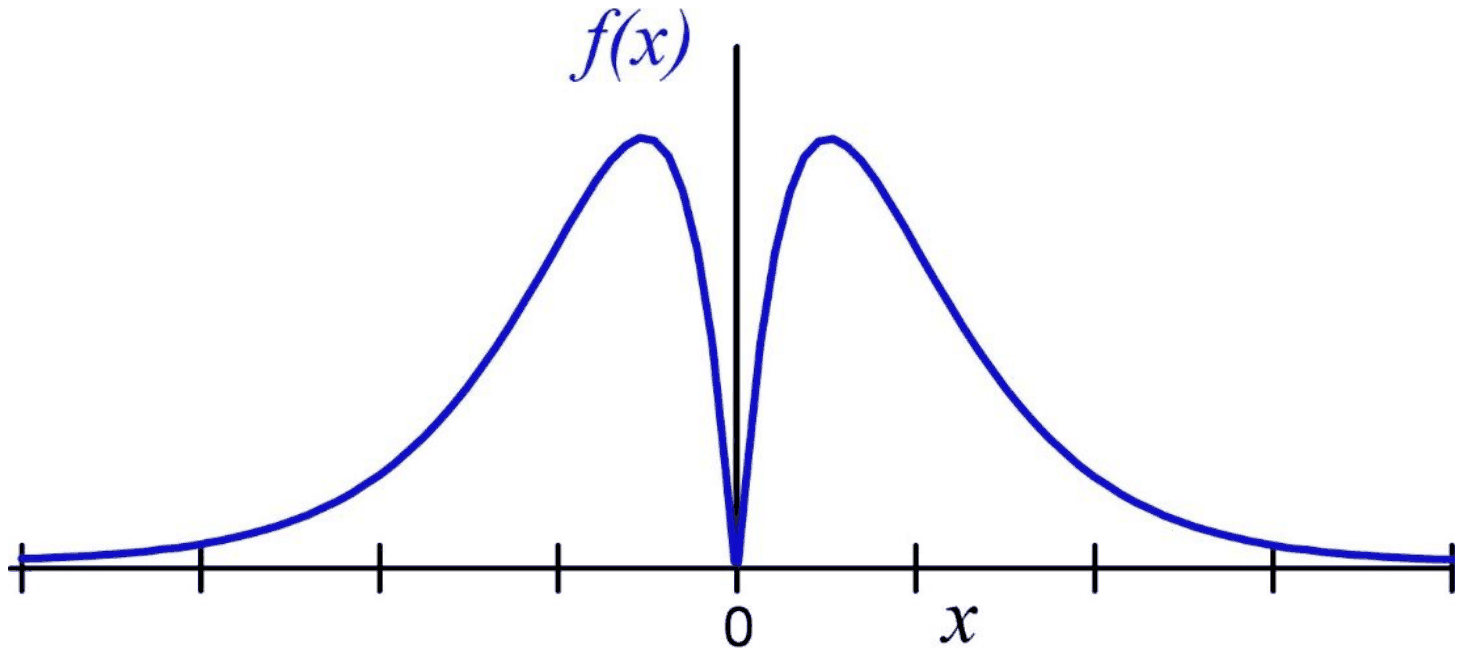
Answer: A
The graph is \(f(x) = x^{2}\,2^{-|x|}\).
Read three features from the graph: it is symmetric about the vertical axis (an even function), it is never negative and touches zero at \(x = 0\), and it decays to zero on both sides.
\(x^{2}\,2^{-|x|}\) has all three: \(x^{2}\) and \(|x|\) are both even, the product is non-negative and zero at the origin, and \(2^{-|x|}\) makes it vanish as \(|x|\) grows, with peaks in between.
\(x\,2^{-|x|}\) is odd, so it would be negative for \(x \lt 0\). \(|x|\,2^{-x}\) and \(x\,2^{-x}\) contain \(2^{-x}\), which grows without bound as x becomes large and negative, so they cannot fall back to zero on the left. Only the first option fits.
Post your comment
Please log in or register to post a comment.
Examination Categories
- SSC Exams
- Banking Exams
- Teaching Exams
- Civil Services Exams
- Railways Exams
- Engineering Recruitment Exams
- Defence Exams
- State Government Exams
- Police Exams
- Insurance Exams
- Nursing Exams
- Other Government Exams
- NRA CET
- PG Entrance Exams
- Campus Placement
- MBA Entrance Exams
- CUET and UG Entrance
- Judiciary Exams
- Regulatory Body Exams
- Software Development