
Discussion
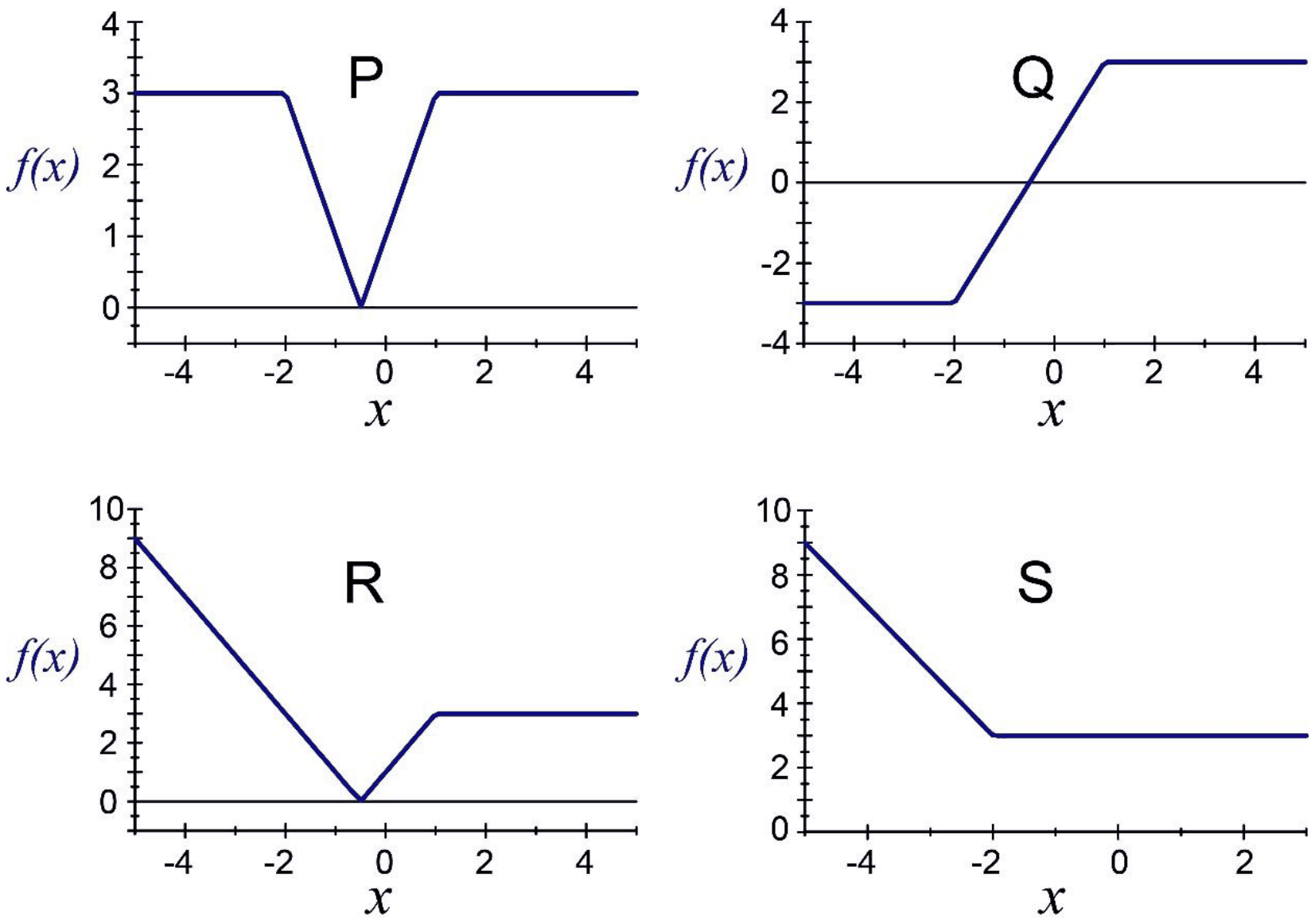
Which one of the given figures P, Q, R and S represents the graph of the following function?
\[ f(x) = \big|\, |x + 2| - |x - 1| \,\big| \]
Answer: A
The graph is P.
Split the line at the points where the inner absolute values change sign, \(x = -2\) and \(x = 1\):
\[ \begin{aligned} x \le -2:&\ \ |(-x-2) - (1-x)| = |-3| = 3 \\ -2 \le x \le 1:&\ \ |(x+2) - (1-x)| = |2x+1| \\ x \ge 1:&\ \ |(x+2) - (x-1)| = 3 \end{aligned} \]
So \(f\) is 3 on both outer pieces, and in the middle it falls along \(|2x+1|\) from 3 at \(x = -2\) to 0 at \(x = -0.5\) and rises back to 3 at \(x = 1\). That is the V between two flat arms in P.
Q is \(|x+2| - |x-1|\) without the outer modulus, so it goes negative. R and S grow without bound on the left, which no part of \(f\) does.
Post your comment
Please log in or register to post a comment.
Examination Categories
- SSC Exams
- Banking Exams
- Teaching Exams
- Civil Services Exams
- Railways Exams
- Engineering Recruitment Exams
- Defence Exams
- State Government Exams
- Police Exams
- Insurance Exams
- Nursing Exams
- Other Government Exams
- NRA CET
- PG Entrance Exams
- Campus Placement
- MBA Entrance Exams
- CUET and UG Entrance
- Judiciary Exams
- Regulatory Body Exams
- Software Development