
Discussion
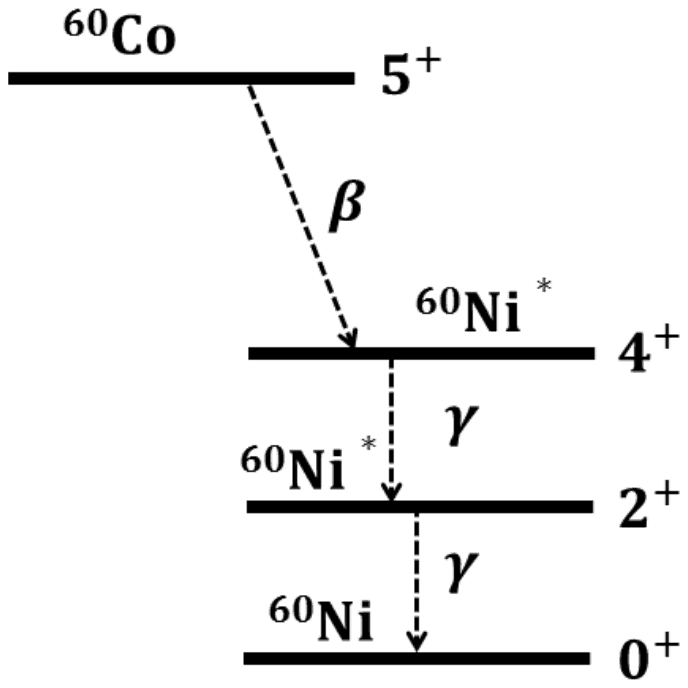
A 60Co nucleus emits a β-particle and is converted to 60Ni* with \(J^{P} = 4^{+}\), which in turn decays to the 60Ni ground state with \(J^{P} = 0^{+}\) by emitting two photons in succession, as shown in the figure. Which one of the following statements is CORRECT?
Answer: C
The correct statement is \(2^{+} \rightarrow 0^{+}\) is an electric quadrupole transition.
A photon of multipolarity \(L\) must satisfy \(|J_{i} - J_{f}| \le L \le J_{i} + J_{f}\) (and \(L \ge 1\)). An electric \(EL\) transition changes parity by \((-1)^{L}\) and a magnetic \(ML\) transition by \((-1)^{L+1}\).
For \(2^{+} \rightarrow 0^{+}\), only \(L = 2\) is allowed, and there is no parity change, so it must be E2, electric quadrupole. M2 would need a parity change.
For \(4^{+} \rightarrow 2^{+}\), \(L\) runs from 2 to 6 with no parity change, so the allowed multipoles are E2, M3, E4, M5, E6, and E2 dominates. An electric octupole (E3) or a magnetic quadrupole (M2) would both change parity, so the first two statements are wrong, as is the last.
Post your comment
Please log in or register to post a comment.
Examination Categories
- SSC Exams
- Banking Exams
- Teaching Exams
- Civil Services Exams
- Railways Exams
- Engineering Recruitment Exams
- Defence Exams
- State Government Exams
- Police Exams
- Insurance Exams
- Nursing Exams
- Other Government Exams
- NRA CET
- PG Entrance Exams
- Campus Placement
- MBA Entrance Exams
- CUET and UG Entrance
- Judiciary Exams
- Regulatory Body Exams
- Software Development