
Discussion
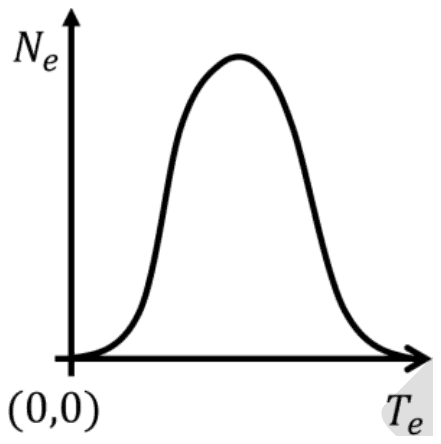
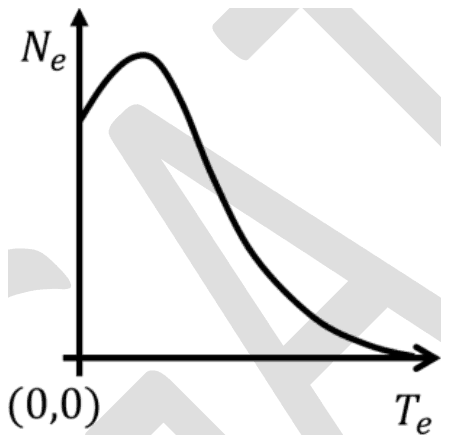
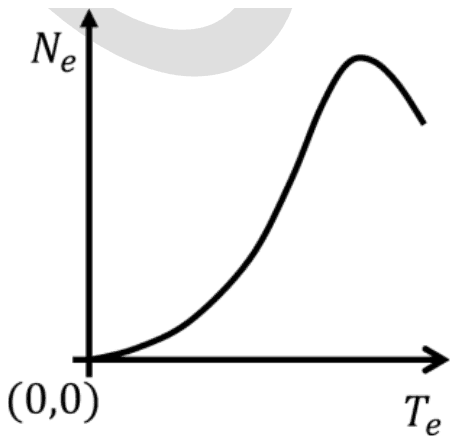
Let \(N_{e}\) and \(T_{e}\), respectively, denote number and kinetic energy of electrons produced in a nuclear beta decay. Which one of the following distributions is correct?
- A.

- B.
- C.
- D.
Answer: C
The correct distribution is the continuous curve that starts above zero, peaks at low energy and falls to zero (C).
In beta decay the available energy is shared among three bodies: the electron, the antineutrino and the recoiling nucleus. So the electron energy is not fixed but spread continuously from 0 up to the endpoint energy, which rules out the single line of (A), the shape expected for a two-body decay.
For electron (β-) emission the Coulomb attraction of the daughter nucleus slows the electrons, piling them up at low energy; the number at very low energy stays finite rather than vanishing, and the spectrum then falls off towards the endpoint. Curve (C) has exactly this shape.
A symmetric bell curve that vanishes at zero energy (B) ignores that Coulomb effect, and a curve peaking near the maximum energy (D) would mean the neutrino usually carries almost nothing, which is not what is observed.
Post your comment
Please log in or register to post a comment.
Examination Categories
- SSC Exams
- Banking Exams
- Teaching Exams
- Civil Services Exams
- Railways Exams
- Engineering Recruitment Exams
- Defence Exams
- State Government Exams
- Police Exams
- Insurance Exams
- Nursing Exams
- Other Government Exams
- NRA CET
- PG Entrance Exams
- Campus Placement
- MBA Entrance Exams
- CUET and UG Entrance
- Judiciary Exams
- Regulatory Body Exams
- Software Development