
Discussion
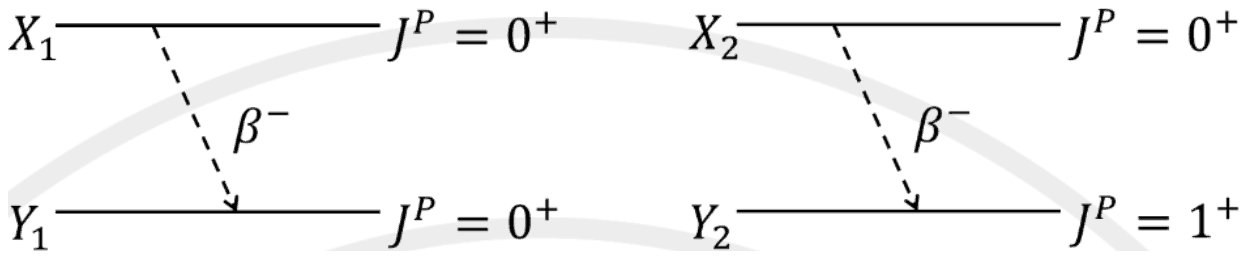
Consider two hypothetical nuclei \(X_{1}\) and \(X_{2}\) undergoing \(\beta\) decay, resulting in nuclei \(Y_{1}\) and \(Y_{2}\), respectively. The decay scheme and the corresponding \(J^{P}\) values of the nuclei are given in the figure. Which of the following option(s) is/are correct? (\(J\) is the total angular momentum and \(P\) is parity)
Answer: B
The correct option is \(X_{1} \to Y_{1}\) is a Fermi transition and \(X_{2} \to Y_{2}\) is a Gamow-Teller transition.
In allowed beta decay there is no change of parity, and the selection rules depend on how the electron and neutrino spins combine. In a Fermi transition their spins are antiparallel (total 0), so \(\Delta J = 0\). In a Gamow-Teller transition they are parallel (total 1), so \(\Delta J = 0, \pm 1\), except that \(0 \to 0\) is forbidden.
\(0^{+} \to 0^{+}\) (\(X_{1} \to Y_{1}\)) cannot be Gamow-Teller, so it is a pure Fermi transition. \(0^{+} \to 1^{+}\) (\(X_{2} \to Y_{2}\)) has \(\Delta J = 1\), which a Fermi transition cannot provide, so it is pure Gamow-Teller.
That rules out every other combination. (This is a multiple-select question; the key accepts this option alone.)
Post your comment
Please log in or register to post a comment.
Examination Categories
- SSC Exams
- Banking Exams
- Teaching Exams
- Civil Services Exams
- Railways Exams
- Engineering Recruitment Exams
- Defence Exams
- State Government Exams
- Police Exams
- Insurance Exams
- Nursing Exams
- Other Government Exams
- NRA CET
- PG Entrance Exams
- Campus Placement
- MBA Entrance Exams
- CUET and UG Entrance
- Judiciary Exams
- Regulatory Body Exams
- Software Development