
Discussion
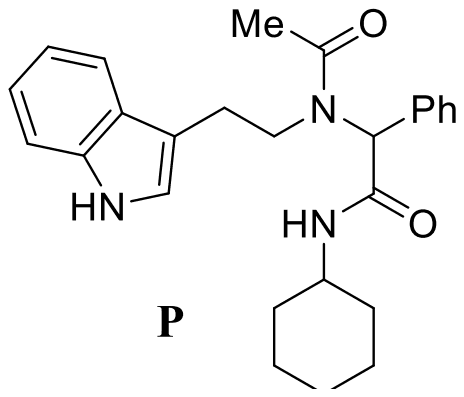
Compound P was prepared based on a four-component reaction at room temperature in methanol. The required starting materials for the synthesis are
- A.

- B.

- C.

- D.

Answer: A
The starting materials are (A): tryptamine, benzaldehyde, acetic acid and cyclohexyl isocyanide.
A four-component reaction in methanol at room temperature giving a bis-amide is the Ugi reaction: an amine and an aldehyde form an imine, the isocyanide carbon adds to the protonated imine, the carboxylate traps the resulting nitrilium ion, and a Mumm rearrangement moves the acyl group onto nitrogen.
Mapping P back onto these parts: the nitrogen carrying the indolylethyl group and the acetyl group comes from tryptamine (amine) and acetic acid (acid); the CH(Ph) carbon comes from benzaldehyde; and the C(O)NH-cyclohexyl amide comes from cyclohexyl isocyanide.
The options with cyclohexanecarbonitrile fail because a nitrile (C≡N bonded through carbon) cannot play the isocyanide's role. The options using indole-3-acetaldehyde and benzylamine would put a benzyl group on the amide nitrogen and the indolylmethyl group on the α-carbon, a different product.
Post your comment
Please log in or register to post a comment.
Examination Categories
- SSC Exams
- Banking Exams
- Teaching Exams
- Civil Services Exams
- Railways Exams
- Engineering Recruitment Exams
- Defence Exams
- State Government Exams
- Police Exams
- Insurance Exams
- Nursing Exams
- Other Government Exams
- NRA CET
- PG Entrance Exams
- Campus Placement
- MBA Entrance Exams
- CUET and UG Entrance
- Judiciary Exams
- Regulatory Body Exams
- Software Development