
Discussion
The major product formed in the following reaction is
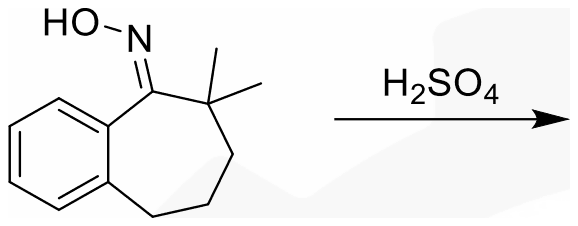
- A.
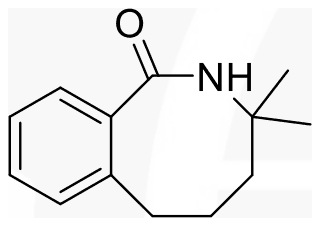
- B.
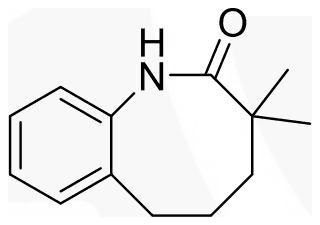
- C.
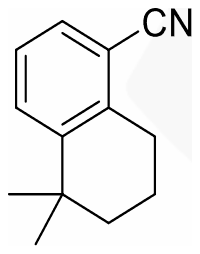
- D.
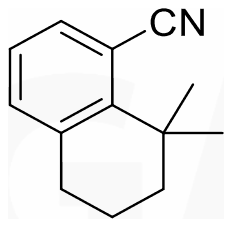
Answer: C
The major product is (C), the tetralin nitrile with the gem-dimethyl group at the far ring-fusion side.
The oxime carbon is bonded to a quaternary CMe2 carbon. In strong acid the protonated oxime does not undergo a normal Beckmann rearrangement; instead it undergoes a Beckmann fragmentation: the C-C bond to the CMe2 carbon breaks, because that releases a stable tertiary carbocation, and the oxime carbon becomes an aryl nitrile (Ar-C≡N).
The cation sits at the end of a three-carbon chain on the ring carbon next to the new CN group. It is captured intramolecularly by the benzene ring (Friedel-Crafts alkylation) at the free ortho position on the far side of that chain, closing a six-membered ring. The product is a 1,1-dimethyltetralin with the CN on the aromatic carbon beside the CH2-bearing ring fusion, as drawn in (C).
(D) places the CMe2 next to the CN, which would need the cation to attack the carbon already carrying the nitrile. (A) and (B) are the lactams of an ordinary Beckmann rearrangement (alkyl or aryl migration), which the fragmentation to a tertiary cation outcompetes.
Post your comment
Please log in or register to post a comment.
Examination Categories
- SSC Exams
- Banking Exams
- Teaching Exams
- Civil Services Exams
- Railways Exams
- Engineering Recruitment Exams
- Defence Exams
- State Government Exams
- Police Exams
- Insurance Exams
- Nursing Exams
- Other Government Exams
- NRA CET
- PG Entrance Exams
- Campus Placement
- MBA Entrance Exams
- CUET and UG Entrance
- Judiciary Exams
- Regulatory Body Exams
- Software Development