
Discussion
The CORRECT order of acidity of the following compounds is
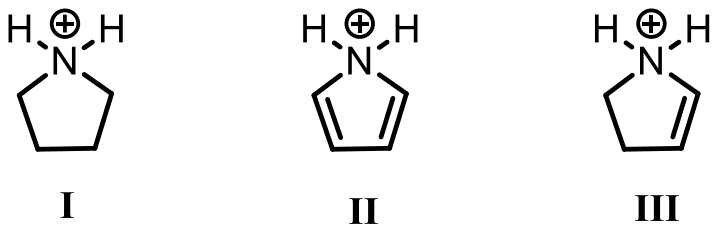
Answer: B
The order of acidity is II \(\gt\) III \(\gt\) I.
These are conjugate acids, so the weaker the parent base, the stronger the acid. Pyrrolidine (I) is a saturated amine with a localised sp3 lone pair, a strong base, so its cation is the weakest acid. In III the nitrogen sits next to a C=C bond, so its lone pair is partly delocalised (an enamine) and the base is weaker. In pyrrole (II) the lone pair is part of the aromatic sextet; protonating nitrogen destroys aromaticity, so pyrrole is an extremely weak base and II is the strongest acid.
Any order placing I first reverses the effect of delocalising the lone pair, and III \(\gt\) II overlooks the loss of aromaticity in II.
Post your comment
Please log in or register to post a comment.
Examination Categories
- SSC Exams
- Banking Exams
- Teaching Exams
- Civil Services Exams
- Railways Exams
- Engineering Recruitment Exams
- Defence Exams
- State Government Exams
- Police Exams
- Insurance Exams
- Nursing Exams
- Other Government Exams
- NRA CET
- PG Entrance Exams
- Campus Placement
- MBA Entrance Exams
- CUET and UG Entrance
- Judiciary Exams
- Regulatory Body Exams
- Software Development