
Discussion
The major products Y and Z in the following reaction sequence are

- A.
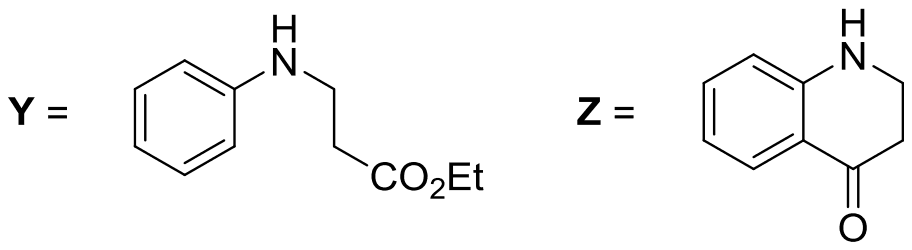
- B.

- C.

- D.

Answer: B
The answer is (B): Y is the N,N-bis(2-ethoxycarbonylethyl)aniline, Z is 1-phenylpiperidin-4-one.
With excess ethyl acrylate, the aniline nitrogen adds twice in a Michael reaction, giving the tertiary amine with two CH2CH2CO2Et arms (Y). Sodium ethoxide then drives a Dieckmann condensation: the carbon next to one ester attacks the other ester, closing a six-membered ring and forming a β-keto ester. Hydrolysis with NaOH, acidification and heating then loses CO2 (decarboxylation) and leaves the 4-piperidone.
(A) and (C) show only a single addition, which excess acrylate rules out. (D) has the right Y but closes a five-membered ring, which does not form here.
Post your comment
Please log in or register to post a comment.
Examination Categories
- SSC Exams
- Banking Exams
- Teaching Exams
- Civil Services Exams
- Railways Exams
- Engineering Recruitment Exams
- Defence Exams
- State Government Exams
- Police Exams
- Insurance Exams
- Nursing Exams
- Other Government Exams
- NRA CET
- PG Entrance Exams
- Campus Placement
- MBA Entrance Exams
- CUET and UG Entrance
- Judiciary Exams
- Regulatory Body Exams
- Software Development