
Discussion
A three-member truss is simply supported at Q and R, and loaded at P by a horizontal force \(F\) as shown. The force in QR is
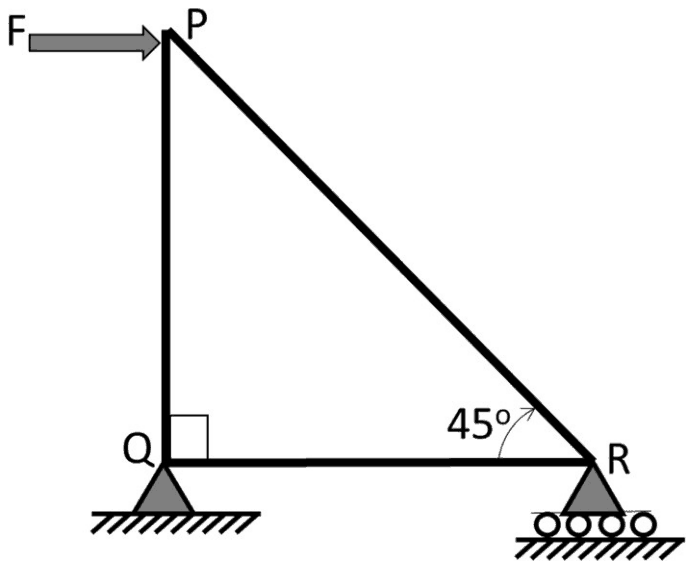
Answer: B
The force in QR is F (tensile).
R is a roller, so its reaction is vertical. With PQ = QR (the 45-degree angle at R), take moments about Q:
\[ \begin{aligned} F \cdot PQ &= R_{R} \cdot QR \\ R_{R} &= F \ \text{(upward)} \end{aligned} \]
At joint R the forces are \(R_{R}\), the member PR at 45 degrees and the horizontal member QR. Vertical balance needs PR to supply F downward, so PR carries \(\sqrt{2}F\) in compression, pushing on R down and to the right. Its horizontal component F must then be balanced by QR pulling R to the left, toward Q, which is tension F.
\(\sqrt{2}F\) is the force in PR, not QR, and it is compressive. Zero would hold only if R took the horizontal load, which a roller cannot.
Post your comment
Please log in or register to post a comment.
Examination Categories
- SSC Exams
- Banking Exams
- Teaching Exams
- Civil Services Exams
- Railways Exams
- Engineering Recruitment Exams
- Defence Exams
- State Government Exams
- Police Exams
- Insurance Exams
- Nursing Exams
- Other Government Exams
- NRA CET
- PG Entrance Exams
- Campus Placement
- MBA Entrance Exams
- CUET and UG Entrance
- Judiciary Exams
- Regulatory Body Exams
- Software Development