
Discussion
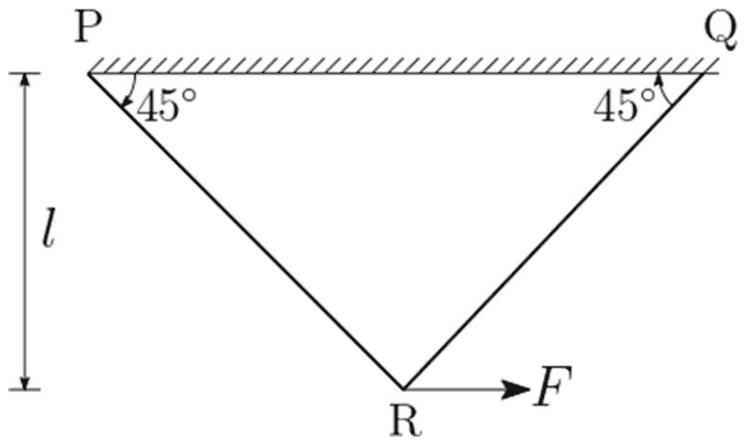
A horizontal load \(F\) is applied at point R on a two-member truss, as shown in the figure. Both the members are prismatic with cross-sectional area, \(A_{0}\), and made of the same material with Young’s modulus \(E\).
The horizontal displacement of point R is:
Answer: C
The horizontal displacement of R is \(\sqrt{2}\frac{Fl}{EA_{0}}\).
Each member runs at 45 degrees from the ceiling down to R, so its length is \(\sqrt{2}l\). At joint R, vertical balance makes the two member forces equal and opposite, and horizontal balance then gives each a magnitude \(F/\sqrt{2}\): one in tension, the other in compression.
By the unit-load method, with n the member forces for a unit horizontal load at R (\(n = \pm 1/\sqrt{2}\)):
\[ \begin{aligned} \delta &= \sum \frac{NnL}{EA_{0}} = 2 \times \frac{(F/\sqrt{2})(1/\sqrt{2})(\sqrt{2}l)}{EA_{0}} \\ &= \sqrt{2}\frac{Fl}{EA_{0}} \end{aligned} \]
Fl/(EA0) results from taking the member length as l instead of \(\sqrt{2}l\), and 2Fl/(EA0) from taking each member force as F. The displacement cannot be zero, since both members change length.
Post your comment
Please log in or register to post a comment.
Examination Categories
- SSC Exams
- Banking Exams
- Teaching Exams
- Civil Services Exams
- Railways Exams
- Engineering Recruitment Exams
- Defence Exams
- State Government Exams
- Police Exams
- Insurance Exams
- Nursing Exams
- Other Government Exams
- NRA CET
- PG Entrance Exams
- Campus Placement
- MBA Entrance Exams
- CUET and UG Entrance
- Judiciary Exams
- Regulatory Body Exams
- Software Development